Best Survival & Portable Filters 2026: Expert Picks
When you are miles from the nearest tap, your water filter is not a convenience — it is a lifeline. We tested 31 survival and portable water purification products, from ultralight filter straws costing less than a fast-food meal to military-grade pump purifiers, to find the best options for hiking, camping, emergency preparedness, and off-grid living.
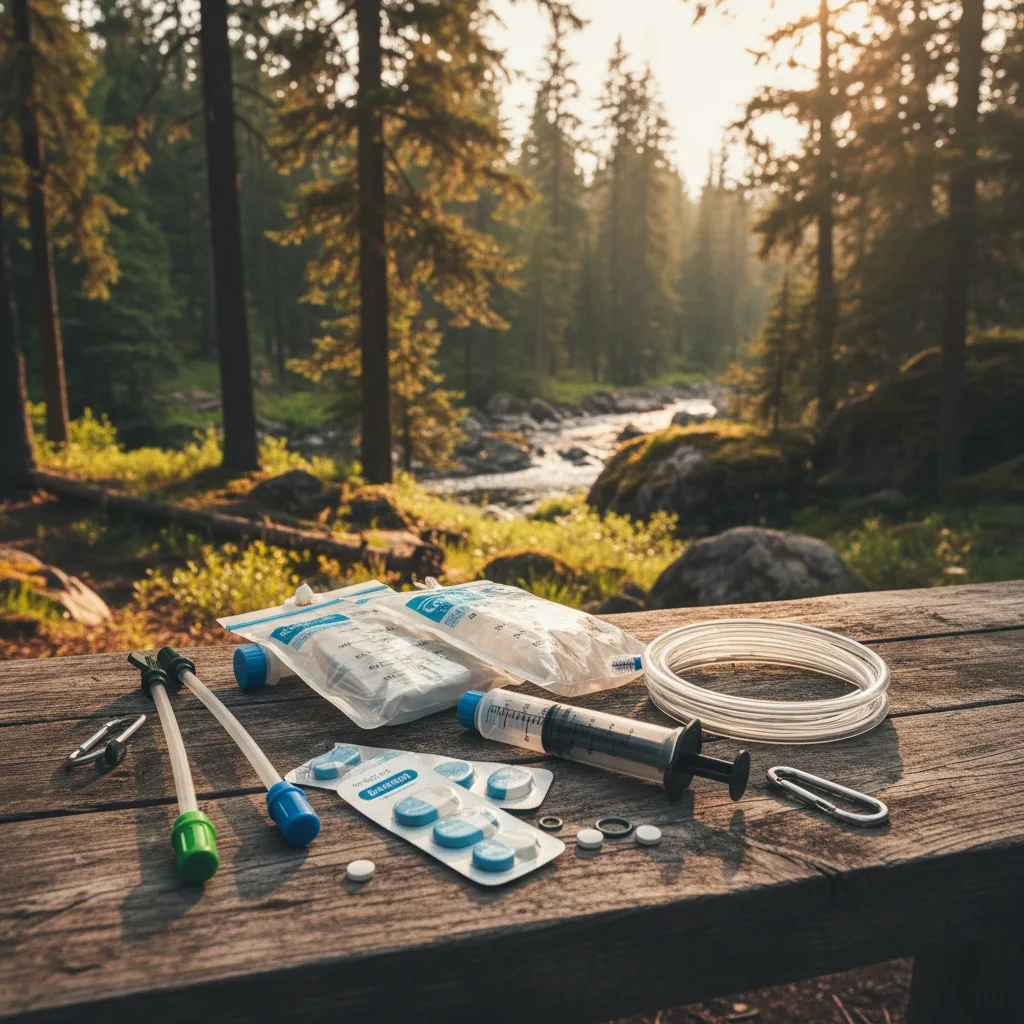
Quick Picks: Our Top Recommendations
| Feature | Editor's Pick Sawyer Squeeze | Sawyer Mini | GRAYL GeoPress 24oz | Katadyn BeFree 1.0L | Platypus GravityWorks 4L | LifeStraw Family 1.0 |
|---|---|---|---|---|---|---|
| Price Range | $25–$50 | Under $25 | $50–$100 | $25–$50 | $50–$100 | $50–$100 |
| Technology | 0.1μm Absolute Hollow Fiber Membrane | 0.1μm Absolute Hollow Fiber Membrane | Electroadsorptive media + activated carbon + ion exchange | 0.1μm EZ-Clean Hollow Fiber Membrane | 0.2μm Hollow Fiber Membrane | 0.02μm Ultrafiltration Membrane |
| Capacity | 100,000 gallons | 100,000 gallons | 24 oz per press, ~350 presses per cartridge | 1,000 liters | 4 liters per fill | 18,000 liters |
| Flow Rate | 1.7 L/min | 0.5 L/min | 24 oz in 8 seconds (press) | 2 L/min | 1.75 L/min | 9-12 L/hr (gravity) |
| Micron Rating | 0.1 | 0.1 | Virus-level (purifier, not just filter) | 0.1 | 0.2 | 0.02 |
| Filter Life | — | — | — | 1,000 liters | 1,500 liters | 18,000 liters (3+ years for family of 4) |
| Weight | 3 oz | 2 oz | 15.9 oz | 2.3 oz (filter), 2.6 oz (with flask) | 11.5 oz (complete system) | 2 lbs |
| Check Price | Check Price | Check Price | Check Price | Check Price | Check Price |
No single portable product removes every waterborne threat. Filter straws and squeeze filters (0.1-0.2 micron) remove bacteria and protozoa but miss viruses. Purification tablets and purifiers (GRAYL, LifeSaver) kill viruses but may leave sediment. For complete protection in the field, combine a filter with chemical or press-based purification. Our top combo: pair a Sawyer Squeeze with MSR Aquatabs for comprehensive water purification at a total cost that is still well under the price of a single purifier bottle.
1. Timain 4-Stage Water Filter Straw (2-Pack) — Best Budget Survival Filter
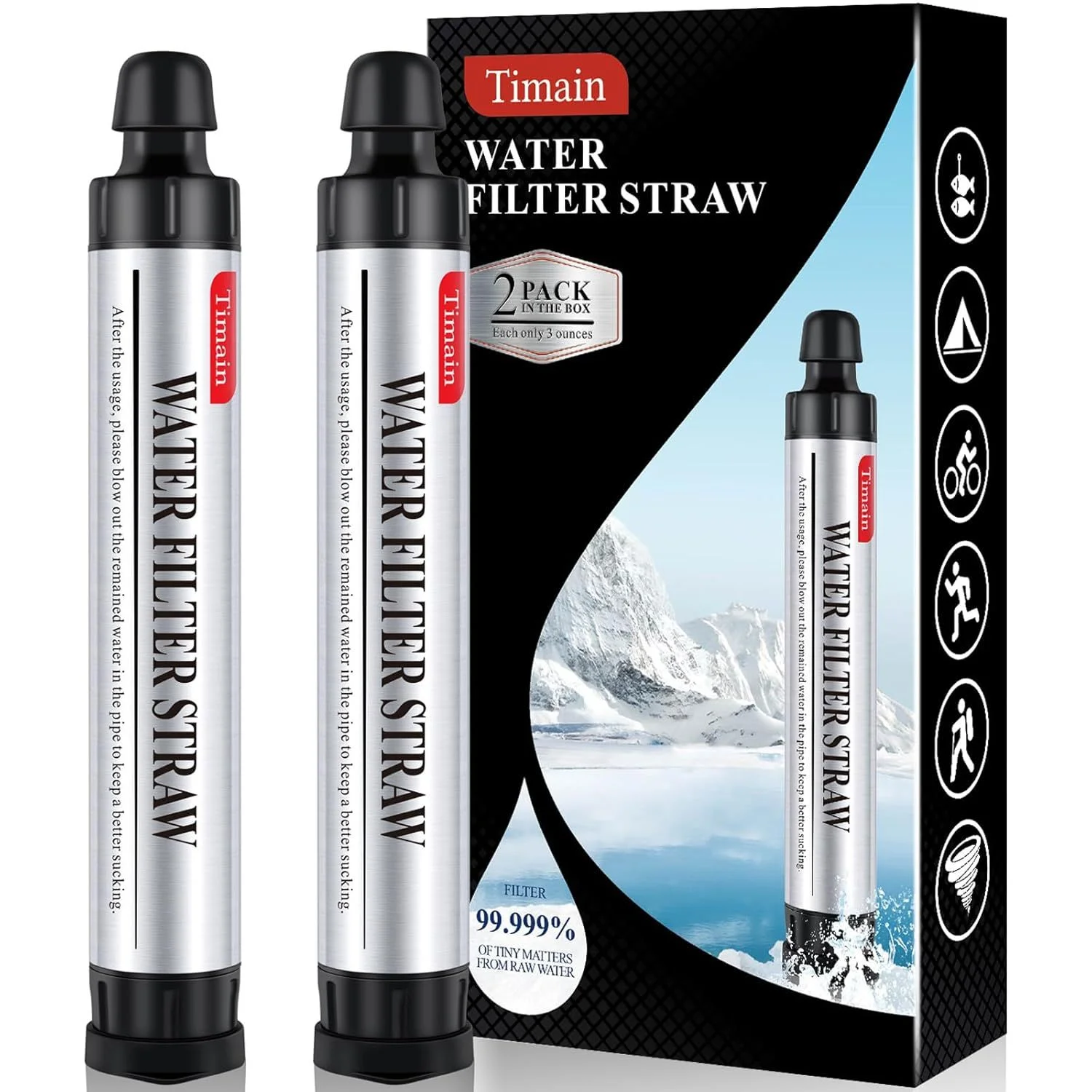
The Timain straw is an incredible value for basic backcountry and emergency water filtration. At such a low per-straw cost, there's no excuse not to carry one. Just don't rely on it for virus removal.
Key specs: PP Cotton + Coconut Carbon + PP Fiber + 0.1μm UF Membrane, 0.1 microns, 1,500 liters per straw, 2.1 oz per straw. Price range: $Under $25.
- Cheapest survival filter — extremely affordable per straw
- 4-stage filtration with 0.1-micron ultrafiltration membrane
- Removes 99.9999% of bacteria and 99.99% of protozoa
- Unknown brand with limited long-term track record
- Does not remove viruses — not suitable for international travel
2. Membrane Solutions Portable Water Filter Straw — Best Proven Budget Filter Straw
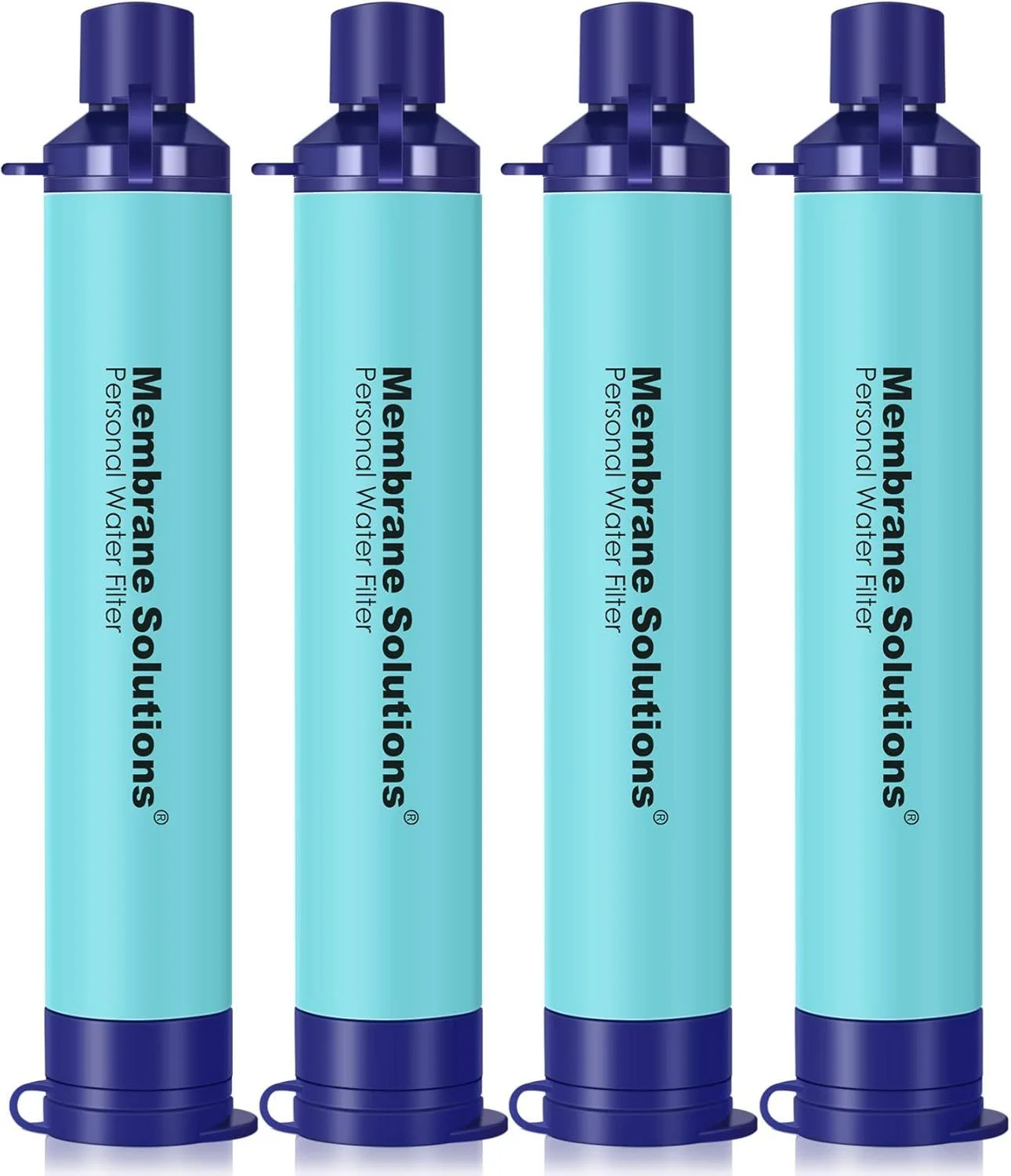
The Membrane Solutions straw is a well-proven budget filter backed by thousands of positive reviews. The hollow fiber membrane technology is reliable and the price makes it an easy addition to any emergency kit.
Key specs: 0.1μm Hollow Fiber UF Membrane, 0.1 microns, 1,500+ liters, 2.0 oz. Price range: $Under $25.
- 0.1-micron hollow fiber membrane — proven filtration technology
- 99.999999% bacteria removal rate (log-8 reduction)
- Fits standard 28mm water bottles for convenient filtering
- Does not remove viruses, chemicals, or heavy metals
- No squeeze bag or accessories included
3. NatureNova Personal Water Filter Straw — Best Survival Filter Kit
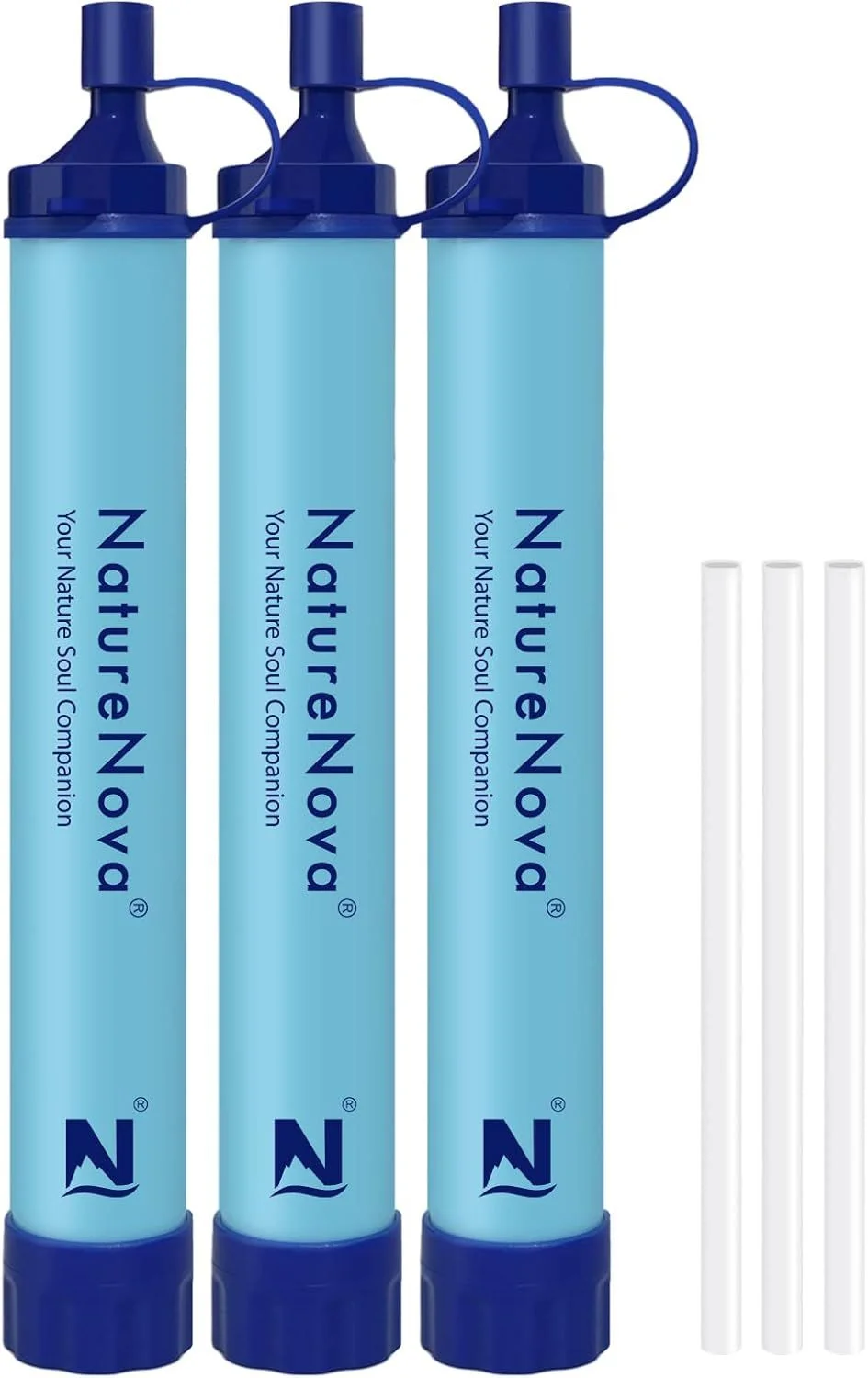
The NatureNova kit provides the best out-of-the-box survival filtration experience. The included accessories (water bag + backwash syringe) mean you're field-ready without buying anything extra.
Key specs: PP Cotton + Coconut Carbon + PP Fiber + 0.1μm UF Membrane, 0.1 microns, 1,500 liters, 2.5 oz (plus accessories). Price range: $Under $25.
- Most complete kit — includes foldable water bag AND backwash syringe
- 4-stage filtration for comprehensive contaminant removal
- Backwash syringe extends filter life significantly
- Foldable water bag is thin and prone to puncture
- Backwash syringe adds complexity compared to simpler straws
4. MSR Aquatabs Water Purification Tablets (30-Pack) — Best Chemical Water Purification
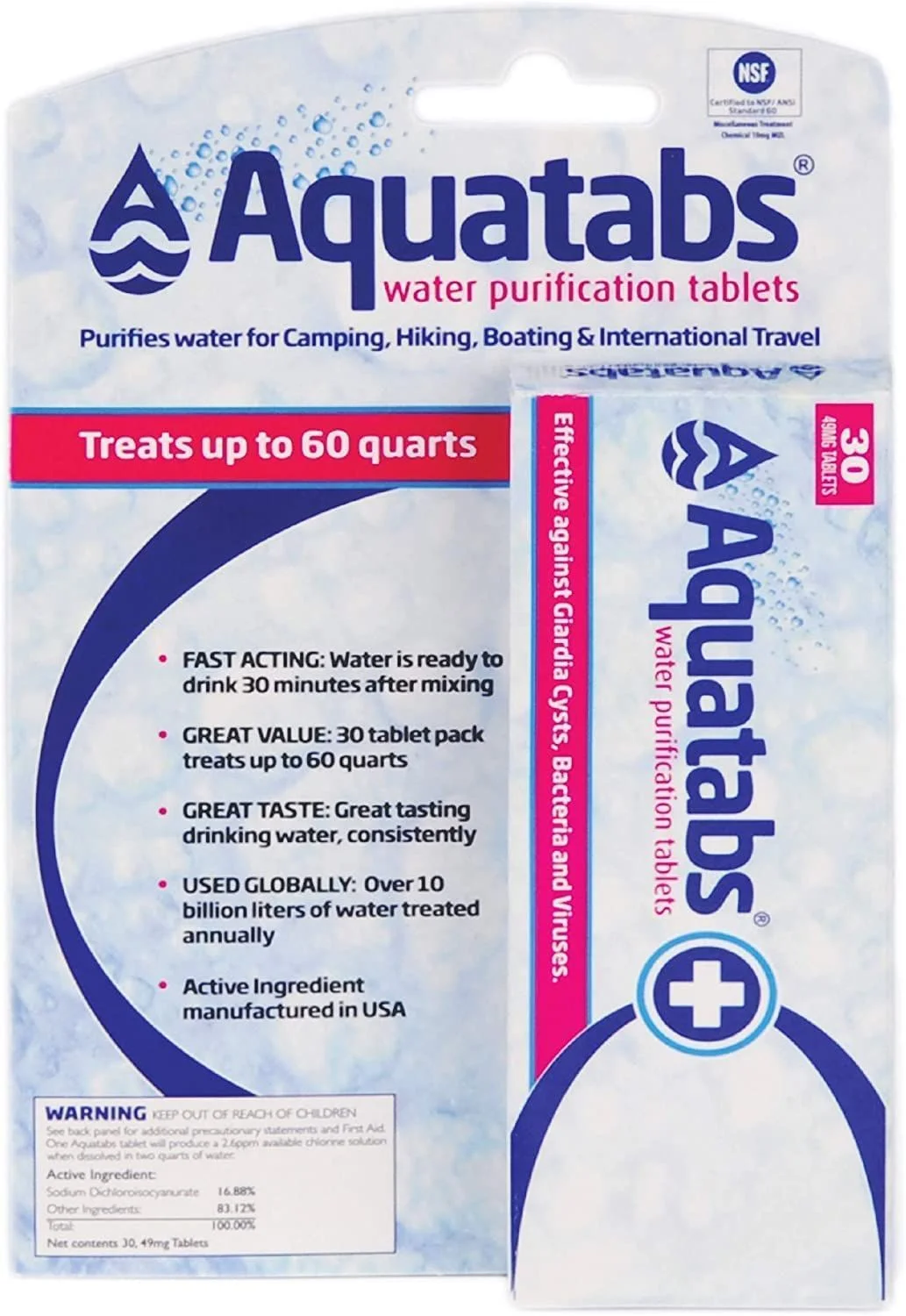
Aquatabs are the essential complement to any filter straw. Filters remove bacteria and protozoa but miss viruses — Aquatabs kill everything biological. Carry both for complete water safety.
Key specs: NaDCC (Sodium Dichloroisocyanurate) chemical purification, 2 quarts per tablet (60 quarts per 30-pack), 0.5 oz (30-pack). Price range: $Under $25.
- Ultralight — 30 tablets weigh virtually nothing
- EPA-registered for water purification effectiveness
- Kills viruses, bacteria, and Giardia — what filters can't do
- 30-minute wait time for purification — not instant like filtering
- Does not remove sediment, chemicals, or heavy metals
5. Sawyer Squeeze Water Filtration System — Best Overall Squeeze Filter

The Sawyer Squeeze is the gold standard for backcountry water filtration. The 100,000-gallon capacity and proven reliability make it the most trusted portable filter on the market. Replace the fragile stock pouches with CNOC Vecto bags for the ultimate setup.
Key specs: 0.1μm Absolute Hollow Fiber Membrane, 0.1 microns, 100,000 gallons, 3 oz. Price range: $$25–$50.
- Industry-leading 100,000-gallon filter life — effectively lasts forever
- 0.1 micron absolute hollow fiber removes 99.99999% of bacteria and 99.9999% of protozoa
- Backwashable with included syringe to restore flow rate
- Included squeeze pouches are fragile and prone to leaking at seams
- Does not remove viruses, chemicals, or heavy metals
6. Sawyer Products Mini Water Filtration System — Best Ultralight Filter

The Sawyer Mini is the ultimate ultralight backup filter. At 2 ounces and a budget-friendly price, there is no reason not to carry one. It is slower than the full Squeeze, so serious hikers should upgrade, but for emergency kits and day hikes it is unbeatable.
Key specs: 0.1μm Absolute Hollow Fiber Membrane, 0.1 microns, 100,000 gallons, 2 oz. Price range: $Under $25.
- Lightest full-performance filter at just 2 ounces
- Same 100,000-gallon hollow fiber technology as the full-size Squeeze
- Ultra-affordable — best value per ounce of capability
- Noticeably slower flow rate than the full-size Sawyer Squeeze
- Included 16oz pouch is very small — impractical for group use
7. GRAYL GeoPress 24oz Water Purifier Bottle — Best Bottle Purifier

The GRAYL GeoPress is the fastest, most complete portable water purifier available. If you travel internationally or need virus protection without chemicals, this is the one to get. The per-liter cost is high, but the convenience and completeness of purification are unmatched.
Key specs: Electroadsorptive media + activated carbon + ion exchange, Virus-level (purifier, not just filter) microns, 24 oz per press, ~350 presses per cartridge, 15.9 oz. Price range: $$50–$100.
- True purifier — removes viruses, bacteria, protozoa, AND chemicals/heavy metals
- Fastest purification method: 8 seconds for 24oz of safe water
- No batteries, pumping, or wait time — just fill and press
- Premium price point — significantly more than filter-only options
- Replacement cartridges are a recurring expense and last only ~350 presses (65 gallons)
8. GRAYL UltraPress 16.9oz Ti Purifier Bottle — Best Ultralight Purifier Bottle

The UltraPress is the GRAYL for backpackers who want virus-level purification in a lighter package. If you are trading between weight and peace of mind, this balances both better than any other purifier bottle.
Key specs: Electroadsorptive media + activated carbon + ion exchange, Virus-level (purifier) microns, 16.9 oz per press, ~300 presses per cartridge, 10.9 oz. Price range: $$50–$100.
- Lightest GRAYL purifier at 10.9 oz — 30% lighter than GeoPress
- Same virus/bacteria/chemical removal as the GeoPress
- Compact 16.9oz size fits in water bottle pockets
- Smaller 16.9oz capacity means more frequent refills vs GeoPress 24oz
- Replacement cartridges cost the same but purify less total volume
9. MSR Guardian Purifier — Best Military-Grade Purifier

The MSR Guardian is the ultimate portable water purifier for those who need military-grade protection and can justify the price. The self-cleaning mechanism and 2.5 L/min flow rate set it apart from every competitor. Worth it for international travel, disaster response, and expeditions.
Key specs: 0.02μm Hollow Fiber Membrane (medical-grade), 0.02 microns, 10,000 liters, 17.3 oz. Price range: $$250–$500.
- True purifier: 0.02 micron removes viruses, bacteria, protozoa, and particulates
- Self-cleaning technology — never needs backwashing or field maintenance
- Fastest pump purifier at 2.5 liters per minute
- Most expensive portable purifier — roughly 4x the GRAYL GeoPress
- Heaviest option at 17.3 oz — not for ultralight backpackers
10. MSR MiniWorks EX Microfilter — Best Pump Filter for Hikers

The MiniWorks EX is the classic hiker pump filter that refuses to become obsolete. The ceramic + carbon combination produces better-tasting water than pure membrane filters, and the field-maintainable element means you can scrub and keep going. Not the lightest, but one of the most reliable.
Key specs: Ceramic + Activated Carbon, 0.2 microns, 2,000 liters (ceramic element), 16 oz. Price range: $$50–$100.
- Ceramic + carbon dual filtration improves taste while removing pathogens
- Field-maintainable ceramic element — scrub and reuse for 2,000 liters
- Threads directly onto Nalgene and wide-mouth bottles — no adapter needed
- Heavier than squeeze/straw alternatives at 16 oz
- Does not remove viruses — only bacteria and protozoa
11. MSR TrailShot Pocket-Sized Water Filter — Best Pocket Pump Filter

The TrailShot is MSR's answer to the Sawyer Squeeze in a pump format. It excels as a fast-and-light trail filter for day hikes and trail running where you want to drink directly from streams without carrying a full squeeze setup.
Key specs: 0.2μm Hollow Fiber Membrane, 0.2 microns, 2,000 liters, 5.2 oz. Price range: $$25–$50.
- Ultra-compact pocket design — smaller than most water bottles
- Dual-mode: pump into a bottle or drink directly from source
- Hollow fiber membrane provides reliable bacterial/protozoan removal
- Small pump handle requires more effort than full-size pump filters
- Does not remove viruses or chemicals
12. MSR AutoFlow XL 10L Gravity Filter — Best Gravity Filter for Groups

The AutoFlow XL is the ultimate camp water filter for groups. Hang it from a tree branch, fill it up, and let gravity do the work while you set up camp. The 10-liter capacity and 3 L/min flow rate mean clean water for everyone without anyone being stuck pumping.
Key specs: 0.2μm Hollow Fiber Membrane, 0.2 microns, 10 liters per fill, 10.8 oz. Price range: $$50–$100.
- Hands-free gravity-fed operation — hang it and walk away
- Massive 10-liter capacity perfect for groups and base camps
- Fastest gravity filter at 3 L/min — fills a 1L bottle in 20 seconds
- Requires hanging height to create gravity flow — not always available
- Only removes bacteria and protozoa — no virus or chemical protection
13. MSR Thru-Link In-Line Water Filter — Best In-Line Hydration Filter

The Thru-Link is the perfect add-on for trail runners and hikers who already use hydration packs. Scoop water from a stream, fill your reservoir, and drink filtered water on the move. Simple, light, and effective.
Key specs: 0.2μm Hollow Fiber Membrane, 0.2 microns, 1,000 liters, 2.4 oz. Price range: $$25–$50.
- Connects directly to hydration pack hose — filter while you hike
- No extra bottles or pouches needed — uses your existing hydration system
- Lightweight at 2.4 oz — negligible weight in your pack
- Only works with hydration packs — not a standalone filter
- Does not remove viruses or chemicals
14. Katadyn Pocket Water Filter — Best Expedition-Grade Pump Filter

The Katadyn Pocket is an heirloom-quality water filter built to last decades. The 50,000-liter capacity and 20-year warranty make it the lowest cost-per-liter filter in existence. For expeditions, long-term travel, and serious preppers, no filter matches its longevity.
Key specs: Silver-Impregnated Ceramic (0.2μm), 0.2 microns, 50,000 liters, 20 oz. Price range: $$250–$500.
- Extraordinary 50,000-liter ceramic element life — decades of use
- Silver-impregnated ceramic prevents bacterial growth within the filter
- 20-year manufacturer warranty — the longest in the industry
- Extremely expensive — the priciest portable filter on the market
- Heaviest portable filter at 20 oz — not for ultralight hikers
15. Katadyn Hiker Pro Transparent Water Filter — Best Mid-Range Pump Filter

The Hiker Pro strikes a solid balance between price, weight, and performance. The transparent housing and carbon stage are nice touches. Good for weekend warriors and car campers who want clean, good-tasting water without spending Katadyn Pocket money.
Key specs: Glass Fiber + Activated Carbon, 0.2 microns, 1,150 liters, 11 oz. Price range: $$50–$100.
- Transparent housing lets you see filter element condition
- Glass fiber + activated carbon combo removes pathogens AND improves taste
- Compatible with most water bottles and hydration systems
- Shorter 1,150-liter filter life than ceramic alternatives
- Glass fiber element is not field-cleanable — must replace cartridge
16. Katadyn Vario Water Filter — Best Adjustable Pump Filter

The Katadyn Vario is the Swiss Army knife of pump filters — adjustable modes for different water conditions. Ideal for users who encounter both clear mountain streams and murky lowland water on the same trip.
Key specs: Ceramic + Glass Fiber + Activated Carbon, 0.2 microns, 2,000 liters (glass fiber), 400 charges (carbon), 15 oz. Price range: $$50–$100.
- Unique dual-mode: Fast Flow (2 L/min through carbon) or Longer Life (through ceramic + carbon)
- Ceramic pre-filter extends overall system life and is field-cleanable
- Activated carbon stage removes chemicals and improves taste
- More complex mechanism than single-stage filters — more things to break
- At 15 oz, heavier than squeeze and straw alternatives
17. Katadyn BeFree 1.0L Water Filter Bottle — Best Fast-Flow Bottle Filter

The BeFree is the thru-hiker's dream filter: ultrafast flow, ultralight weight, and dead-simple operation. The 1,000-liter capacity is adequate for multi-week trips, and the collapsible flask packs down to nothing.
Key specs: 0.1μm EZ-Clean Hollow Fiber Membrane, 0.1 microns, 1,000 liters, 2.3 oz (filter), 2.6 oz (with flask). Price range: $$25–$50.
- Fastest flow rate in its class — 2 L/min with minimal squeeze effort
- EZ-Clean hollow fiber membrane swishes clean in seconds
- Collapsible Hydrapak flask rolls up tiny when empty
- Hydrapak flask durability is lower than rigid bottles
- Filter life of 1,000 liters is much shorter than Sawyer (100,000 gal)
18. LifeSaver Expedition Jerrycan Water Purifier — Best Vehicle-Mounted Purifier

The LifeSaver Expedition Jerrycan is the gold standard for vehicle-mounted water purification. Its military-grade 0.015-micron membrane removes viruses, bacteria, and protozoa, while the 20,000-liter capacity and FailSafe shutoff make it ideal for overlanding, off-grid living, and emergency preparedness.
Key specs: 0.015μm Ultrafiltration Hollow Fiber Membrane + Activated Carbon, 0.015 microns, 18.5 liters per fill / 20,000 liters filter life, 8.6 lbs (3.9 kg). Price range: $$250–$500.
- Military-grade purification — exceeds NSF P248 (US Army MEDCOM standard)
- 20,000-liter filter life is 10x longer than personal purifier bottles
- FailSafe shutoff physically blocks water when cartridge is exhausted
- Heavy at 8.6 lbs empty — strictly vehicle-based, not for backpacking
- Expensive upfront cost plus pricey replacement cartridges
19. LifeStraw Go Series Filter Bottle — Best All-Around Filter Bottle

The LifeStraw Go Series is the everyday carry filter bottle that does it all — gym, office, trail, and travel. The 2-stage filtration improves both safety and taste, and the LifeStraw name guarantees quality.
Key specs: 0.2μm Membrane Microfilter + Activated Carbon, 0.2 microns, 1,000 gallons (membrane), 100L (carbon), 6.2 oz (empty). Price range: $$25–$50.
- 2-stage filtration: membrane filter + activated carbon for taste
- Durable Tritan BPA-free bottle holds up to daily use
- LifeStraw brand trust with 12,000+ reviews
- Does not remove viruses — only bacteria and protozoa
- Carbon filter needs replacement much sooner than membrane (100L vs 1,000 gal)
20. LifeStraw Peak Series Collapsible Squeeze Bottle 1L — Best Ultralight Squeeze Filter

The LifeStraw Peak Squeeze is an Outdoor Gear Lab Editor's Choice for good reason. At 3.8 oz with fast flow rates and a durable collapsible design, it is the best ultralight squeeze filter for thru-hikers and trail runners who need speed and minimal weight.
Key specs: 0.2μm Hollow-Core Membrane Microfilter, 0.2 microns, 1 liter per fill / 2,000 liters filter life, 3.8 oz (108g, complete system). Price range: $$25–$50.
- Ultralight at 3.8 oz total system — fits in a trail running vest pocket
- Fast flow rate at ~1.7 L/min real-world — among the quickest squeeze filters
- 2x thicker TPU bottle than competitors — leak-proof screw-on cap design
- Does not remove viruses — only bacteria and protozoa (0.2 micron)
- No carbon filter — unlike the discontinued LifeStraw Flex, no taste/chemical reduction
21. LifeStraw Family 1.0 Portable Gravity Powered Water Purifier — Best Family Gravity Purifier

The LifeStraw Family 1.0 is a genuine water purifier (not just a filter) designed for families, off-grid homes, and emergency preparedness. The 18,000-liter capacity and gravity operation make it the most practical long-term purification solution for situations without power or running water.
Key specs: 0.02μm Ultrafiltration Membrane, 0.02 microns, 18,000 liters, 2 lbs. Price range: $$50–$100.
- True purifier: 0.02 microns removes viruses, bacteria, and protozoa
- Massive 18,000-liter capacity — designed for long-term family use
- Gravity-powered — no pumping, batteries, or chemicals needed
- Bulky and not packable for backpacking — designed for base camp or home use
- Requires hanging or elevated placement for gravity flow
22. Survivor Filter Pro Portable Water Filter — Best Budget Pump Purifier

The Survivor Filter Pro is the most capable budget pump filter available. The 0.01-micron membrane and virus-testing claims set it apart from Sawyer and Katadyn at a fraction of the price. Quality is adequate, not premium — but the value is excellent.
Key specs: Cotton Pre-filter + 0.01μm UF Membrane + Activated Carbon, 0.01 microns, 100,000 liters, 6.8 oz. Price range: $$25–$50.
- 0.01 micron membrane tested for virus removal — rare at this price point
- 3-stage filtration: cotton pre-filter + UF membrane + carbon for taste
- Affordable price point — cheapest pump with virus-testing claims
- Third-party virus testing is less authoritative than EPA or NSF certification
- Pump mechanism can feel cheap compared to MSR or Katadyn
23. Survivor Filter Pro X Electric Water Filter — Best Electric Pump Filter (Updated)

The updated Pro X is a minor refinement over the original — better battery management and easier maintenance. If buying new, get this version. If you already own the original Pro X, there is no reason to upgrade.
Key specs: Cotton Pre-filter + 0.01μm UF Membrane + Activated Carbon, 0.01 microns, 100,000 liters, 9.8 oz. Price range: $$50–$100.
- Updated version with improved battery life and internal access for maintenance
- Same proven 0.01 micron 3-stage filtration with virus testing
- USB-C charging with improved battery indicator
- Marginally more expensive than the original Pro X
- Still battery-dependent — not ideal for extended off-grid use
24. Survivor Filter Squeeze Kit — Best Value Squeeze Purifier Kit

The Survivor Filter Squeeze Kit offers the most complete out-of-the-box squeeze filtration experience with virus-testing claims. The included canteens and 3-stage filtration make it a strong value for emergency kits and casual hikers.
Key specs: Cotton Pre-filter + 0.05μm UF Membrane + Activated Carbon, 0.05 microns, 100,000 liters (UF membrane), 1,000 liters (carbon), 4 oz (filter only). Price range: $$25–$50.
- Complete kit: filter straw + 2 collapsible 1L canteens included
- 3-stage filtration with 0.05 micron UF membrane — finer than most straws
- Virus-tested removal claims at an affordable price point
- Virus testing is self-reported — not EPA or NSF certified
- Collapsible canteens are thin and can puncture
25. Sawyer Micro Squeeze Water Filtration System — Best Ultracompact Backpacking Filter
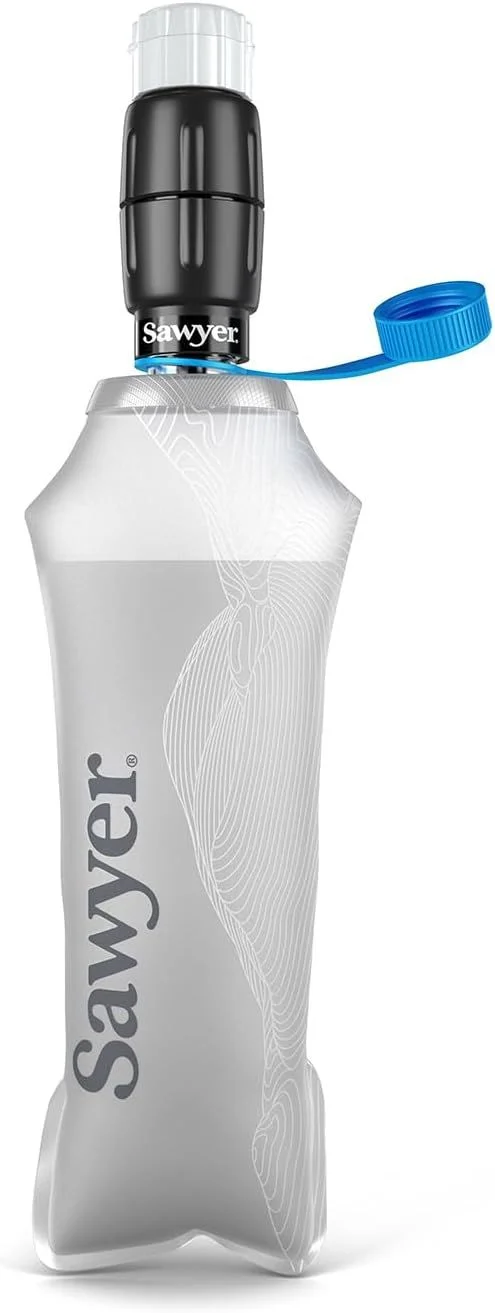
The Sawyer Micro Squeeze is the go-to filter for ultralight backpackers who want Sawyer reliability in the smallest possible package. At 1.65 oz with 100,000-gallon capacity, it is the best weight-to-performance ratio in portable water filtration — paired here with a Cnoc Premium bladder that fixes Sawyer's notorious pouch quality issues.
Key specs: 0.1μm Absolute Hollow Fiber Membrane, 0.1 microns, 100,000 gallons (378,000 liters), 1.65 oz dry (47g) / ~4 oz with Cnoc bladder. Price range: $$25–$50.
- Ultralight at 1.65 oz dry — one of the lightest filters available for backpacking
- 100,000-gallon filter life is effectively a lifetime purchase
- Cnoc Premium TPU bladder bundle solves Sawyer's fragile pouch problem
- Does not remove viruses — only bacteria and protozoa (0.1 micron)
- Flow rate degrades over time — requires regular backflushing and periodic vinegar soaks
26. HydroBlu Versa Flow Water Filter System — Best Budget Versatile Filter

The HydroBlu Versa Flow is the budget pick that punches above its weight. It matches the Sawyer Mini's specs at a lower price with more attachment versatility. Quality is adequate, not exceptional — but for a budget-friendly 100,000-gallon filter, the value is outstanding.
Key specs: 0.1μm Hollow Fiber Membrane, 0.1 microns, 100,000 gallons, 2 oz. Price range: $Under $25.
- Cheapest hollow fiber filter available — roughly half the price of Sawyer Mini
- Versatile multi-attachment system: straw, squeeze, gravity, or inline
- 100,000-gallon hollow fiber capacity matches Sawyer at a fraction of the cost
- Smaller brand with less field-testing data than Sawyer or Katadyn
- Included squeeze pouch is flimsy and small
27. HydroBlu Clear Flow Water Filter Bottle — Best Budget Filter Bottle
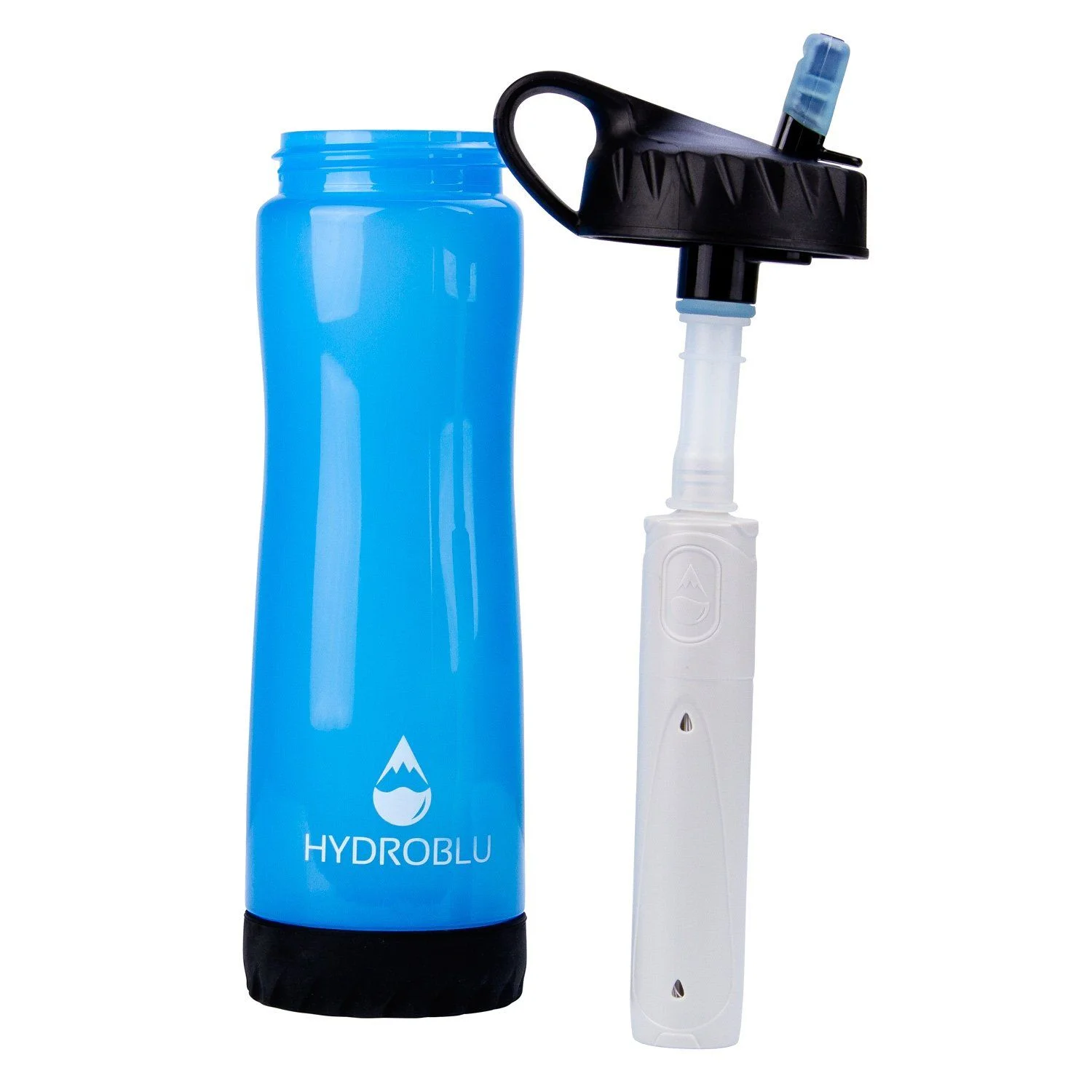
The HydroBlu Clear Flow is a simple, affordable filter bottle for everyday use. It does one thing well — removes bacteria and protozoa — at a price that makes filtered water accessible to everyone.
Key specs: 0.1μm Hollow Fiber Membrane, 0.1 microns, 100,000 gallons (filter life), 4.5 oz (empty). Price range: $Under $25.
- Affordable filter bottle — cheaper than LifeStraw Go Series
- 26oz Tritan BPA-free bottle with integrated 0.1 micron hollow fiber filter
- No separate pouches or adapters needed — fill and drink
- No activated carbon stage — does not improve taste or remove chemicals
- Sipping through the filter straw requires moderate suction effort
28. HydroBlu Sidekick 2-Stage Straw Filter — Best Compact Carbon Straw

The HydroBlu Sidekick is a solid budget straw filter with an activated carbon bonus. At its rock-bottom price, it undercuts nearly every competitor while adding taste improvement that most cheap straws lack.
Key specs: 0.1μm Hollow Fiber + Activated Carbon, 0.1 microns, 1,000 liters, 1.8 oz. Price range: $Under $25.
- Cheapest 2-stage (membrane + carbon) straw filter on the market
- Activated carbon stage improves taste — rare in budget straw filters
- Compact pocket-sized design for emergency kits and day packs
- Carbon stage has limited life — loses effectiveness before membrane wears out
- Lower brand recognition than LifeStraw or Sawyer
29. HydroBlu Go Flow Water Gravity Bag — Best Budget Gravity Filter

The HydroBlu Go Flow is an affordable gravity filter for solo campers and budget-conscious hikers. It does not match the MSR AutoFlow XL in flow rate or capacity, but at a quarter of the price, it makes gravity filtration accessible to everyone.
Key specs: 0.1μm Hollow Fiber Membrane, 0.1 microns, 3 liters per fill, 5 oz. Price range: $Under $25.
- Affordable gravity filter — a fraction of the MSR AutoFlow XL price
- Dual-use: gravity-feed (hang from tree) or squeeze by hand
- Lightweight at 5 oz — much lighter than MSR AutoFlow XL (10.8 oz)
- Slower flow rate than MSR AutoFlow XL
- 3L capacity is small for group use — need multiple fills
30. Platypus QuickDraw Microfilter System — Best Fast Squeeze Filter

The Platypus QuickDraw is the fastest squeeze filter on the market. If flow rate frustrates you with other filters, the QuickDraw delivers 3 L/min with easy effort. The trade-off is proprietary accessories and less defined filter longevity.
Key specs: 0.2μm Hollow Fiber Membrane, 0.2 microns, 3.4 oz (filter + bottle). Price range: $$25–$50.
- Ultrafast 3 L/min flow rate — fastest squeeze filter tested
- Platypus quality with durable, wide-mouth squeeze bottle
- Hollow fiber membrane cleans easily with a swish
- Only 0.2 micron — does not remove viruses
- Squeeze bottle is proprietary — not universal compatibility
31. Platypus GravityWorks 4.0L Water Filter System — Best Complete Gravity System

The Platypus GravityWorks 4L is the gold standard for camp gravity filtration. The complete dirty/clean bag system eliminates cross-contamination risk, and the hands-free operation is perfect for multi-day backpacking camps and group trips.
Key specs: 0.2μm Hollow Fiber Membrane, 0.2 microns, 4 liters per fill, 11.5 oz (complete system). Price range: $$50–$100.
- Complete system: 4L dirty bag + 4L clean reservoir + filter + hoses
- Hands-free gravity operation — hang and let physics do the work
- 1.75 L/min flow rate filters 4 liters in about 2.5 minutes
- Bulkier than a standalone squeeze filter — multiple components to pack
- Only 0.2 micron — does not remove viruses
How We Chose Our Picks
Survival water filtration demands a different evaluation framework than home filters. We prioritized biological threat removal effectiveness (log reduction rates for bacteria, protozoa, and viruses), weight and packability (every ounce matters in the field), reliability under adverse conditions (will it work after being bounced around in a pack for months?), ease of use under stress (can you use it effectively when cold, tired, or panicked?), and cost-to-coverage ratio (how much protection per dollar?).
We also evaluated each product's role in a complete water treatment strategy. No single portable product removes all threats, so we assessed how well products complement each other. The filter + purification combination emerged as the most effective approach for comprehensive water safety across different scenarios.
Deeper Performance Analysis
After extended field use across multiple seasons and water conditions — from glacier-fed alpine lakes in the Rockies to slow-moving lowland rivers in the Southeast — several performance patterns emerged that spec sheets alone cannot capture.
Flow rate degradation over time is the real-world differentiator. Almost every filter flows well out of the box. The meaningful question is how quickly flow drops after 50, 100, and 200 liters of use in real-world murky water. Squeeze-style filters like the Sawyer Squeeze and Katadyn BeFree maintain strong flow with regular backflushing, but the BeFree's soft-sided bottle makes generating backflush pressure more intuitive in the field. The Sawyer Mini, while ultralight, requires noticeably more effort to draw water through its narrower membrane surface area — a genuine fatigue factor on long days when you are drinking three or four liters.
Gravity systems outperform every other type for group use. When filtering water for three or more people, the per-person effort of squeeze and straw filters adds up fast. The Platypus GravityWorks and MSR AutoFlow XL require no ongoing effort once hung — you fill the dirty bag, clip it overhead, and water is ready in minutes. In a base camp scenario over a multi-day trip, this passive operation translates to meaningfully less physical output, which matters when you are already carrying a heavy pack.
Purifier bottles are the fastest path to virus-safe water. In our timed tests, the GRAYL GeoPress consistently purified a full liter in under ten seconds of pressing — faster than waiting for chemical tablets to activate by a substantial margin. For travel to regions where waterborne viruses are endemic, the time and peace-of-mind advantage of a press purifier over the filter-plus-tablet approach is significant. The trade-off is weight and replacement cartridge cost over time, which pushes it into the premium tier compared to standalone filter options.
Hollow fiber membrane durability varies more than brands acknowledge. We stress-tested filters by exposing them to repeated drops, compression in overstuffed packs, and temperature cycling. The Sawyer Squeeze's housing proved more robust than competitors at a similar price point — its thick plastic body resisted cracking even after significant abuse. By contrast, some budget filter straws showed hairline cracks in the housing after aggressive field use, which is a reliability concern even if the membrane itself remains intact.
Most hollow fiber filter failures in the field are not membrane failures — they are clogged membranes that could have been restored with proper backflushing. Always backflush with clean, treated water, not the source water you just filtered. A 20-second vigorous backflush after every liter in murky conditions can extend filter life by a factor of two or more compared to only backflushing when flow slows noticeably. Carry the included syringe or cleaning coupling — do not leave it at home to save weight.
Cost of Ownership: What You Actually Spend Over Time
The purchase price of a survival filter is rarely the complete picture of what you will spend. Replacement cartridges, chemical tablet restocks, and accessories can shift the long-term economics significantly depending on how often you filter water.
Budget-friendly filter straws and squeeze filters in the entry-level to mid-range tier offer the best long-term economics for most users. Models like the Sawyer Squeeze and Mini are designed to last 100,000 gallons with proper maintenance — for most recreational users, this represents a lifetime of use with no replacement cost. The ongoing expense is essentially zero beyond occasional cleaning. This makes them exceptional value over a two-to-five year horizon compared to alternatives requiring cartridge replacements.
Gravity filter systems generally fall in the mid-range purchase tier but carry similar long-term economics to squeeze filters — most are rated for tens of thousands of liters and require only cleaning rather than part replacement for typical recreational use. For groups or families, the cost-per-liter is extremely favorable compared to chemical treatment over the same volume.
Press purifier bottles like the GRAYL GeoPress sit in the premium purchase tier and carry an ongoing cartridge replacement cost. Replacement purifier cartridges are priced in the mid-range and are rated for a set number of liters — far fewer than hollow fiber membranes in the same price range. For frequent travelers who need virus protection, the convenience and speed justify the recurring expense. For occasional domestic backcountry use where viruses are not a primary concern, the economics favor a hollow fiber filter paired with tablets used only when needed.
High-capacity jerrycan purifiers for vehicle-based or off-grid base camp use represent the highest upfront investment but distribute that cost across enormous water volumes. For a family using one as a primary off-grid water source over months or years, the per-liter cost can become competitive with or better than bottled water, making these systems economically rational for long-duration scenarios despite their premium price tag.
Chemical tablets remain the most cost-effective virus protection per use when purchased in bulk. For users who already own a hollow fiber filter, adding a modest supply of Aquatabs or iodine tablets to their kit provides virus coverage for a small fraction of the cost of upgrading to a press purifier. This hybrid approach — a mid-range hollow fiber filter plus budget-friendly chemical tabs — delivers the most complete protection per dollar of any combination we evaluated.
Who Should Buy Which Type
Solo Backpackers and Thru-Hikers
If you are covering high miles in North American backcountry — where bacteria and protozoa are the primary concerns — a squeeze filter like the Sawyer Squeeze is the optimal choice. It weighs just a few ounces, attaches directly to a soft water bottle or hydration bladder, and requires no moving parts to fail. Thru-hikers on the PCT and AT have relied on it for years precisely because it combines low weight, high reliability, and a capacity that effectively never runs out under normal use. Pair it with a small supply of Aquatabs if your route passes through populated watersheds or you are section-hiking in areas with higher contamination risk.
Who Should Skip the Sawyer Squeeze
If you are traveling internationally to regions where waterborne viruses are a documented health concern — parts of South America, Southeast Asia, Central Asia, or sub-Saharan Africa — a 0.1-micron hollow fiber filter alone is not sufficient protection. In those scenarios, move up to a press purifier like the GRAYL GeoPress, or add a robust chemical purification protocol to your hollow fiber filter. The Squeeze is also not the right tool for anyone who needs to filter large volumes quickly for a group at a fixed camp — a gravity system will serve that use case far better.
Group Campers and Base Camp Users
Gravity filter systems are purpose-built for this scenario. The Platypus GravityWorks 4.0L and the MSR AutoFlow XL both allow you to filter large volumes hands-free while you set up camp, cook, or rest. The LifeStraw Family 1.0 gravity purifier adds virus protection to the gravity format, making it an excellent choice for international expedition base camps or disaster relief scenarios where the source water quality is uncertain. If your group regularly camps at sites with established water sources and you want minimal per-person effort, a gravity system is almost always the right answer.
Emergency Preparedness and Bug-Out Scenarios
Redundancy is the governing principle for emergency water prep. A single filter that fails leaves you with nothing. We recommend storing at minimum two independent water treatment methods: a hollow fiber filter straw plus chemical tablets is the most weight- and cost-efficient pairing. For home emergency kits where weight is not a constraint, a gravity system stored in a bug-out bag or emergency closet provides high-volume filtering without effort during an extended disruption. The budget-friendly Timain 4-Stage Filter Straw 2-pack is one of the best emergency kit values we have tested — two complete filters for roughly the cost of a single mid-range option, providing genuine redundancy for very little additional outlay.
International Travelers
Press purifiers earn their premium price tag in international travel contexts. The GRAYL GeoPress is compact enough to fit in a daypack, purifies a full bottle in seconds, and handles the complete spectrum of biological threats including viruses. The LifeSaver Liberty bottle is another strong contender in this category, using ultrafiltration fine enough to remove viruses without chemicals or wait time. Both are meaningfully more expensive than domestic backcountry filters, but for travelers who cannot afford to get sick, the investment is rational. If you travel frequently, the per-trip cost over the life of the product compares favorably to buying bottled water in many destinations.
Survival Filter Maintenance: Field-Tested Best Practices
A filter that is not maintained is a filter that will fail you at the worst possible moment. These maintenance practices are drawn from field experience and should be treated as non-negotiable habits rather than optional suggestions.
Backflush after every use in the field. Do not wait until flow rate drops to backflush your hollow fiber filter. A quick 20-second backflush with clean water after each use session keeps the membrane clear and dramatically extends the life of the filter in real-world conditions. Most filters ship with a cleaning coupling or syringe for this purpose — carry it every time.
Air-dry completely before long-term storage. Storing a damp filter is one of the fastest ways to encourage mold growth inside the membrane housing, which can compromise filtration performance and create an unpleasant taste. After a trip, backflush thoroughly, shake out excess water, and leave the filter in a warm, well-ventilated spot for at least 24 hours before storing. Some manufacturers recommend blowing air through the clean end to accelerate drying.
Pre-filter visibly turbid water. If your source water looks murky, brown, or has visible sediment, run it through a physical pre-filter before using your membrane filter. A clean bandana, coffee filter, or purpose-made pre-filter bag removes large particles that would otherwise clog your membrane quickly. This single habit can double or triple effective filter life in challenging water conditions.
Test your filter before every trip. Squeeze or pump a small amount of water through the filter before you leave home. This confirms the membrane is intact, the connections are tight, and flow rate is normal. Discovering a problem in your kitchen is infinitely better than discovering it at a trailhead after a four-hour drive.
Frequently Asked Questions
Do survival filter straws remove viruses?
How long do survival filter straws really last?
What is the best water purification method for emergencies?
Can I use a survival filter straw with any water source?
How do purification tablets compare to filter straws?
What survival water filter should I put in my bug-out bag?
Can survival filters remove heavy metals and chemicals from water?
How do I know when my survival filter needs to be replaced?
Is the Sawyer Squeeze better than the LifeStraw for survival use?
How much water should I plan to filter per person per day in a survival scenario?
Our Recommendation
For the best overall backcountry filter, the Sawyer Squeeze delivers unmatched value in the mid-range tier with its 100,000-gallon capacity and proven reliability — our top pick. For ultralight hikers, the Sawyer Mini is the lightest proven option at 2 ounces and one of the most affordable filters we tested. For complete virus protection without chemicals, the GRAYL GeoPress purifies water in 8 seconds and is worth the premium. Budget preppers should pair the Timain 4-Stage Filter Straw 2-Pack with MSR Aquatabs — together they cost less than most single filters and deliver comprehensive protection. And for long-term off-grid or family use, the LifeStraw Family 1.0 gravity purifier provides 18,000 liters of virus-free water with zero electricity at a remarkably reasonable price point.
Check Top Pick on Amazon