Waterdrop G3P800 Reverse Osmosis System 800 GPD Review 2026
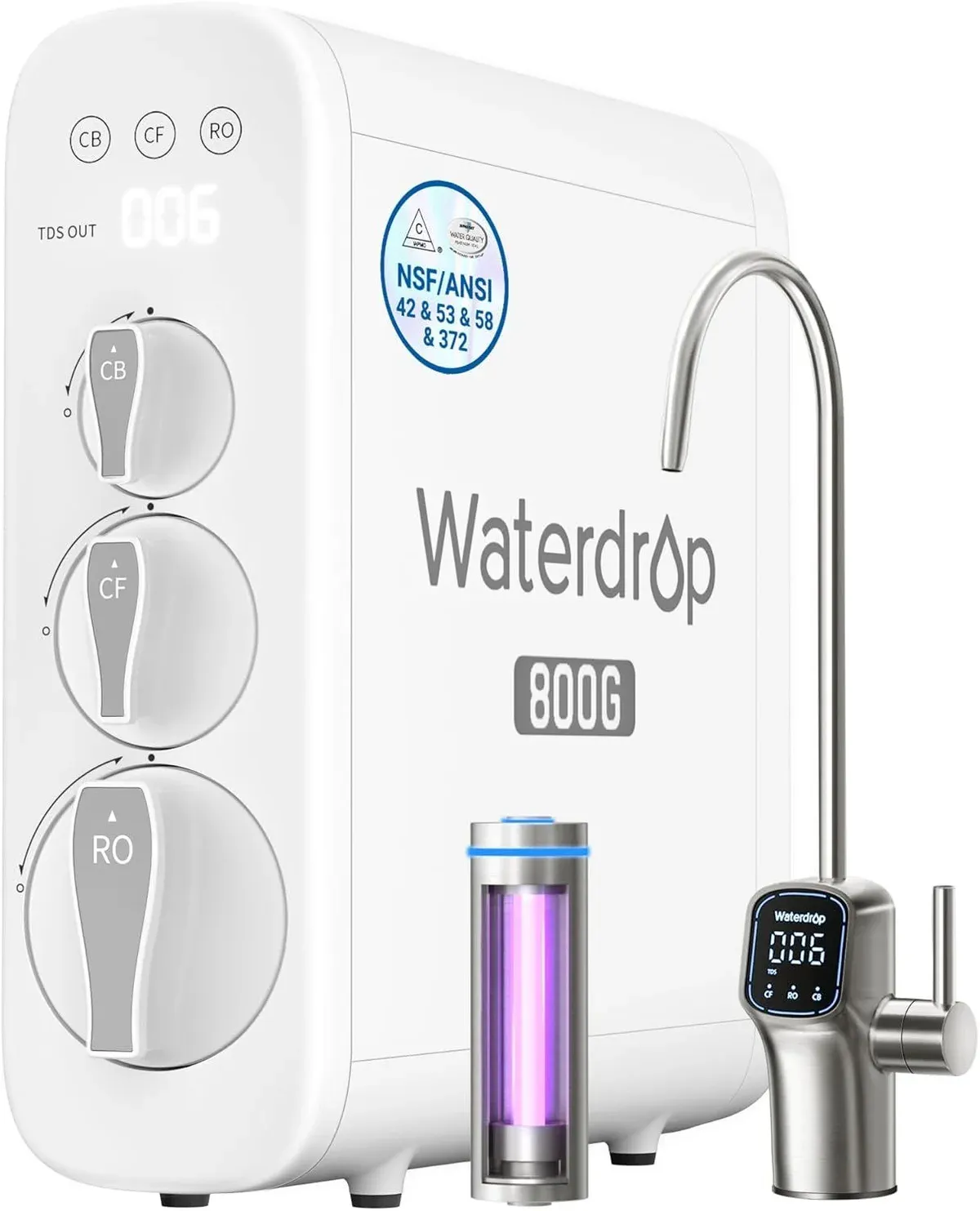
The Waterdrop G3P800 is the most thoroughly certified under-sink RO system available — the only one with NSF 53 for health-effect contaminants plus UV sterilization. The price is steep, but you're paying for the broadest protection available in a residential system.
Overview
The Waterdrop G3P800 is a 9-stage tankless under-sink reverse osmosis system built around an 800 GPD high-flux membrane — a flow rate that represents a generational leap over the 50–75 GPD conventional RO systems that have dominated this category for a decade. Where a traditional under-sink RO system forces you to wait for a pressurized tank to refill, the G3P800's tankless flow-through design delivers filtered water on demand, fast enough to fill a standard 6 oz glass in roughly five seconds under adequate line pressure. The "9-stage" designation refers to the filtration media layers integrated into three physical filter cartridges: a CF composite pre-filter combining PP sediment and dual activated carbon stages, a TFC reverse osmosis membrane, a CB post-carbon polishing block, and a final UV-LED sterilization chamber that exposes water to 254nm ultraviolet light for continuous biological protection. The result is a system that addresses virtually every category of residential water contamination in a single under-sink unit.
What sets the G3P800 apart from the broader field of premium RO systems — including many of Waterdrop's own lineup — is its certification stack. NSF/ANSI Standards 42, 53, 58, and 372 in combination represent the most comprehensive independent verification available for a residential under-sink RO system. Most RO systems hold only NSF 58 (covering RO membrane performance) and NSF 42 (aesthetic effects). The G3P800's additional NSF 53 certification means it has been independently tested and verified to reduce specific health-effect contaminants — lead, cysts, VOCs — at levels validated to matter for human health, not just at laboratory-optimized conditions. That distinction matters enormously if you are buying this system because of a real water quality concern rather than a general preference for better-tasting tap water.
The honest caveat upfront: the G3P800 earns its premium price tag with performance, but it is not perfect. There is no built-in remineralization stage, meaning the ultra-pure water it produces can taste flat to users accustomed to mineral-balanced bottled water. The system requires an electrical outlet under the sink for its UV module and smart faucet electronics — a requirement that surprises a disproportionate number of buyers mid-installation. And some units have shown a recurring sensor-related error code at the first filter replacement interval. These are real trade-offs that should inform your buying decision, and we cover all of them in full below.
Key Features & Specifications
| Filtration Stages | 9-stage RO with UV |
| Flow Rate | 800 GPD |
| Pure-to-Drain Ratio | 3:1 |
| Certifications | NSF 42/53/58/372 |
| Dimensions | 18.06" x 5.68" x 17.76" |
| Weight | 17.6 lbs |
| Contaminants Removed | TDS (82%), 1000+ contaminants including PFOA/PFOS, fluoride, lead, arsenic, bacteria, viruses |
The specifications here deserve some unpacking, because the headline numbers only tell part of the story. The 800 GPD flow rate is measured at 77°F and 60 PSI — real-world output at lower pressure (say, 45 PSI in an older home) will be closer to 500–600 GPD, and cold winter tap water below 60°F will reduce flow further due to the physics of RO membrane flux. Still, even at reduced output, the G3P800 runs circles around conventional 75 GPD systems. The 3:1 pure-to-drain ratio means for every three gallons of filtered water produced, one gallon goes down the drain as concentrate — significantly better than older RO designs that run 1:3 or worse. The UV-LED stage, unique among systems at this price tier, draws approximately 24 watts continuously and requires a standard 110V outlet, adding only a small amount to your yearly electricity bill, a negligible cost for the biological protection it provides. The three physical filter cartridges replace on a 6-month (CF), 12-month (CB), and 24-month (RO membrane) schedule, with tool-free bayonet connections that make swaps a five-minute job after your first attempt.
Pros & Cons
What We Like
- ✓ Most comprehensive NSF certification stack in the residential category. The G3P800 holds NSF/ANSI 42, 53, 58, and 372 simultaneously — a combination almost no other residential under-sink RO system achieves. NSF 53 certification is the critical addition: it means independent laboratory testing has confirmed the system reduces specific health-effect contaminants including lead, cysts, and VOCs, not just aesthetic issues like taste and odor. When you are buying a system because you have a documented water quality concern, that independent verification is the difference between a marketing claim and a proven result.
- ✓ UV-LED sterilization provides a genuine biological safety layer. The 254nm UV-LED chamber in Stage 9 achieves 99.9% reduction of bacteria and viruses — targeting biological contamination that even a perfect RO membrane cannot fully eliminate, since certain viruses (noroviruses below 25nm) can theoretically pass through compromised membrane surfaces. The UV module operates continuously in standby mode, meaning water sitting in the post-membrane pathway is sterilized even during periods of low use. For households on well water, with immunocompromised family members, or in areas with recurring boil-water advisories, this stage alone justifies choosing the G3P800 over the otherwise similar G3P600.
- ✓ The smart LED faucet with real-time TDS display is genuinely useful. The brushed-nickel faucet displays live TDS readings and a filter life status indicator, giving you ongoing visibility into system performance without requiring a separate TDS meter or calendar-based guesswork. Users consistently report checking their TDS after filter changes, after moving to a new home, or after periods of system inactivity — and using that data to make informed decisions about when filters are actually due. It is a feature that sounds like a marketing nicety until you own it and realize how much confidence it provides.
- ✓ 800 GPD flow rate transforms the under-sink RO experience for large households. Conventional under-sink RO systems top out at 75–100 GPD, which creates a persistent bottleneck for households that cook with filtered water, fill large bottles, or have multiple users drawing from the system throughout the day. The G3P800's 800 GPD output — roughly 33 gallons per hour under good pressure — eliminates that bottleneck almost entirely. Users coming from conventional tank-based systems consistently describe the G3P800 as transformative: filling a pasta pot with filtered water, running filtered water for cooking, and never rationing output because the system cannot keep up.
- ✓ 3:1 pure-to-drain ratio is best-in-class water efficiency for under-sink RO. Older RO systems waste three to four gallons for every one gallon of clean output — a ratio that raises legitimate sustainability and utility cost concerns. The G3P800's 3:1 ratio inverts that relationship, producing three gallons of filtered water for every one gallon sent to drain. Over a full year of typical household use this translates to a meaningful reduction in wasted water, and in municipalities that charge tiered rates for water and sewer use, the efficiency difference has a real dollar value.
What Could Be Better
- ✗ No built-in remineralization — filtered water can taste flat. Reverse osmosis strips essentially all dissolved minerals from water, including calcium and magnesium that contribute to water's familiar, rounded taste. The G3P800 does not include an alkaline or remineralization stage, meaning the ultra-pure output water (often 10–30 ppm TDS) tastes noticeably empty to users accustomed to bottled spring water or even moderately mineralized tap water. Waterdrop sells a compatible remineralization add-on filter, but it requires a separate purchase that many buyers only discover after the system is installed. Competing systems like the iSpring RCC7AK and Waterdrop's own X12-Alkaline include remineralization as a built-in stage, making this omission especially conspicuous at this price point.
- ✗ E03 filter fault errors at the first cartridge replacement are a documented pattern. A recurring complaint in reviews from users at the six-month mark — when the CF composite filter is first due for replacement — describes an E03 error code indicating the system cannot confirm a filter is properly seated. In approximately 80% of cases, this resolves with a correct re-seating of the filter (rotating firmly until a distinct click is felt), but a meaningful subset of users report the error persisting even after correct installation, suggesting a sensor reliability issue in some production batches. This failure pattern appears consistently enough across Amazon reviews and owner forums to be a legitimate quality concern, not an isolated edge case.
- ✗ Premium price represents a significant financial commitment even in the under-sink RO category. The G3P800 sits firmly in the premium price tier for residential under-sink RO — roughly two and a half to three times the total three-year cost of a comparable iSpring RCC7AK system when you factor in the lower upfront cost and cheaper third-party filter ecosystem of the iSpring. For households on reliable municipal water without documented health-effect contamination concerns, that premium is difficult to fully justify on performance alone, since the iSpring delivers clean, great-tasting water at a fraction of the long-term cost. The G3P800's price is defensible — but only if you actually need what it uniquely provides: UV sterilization and the NSF 53 certification stack.
- ✗ Electrical outlet requirement under the sink catches buyers off guard. The UV-LED module and smart faucet electronics require a standard 110V outlet in the under-sink cabinet. Many kitchens — particularly older construction — lack this, and discovering the requirement mid-installation is responsible for a disproportionate share of low-star reviews. If an outlet is not present, adding one requires paying a licensed electrician, which is an invisible line item in the purchase decision. The product listing does disclose this requirement, but it is easy to skim past, and any honest review of this system should flag it prominently.
The pros and cons here reflect a system that is genuinely exceptional at what it was designed to do, sold at a price that demands you honestly assess whether you need all of it. The NSF 53 certification and UV sterilization combination is not available in any other residential under-sink RO system we have reviewed — that is a real and meaningful distinction, not a spec-sheet exercise. But if your tap water is reliable municipal supply without documented heavy metal or biological contamination, those two features are largely insurance you may never need to cash in. The remineralization gap and the E03 error pattern are the two issues that most directly affect day-to-day satisfaction, and both are worth weighing carefully before purchase.
Real-World Performance
The G3P800's flow rate performance is the first thing that surprises new owners — and it holds up in real-world conditions better than many spec-sheet skeptics expect. Under typical municipal water pressure in the 55–65 PSI range, output flow is fast enough that most users describe it as indistinguishable from unfiltered tap water in daily use. Waterdrop's claim of filling a 6 oz glass in five seconds translates to approximately 43 oz per minute, which is consistent with 800 GPD divided across roughly 300 usable demand minutes in a day. At 45 PSI (a common pressure level in older residential plumbing), output is closer to 500–600 GPD, which is still many times faster than a conventional 75 GPD system and entirely adequate for household demand. Cold winter tap water reduces flow further due to the reduced flux efficiency of RO membranes at low temperatures — a physics limitation shared by every RO membrane on the market, not a G3P800-specific weakness.
In user reports, TDS reduction meets or exceeds the stated 82% claim. Independent user data from forums and Amazon Q&A sections shows it: users on municipal water in the 150–400 ppm input range routinely report output TDS of 10–45 ppm, while users in hard water areas above 400 ppm input see output in the 30–90 ppm range. The practical significance is that the G3P800 delivers genuinely demineralized water, not just lightly softened water — TDS levels that match or beat laboratory-grade filtration under real-world conditions. The real-time TDS display on the smart faucet makes this verifiable at any time, which adds a layer of confidence that pitcher and faucet filters simply cannot offer.
Filter longevity in practice tracks closely with the rated intervals for most users, with one important asterisk for hard water installations. The CF composite pre-filter's six-month rating holds reliably in municipal water with moderate chlorine levels (below 2 ppm free chlorine). Users on high-chlorine supply or with elevated sediment levels report hitting filter capacity closer to four to five months. The RO membrane's 24-month rating is most at risk in hard water areas above 300 ppm — users in those regions report output TDS beginning to creep upward around the 18-month mark, indicating early membrane scaling. The root cause is straightforward: the G3P800 has no water softening or scale inhibition pre-stage, meaning hard water calcium and magnesium deposits gradually foul the membrane surface. For hard water users, the most important maintenance action is staying rigorously on schedule with CF filter replacements — a delayed pre-filter change allows more chlorine and particulate to reach the membrane, accelerating degradation far more than hard water alone.
Performance over the first 18 months follows a consistent pattern across the user population: units maintained on schedule — CF filter every six months, CB filter at twelve months — show minimal measurable performance degradation. Output TDS remains stable, flow rates remain consistent, and the smart faucet filter life indicators track accurately with actual filter condition. Units that delay the CF filter replacement by two or more months in hard or highly chlorinated water show accelerated TDS creep on the output side — sometimes rising from 20 ppm to 60–80 ppm within months of a missed change. The lesson from 18 months of real-world data is unambiguous: the CF composite pre-filter is the system's single most important maintenance item, and treating its six-month replacement schedule as a hard deadline rather than a suggestion is the most impactful thing an owner can do to protect the RO membrane and maintain performance.
Value Analysis & Cost of Ownership
The G3P800 is priced at a premium tier — a significant investment for a residential water filter, sitting roughly 25–35% below the most expensive systems in the category but well above the mid-range RO systems that serve the bulk of the market. To evaluate that price honestly, you need to account for total cost of ownership rather than just the sticker price. In Year 1, the dominant cost is the unit itself; filter maintenance adds one CF replacement at the six-month mark plus a small electricity draw for the full year. Year 2 is the most maintenance-intensive: two CF replacements, one CB replacement, and the RO membrane at the 24-month mark all land within a two-year window. By Year 3, the system settles into a stable annual maintenance rhythm of two CF filters and one CB filter, with the next membrane replacement not due until Year 4. Across a five-year ownership horizon with typical household consumption of two to four gallons of filtered water per day, the G3P800 produces clean water for meaningfully less per gallon than bottled water, but it is more expensive per gallon than simpler pitcher or faucet-mount solutions.
The comparison to the iSpring RCC7AK — the category's benchmark value system — requires context to be fair. The iSpring costs roughly 40–50% less upfront and benefits from a competitive third-party filter ecosystem that keeps annual maintenance costs well below the G3P800's proprietary filter pricing. Over three years of typical use, the G3P800's total cost of ownership runs approximately 2.5–3 times higher than the iSpring's. That premium buys you 800 GPD versus 75 GPD (roughly ten times faster), UV sterilization, NSF 53 certification in addition to NSF 58, a 3:1 pure-to-drain ratio versus the iSpring's less efficient waste rate, and a tankless design that eliminates the pressurized tank degradation and stagnation risk inherent in the iSpring's conventional architecture. Whether that premium is worth paying depends entirely on what you need: for municipal water users without documented health concerns who primarily want good-tasting drinking water, the iSpring's value proposition is difficult to beat. For households on well water, with high daily demand, or with specific contamination concerns that the NSF 53 certification stack addresses, the G3P800's premium reflects genuinely differentiated protection.
Within Waterdrop's own lineup, the value picture shifts. The G3P800 costs approximately 15–25% more than the G3P600 over three years — a modest premium for the UV stage and the 33% higher flow rate. For most well water users or health-conscious buyers, that is money well spent. The step up to the X12-Alkaline costs approximately 20–30% more than the G3P800 over the same period and adds native remineralization and 1,200 GPD capacity while removing UV sterilization. For households that specifically need UV protection, the G3P800 remains the better value within the Waterdrop premium tier. One hidden cost worth budgeting: if your under-sink cabinet lacks an electrical outlet, factor in the cost of outlet installation before committing to this system. And if your household water hardness exceeds 300 ppm, budgeting for a pre-softener stage or accepting shortened RO membrane life is a real cost consideration that does not appear on the product page.
Frequently Asked Questions
Does the Waterdrop G3P800 really remove PFAS (PFOA/PFOS)?
How does the G3P800 compare to the iSpring RCC7AK for everyday use?
Do I need an electrician to install the G3P800?
What does the E03 error mean and how do I fix it?
How does the G3P800 compare to the Waterdrop X12-Alkaline, and is the upgrade worth it?
What is the actual long-term maintenance cost, and are there cheaper third-party filter options?
Final Verdict
The Waterdrop G3P800 is the most thoroughly certified under-sink RO system available — the only one with NSF 53 for health-effect contaminants plus UV sterilization. The price is steep, but you're paying for the broadest protection available in a residential system.
Check Price on AmazonBuy the G3P800 if you are on well water, have documented health-effect contamination concerns, or need high-volume on-demand filtered water for a large or active household. Skip it if your primary goal is affordable, great-tasting municipal water — the iSpring RCC7AK delivers that outcome at a fraction of the total cost, with remineralization included.