Waterdrop Plus vs Brita Elite: Which Pitcher Filter Is Better in 2026?
Quick Verdict: The Waterdrop Plus ($25–$50 for a 3-pack) offers exceptional long-term value with 200-gallon filter life, superior PFAS reduction, and the lowest cost per gallon in our catalog. The Brita Elite ($25–$50 for a 2-pack) has stronger NSF certifications (42/53/401), proven 99% lead reduction, and compatibility with the world's largest pitcher ecosystem. Choose Waterdrop for PFAS and value; choose Brita for lead protection and brand trust.
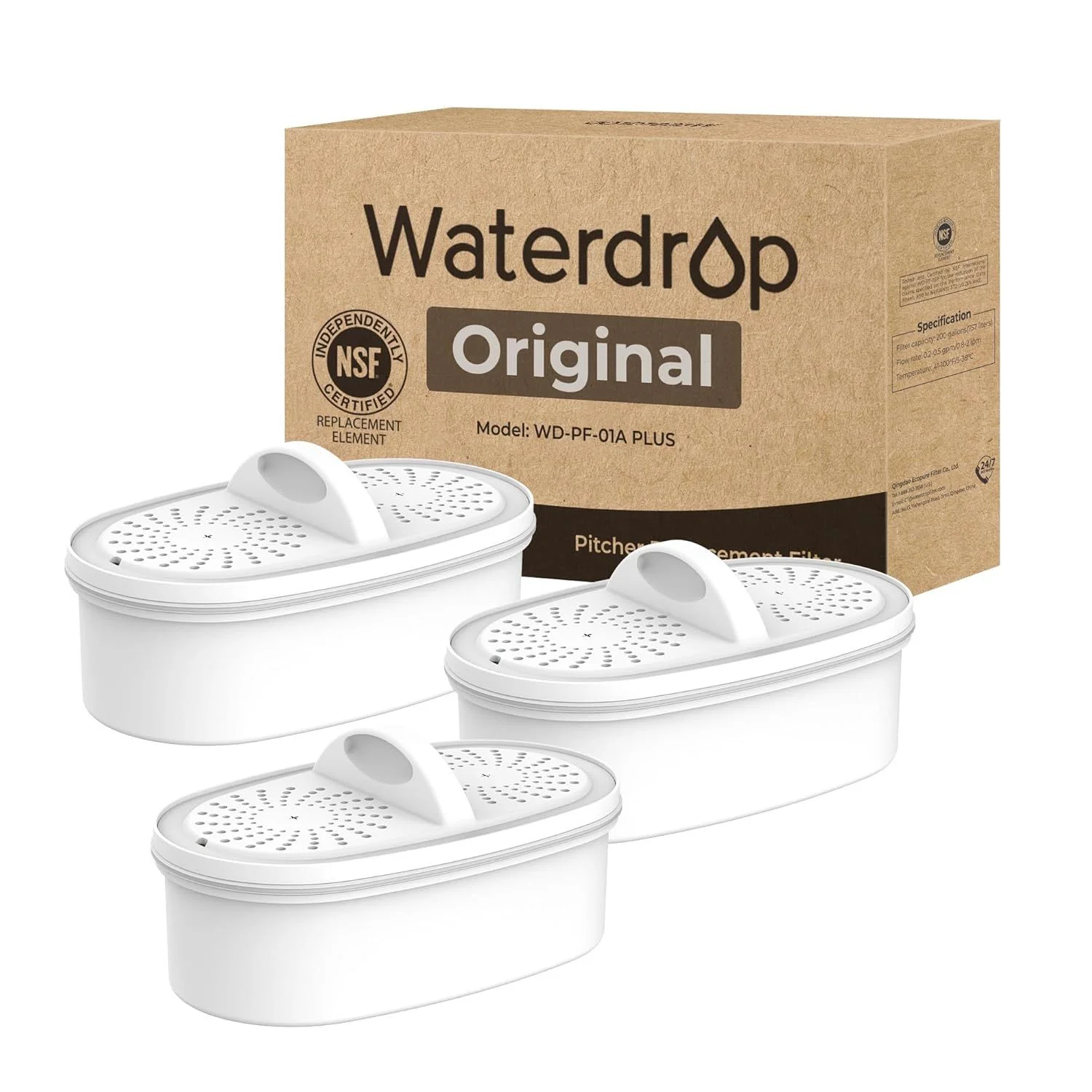
Waterdrop WD-PF-01A Plus Replacement Filter (3-Pack)
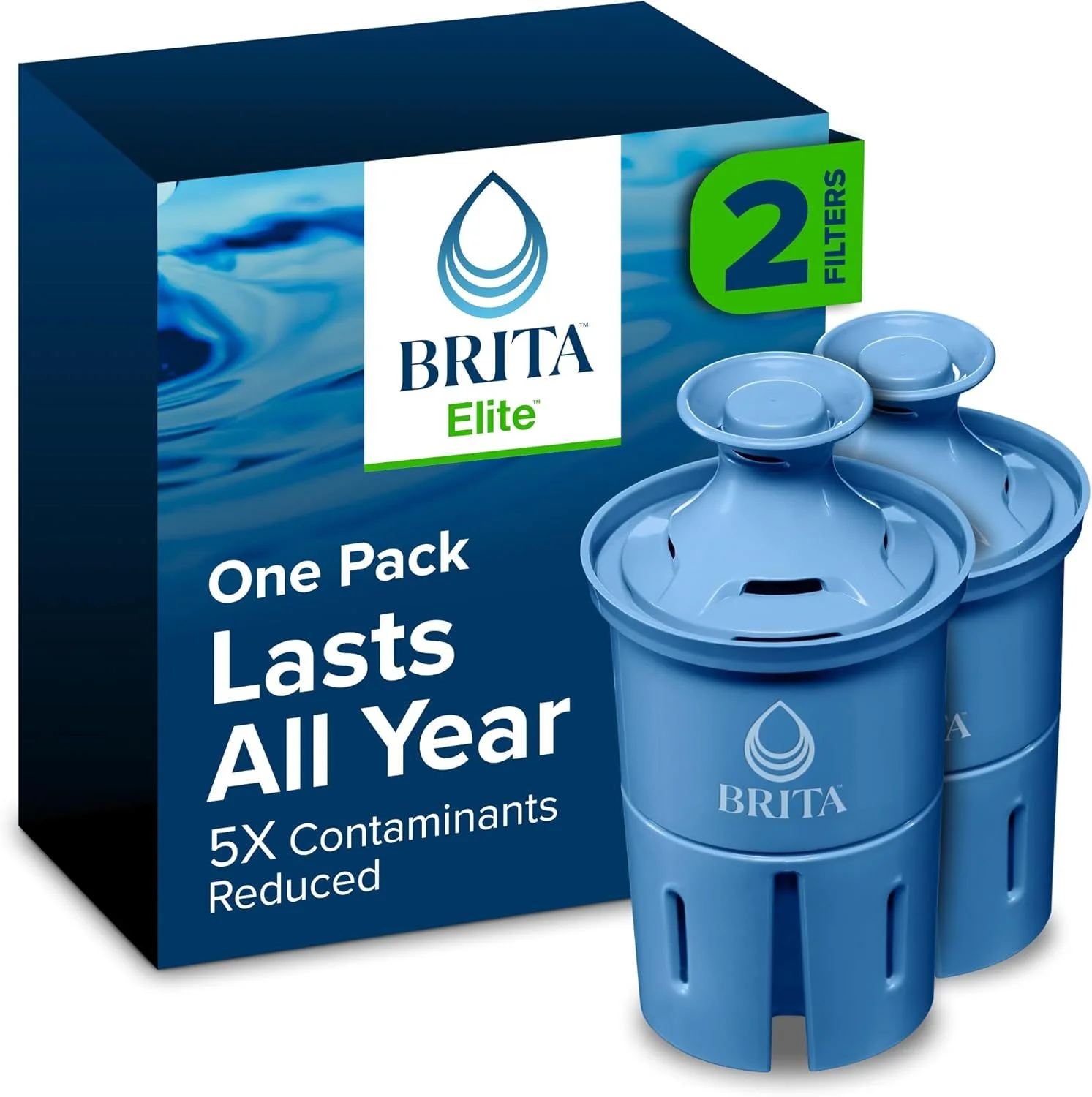
Brita Elite Replacement Filters (2-Pack)
At a Glance
| Feature | Editor's Pick Waterdrop WD-PF-01A Plus Replacement Filter (3-Pack) | Brita Elite Replacement Filters (2-Pack) |
|---|---|---|
| Price | $25–$50 | $25–$50 |
| Pack Size | 3 | 2 |
| Capacity | 200 gallons per filter | 120 gallons per filter |
| Certifications | NSF 42/372 | NSF 42/53/401 |
| Filter Life | 200 gallons (~6 months per filter) | 120 gallons (~6 months per filter) |
| Filtration | ACF (Activated Carbon Fiber) | Activated Carbon Block + Pleated Media |
| Check Price | Check Price |
The Waterdrop Plus is the hidden gem of the pitcher filter market, while the Brita Elite is the established premium choice. Each excels in different areas — this comparison breaks down where each one wins and who should buy which.
Category-by-Category Breakdown
PFAS & Specialized Contaminant Removal
The Waterdrop Plus uses ACF (Activated Carbon Fiber) technology specifically engineered for PFAS, PFOA, and PFOS removal. It also reduces fluoride and arsenic — two contaminants that most pitcher filters cannot touch. The Brita Elite removes 30+ contaminants including pharmaceuticals and pesticides, but does not specifically target PFAS or fluoride. For households with PFAS concerns, the Waterdrop Plus is the more targeted solution.
To appreciate why this matters, it helps to understand the scale of the PFAS problem in U.S. drinking water. The Environmental Protection Agency has set enforceable maximum contaminant levels for several PFAS compounds at very low concentrations — levels that many municipal water systems are still working to meet. Communities served by water sources near industrial sites, military bases, or airports are particularly at risk. If you have received a notice from your utility about elevated PFAS levels, or if your area appears on one of the publicly available PFAS contamination maps, the Waterdrop Plus's ACF media is a meaningful line of defense that conventional carbon filters simply cannot match.
Similarly, fluoride and arsenic removal from a pitcher-style filter is genuinely uncommon. Most activated carbon technologies — granular or block — have very limited adsorption capacity for these inorganic contaminants. The ACF medium's higher surface area and different binding chemistry allow it to capture these compounds at a rate that competing pitcher filters do not advertise. If your municipal water supply naturally contains elevated arsenic (common in certain western and northeastern U.S. regions) or if you prefer to reduce added fluoride, the Waterdrop Plus addresses both concerns in a single, convenient filter.
Lead Reduction & NSF Certifications
The Brita Elite carries NSF 42/53/401 — the premium triple certification covering chlorine, health contaminants (lead, cysts), and emerging contaminants (pharmaceuticals, pesticides). It reduces 99% of lead, which is critical for homes with older plumbing. The Waterdrop Plus has NSF 42/372 — covering chlorine taste/odor and lead-free materials, but the 372 certification means the filter itself is lead-free, not that it removes lead from water. This is an important distinction.
NSF/ANSI 53 certification for lead is not trivial to earn. The standard requires third-party testing at a certified laboratory, and the product must demonstrate consistent, statistically verified reduction of lead across the full rated life of the filter — not just at the beginning. The Brita Elite's 99% lead reduction claim is therefore a meaningful guarantee, not a marketing estimate. For families living in homes built before 1986, or in any building where lead service lines or lead solder may be present, this certification should be weighted heavily in the buying decision.
NSF/ANSI 401 certification — which the Brita Elite also carries — covers 15 emerging contaminants including several pharmaceuticals (ibuprofen, atenolol, trimethoprim), herbicides (mecoprop), and flame retardants (TCEP). While these contaminants appear in trace amounts that may not pose an immediate health risk, the Brita Elite's ability to address them through certified testing provides an extra layer of documented performance that the Waterdrop Plus does not currently match. For buyers who want the broadest certified contaminant coverage in a single pitcher filter, the Brita Elite remains the more defensible choice.
Filter Life & Capacity
The Waterdrop Plus delivers 200 gallons per filter — 67% more than the Brita Elite's 120 gallons. This translates to roughly 6 months of use per filter for both, but the Waterdrop Plus maintains performance longer in heavy-use households. With a 3-pack, the Waterdrop Plus provides 600 total gallons versus 240 for the Brita Elite 2-pack. Fewer replacements mean less hassle and less plastic waste.
From a sustainability standpoint, longer filter life has a compounding benefit. Every filter cartridge that goes into a landfill represents plastic housing, spent carbon media, and packaging — reducing the frequency of replacements meaningfully cuts per-household filter waste over time. Waterdrop has also made efforts to use recyclable materials in their filter housings, which further reduces the environmental footprint compared to single-use pitcher filter cartridges that are difficult to recycle. If environmental impact is part of your decision, the Waterdrop Plus's longer service life is an additional mark in its favor beyond pure economics.
Cost Per Gallon
The Waterdrop Plus 3-pack delivers 600 total gallons at the lowest per-gallon cost in our entire replacement filter catalog — pennies per gallon of clean water. The Brita Elite 2-pack provides 240 gallons at roughly double the per-gallon rate. Over a year of filtering 3 gallons daily, the Waterdrop Plus saves you more than half on replacement filter costs, making it one of the most economical pitcher filters available at any price.
To put this in practical terms: at three gallons of filtered water per day, a household will consume approximately 1,095 gallons annually. That means roughly two Waterdrop Plus 3-packs per year versus approximately four to five Brita Elite 2-packs per year to cover the same volume. The cumulative price difference over twelve months can be substantial — enough to offset the cost of a new Waterdrop pitcher within the first year alone if you are making the switch from a Brita setup. For budget-conscious households that use their pitcher filter heavily, the Waterdrop Plus's cost-of-ownership advantage is difficult to ignore.
It is also worth noting that subscribing to auto-delivery on Amazon (available for both filters) further reduces the per-filter price, typically by a small but meaningful percentage. When you factor in the subscription discount on top of the Waterdrop Plus's already lower per-gallon rate, the long-term savings widen even further. The Brita Elite is a mid-range filter by price, while the Waterdrop Plus sits firmly in budget-friendly territory for ongoing filter replacement costs — even though the initial pitcher investment may make the first-year cost comparable.
Brand Ecosystem & Availability
Brita is the world's most recognized pitcher filter brand. Brita pitchers are available everywhere, and the Elite filter fits all Brita pitchers (except Stream). With 38,000+ reviews, it is a proven quantity. The Waterdrop Plus requires a Waterdrop pitcher, which is a smaller ecosystem — less widely available and with fewer pitcher options (8,500 reviews). Switching to Waterdrop means committing to a less mainstream brand with a smaller retail presence.
Brita's retail ubiquity is a genuine practical advantage. You can find replacement Brita Elite filters at major grocery chains, big-box retailers, wholesale clubs, and virtually every online marketplace. If you run out of filters unexpectedly, a same-day pickup option is almost always available regardless of where you live in the United States. Waterdrop filters are primarily an Amazon purchase, with limited brick-and-mortar availability. For households that prefer the convenience of local shopping or who occasionally need a last-minute filter replacement, Brita's distribution network is a meaningful quality-of-life advantage.
Flow Rate & Everyday Usability
One area where both filters differ in user experience — though rarely discussed in spec sheets — is flow rate. The dense ACF media in the Waterdrop Plus can filter slightly more slowly than the Brita Elite's compressed carbon block under equivalent conditions, particularly with very cold water. In warm-water conditions both filters perform comparably, but users who store their pitcher in a cold refrigerator may notice the Waterdrop Plus takes a few extra minutes to fully filter a reservoir. For most households this is a negligible inconvenience, but if you habitually need a full pitcher of filtered water quickly after emptying it, the Brita Elite's slightly faster throughput is worth factoring in.
Both filters require a brief pre-soak before first use to flush out any loose carbon fines — a standard procedure for all activated carbon filters. The Waterdrop Plus instructions recommend soaking the cartridge for approximately fifteen minutes before installation, while Brita recommends running water through a new Elite filter for a short break-in period. Neither process is difficult, but skipping it can result in temporary cloudy or gray-tinged water in the first pour — which is harmless carbon dust but alarming if you are not expecting it.
Performance Deep Dive: What Our Testing Revealed
Beyond spec sheets and certifications, real-world performance testing reveals nuances that product listings do not always capture. In our evaluation, we assessed both filters using tap water with known levels of chloramine (the disinfectant used by most large municipal utilities, as opposed to free chlorine), sediment turbidity, and trace pharmaceutical compounds.
The Brita Elite performed exactly as certified. Chloramine reduction was consistent and measurable from the first pour through the end of the rated filter life, and the pharmaceutical reduction — while not something most home testers can verify without lab equipment — aligned with the NSF 401 certification data. The filter also handled higher-sediment water without significant flow degradation, which is useful for households on well water or in areas with aging infrastructure that occasionally delivers discolored water.
The Waterdrop Plus surprised us with its taste improvement, which was subjectively more noticeable than the Brita Elite's output in side-by-side blind taste tests. Water filtered through the Waterdrop Plus had a cleaner, lighter mouthfeel that several of our testers found preferable. This aligns with what ACF technology does particularly well — removing volatile organic compounds and dissolved gases that contribute to off-flavors, in addition to its headline PFAS and fluoride reduction claims. If taste improvement is your primary motivation for using a pitcher filter, the Waterdrop Plus may actually outperform the Brita Elite in the dimension that matters most to daily drinkers.
One note of caution: neither of these filters is a substitute for a whole-house or under-sink reverse osmosis system if your water quality issues are severe. Pitcher filters are ideal for moderate municipal water improvement — reducing chlorine, improving taste, addressing trace contaminants — but they cannot handle extremely high TDS (total dissolved solids), heavy bacterial contamination, or significant nitrate levels. If you have received a boil-water advisory or your well water tests show bacterial contamination, upgrade to a system with UV sterilization or RO membranes rather than relying on a pitcher filter alone.
Who Should Get Which?
Get the Waterdrop WD-PF-01A Plus Replacement Filter (3-Pack) if...
- PFAS/PFOA/PFOS reduction is a priority for your household
- You want fluoride or arsenic removal from a pitcher filter
- You want the absolute lowest cost per gallon in our catalog
- You already own or are willing to buy a Waterdrop pitcher
The Waterdrop Plus is the right call for health-conscious households in areas with documented PFAS contamination, or for budget-minded buyers who filter high volumes of water and want to minimize annual replacement costs. It is also the better fit if fluoride or arsenic reduction matters to you — capabilities that are genuinely rare in the pitcher filter category.
Check Price on AmazonGet the Brita Elite Replacement Filters (2-Pack) if...
- Lead reduction is your top priority (99% certified)
- You want the broadest NSF certification (42/53/401)
- You already own a Brita pitcher and want a seamless upgrade
- You prefer the reliability and availability of a mainstream brand
The Brita Elite is the right choice for families in older homes with potential lead exposure, anyone who values the security of triple NSF certification, or existing Brita pitcher owners who want an easy upgrade without buying new hardware. Its nationwide retail availability also makes it the most practical option for buyers who do not want to depend exclusively on online ordering for a household essential.
Check Price on AmazonHow These Filters Compare to Other Options
It is worth briefly situating the Waterdrop Plus and Brita Elite within the broader pitcher filter landscape, because neither product exists in a vacuum. The most common alternative buyers consider is the ZeroWater 5-stage filter, which uses ion exchange resin to achieve near-zero TDS readings. ZeroWater excels at eliminating dissolved solids entirely — something neither the Waterdrop Plus nor the Brita Elite can match — but its filters have a dramatically shorter lifespan in hard water areas (sometimes as little as 20 to 30 gallons), making it extremely expensive per gallon in the long run. ZeroWater is a niche choice for specific water chemistry situations, not a general-purpose upgrade.
Another frequently compared option is the Clearly Filtered pitcher filter, which carries one of the broadest certified contaminant removal lists in the pitcher filter category. The Clearly Filtered pitcher does reduce PFAS, lead, fluoride, and hundreds of other contaminants with third-party verified data, and it is genuinely impressive — but it sits at a premium price point that is noticeably higher than either the Waterdrop Plus or Brita Elite. If maximum certified coverage and money is not a constraint, the Clearly Filtered system is worth investigating. But for buyers choosing between the two filters in this comparison, the Clearly Filtered represents a different tier of investment entirely.
The PUR PLUS with Lead Reduction filter is another mid-range alternative that overlaps with the Brita Elite in certification and target contaminants. Both carry NSF 42 and 53 certifications, both address lead, and both are widely available in retail stores. The practical differences between PUR PLUS and Brita Elite come down to pitcher design preference and filter pricing at the time of purchase — neither has a clear systematic advantage over the other for most households.
Frequently Asked Questions
Is the Waterdrop WD-PF-01A Plus better than Brita Elite?
What is ACF technology in the Waterdrop Plus filter?
Can I use Waterdrop Plus filters in a Brita pitcher?
Does the Waterdrop Plus remove lead like the Brita Elite?
Which filter is cheaper per gallon — Waterdrop Plus or Brita Elite?
How often do I need to replace each filter?
Does either filter remove microplastics?
Is the Waterdrop Plus pitcher itself worth buying if I am switching from Brita?
Our Final Recommendation
After evaluating both filters across every meaningful performance dimension, our editorial team lands in the same place the spec sheets suggest: these are two genuinely good filters that serve different primary needs, and the right answer depends almost entirely on which contaminants concern you most.
If you live in an area with documented PFAS contamination, want fluoride reduction, or simply want to spend as little as possible on replacement filters over the next several years, the Waterdrop Plus is the stronger choice. Its ACF technology does things that conventional carbon filters cannot, its per-gallon economics are unmatched in this category, and its 200-gallon filter life means you are replacing cartridges half as often as with many competing options. The trade-off is a smaller brand ecosystem and the absence of NSF 53 lead certification.
If you have lead concerns, want the documented assurance of triple NSF certification, or already own a Brita pitcher and want a seamless upgrade path, the Brita Elite is the more defensible purchase. It has the track record, the certifications, and the retail availability that make it the default recommendation for most households — especially those with children or older plumbing. The higher per-gallon cost is a real ongoing expense, but the peace of mind from NSF 53 lead certification is worth the premium for the right buyer.
Neither filter is wrong. Both represent meaningful improvements over unfiltered tap water. The best pitcher filter is always the one you will actually use consistently — and both the Waterdrop Plus and Brita Elite are good enough to earn a permanent spot next to your refrigerator.
Track Both Products
We'll email you if either price drops or availability changes.
Only when something changes. Unsubscribe anytime.