ZeroWater vs PUR: Which Pitcher Filter Is Better in 2026?
Quick Verdict: The PUR 4-Pack (Under $25) is the practical winner for most households — solid NSF 42/53 certified filtration with lead removal at one of the lowest per-gallon costs in the pitcher category. ZeroWater ($50–$100 for a 4-pack) achieves deeper purification with 0 TDS and PFAS removal, but its 15-25 gallon filter life makes it 4-7x more expensive per gallon. Choose ZeroWater only if you have very hard water or need verified PFAS reduction.
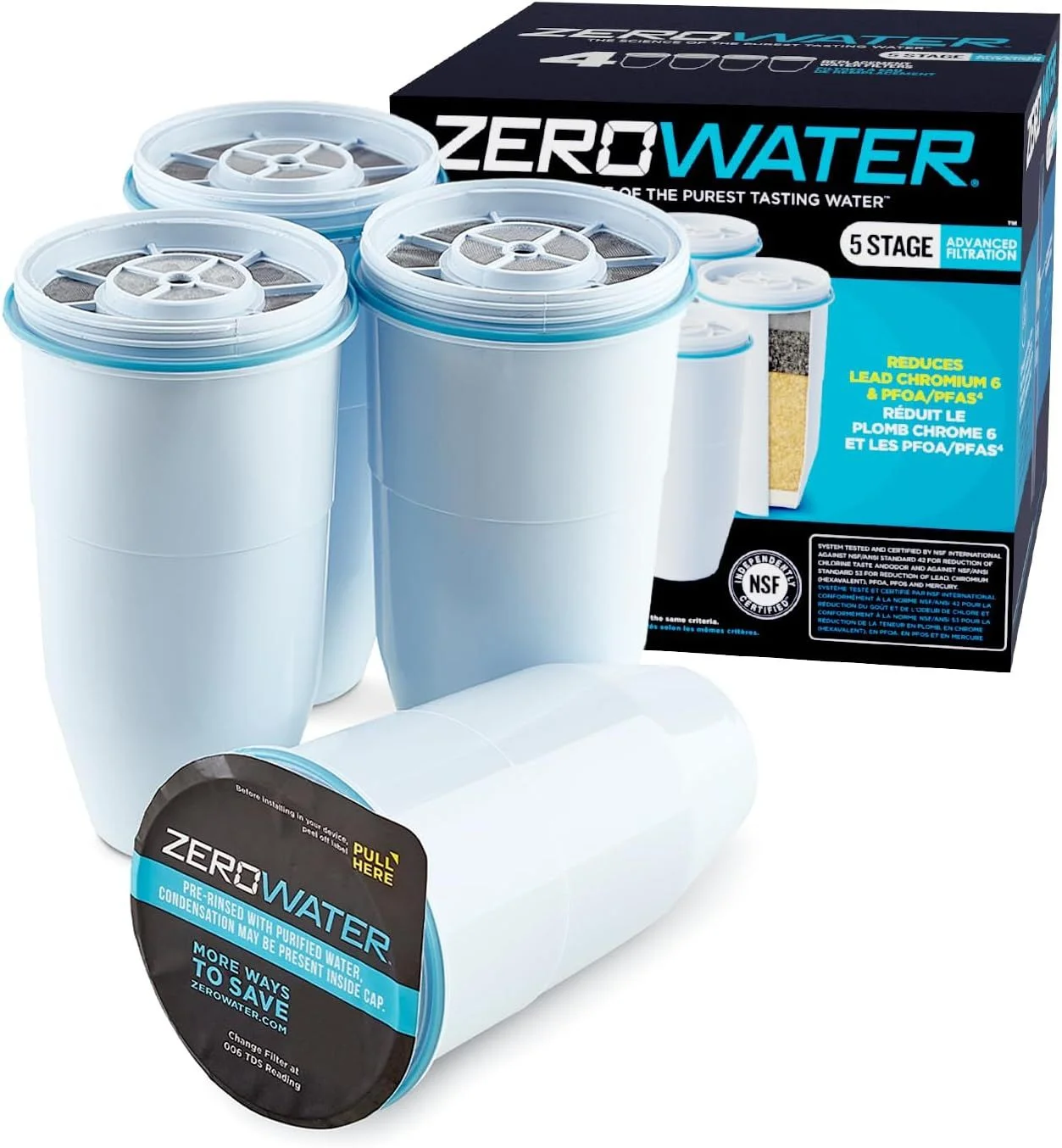
ZeroWater 5-Stage Replacement Filter (4-Pack)
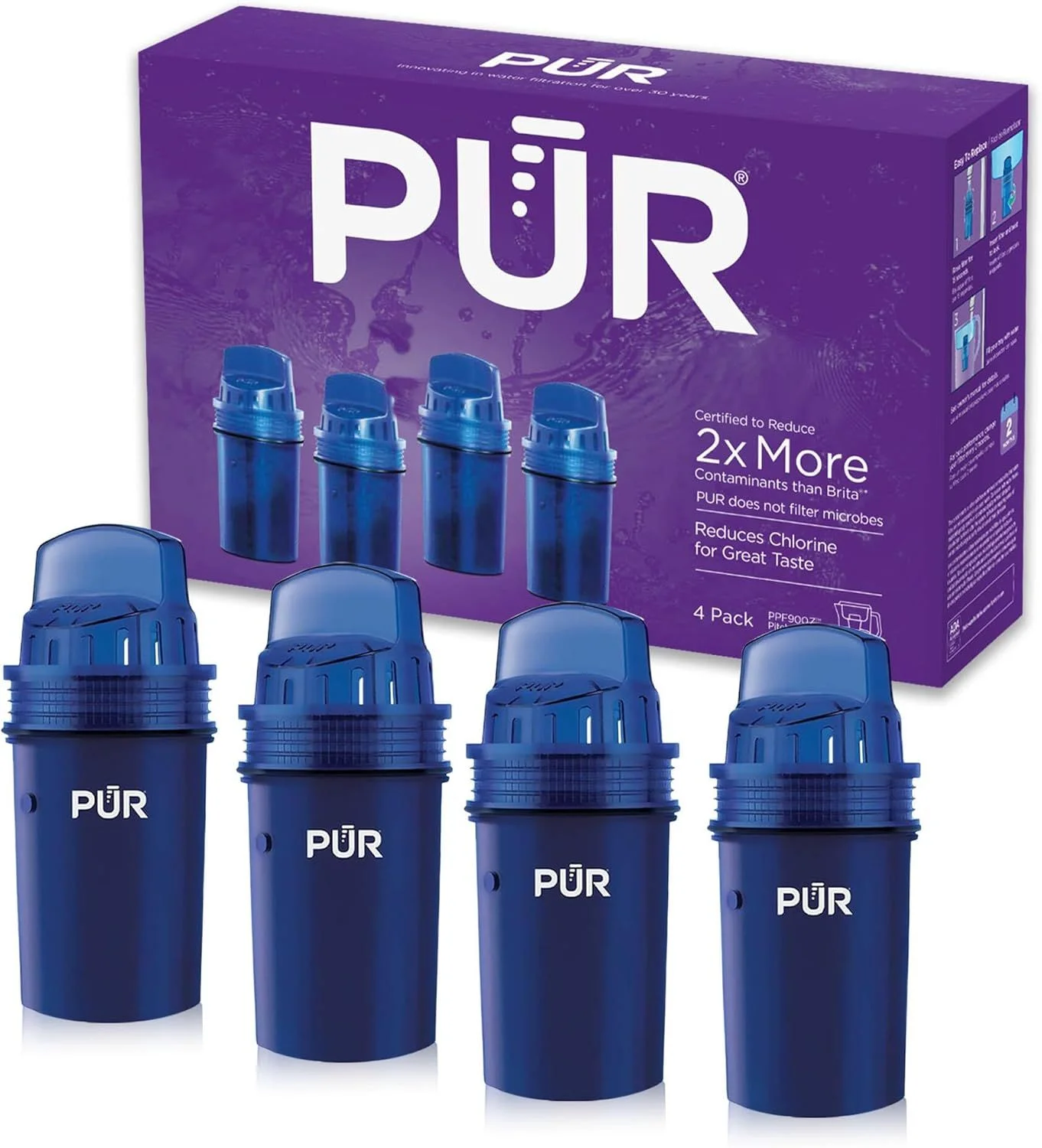
PUR Water Pitcher Replacement Filter (4-Pack)
At a Glance
| Feature | ZeroWater 5-Stage Replacement Filter (4-Pack) | Editor's Pick PUR Water Pitcher Replacement Filter (4-Pack) |
|---|---|---|
| Price | $50–$100 | Under $25 |
| Pack Size | 4 | 4 |
| Capacity | ~15-25 gallons per filter (varies by source water TDS) | 40 gallons per filter |
| Certifications | IAPMO (lead, chromium, PFOA, PFOS) | NSF 42/53 |
| Filter Life | 15-25 gallons (2-8 weeks depending on TDS) | 40 gallons (~2 months per filter) |
| Filtration | 5-Stage Ion Exchange + Activated Carbon | 2-in-1 Activated Carbon + Ion Exchange |
| Check Price | Check Price |
ZeroWater and PUR take fundamentally different approaches: ZeroWater goes all-in on TDS removal with a 5-stage ion exchange system, while PUR offers targeted contaminant reduction with a practical filter life. This comparison comes down to whether you prioritize maximum purity or affordable, convenient filtration.
Category-by-Category Breakdown
Filtration Depth
ZeroWater's 5-stage ion exchange system achieves something no other pitcher filter can: 0 TDS water. It is IAPMO certified for lead, chromium, PFOA, and PFOS reduction, plus it removes 99.6% of all total dissolved solids including fluoride. PUR's 2-in-1 activated carbon and ion exchange removes 20+ specific substances and is NSF 42/53 certified for lead, mercury, and chlorine. ZeroWater filters more thoroughly, but PUR targets the contaminants that matter most to most households.
It is worth understanding what "filtration depth" actually means in practical terms. ZeroWater's ion exchange resin works by swapping harmful and neutral ions alike with hydrogen and hydroxide ions, which is why it achieves such a comprehensive reduction in dissolved solids. PUR's approach uses a combination of activated carbon — excellent for chlorine, volatile organic compounds, and taste-and-odor improvement — alongside a modest ion exchange component that addresses heavy metals like lead and mercury. The result is that PUR produces water that is genuinely clean and safe for most municipal water sources, while ZeroWater produces water that is as close to laboratory-grade purity as a pitcher filter can achieve. For households on typical city water with no specific contamination concerns, PUR's filtration is more than sufficient. For those in areas with aging infrastructure, known lead pipe issues, or industrial contamination, ZeroWater's deeper approach offers a meaningful safety margin.
Filter Life & Practicality
PUR filters last 40 gallons — about 2 months for average use. ZeroWater filters last only 15-25 gallons, and in high-TDS areas can deplete in as little as 2 weeks. This means a PUR 4-pack covers 8 months of use, while a ZeroWater 4-pack may cover only 2-4 months. The constant replacement cycle with ZeroWater is its biggest practical limitation — you need to keep a stockpile on hand to avoid gaps in filtered water. In practice, most households won't notice PUR filter changes at all since they happen roughly every two months, while ZeroWater users quickly learn to watch the included TDS meter and keep spare filters in the pantry.
Beyond the replacement frequency, filter life affects the overall ownership experience in ways that go beyond cost. ZeroWater's short filter life creates a logistical challenge: ordering filters online means planning ahead, and if you run out unexpectedly, you are back to unfiltered tap water until your order arrives. Retail availability of ZeroWater replacement filters varies more than PUR's, which are stocked in nearly every grocery and big-box store in the country. For households that prefer to grab a filter on a grocery run rather than managing an online subscription, PUR's wider retail footprint is a genuine convenience advantage. ZeroWater does offer a subscription program that auto-ships filters on a schedule, which helps, but it adds another account and recurring charge to manage.
Cost Per Gallon
PUR's 4-pack yields 160 gallons total at one of the cheapest per-gallon costs in the pitcher category. ZeroWater's 4-pack yields only 60-100 gallons — roughly 4-7x the per-gallon expense. The cost gap is enormous: over a year of filtering 3 gallons daily, PUR costs a fraction of what ZeroWater demands. For budget-conscious households, PUR delivers strong filtration at dramatically lower running costs.
To put this in perspective with real-world scenarios: a family of four that filters all drinking and cooking water — roughly 4 to 5 gallons per day — would burn through a ZeroWater 4-pack in as little as two to three weeks if their local tap water has moderate to high TDS. That same family would use a PUR 4-pack over nearly six months. Over the course of a full year, the cost differential between the two systems is substantial enough that many ZeroWater users end up abandoning the system not because of dissatisfaction with filtration quality, but because the ongoing filter costs become difficult to justify. If you are comparing ZeroWater purely on the performance merits and can absorb the higher running cost, it earns its premium. But for most households making a rational cost-benefit decision, PUR's economics are far more sustainable.
PFAS & Specialized Contaminant Removal
ZeroWater has a verified edge here. Its IAPMO certification covers PFOA and PFOS — the "forever chemicals" that are an increasing public health concern. PUR does not certify for PFAS removal. If you live in an area with known PFAS contamination (near military bases, industrial sites, or airports that used AFFF firefighting foam), ZeroWater's certified PFAS reduction provides meaningful protection that PUR cannot match.
The significance of PFAS certification deserves additional context. The EPA finalized enforceable maximum contaminant levels for several PFAS compounds in 2024, signaling that these substances are no longer a niche concern — they are a mainstream water quality issue affecting millions of Americans. PFAS compounds have been linked to immune system disruption, thyroid disease, and certain cancers with prolonged exposure. While ZeroWater is not the only filtration technology capable of PFAS reduction — reverse osmosis systems and certain activated carbon block filters also perform well — it is notably one of the very few pitcher-format filters with third-party certification for PFOA and PFOS reduction. For renters or those who cannot install under-sink systems, ZeroWater fills an important gap in the market. PUR's lack of PFAS certification is not necessarily an indication that it removes zero PFAS, but without third-party verification, you cannot rely on it for that purpose.
Taste & User Experience
Most users report that PUR-filtered water tastes clean and natural, with beneficial minerals left intact. ZeroWater's 0-TDS output strips all minerals, producing water that many describe as flat or empty-tasting. PUR also includes the LockFit design for secure filter seating. ZeroWater includes a TDS meter — a useful tool for measuring water quality and knowing when to replace filters. Both approaches have merit, but most taste testers prefer water with some mineral content. If you regularly brew coffee or tea, PUR's mineral-retaining filtration tends to produce a fuller-bodied flavor, while ZeroWater's stripped output can make hot beverages taste noticeably thin.
The taste difference between fully demineralized and lightly filtered water is not subtle for most people. Water sommeliers and specialty coffee professionals specifically value mineral content — calcium and magnesium interact with coffee grounds during extraction in ways that affect flavor complexity. Calcium bicarbonate, for example, acts as a buffer that prevents espresso from tasting too acidic. Stripping all minerals from water, as ZeroWater does, produces a neutral-pH, flat liquid that coffee professionals sometimes call "dead water." On the other hand, some users who find their tap water has an objectionable taste or smell due to high chloramine levels, sulfur compounds, or iron content may actually prefer ZeroWater's completely stripped output since it eliminates all of those off-notes entirely. Your preference will depend significantly on what your tap water tastes like to begin with and how sensitive you are to water flavor in beverages.
Cost of Ownership Over Time
Understanding the total cost of ownership — not just the upfront purchase price — is essential when choosing between these two systems. Both pitchers fall into the budget-friendly to mid-range category for the initial purchase, with ZeroWater typically priced slightly higher for the pitcher itself due to the included TDS meter. The real financial divergence happens in ongoing filter replacement costs.
For a single person filtering roughly one to two gallons per day, PUR filters will comfortably last two full months and the annual filter spend remains very modest — one of the most affordable options in the pitcher category. ZeroWater filters for the same usage in a low-TDS water area might last four to six weeks, meaning annual filter costs are noticeably higher but not dramatically so. The situation changes significantly for families or in high-TDS water areas. A household filtering four or more gallons daily in a hard-water region could see ZeroWater filter costs run five to seven times higher than PUR annually. Over a two-to-three year ownership horizon, the cumulative difference can exceed the cost of the pitcher itself several times over.
One strategy some ZeroWater users employ is to use ZeroWater exclusively for drinking water consumed directly and use a less expensive filtered or tap water source for cooking, which reduces daily throughput and extends filter life. This is a reasonable workaround, but it adds complexity to your kitchen routine. PUR users typically filter everything without concern because the economics support unlimited use throughout the day.
Who Should Get Which?
Get the ZeroWater 5-Stage Replacement Filter (4-Pack) if...
- You need maximum TDS reduction — 0 ppm verified purity
- PFAS/PFOA/PFOS contamination is a known issue in your area
- You want fluoride removal from a pitcher filter
- You are willing to invest more for laboratory-grade water purity
Get the PUR Water Pitcher Replacement Filter (4-Pack) if...
- You want strong lead and chlorine reduction at an affordable per-gallon cost
- You prefer changing filters every 2 months, not every 2-3 weeks
- You want water that retains natural minerals and tastes pleasant
- Budget is a consideration — PUR costs 4-7x less per gallon
Who Should Skip Both and Consider Alternatives
If your primary concern is comprehensive protection across the widest possible range of contaminants — including heavy metals, PFAS, nitrates, arsenic, and microplastics — a pitcher filter of any kind may not be the right tool for your situation. Under-sink reverse osmosis systems, such as those from APEC, iSpring, or Waterdrop, provide multi-stage filtration that surpasses both ZeroWater and PUR on nearly every measurable dimension, with lower per-gallon costs over time and filter lives measured in months rather than weeks. They require installation and a higher upfront investment in the mid-range to premium tier, but for households with serious water quality concerns, they represent significantly better value over a three-to-five year horizon.
Households in rental situations or those who want a no-installation solution but need better-than-pitcher filtration should also consider countertop filters such as the Clearly Filtered or AquaTru countertop RO system, which bridge the gap between pitcher convenience and under-sink performance. If you are primarily concerned about chlorine taste and general water quality improvement with no specific contaminant concerns, even a standard Brita pitcher with a Longlast+ filter offers competitive performance at an even lower per-gallon cost than PUR.
Frequently Asked Questions
Is ZeroWater better than PUR for water filtration?
Which is cheaper in the long run — ZeroWater or PUR?
Does PUR remove PFAS like ZeroWater does?
Why do ZeroWater filters need to be replaced so often?
Can I use ZeroWater filters in a PUR pitcher?
How do I know when my ZeroWater filter needs to be replaced?
Is ZeroWater or PUR better for well water?
Does ZeroWater remove beneficial minerals from water?
How does ZeroWater compare to Brita in addition to PUR?
Our Final Take
After weighing filtration depth, cost of ownership, user experience, and practical everyday usability, the recommendation splits cleanly along household needs. PUR is the right choice for the vast majority of households on municipal water — it is certified for the contaminants that pose the greatest documented risk (lead and chlorine), its 40-gallon filter life keeps maintenance minimal, and its per-gallon cost is among the lowest in the entire pitcher filter category. It is a reliable, no-drama solution that simply works.
ZeroWater earns its place for a specific and legitimate subset of buyers: those with documented PFAS concerns in their water supply, renters who cannot install under-sink systems but want the deepest possible pitcher-format filtration, or households that have tested their water and found concerning TDS levels that PUR's targeted approach may not fully address. Going in with realistic expectations about filter life and ongoing costs is essential — ZeroWater users who feel frustrated by the system almost universally cite being surprised by how quickly filters deplete, which is an avoidable frustration with proper advance knowledge.
Whichever system you choose, both represent a significant improvement over unfiltered tap water for most households, and either is a practical, counter-friendly solution that requires no plumbing knowledge to install or maintain.
Track Both Products
We'll email you if either price drops or availability changes.
Only when something changes. Unsubscribe anytime.