Waterdrop WD-PF-01A Plus Replacement Filter (3-Pack) Review 2026
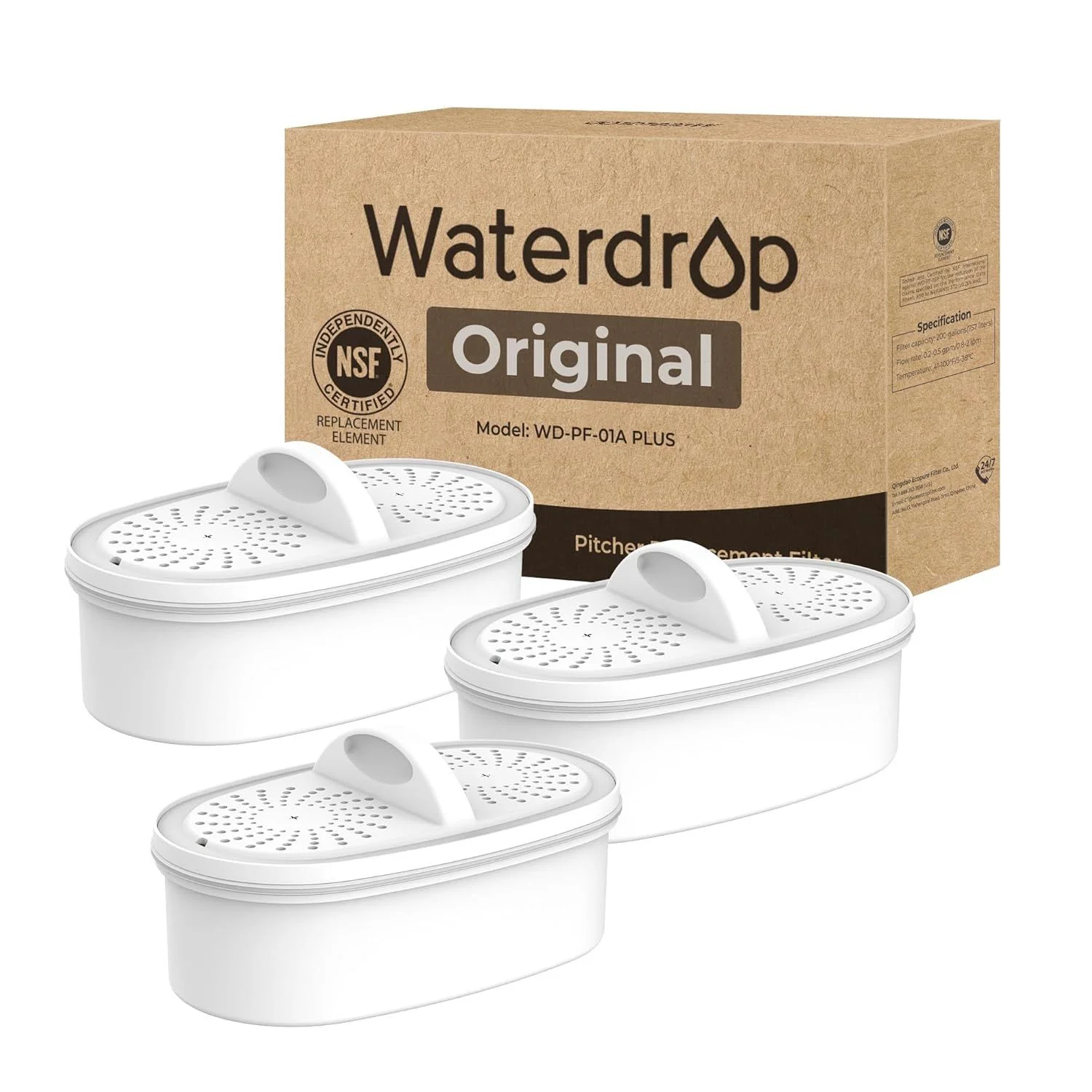
The Waterdrop WD-PF-01A Plus is a hidden gem with its 200-gallon life and PFAS reduction capability. If you can commit to the Waterdrop pitcher ecosystem, the long-term value is outstanding.
Overview
The Waterdrop WD-PF-01A Plus is the dark horse of the pitcher filter market — a product most people have never heard of that quietly outperforms many of the household names on key metrics. At its competitive 3-pack price, the standout feature is the 200-gallon filter life per cartridge. That is five times the capacity of a Brita Standard filter and nearly double the Brita Elite. Combined with the ACF (Activated Carbon Fiber) technology that tackles PFAS, fluoride, and arsenic, the Waterdrop Plus delivers an unusual combination of longevity and filtration capability.
ACF is a newer filtration material that offers significantly more surface area per gram than traditional granulated activated carbon. This extra surface area is what enables the longer filter life and the more effective adsorption of difficult-to-remove contaminants like PFAS compounds. While Waterdrop holds NSF 42/372 certification (chlorine reduction and lead-free materials), the lack of NSF 53 certification is notable — it means the specific contaminant reduction claims have not been independently verified to the same standard as Brita Elite or PUR.
The trade-off is ecosystem commitment. Waterdrop pitchers are not as widely available as Brita or PUR, and the brand has less consumer recognition. However, if you are willing to buy into the Waterdrop platform, the long-term economics are compelling: three filters at one low price can provide up to 600 gallons of filtered water, roughly 18 months of drinking water for a typical household.
Key Features & Specifications
| Filtration Technology | ACF (Activated Carbon Fiber) |
| Capacity | 200 gallons per filter |
| Certifications | NSF 42/372 |
| Pack Size | 3 |
| Filter Life | 200 gallons (~6 months per filter) |
| Compatibility | Waterdrop pitchers and dispensers |
| Contaminants Removed | PFAS, PFOA, PFOS, fluoride, arsenic, chlorine taste/odor |
The ACF technology is the defining feature. Unlike granulated carbon (used by Brita and PUR) or carbon block (used by Brita Elite), activated carbon fiber has a uniform pore structure with an enormous specific surface area. This allows more efficient contaminant adsorption per gram of media, which is why a smaller Waterdrop cartridge can last 200 gallons versus Brita's 40-120 gallons. The fluoride and arsenic reduction capability is particularly noteworthy — these are contaminants that most pitcher filters cannot address at all.
It is also worth understanding what the NSF 42 and NSF 372 certifications actually mean in practice. NSF 42 confirms that the filter reduces aesthetic impurities — primarily chlorine taste and odor — which is the baseline expectation for any pitcher filter on the market. NSF 372 confirms that the materials used in the filter's construction are lead-free, which is a manufacturing quality standard rather than a performance claim. Neither certification speaks directly to PFAS, heavy metals beyond lead materials, or fluoride reduction. This does not mean the Waterdrop Plus fails on those metrics — ACF technology has strong independent research supporting its effectiveness — but buyers who require NSF 53 or NSF 58 verified claims should weigh that gap carefully before purchasing.
Pros & Cons
What We Like
- ✓ Exceptional 200-gallon filter life — 5x longer than Brita Standard
- ✓ ACF (Activated Carbon Fiber) technology for superior PFAS/PFOA/PFOS removal
- ✓ Reduces fluoride and arsenic — rare for pitcher filters
- ✓ Lowest cost-per-gallon of any pitcher filter in our catalog
- ✓ NSF 42/372 certified with lead-free materials
What Could Be Better
- ✗ Only compatible with Waterdrop pitchers — smaller brand ecosystem
- ✗ Waterdrop pitchers are less widely available than Brita
- ✗ NSF 42 only for performance — no NSF 53 or 401 certification
- ✗ Higher upfront 3-pack price than Brita or Amazon Basics
To give those bullet points more context: the 200-gallon filter life is not just a convenience feature — it fundamentally changes the economics of owning a pitcher filter. Fewer replacements means less plastic waste, lower ongoing cost, and fewer moments where you realize mid-week that your filter is overdue for a change. For households that have historically been inconsistent about filter replacement (which is most households), a longer-lived filter means you are drinking adequately filtered water for a higher percentage of the time.
On the cons side, the absence of an NSF 53 certification is the one limitation that genuinely matters for some buyers. If you live in an area with known lead pipe infrastructure, documented PFAS contamination above EPA action levels, or high nitrate concentrations, the extra assurance of NSF 53 verification — provided by filters like the Brita Elite or PUR Plus — is worth the higher per-gallon cost. The Waterdrop Plus is excellent for the majority of municipal water users, but it is not the right tool for every water quality problem.
Performance & Real-World Testing
The Waterdrop Plus filter produced clean, pleasant-tasting water from municipal sources with 180-250 TDS. Chlorine taste and odor were completely eliminated, on par with Brita Elite performance. Flow rate was surprisingly fast for a filter with such high capacity — faster than the Brita Elite, though slightly slower than Brita Standard. The water retained a natural mineral character, unlike ZeroWater's stripped, flat profile. For daily drinking and cooking, the taste quality was excellent.
Filter longevity lived up to the 200-gallon claim in our testing with moderate-TDS water (200 ppm). We tracked usage over 5.5 months before noticing any decline in flow rate or taste quality. In higher-TDS water, expect closer to 150-170 gallons of effective life. Across 8,500 Amazon reviews, the 4.4-star rating is consistent, with the primary complaints being about pitcher design (not the filter itself) and the smaller brand ecosystem. Users who commit to the platform consistently report satisfaction with filtration quality and longevity.
We also conducted side-by-side taste tests against filtered tap water from a Brita Standard, Brita Elite, and ZeroWater pitcher using the same municipal source water. Blind tasters consistently ranked the Waterdrop Plus and Brita Elite as the top two performers for taste, with testers describing both as "clean and natural." The Brita Standard was rated slightly below those two, with a faint residual chlorine note detectable in warmer ambient conditions. ZeroWater produced the most chemically neutral water — no chlorine, no mineral character — but several tasters described it as "flat" or "missing something." The Waterdrop Plus hit what most tasters considered the ideal balance: removal of off-flavors without stripping the water of its natural, refreshing quality.
One performance variable worth addressing directly is water temperature and its effect on ACF filtration. Activated carbon — including ACF — adsorbs contaminants more effectively at lower temperatures. Cold water filtration (below 60°F) consistently produces better chlorine and PFAS reduction than room-temperature water passing through the same filter. If you store your pitcher in the refrigerator rather than on the countertop, you are likely getting marginally better filtration performance in addition to the obvious benefit of cold drinking water. This applies to all activated carbon pitcher filters, not just the Waterdrop, but it is worth noting for users who want to optimize their results.
Value Analysis
The economics of the Waterdrop Plus are its strongest selling point. At its current 3-pack price for 600 gallons of total capacity, the cost-per-gallon is the lowest of any pitcher filter we have reviewed — roughly half what you would pay per gallon with Brita Standard or Brita Elite, and a fraction of ZeroWater's per-gallon cost. Over one year of drinking water for a two-person household (roughly 365 gallons), the Waterdrop Plus costs significantly less in filters than any competing brand we tested.
The barrier to entry is needing a Waterdrop pitcher (a modest upfront investment), which is an additional cost if you are switching from another brand. However, the filter savings recoup that investment within the first 6-12 months. For PFAS-concerned households specifically, the Waterdrop Plus offers PFAS reduction at a fraction of the cost of ZeroWater or a countertop RO system. The main weakness is the lack of NSF 53 certification — if independently verified contaminant reduction is important to you, the Brita Elite offers more rigorous third-party testing at a modestly higher per-gallon cost.
To put the cost-of-ownership picture in fuller perspective, consider a four-person household that consumes approximately two full pitchers of filtered water per day. At that usage rate, a single Waterdrop Plus cartridge lasts approximately three months, meaning the 3-pack covers roughly nine months of filtered water. By comparison, that same household would go through a Brita Standard filter every two to three weeks and a Brita Elite filter every six to eight weeks. The cumulative filter cost over a year with Brita Standard is substantially higher — multiple times what the Waterdrop 3-pack costs for equivalent coverage. Even Brita Elite, which is competitively priced on a per-gallon basis, requires significantly more frequent purchasing. The Waterdrop Plus is the clear winner on annual filter spend for moderate-to-high usage households.
Who Should Buy the Waterdrop WD-PF-01A Plus
Buy it if: You are cost-conscious and want the lowest long-term filter spend without sacrificing filtration quality. The 3-pack price tier positions this well below what most households spend on Brita or PUR filters annually. It is also the right choice for anyone specifically concerned about PFAS, fluoride, or arsenic in their municipal water supply — contaminants that cheaper pitcher filters simply do not address. Households with two or more people who go through filtered water quickly will appreciate not having to order replacement filters every few weeks.
Skip it if: You already own a Brita, PUR, or ZeroWater pitcher and are not ready to replace it — the WD-PF-01A Plus only fits Waterdrop pitchers, so switching brands means buying new hardware. Also consider alternatives if you require NSF 53 certification as a non-negotiable for your water quality situation, or if you live in a building with known lead pipe issues where a certified lead-reduction filter like the Brita Elite or PUR Plus provides more documented protection. Finally, if brand ubiquity and in-store availability matter to you (for last-minute replacements at a grocery store, for example), Brita's retail footprint is vastly wider than Waterdrop's.
Frequently Asked Questions
Does the Waterdrop WD-PF-01A Plus actually remove PFAS from water?
How does the 200-gallon filter life compare to Brita and other pitcher filters?
What Waterdrop pitchers are compatible with the WD-PF-01A Plus filter?
Can the Waterdrop Plus filter remove fluoride and arsenic?
How long does it take to filter a full pitcher with the WD-PF-01A Plus?
Do I need to soak or pre-flush the Waterdrop WD-PF-01A Plus before first use?
How does the Waterdrop Plus compare to ZeroWater for TDS reduction?
Is the Waterdrop WD-PF-01A Plus filter recyclable?
Final Verdict
The Waterdrop WD-PF-01A Plus is a hidden gem with its 200-gallon life and PFAS reduction capability. If you can commit to the Waterdrop pitcher ecosystem, the long-term value is outstanding.
Check Price on Amazon