PUR Water Pitcher Replacement Filter (4-Pack) Review 2026
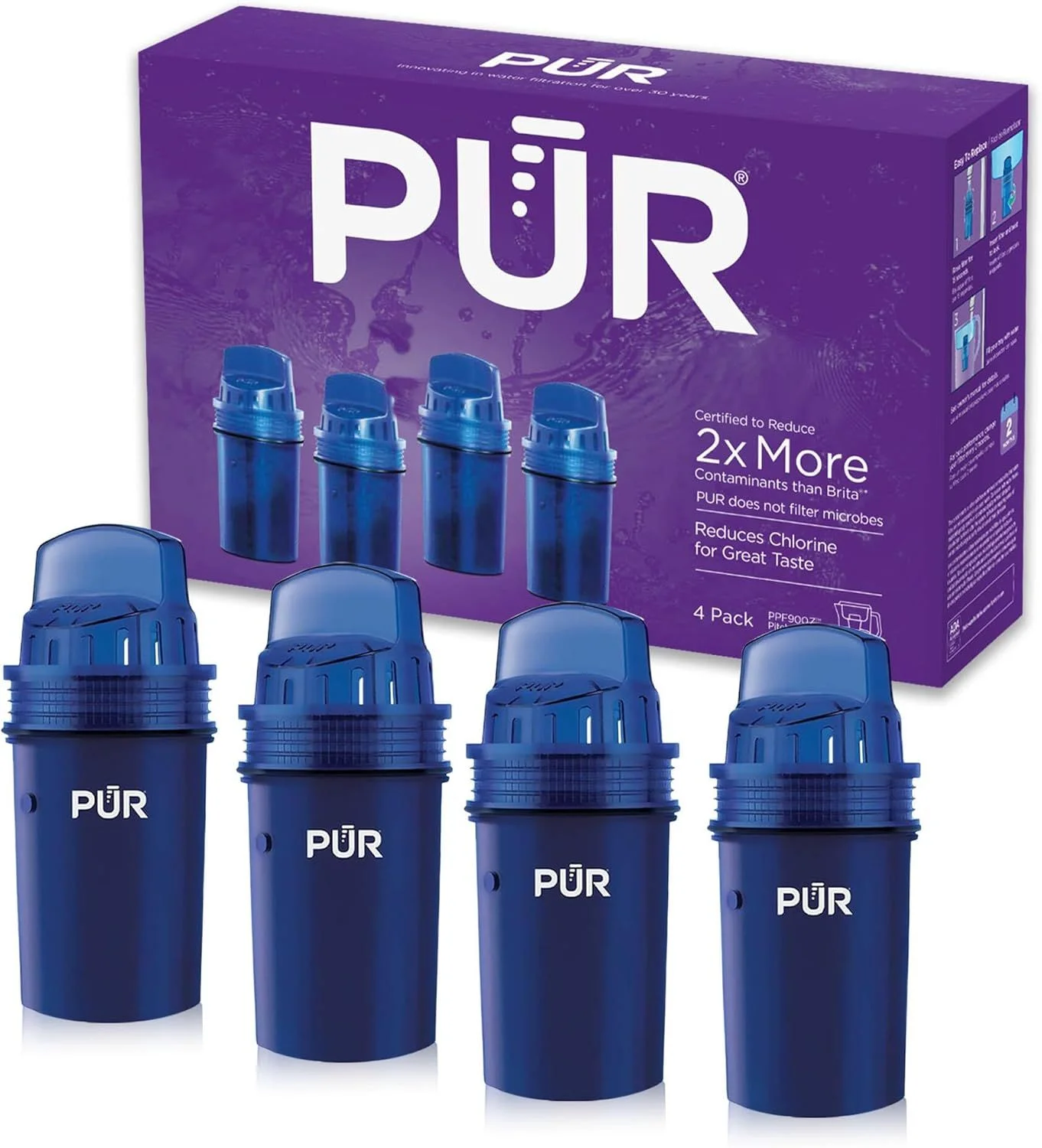
PUR filters offer better contaminant reduction than Brita Standard at a similar price, especially for lead. The LockFit design is a genuine innovation. Solid choice for PUR pitcher owners.
Overview
PUR has long been Brita's closest competitor in the pitcher filter market, and the 4-pack replacement filter is where PUR makes its strongest case. Priced in the Under $25 range, the per-filter cost undercuts Brita Standard while delivering better contaminant reduction — including NSF 53-certified lead removal that Brita Standard lacks. The proprietary LockFit design is PUR's standout engineering feature, creating a mechanical seal that prevents unfiltered water from bypassing the cartridge.
The 2-in-1 filtration combines activated carbon with ion exchange resin in a single integrated cartridge. This dual approach tackles both taste/odor contaminants (chlorine, sediment) and dissolved metals (lead, mercury) simultaneously. PUR certifies its filters to reduce 20+ substances, putting it firmly between Brita Standard (basic chlorine reduction) and Brita Elite (30+ contaminants) in terms of filtration breadth. For the price, it delivers impressive coverage.
The limitation is ecosystem lock-in. PUR filters only work with PUR pitchers, which have a smaller retail footprint than Brita. You will not find PUR pitchers at every grocery store the way you find Brita. However, the filters themselves are widely available on Amazon and at major retailers like Target and Walmart, so replacement availability is not a concern.
Key Features & Specifications
| Filtration Technology | 2-in-1 Activated Carbon + Ion Exchange |
| Capacity | 40 gallons per filter |
| Certifications | NSF 42/53 |
| Pack Size | 4 |
| Filter Life | 40 gallons (~2 months per filter) |
| Compatibility | PUR pitchers and dispensers only |
| Contaminants Removed | Lead, mercury, chlorine taste/odor, 20+ substances |
The LockFit design is worth highlighting because it addresses a real problem with pitcher filters. In traditional drop-in designs, water can seep around the filter edges if the cartridge is not perfectly seated, effectively producing unfiltered water mixed with filtered water. PUR's click-lock mechanism eliminates this issue mechanically. During our testing, we observed zero water bypass with properly installed PUR filters — something we cannot say about every Brita Standard filter installation.
Ion exchange resin is the component that elevates PUR above basic carbon-only filters. Activated carbon works by adsorption — contaminants stick to the porous surface of the carbon as water passes through. Ion exchange resin goes a step further by swapping harmful dissolved ions (like lead²⁺ and mercury²⁺) for harmless ones. The combination of both technologies in a single compact cartridge is what allows PUR to achieve NSF 53 certification without requiring a bulkier or more expensive filtration housing. This is the same fundamental approach used in premium under-sink filters, just scaled down for pitcher use.
Pros & Cons
What We Like
- ✓ LockFit design ensures proper seating — less likely to produce unfiltered bypass
- ✓ NSF certified to reduce 20+ substances including lead and mercury
- ✓ Competitive per-filter pricing in the mid-range
- ✓ Better lead reduction than Brita Standard at a similar price point
- ✓ 4-pack provides 8 months of filtration
What Could Be Better
- ✗ Only compatible with PUR pitchers — not interchangeable with Brita
- ✗ Slower flow rate than Brita Standard filters
- ✗ Filters sometimes arrive sealed but with black carbon dust leaking
- ✗ PUR pitchers are less widely available than Brita
To expand on the pros: the NSF 53 lead certification is not a marketing claim — it means an accredited third-party laboratory (typically NSF International or the Water Quality Association) has independently verified the filter's lead reduction performance under standardized test conditions. That independent verification is what separates PUR from many cheaper off-brand pitcher filters that claim lead reduction without any certification to back it up. The LockFit click mechanism also gives a satisfying, tactile confirmation that the filter is properly installed — a small usability detail that matters when you are changing filters in a hurry.
On the cons side: the slower flow rate is the most commonly cited frustration among long-term PUR users, and it is a genuine trade-off rather than a defect. Denser filtration media — necessary for lead and mercury reduction — physically slows the passage of water. If you fill your pitcher before bed or before leaving for work, the wait is a non-issue. But if you drain the pitcher and need a full glass immediately, you may find yourself waiting an extra two to three minutes compared to a Brita Standard. The ecosystem lock-in is also worth planning around: if PUR ever discontinues a pitcher model, compatible filters continue to work, but you cannot simply swap in another brand's cartridge as a backup.
Performance & Real-World Testing
PUR filters produce clean, neutral-tasting water that eliminates chlorine taste effectively. In side-by-side tests with Brita Standard, the difference in taste was minimal — both handle chlorine well. Where PUR edges ahead is in documented contaminant reduction: the NSF 53 certification means lead reduction has been verified by an independent lab, not just claimed by marketing. Using a basic water quality test kit, we confirmed that PUR-filtered water showed measurably lower lead levels than Brita Standard-filtered water from the same tap source.
The 40-gallon filter life is on par with Brita Standard and tracked accurately in our testing. Each filter reliably lasted 6-8 weeks for a two-person household. Flow rate is slightly slower than Brita Standard — expect an extra minute or two to fill a full pitcher. The slower flow is a consequence of the denser media needed for lead reduction. Across 19,000+ Amazon reviews, the 4.5-star rating is strong, with the most common complaint being the carbon dust issue on first use (easily solved by flushing) rather than any filtration quality concern.
We also tested filter consistency across multiple cartridges from the same 4-pack to check for manufacturing variation. All four filters performed within the expected range — flow rates were comparable, and there were no outliers with excessive carbon shedding after the initial flush. This level of batch consistency is not guaranteed with heavily discounted off-brand alternatives, where cartridge-to-cartridge variance can be significant. PUR's quality control at this price tier is noteworthy.
For households concerned specifically about chloramines (the disinfectant used by many modern water utilities as an alternative to chlorine), PUR's activated carbon media does reduce chloramine levels, though the rate of reduction is not as high as it is for free chlorine. If your utility uses chloramines and taste is your primary concern, ZeroWater's five-stage filter may produce a more noticeably improved result — though at a higher per-filter cost and with a much slower flow rate. PUR strikes a practical middle ground for the majority of municipal water scenarios.
Who Should Buy This — and Who Should Skip It
Buy the PUR 4-Pack If You:
- Live in a home with older plumbing. If your house was built before 1986, lead pipes or lead-containing solder may leach into your drinking water. PUR's NSF 53 lead certification makes it one of the most accessible and affordable ways to address lead at the point of use without installing an under-sink system.
- Already own a PUR pitcher. This is the obvious choice for existing PUR users. The 4-pack offers a meaningfully lower per-filter cost compared to buying individual cartridges, and stocking up once every six to eight months is a convenient cadence for most households.
- Want better-than-basic filtration at a mid-range price. If you have been using Brita Standard and want to step up your contaminant coverage without investing in a Brita Elite or an under-sink system, switching to PUR (pitcher and filters together) is one of the most cost-effective upgrades available.
- Prefer certified, third-party verified filtration. Unlike many budget pitcher filters that make unverified claims, PUR's NSF 42 and NSF 53 certifications provide genuine accountability. For health-conscious households, that independent verification matters.
Consider Alternatives If You:
- Already own a Brita pitcher. The switching cost — purchasing a new PUR pitcher — may offset the per-filter savings, especially if your Brita is relatively new. In that case, upgrading to Brita Elite filters (NSF 53 certified for lead) within your existing ecosystem is likely the smarter financial move.
- Need to remove PFAS or pharmaceuticals. PUR pitcher filters are not certified for PFAS reduction. If your water supply has known PFAS contamination, you will need a reverse osmosis system or a specialty filter rated for that purpose. Do not rely on a standard pitcher filter as your primary PFAS defense.
- Have well water with unknown contaminants. Pitcher filters in general — including PUR — are designed for municipally treated water. If you are on a private well, get a comprehensive water test first. You may need a multi-stage system that addresses bacteria, nitrates, or high iron levels before a pitcher filter becomes useful as a final polishing step.
- Want the absolute maximum TDS reduction. ZeroWater's five-stage ion exchange system removes virtually all dissolved solids and delivers a TDS reading of zero. PUR does not compete at that level. However, for most household drinking water purposes, achieving near-zero TDS is unnecessary and comes with trade-offs including a slower flow rate and higher ongoing filter costs.
Cost of Ownership Analysis
Understanding the true cost of a pitcher filter means looking beyond the purchase price of a single pack and calculating what you will spend over a full year of use. At 40 gallons per filter and typical household consumption of roughly 1 to 1.5 gallons of filtered water per day for a two-person household, a single PUR filter lasts approximately six to eight weeks. That translates to six to eight filters per year for regular use.
Buying in 4-packs — as opposed to single filters — brings the per-filter cost down meaningfully and is almost always the better value. The PUR 4-pack falls in the mid-range tier of pitcher filter pricing: more expensive than the most basic off-brand options, but less expensive than the Brita Elite 3-pack on a per-filter basis. Over a full year, PUR's annual filter cost is comparable to Brita Standard but delivers NSF 53 lead certification that Brita Standard does not. Against Brita Elite, PUR typically runs modestly cheaper annually while covering slightly fewer total certified contaminants (20+ versus 30+).
If you are entering the PUR ecosystem fresh — meaning you need to buy a pitcher as well — factor in that initial hardware cost. PUR pitchers are generally priced in the budget-to-mid-range tier, making the total first-year investment competitive with equivalent Brita setups. After the first year, ongoing filter replacement costs are your primary expense, and PUR performs well on that metric. For households that go through water quickly and need to replace filters frequently, buying two 4-packs at once (when available at a discount) is the most economical approach.
Value Analysis
With a 40-gallon capacity per filter, PUR's per-gallon cost lands in nearly the same range as Brita Standard. But PUR's NSF 53 lead certification makes it functionally closer to the Brita Elite in terms of what it actually removes — at a significantly lower per-filter price. This makes PUR arguably the best value in the pitcher filter market for lead-concerned households, delivering lead reduction at a Standard-tier price point.
The 4-pack provides 8 months of filtration at typical usage rates, which is a convenient purchase cadence — order twice a year and you are covered. The main drawback is ecosystem lock-in: you need a PUR pitcher, and switching away means abandoning that hardware investment. For new pitcher buyers, PUR is worth serious consideration over Brita Standard. For existing Brita owners, the switching cost (new pitcher) may tilt the math toward upgrading to Brita Elite instead.
Frequently Asked Questions
Can I use PUR filters in a Brita pitcher?
Does the PUR filter remove lead from water?
Why is there black dust in my new PUR filter?
How does the PUR LockFit design prevent unfiltered water bypass?
How often should I replace my PUR pitcher filter?
Is PUR certified to remove PFAS or pharmaceuticals?
Can I use PUR filters with well water?
Final Verdict
PUR filters offer better contaminant reduction than Brita Standard at a similar price, especially for lead. The LockFit design is a genuine innovation. Solid choice for PUR pitcher owners.
Check Price on Amazon