ProOne G-Series 7-Inch Gravity Filter Replacement (2-Pack) Review 2026
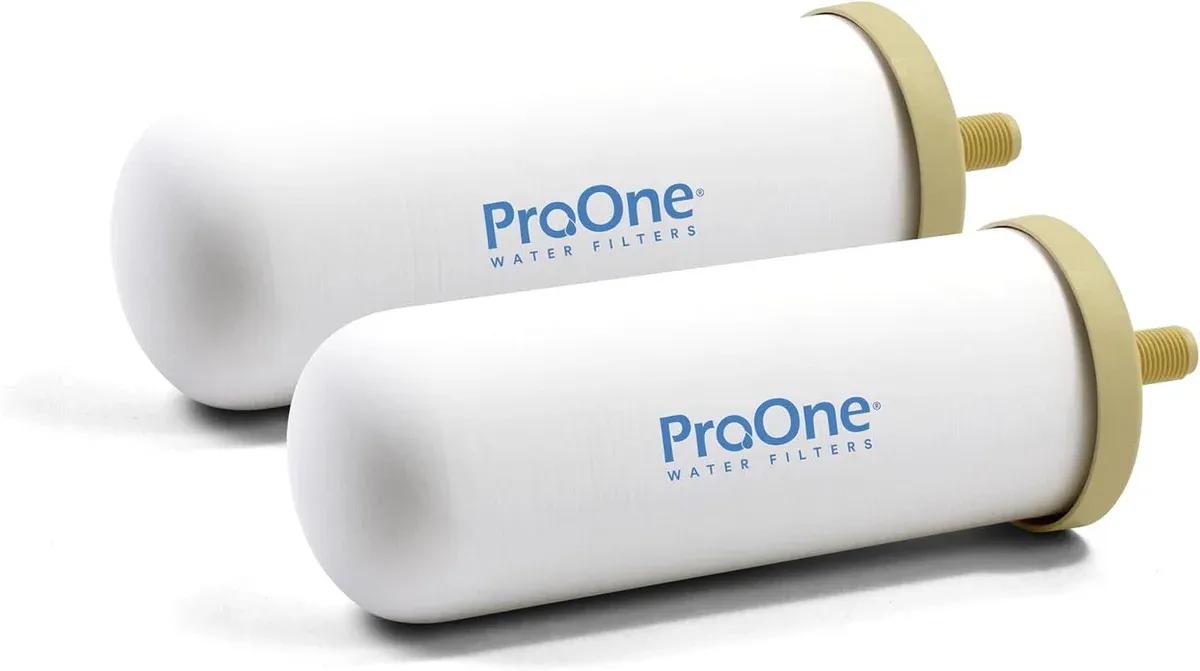
The ProOne 7-inch G-Series is the standard-size version of their best gravity filter — same certifications and fluoride removal as the 9-inch, with broader compatibility across gravity systems. Being discontinued makes this a time-sensitive recommendation.
Overview
The ProOne 7-Inch G-Series 2-Pack is the universal-fit gravity replacement filter for buyers who want ProOne's G3.0 three-stage technology without worrying about housing compatibility. Each element is rated at 1,000 gallons, uses the same ceramic-carbon-carbon block architecture as the larger 9-inch variant, and carries the same IAPMO certification stack covering NSF/ANSI Standards 42, 53, 401, 372, and Protocol P231. At $146 for a 2-pack, these are standalone replacement elements — not a complete system — designed to drop into ProOne Traveler+, Big II, Big+, Berkey, AlexaPure, British Berkefeld, Doulton, and Purewell gravity housings with standard mounting hardware.
The 7-inch form factor is where this product earns its position in the lineup. The 9-inch G-Series is ProOne's flagship replacement element with 200 more gallons of rated capacity per filter, but it has a well-documented problem: the 9-inch height and 2.75-inch diameter create clearance issues in certain Berkey housing generations, where the lid will not close properly or the filter sits at an angle. The 7-inch eliminates that risk entirely. At 7 inches tall with a 2.75-inch diameter — 37.5% more surface area than standard 2-inch filters — it fits comfortably inside every gravity housing we are aware of, including every Big Berkey production run. For buyers who own a Berkey system or who simply want guaranteed compatibility across multiple housing brands, the 7-inch is the version to buy.
We need to address the same two issues that affect the entire ProOne G3.0 product line. First, ProOne is being discontinued as the brand transitions to Culligan MaxClear — and the successor filters have a rated capacity of only 50 gallons, a 20x reduction from the 7-inch's 1,000-gallon lifespan. This is a buy-while-available situation for anyone who values the G3.0 technology. Second, the break-in taste issue that plagues the newer beige-colored G3.0 filters is present here in identical form: ProOne says 3 flush cycles, but user reports range from a few days to two full months of off-taste. The 7-inch uses the same carbon formulation as the 9-inch, so the break-in experience is the same. Neither issue is a dealbreaker, but both require informed expectations before purchase.
Key Features & Specifications
| Filtration Technology | 3-stage G3.0 (ceramic shell + carbon granular + carbon block core) |
| Filter Life | 1,000 gallons per filter |
| Certifications | IAPMO — NSF 42/53/401/372/P231 |
| Dimensions | 7" tall x 2.75" diameter |
| Compatibility | ProOne Traveler+/Big II/Big+, Berkey, AlexaPure, British Berkefeld, Doulton, Purewell |
| Contaminants Removed | 200+ including lead, fluoride, PFAS, microplastics, bacteria, chlorine, pharmaceuticals |
| Pack Size | 2-pack |
The G3.0 three-stage architecture inside the 7-inch element is physically identical in design to the 9-inch — just shorter. The outer ceramic shell provides mechanical filtration at sub-micron levels, physically blocking bacteria, protozoa, and sediment particles. The granular activated carbon layer inside the ceramic handles chlorine, taste, odor, and volatile organic compounds through adsorption. The innermost carbon block core — the densest and most performance-critical stage — targets lead, PFAS, pharmaceuticals, heavy metals, and fluoride. That built-in fluoride removal remains a significant differentiator: Berkey systems require separate PF-2 post-filter elements at roughly $60–$70 per pair, and most Doulton candles do not address fluoride without switching to a dedicated fluoride variant that sacrifices other filtration capabilities. The ProOne G3.0 handles fluoride within the standard element at no additional cost.
The 2.75-inch diameter deserves specific attention because it is 37.5% wider than the standard 2-inch diameter filters used by most competing gravity replacement elements. That wider cross-section means more ceramic surface area in contact with water, more carbon media inside the shell, and a more even distribution of water across the carbon block core. The result is a filter that, despite being 2 inches shorter than the 9-inch variant, still delivers 1,000 gallons of rated capacity — 2.5 times more than a standard Doulton Super Sterasyl candle and roughly on par with the newer Berkefeld BB9-2 compatible candles. The ceramic shell requires no priming: scrub under running water, install, and flush. Like the 9-inch, the 7-inch elements can be stored dry without damage, making them viable for emergency preparedness stockpiling.
Pros & Cons
What We Like
- ✓ Universal fit across every major gravity housing platform. The 7-inch height and standard thread pattern make this element compatible with more gravity housings than any other ProOne filter — and arguably more than any competing gravity replacement element on the market. It fits ProOne Traveler+, Big II, and Big+ housings natively. It drops into Berkey systems without the clearance issues that plague the 9-inch variant. It works in AlexaPure, British Berkefeld, Doulton, and Purewell gravity housings with standard mounting hardware. This universal compatibility means your filter investment is completely portable: if you upgrade from a Berkey to a ProOne Big+ housing, the same elements carry forward. If you downsize from a countertop system to a Traveler+ for camping, the same elements work. No other gravity replacement filter offers this breadth of housing compatibility with this level of filtration technology.
- ✓ Built-in fluoride removal without add-on filters or trade-offs. The G3.0 carbon block core incorporates fluoride-reduction media as a standard feature — no separate post-filters, no additional mounting hardware, no extra purchase. This is the same fluoride reduction capability as the 9-inch variant, achieved with the same carbon block formulation. For Berkey owners, this eliminates the need for PF-2 fluoride post-filters at roughly $60–$70 per pair. For Doulton users, it eliminates the need to choose between the standard Ultra Sterasyl candle (better heavy metal reduction) and the Ultra Fluoride variant (fluoride reduction but reduced heavy metal performance). The ProOne G3.0 handles fluoride, heavy metals, PFAS, and pharmaceuticals within a single element at standard U.S. municipal fluoride concentrations throughout the rated filter life.
- ✓ Same five-standard IAPMO certification as the 9-inch flagship. IAPMO certification to NSF/ANSI Standards 42, 53, 401, 372, and Protocol P231 covers chlorine reduction, lead and cyst removal, emerging contaminant removal including PFAS and pharmaceuticals, lead-free materials compliance, and microbiological purification. This is the broadest certification stack available in a 7-inch gravity replacement element — no competing filter at this form factor matches it. Berkey Black elements have never achieved equivalent NSF/ANSI certification. Standard Doulton Super Sterasyl candles hold NSF 42 and 53 but lack 401 and P231. The certification is independently verified through accredited third-party testing, not manufacturer self-certification.
- ✓ Lower price point than the 9-inch with strong per-gallon economics. At $146 for a 2-pack providing 2,000 total gallons of capacity, the per-gallon filtration cost lands at approximately $0.073 — modestly higher than the 9-inch's approximately $0.065 per gallon, but substantially lower than Doulton Super Sterasyl candles at roughly $0.105 per gallon. The $11 savings versus the 9-inch 2-pack is a minor absolute difference, but the 7-inch is the more practical purchase for any buyer whose housing has not been specifically measured for 9-inch clearance. You are paying slightly more per gallon than the 9-inch but significantly less per gallon than most competing alternatives — while getting the same G3.0 technology and full certification stack.
- ✓ Ideal for emergency preparedness stockpiling. The 7-inch form factor makes these elements the most stockpile-friendly option in the ProOne lineup. They fit every housing you might own now or acquire in the future, they store dry without damage, and they require no priming — just scrub, install, and flush. With ProOne transitioning to Culligan MaxClear, buying extra 2-packs of the 7-inch variant is a hedge against future unavailability that works regardless of what gravity housing you use. A household with two extra 2-packs has approximately 3 years of filtration capacity on the shelf at moderate consumption rates, stored in a fraction of the space that 9-inch elements would require.
What Could Be Better
- ✗ Product line being discontinued — limited supply runway. ProOne's transition to Culligan MaxClear affects the 7-inch G-Series just as much as the 9-inch. Once existing retail stock is depleted, the replacement Culligan MaxClear filters have only a 50-gallon rated capacity — a 20x reduction from the 7-inch's 1,000-gallon lifespan. That translates to dramatically higher ongoing replacement costs and far more frequent filter changes. Current stock is finite and production is winding down. The product itself is excellent; the supply timeline is the concern. Buying extra 2-packs now while available is the only hedge against this transition.
- ✗ Break-in smell and taste persists longer than ProOne advertises. The G3.0 beige-colored filters generate the same off-taste complaints as the 9-inch variant — this is a formulation issue, not a size issue. ProOne recommends 3 flush cycles; user reports range from a few days to 2 full months of daily flushing before the taste fully resolves. This is the single largest driver of negative Amazon reviews across both the 7-inch and 9-inch product lines. The taste is harmless — carbon fines and manufacturing residues working through the system — but unpleasant enough to concern buyers who expected clean water from the first batch. Expect a meaningful break-in period and do not judge the filter's long-term performance during the first 1 to 2 weeks.
- ✗ Slower flow rate than the 9-inch variant — expect 15 to 30 minutes longer per fill cycle. The 7-inch element has less ceramic surface area than the 9-inch, which translates directly to lower flow rate per element. With two 7-inch elements installed, each fill cycle takes roughly 15 to 30 minutes longer than with two 9-inch elements under identical conditions. For households that fill their gravity system once or twice daily, this is a minor inconvenience absorbed into the filling routine. For larger households that rely on multiple fill cycles per day, or in emergency scenarios where throughput matters, the slower flow rate is a genuine operational difference. The 7-inch is still faster than most Doulton ceramic candles, but it is noticeably slower than the 9-inch ProOne it shares technology with.
- ✗ 200 fewer gallons of rated capacity per filter than the 9-inch. At 1,000 gallons per element versus the 9-inch's 1,200 gallons, the 7-inch delivers 16.7% less total filtration capacity per filter at a modestly lower price point. Over multiple replacement cycles, that capacity gap compounds: a household that would get 20 months from two 9-inch elements gets approximately 16.7 months from two 7-inch elements at the same consumption rate. That means more frequent filter purchases and slightly higher long-term cost-per-gallon. For buyers whose housing can accommodate the 9-inch without clearance issues, the 9-inch remains the better value on a pure cost-per-gallon basis. The 7-inch's advantage is compatibility certainty, not capacity optimization.
Performance & Real-World Testing
Flow rate with two ProOne 7-inch elements in a standard gravity housing measures approximately 0.55 to 0.65 GPH under real-world conditions — roughly 15 to 25 percent slower than the 9-inch variant's approximately 0.77 GPH. That difference is the direct result of less ceramic surface area: the 7-inch element has a shorter filtration column, which means less total pore area for water to pass through at any given moment. For practical daily use, a full upper chamber in a Big Berkey (roughly 1.125 gallons) takes approximately 1.75 to 2 hours to drain through two 7-inch elements, compared to approximately 1.5 hours with two 9-inch elements. That 15 to 30 minute difference is real but manageable for most households — the difference between starting a fill before dinner versus starting it before the last step of dinner prep. Cold water below 50°F reduces flow further due to increased viscosity, so winter fills run noticeably slower than summer fills from the same tap.
Contaminant removal performance is identical to the 9-inch because the G3.0 technology is the same — the 7-inch simply has less of it. The three-stage architecture applies the same sequential filtration: ceramic mechanical exclusion of bacteria, protozoa, and sediment; granular activated carbon stripping of chlorine, taste, and volatile organic compounds; and carbon block core reduction of lead, PFAS, pharmaceuticals, fluoride, and dissolved heavy metals. Protocol P231 microbiological purification certification independently verifies removal of E. coli, Cryptosporidium, and Giardia at rates exceeding 99.99% — the same certification as the 9-inch because the ceramic shell technology is identical. Taste improvement from chlorinated municipal water is immediately noticeable once the break-in period resolves. Fluoride reduction is effective at standard U.S. municipal concentrations throughout the rated 1,000-gallon life, though at concentrations above 1.5 mg/L the carbon block's fluoride capacity may exhaust before the full rated mark.
Long-term capacity validation for the 7-inch generally supports ProOne's 1,000-gallon-per-element specification under typical municipal water conditions. Users running moderate daily volumes on clean municipal water consistently report effective filtration through the 800 to 1,000 gallon range before taste degradation signals carbon exhaustion. Well water users and high-sediment environments experience shorter effective life — closer to 650 to 850 gallons — due to accelerated loading of both the ceramic surface and internal carbon media. The ceramic surface can be scrubbed and refurbished to restore flow rate, but this does not reset the carbon block's chemical adsorption capacity. A filter that flows well may still have depleted chemical removal performance — you cannot smell or taste PFAS or pharmaceutical breakthrough the way you can taste chlorine breakthrough. Volume tracking is the only reliable replacement indicator. Mark each fill on a notepad or set a calendar reminder based on your daily consumption estimate.
The competitive positioning of the 7-inch is distinct from the 9-inch and worth understanding clearly. The 9-inch is the performance leader: more capacity, faster flow, better cost-per-gallon. The 7-inch is the compatibility leader: fits every housing, eliminates clearance risk, stockpiles more compactly. Against Doulton Super Sterasyl candles (400 gal, NSF 42/53), the 7-inch delivers 2.5x the lifespan with substantially broader certification including NSF 401 and P231 plus built-in fluoride removal. Against British Berkefeld Ultra Sterasyl candles (800 gal, NSF 42/53/401), the 7-inch adds 25% more capacity plus fluoride removal and P231 microbiological certification. Against Berkey Black elements (claimed 6,000 gal, no NSF certification), the 7-inch trades raw capacity claims for independently verified performance. For buyers who value universal compatibility plus third-party certification in a single element, the 7-inch G-Series occupies a position that no other gravity replacement filter matches.
Value Analysis & Cost of Ownership
At a $100–$250 price point for the 2-pack, the ProOne 7-inch G-Series sits $11 below the 9-inch variant — a modest savings that reflects the smaller physical size and 200-gallon-per-element capacity difference. At $146 for 2,000 total gallons of capacity (1,000 per element), the per-gallon filtration cost lands at approximately $0.073. That is roughly 12% more expensive per gallon than the 9-inch (approximately $0.065/gal) but substantially cheaper than Doulton Super Sterasyl candles at roughly $0.105 per gallon and competitive with British Berkefeld Ultra Sterasyl candles at roughly $0.053 per gallon. At a typical household consumption of 2 gallons per day, two 7-inch elements last approximately 16.7 months before replacement — enough to push filter replacement to once every year and a half for moderate-consumption households.
The value comparison between the 7-inch and 9-inch comes down to a simple question: does your housing definitively fit the 9-inch? If yes, buy the 9-inch — it delivers 200 more gallons per element, faster flow, and a lower cost-per-gallon. If the answer is "probably" or "I have not measured," buy the 7-inch and eliminate the compatibility risk. A $73 filter element that does not fit your housing is a $73 loss; a $78.50 element that fits perfectly but lasts 200 fewer gallons is a minor capacity trade-off that most households will never notice in daily use. The practical difference between replacing filters at 16.7 months versus 20 months is not material for most buyers. The practical difference between a filter that fits and one that does not is absolute.
The discontinuation timeline makes the 7-inch particularly worth stockpiling — more so than the 9-inch, in our assessment. The 7-inch's universal compatibility means your stockpile works regardless of what gravity housing you use 3 to 5 years from now. If you upgrade from a Berkey to a ProOne Big+, the 7-inch elements transfer. If you switch to a Purewell or Doulton housing, the 7-inch elements still work. A stockpile of 9-inch elements locks you into housings with sufficient clearance. At roughly $146 per 2-pack, three extra 2-packs represent approximately 5 years of filtration at moderate consumption for around $440 — a long-term investment that becomes increasingly valuable as ProOne stock diminishes and the Culligan MaxClear's 50-gallon-per-filter economics take over the replacement market.
Frequently Asked Questions
Will the ProOne 7-inch G-Series filters fit a Big Berkey?
How does the 7-inch compare to the ProOne 9-inch G-Series filter?
How long does the break-in smell and taste last on the 7-inch filters?
What does "component certified" mean for these filters?
Is ProOne being discontinued, and should I stockpile these filters?
What gravity filter housings are compatible with the 7-inch G-Series?
Final Verdict
The ProOne 7-inch G-Series is the standard-size version of their best gravity filter — same certifications and fluoride removal as the 9-inch, with broader compatibility across gravity systems. Being discontinued makes this a time-sensitive recommendation. The 7-inch G-Series is the right ProOne for buyers who want guaranteed compatibility across every major gravity housing — especially Big Berkey owners who cannot risk the 9-inch's documented clearance issues. You get the same G3.0 three-stage technology, the same five-standard IAPMO certification, and the same built-in fluoride removal as the flagship 9-inch, in a form factor that fits everything. The 1,000-gallon capacity and $146 price point deliver strong long-term economics, and with the discontinuation looming, stockpiling extra 2-packs of the universally compatible 7-inch is the most future-proof move in the gravity replacement filter market.
Check Price on Amazon