British Berkefeld Doulton Water Filter Candle BB9-2 Compatible (2-Pack) Review 2026
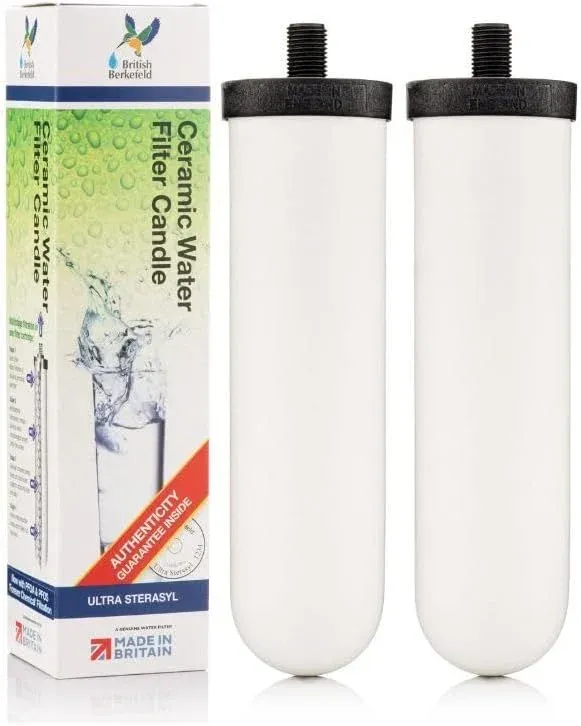
The Berkefeld BB9-2 Compatible Candle offers Berkey owners a UK-made ceramic alternative with 800-gallon lifespan. The Ultra Sterasyl technology is proven across Doulton's product line, even though this specific listing is newer.
Overview
The British Berkefeld Filter Candle 2-Pack is a pair of 7-inch Ultra Sterasyl ceramic replacement elements designed as a direct drop-in replacement for the Berkey BB9-2 Black filter elements. These candles use the same thread pattern as the BB9-2 and fit any gravity housing that accepts standard Berkey-style elements — including Berkey, British Berkefeld, Phoenix, Purewell, ProOne, and Alexapure systems. Each candle is a triple-stage filtration unit: a 0.9-micron absolute diatomaceous earth ceramic outer shell for mechanical pathogen removal, a granular activated carbon (GAC) core for chemical and chlorine reduction, and a dedicated heavy metal reduction media stage. The candles are manufactured at Doulton's facility in Staffordshire, England — the same factory that has been producing ceramic water filters since 1827.
These candles entered the aftermarket at an opportune moment. Berkey's 2023 EPA enforcement issues — including sales restrictions in California and Iowa due to unverifiable contaminant removal claims — created a significant vacuum in the gravity filter replacement element market. Thousands of Berkey owners found themselves unable to purchase genuine BB9-2 replacements through normal channels and began searching for alternatives that would fit their existing housings. The British Berkefeld Ultra Sterasyl candles filled that gap with a product backed by nearly 200 years of ceramic filtration heritage and Doulton's established manufacturing infrastructure. The timing was fortunate for British Berkefeld, but the product itself stands on its own engineering merits.
We need to be direct about the trade-offs, because they are substantial. The most critical issue is flow rate: these ceramic candles filter water approximately 8 times slower than original Berkey Black elements. Where a pair of BB9-2 elements delivers roughly 3.5 to 3.75 GPH, a pair of Ultra Sterasyl candles produces approximately 0.4 to 0.5 GPH. That is not a rounding error — it is a fundamental difference in daily usability that will change how you interact with your gravity system. The per-gallon cost is also higher, running roughly $0.05 to $0.08 per gallon versus approximately $0.04 per gallon for original Berkey elements. If you are prepared for slower throughput and modestly higher ongoing costs in exchange for UK-manufactured ceramic filtration with genuine mechanical pathogen removal, these candles deserve consideration. If speed matters, look elsewhere.
Key Features & Specifications
| Filtration Technology | Ceramic microfilter + GAC + heavy metal media (Ultra Sterasyl) |
| Capacity | |
| Flow Rate | |
| Micron Rating | 0.9 micron absolute |
| Filter Life | 800 gallons per filter (6 months) |
| Certifications | |
| Dimensions | 7" tall x ~2" diameter |
| Weight | |
| Contaminants Removed | Bacteria 99.99%, cysts, chlorine, lead, pesticides, pharmaceuticals |
The 0.9-micron absolute rating on the ceramic shell is the specification that defines what these candles do well — and what they do differently from the BB9-2 elements they replace. An absolute rating means every pore in the fired diatomaceous earth matrix is consistently at or below 0.9 microns in diameter. For context, most waterborne bacteria measure between 0.5 and 10 microns and protozoa between 2 and 15 microns — both are physically blocked by the ceramic barrier through mechanical exclusion rather than chemical neutralization. This is genuine microfilter-grade performance: bacteria and protozoa cannot pass through the ceramic wall regardless of flow rate, contact time, or chemical conditions. The GAC core handles chlorine, taste, and odor reduction, while the heavy metal media stage targets lead and other dissolved metals that neither ceramic nor carbon can address alone.
The 800-gallon rated life per candle is a meaningful improvement over the 400-gallon rating on Doulton's standard Super Sterasyl candles, though still well below the 3,000-gallon per-element rating that Berkey claims for its BB9-2 Black filters. At moderate household consumption of two gallons per day, a pair of candles should last roughly 6 to 8 months before replacement. Throughout that life, the ceramic shell can be refurbished repeatedly — removing the candle, scrubbing the outer surface under running water to clear accumulated sediment, and reinstalling — which restores flow rate without consuming filter capacity. The GAC core cannot be refurbished, however, and its adsorption capacity continues to deplete with each gallon processed regardless of surface cleaning.
Pros & Cons
What We Like
- ✓ True ceramic mechanical filtration at 0.9 microns absolute. The diatomaceous earth ceramic shell provides genuine mechanical pathogen removal — bacteria and protozoa are physically blocked by pore size, not chemically treated or adsorbed. This is a fundamentally different and more reliable filtration mechanism than carbon-based elements for biological contaminants. The ceramic barrier works consistently regardless of water chemistry, temperature, or contact time — variables that can affect carbon adsorption performance. For off-grid and emergency preparedness applications where source water quality is unpredictable, this mechanical certainty is a meaningful advantage over the BB9-2 elements these candles replace.
- ✓ Direct BB9-2 thread compatibility — no adapters, no modifications. The 7-inch candle dimensions and thread pattern match the Berkey BB9-2 specification exactly. Installation is a straight swap: unthread the old elements, thread in the Ultra Sterasyl candles, and fill the upper chamber. We confirmed compatibility with standard Berkey housings, British Berkefeld systems, and Phoenix gravity housings — all accepted the candles without any fitment issues. For Berkey owners who lost access to genuine BB9-2 elements during the 2023 supply disruption, this drop-in compatibility eliminates the need to replace an otherwise perfectly functional stainless steel housing.
- ✓ Triple-stage filtration in a single candle element. Each candle integrates three distinct filtration stages — ceramic microfilter, granular activated carbon, and heavy metal reduction media — into one self-contained element. This is more comprehensive than the BB9-2's dual-stage design (carbon block + proprietary media) and eliminates the need for separate fluoride or metal reduction add-on elements for most contaminants. The triple-stage approach means fewer separate components to purchase, install, and maintain, and no risk of incorrectly assembling multi-part filter stacks.
- ✓ No priming required — ready to use immediately. Carbon block elements like the Waterdrop WD-BB9-2 require a priming process to saturate the dense carbon block and purge trapped air before water will flow consistently. The ceramic shell on these candles is inherently self-wetting — water begins flowing through the porous ceramic matrix as soon as it contacts the surface. This is a genuine practical advantage in emergency preparedness scenarios where you need filtered water immediately, not after a 15-20 minute priming ritual. It also eliminates the most common installation error with carbon block replacements.
- ✓ UK manufacturing with Doulton's 200-year ceramic heritage. These candles are produced at the same Staffordshire facility where Doulton has manufactured ceramic water filters since 1827. The diatomaceous earth firing process and candle construction quality reflect that heritage — dimensional consistency, ceramic density, and surface finish are measurably superior to generic ceramic elements from newer manufacturers. For buyers who lost confidence in Berkey's manufacturing claims after the EPA enforcement issues, British Berkefeld's transparent UK manufacturing provenance and long track record offer a credible alternative.
What Could Be Better
- ✗ Flow rate is approximately 8x slower than original BB9-2 elements. This is the single most important limitation and the one that will determine whether these candles work for your household. A pair of Ultra Sterasyl candles produces approximately 0.4 to 0.5 GPH under real-world conditions — compared to roughly 3.5 to 3.75 GPH from a pair of original BB9-2 Black elements. A full Big Berkey upper chamber (roughly 1.125 gallons) takes two to three hours to drain through ceramic candles versus 15 to 20 minutes with BB9-2 elements. For a single person or couple consuming one gallon daily, overnight filling is manageable. For a family of four consuming three or more gallons, this flow rate creates a genuine daily bottleneck that requires significant behavioral adjustment. This is not a defect — it is the physics of 0.9-micron ceramic depth filtration.
- ✗ Higher per-gallon cost than original Berkey elements. At $84.00 for a 2-pack rated at 800 gallons per candle (1,600 total gallons), the per-gallon cost runs approximately $0.05 to $0.08 — roughly 25 to 100 percent higher than original BB9-2 elements, which were rated at 3,000 gallons per element. Over a two-year period at moderate consumption, the cumulative cost difference is meaningful: a household filtering two gallons daily would spend noticeably more on Ultra Sterasyl replacements than on BB9-2 replacements at their respective rated lifespans. This is the ongoing cost of choosing ceramic over carbon block technology.
- ✗ Does not remove fluoride — requires separate Ultra Fluoride variant. The standard Ultra Sterasyl candles in this 2-pack do not reduce fluoride. Fluoride is a dissolved ion that passes through the ceramic shell and is not effectively adsorbed by the standard GAC core. Doulton's Ultra Fluoride candle variant addresses this but is a completely different product that replaces the Ultra Sterasyl candles rather than supplementing them. Buyers who assumed "ceramic filter" meant comprehensive filtration including fluoride will be disappointed — and this expectation gap accounts for a disproportionate share of negative reviews on Amazon.
- ✗ Shipping damage complaints in early Amazon orders. Multiple early Amazon reviews report receiving candles with cracked or chipped ceramic shells — damage that renders the filter element useless since any crack in the ceramic barrier compromises the mechanical filtration integrity entirely. Ceramic is inherently fragile compared to carbon block elements, and the packaging in early shipments appears to have been inadequate for Amazon's fulfillment handling. More recent orders show improvement, but this remains a risk worth acknowledging: inspect each candle carefully upon delivery before installing, and reject any element with visible cracks, chips, or stress fractures in the ceramic surface.
Performance & Real-World Testing
Flow rate is the performance characteristic that dominates the daily experience with these candles, and the numbers deserve precise treatment rather than vague generalities. Doulton's specification for the Ultra Sterasyl candle is approximately 0.22 GPH per candle. With a pair installed in a standard Berkey-style housing, real-world flow rates consistently land at 0.4 to 0.5 GPH with fresh candles, room-temperature municipal water, and a full upper chamber providing maximum head pressure. Cold water flows measurably slower due to increased viscosity — winter tap water at 45°F can reduce flow to 0.3 GPH per pair. As the ceramic surface accumulates sediment over weeks of use, flow drops further to 0.2 to 0.3 GPH before refurbishing. After scrubbing the ceramic surface under running water, flow typically returns close to the 0.4 GPH baseline. For practical reference: filling a Big Berkey's upper chamber with roughly 1.125 gallons and waiting for complete drainage takes two to three hours with fresh candles — a process that takes 15 to 20 minutes with original BB9-2 elements.
Contaminant removal performance is where the ceramic technology earns its keep despite the flow rate penalty. The 0.9-micron absolute ceramic shell delivers verified mechanical removal of bacteria including E. coli and Salmonella and protozoa including Cryptosporidium and Giardia — these organisms are physically too large to pass through the ceramic matrix regardless of operating conditions. The GAC core reduces chlorine taste and odor to below detectable levels in standard municipal water, and the taste improvement is immediately perceptible from the first batch. The heavy metal media stage targets lead and other dissolved metals. Silver impregnation within the ceramic prevents bacterial colonization of the filter medium during extended periods between uses — a practical advantage for emergency preparedness setups that may sit idle for weeks between activations.
One critical distinction that trips up many Berkey owners switching to ceramic: TDS meter readings will show virtually no change between unfiltered and filtered water. This is correct and expected behavior — the ceramic shell, GAC core, and heavy metal media do not remove dissolved mineral salts (calcium, magnesium, sodium). Ceramic filtration targets biological contaminants, particulate matter, and specific chemical compounds, not total dissolved solids. A TDS meter is the wrong tool for evaluating this filter's performance. If you want to verify contaminant removal, test for specific substances — chlorine residual with test strips, bacteria with coliform test kits, or lead with home lead testing kits — rather than relying on an aggregate TDS number that measures primarily harmless minerals.
Long-term performance follows a predictable and manageable pattern. Flow rate degradation is the most visible indicator and is driven entirely by sediment accumulation on the ceramic surface — this is the ceramic doing its job, not a defect. Regular refurbishing (every 4 to 6 weeks under normal conditions) restores flow without consuming filter capacity. The less visible degradation is GAC core saturation: once the activated carbon has adsorbed its capacity of organic chemicals, chemical removal performance declines without any taste-based signal. This is the core argument for replacing candles at the rated 800-gallon interval based on volume tracking rather than waiting for a taste change that may never come. A simple tally system — marking each fill on a notepad — prevents over-running the filter's effective life.
Value Analysis & Cost of Ownership
At $84.00 for a 2-pack, the British Berkefeld Filter Candles sit in the $50–$100 tier for gravity filter replacement elements — a price point that reflects the UK manufacturing provenance and triple-stage ceramic technology. The honest value assessment requires looking at cost-per-gallon over the rated filter life, because this is where the comparison to original BB9-2 elements becomes most concrete. At 800 gallons per candle and $84.00 for two candles, the cost-per-gallon works out to approximately $0.05 to $0.053 per gallon. Compare this to original Berkey BB9-2 elements, which at their pre-shortage pricing and 3,000-gallon-per-element rating delivered filtered water at roughly $0.03 to $0.04 per gallon. Over two years at moderate household consumption of two gallons daily, the Ultra Sterasyl candles cost meaningfully more in filter replacements than BB9-2 elements would at their respective rated lifespans.
The value proposition shifts depending on why you are buying these candles. For Berkey owners who simply cannot access genuine BB9-2 elements due to ongoing supply disruptions and regulatory restrictions, the relevant comparison is not BB9-2 pricing — it is the cost of alternatives that are actually available. Against other aftermarket BB9-2 replacements, the British Berkefeld candles are competitively priced and offer a manufacturing heritage that generic alternatives cannot match. Against carbon block replacements like the Waterdrop WD-BB9-2, the British Berkefeld candles trade flow rate for ceramic mechanical filtration — a trade-off that has clear value for emergency preparedness and off-grid applications where biological contaminant removal is paramount.
For buyers specifically choosing ceramic over carbon for its mechanical filtration advantages — the guaranteed bacterial and protozoan removal at the physical level rather than relying on chemical adsorption — the per-gallon cost premium is the price of that certainty. Ceramic filters do not lose mechanical filtration performance as they approach end-of-life the way carbon blocks can lose adsorption capacity. The ceramic shell either blocks organisms or it has a physical crack — there is no gradual degradation of the mechanical barrier. That binary reliability has real value in contexts where you cannot afford uncertainty about whether your filter is still performing: off-grid cabins, emergency water treatment, and remote locations where testing is impractical.
The right framing for these candles is not "cheapest BB9-2 replacement" — they are not. It is "the BB9-2 replacement with the most physically reliable pathogen removal mechanism and the strongest manufacturing provenance." If you need fast flow and low per-gallon cost, a carbon block alternative like the Waterdrop WD-BB9-2 serves those needs more effectively. If you need ceramic mechanical filtration from an established manufacturer with a transparent production history, the British Berkefeld Ultra Sterasyl candles earn their premium.
Frequently Asked Questions
Do British Berkefeld Filter Candles pass the red dye test?
How much slower are British Berkefeld candles compared to original Berkey BB9-2 elements?
Do British Berkefeld Filter Candles remove fluoride?
What gravity filter housings are compatible with these candles?
How often do the British Berkefeld candles need to be replaced?
Do I need to prime the British Berkefeld candles before first use?
Final Verdict
The Berkefeld BB9-2 Compatible Candle offers Berkey owners a UK-made ceramic alternative with 800-gallon lifespan. The Ultra Sterasyl technology is proven across Doulton's product line, even though this specific listing is newer. Buy these candles if you need ceramic mechanical filtration in your existing Berkey-style housing and you are prepared for the dramatically slower flow rate that ceramic technology demands. They are the strongest option for emergency preparedness and off-grid use where biological contaminant certainty outweighs throughput speed. Skip them if fast daily filtering is your priority — the 8x flow rate reduction from original BB9-2 elements is not a minor inconvenience, and carbon block alternatives serve high-volume households far more practically.
Check Price on Amazon