ProOne G-Series vs Culligan MaxClear: Which Gravity Replacement Filter Is Better in 2026?
Quick Verdict: The ProOne 9-inch G-Series is overwhelmingly the better value — 24x the filter lifespan (1,200 gallons vs 50), broader certifications (five NSF standards vs three), and approximately $48/year operating cost vs the Culligan MaxClear's $1,066/year. The Culligan MaxClear has 100% fluoride removal in lab testing and the backing of a 75-year water treatment brand, but the 50-gallon filter life and independent testing showing manganese in output make it hard to recommend at the same price. Buy the ProOne while it is still available.
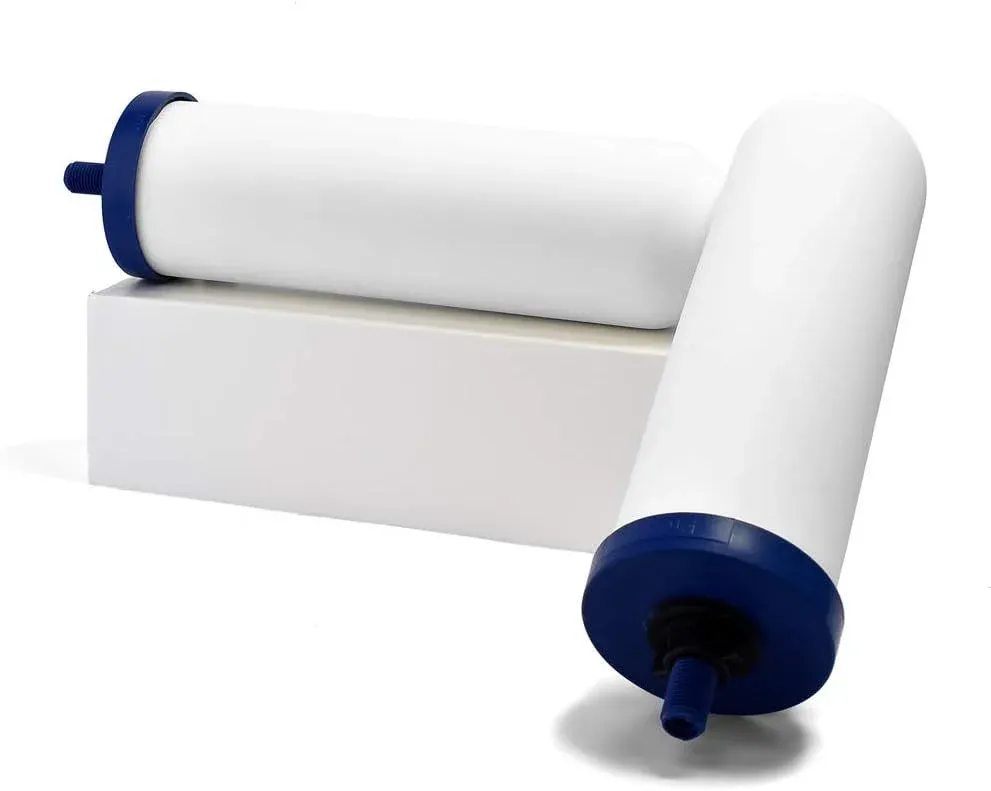
ProOne 9-Inch Gravity Water Filter Replacement G-Series (2-Pack)
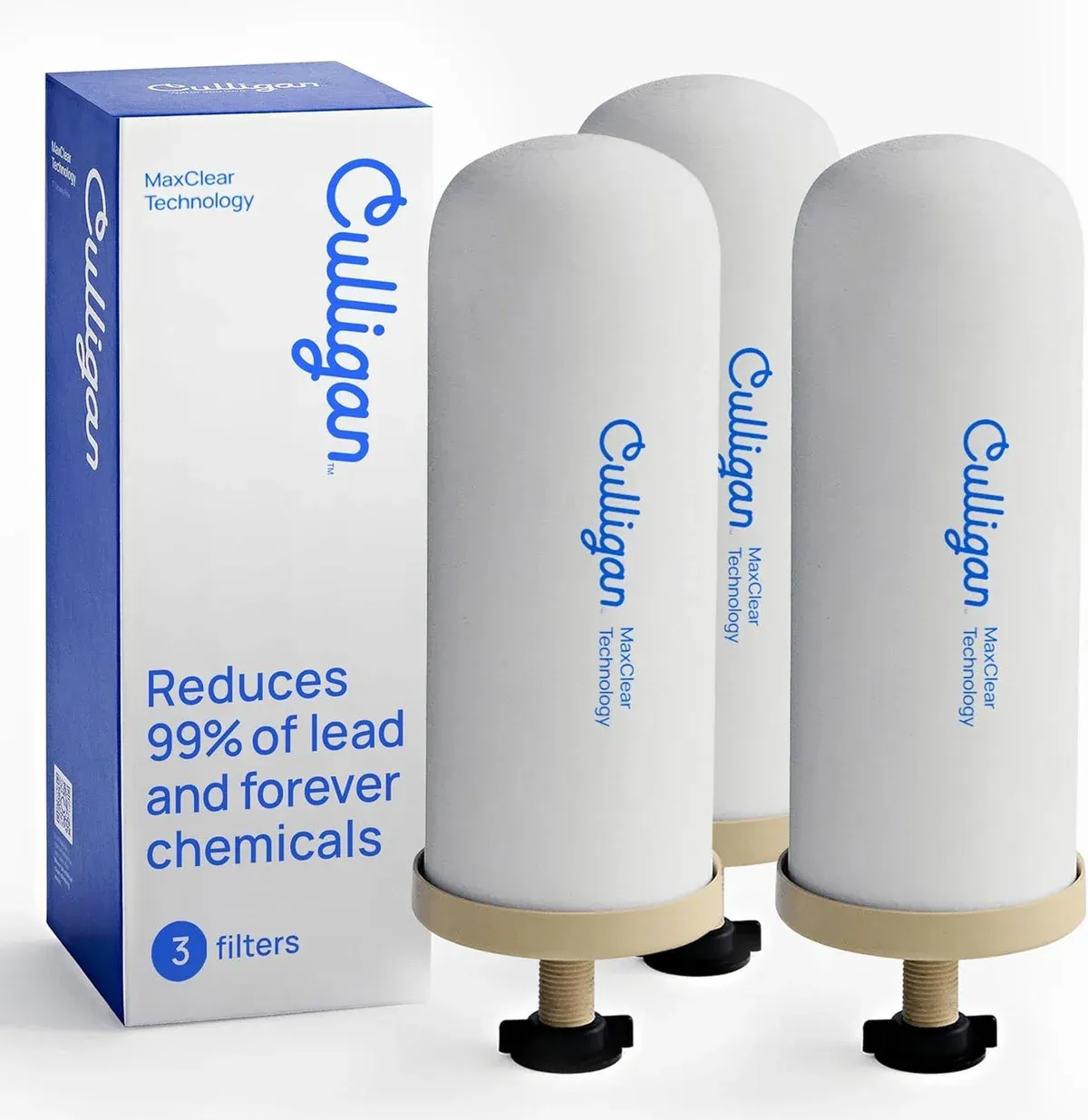
Culligan MaxClear 7-Inch Gravity Water Filter Replacement (2-Pack)
At a Glance
| Feature | Editor's Pick ProOne 9-Inch Gravity Water Filter Replacement G-Series (2-Pack) | Culligan MaxClear 7-Inch Gravity Water Filter Replacement (2-Pack) |
|---|---|---|
| Price (2-Pack) | $100–$250 | $100–$250 |
| Filtration | 3-stage G3.0 (ceramic shell + carbon granular + carbon block core) | Ceramic outer shell + high-flow carbon block + GAC (coconut shell) |
| Filter Life | 1,200 gallons per filter | 50 gallons per filter (6 months) |
| Certifications | IAPMO — NSF 42/53/401/372/P231 | IAPMO — NSF 42/53/401 |
| Dimensions | 9" tall x 2.75" diameter | 7" tall |
| Contaminants | 200+ including lead, fluoride, PFAS, microplastics, bacteria, chlorine, pharmaceuticals | Lead 99%, PFAS 99%, microplastics 96%, fluoride 100%, chlorine, pharmaceuticals |
| Check Price | Check Price |
This is the most consequential comparison in the gravity filter replacement market right now. The ProOne G-Series and Culligan MaxClear are not just competitors — they are predecessor and successor. The Culligan MaxClear is the product that ProOne's G3.0 technology is transitioning into as the brand moves under Culligan's umbrella. In theory, this should be a seamless upgrade: same technology, same compatibility, better brand backing. In practice, the numbers tell a very different story. The ProOne G-Series delivers 1,200 gallons per filter at $157 per 2-pack. The Culligan MaxClear delivers 50 gallons per filter at $146 per 2-pack. That is a 24x reduction in per-filter capacity for essentially the same price. Understanding why this gap exists — and what it means for your gravity filter budget — is critical.
Category-by-Category Breakdown
Filter Lifespan: The 24x Gap
The ProOne 9-inch G-Series is rated for 1,200 gallons per filter element. A 2-pack provides 2,400 gallons of total filtration capacity. At typical household consumption of 2 gallons per day, a single 2-pack lasts approximately 3.3 years. The Culligan MaxClear 7-inch is rated for 50 gallons per filter element. A 2-pack provides 100 gallons of total filtration capacity. At the same 2 gallons per day, a single 2-pack lasts approximately 50 days — roughly 7 weeks.
This is not a marginal difference. This is a fundamental shift in the economics of gravity filtration. The ProOne G3.0 filter was designed as a long-life element — the combination of a cleanable ceramic outer shell and a dense carbon block core creates a filter that sustains effective contaminant removal over hundreds of filling cycles. The Culligan MaxClear's 50-gallon rating suggests either a fundamentally different media composition that exhausts much faster, a far more conservative rating methodology, or both.
To put the disparity in household terms: a family of four consuming 3 gallons of filtered water per day would need approximately 11 Culligan MaxClear 2-packs per year at $146 each — over $1,600 annually in filter replacement costs. The same family would need less than one ProOne G-Series 2-pack per year — under $50 annually. This is the difference between a gravity filter that costs roughly the same as a Brita pitcher to operate and one that costs more than a subscription water delivery service.
We have seen some speculation that the 50-gallon rating may be overly conservative or a listing error. Until Culligan officially corrects or explains the specification, we evaluate based on published data. Even if the practical lifespan proves to be 2-3x the rated capacity (100-150 gallons), the Culligan MaxClear remains dramatically more expensive to operate than the ProOne G3.0.
Certifications & Verified Performance
The ProOne 9-inch G-Series carries IAPMO certification to five standards: NSF 42 (chlorine taste/odor), NSF 53 (health-effect contaminants including lead), NSF 401 (emerging contaminants including PFAS and pharmaceuticals), NSF 372 (lead-free materials), and Protocol P231 (microbiological purification — bacteria and cyst removal to EPA drinking water standards). This is the broadest certification stack of any gravity replacement filter currently on the market.
The Culligan MaxClear 7-inch carries IAPMO certification to three standards: NSF 42, NSF 53, and NSF 401. Notably absent are NSF 372 (lead-free materials verification) and Protocol P231 (microbiological purification). The missing P231 certification is the more consequential gap — it means the Culligan MaxClear has not been independently verified for bacteria and cyst removal to EPA standards. For buyers using gravity filtration as their primary microbiological barrier (well water, off-grid, emergency preparedness), the absence of P231 certification is a material downgrade from the ProOne G3.0's verified performance.
The Culligan MaxClear does carry one distinction the ProOne does not: 100% fluoride removal in independent lab testing. ProOne's G3.0 filters include activated alumina for fluoride reduction but do not claim or certify a specific fluoride removal percentage. The Culligan's 100% fluoride claim is backed by lab results, not NSF certification (there is no standard NSF fluoride certification for gravity filters), but it is a meaningful performance data point for fluoride-concerned buyers.
Overall, the ProOne's broader certification stack — especially the P231 microbiological purification — represents more independently verified performance across more contaminant categories. The Culligan's fluoride testing is impressive but does not compensate for the two missing certifications.
Water Quality Concerns: The Manganese Finding
Independent testing of the Culligan MaxClear filter found detectable levels of manganese and dichloromethane (a chlorinated solvent also known as methylene chloride) in the filtered output water. This finding is concerning for a product whose primary purpose is to remove contaminants from drinking water — not introduce new ones.
Context matters here. Many activated carbon filters leach trace minerals during their initial break-in period, and manganese is a naturally occurring element found in many carbon sources. If the manganese finding is limited to the first few filtration cycles, it may be a break-in artifact rather than a persistent quality issue. Dichloromethane, however, is a synthetic compound that should not be present in filter media — its detection suggests either manufacturing contamination or a reaction between the filter's chemical composition and chlorinated source water.
The ProOne G3.0 has a longer market track record with more cumulative third-party testing, and we have not encountered comparable contaminant introduction findings. The G3.0's break-in period is documented (some users report a chemical smell during the first 3-4 cycles), but third-party testing has not identified contaminant introduction as a systematic issue. The Culligan MaxClear is a newer product with less cumulative testing data, so it is possible that the manganese finding reflects an early production run issue that will be resolved. But until Culligan addresses the finding publicly, it is a legitimate concern that informed buyers should be aware of.
Brand Backing & Long-Term Continuity
This is the one category where the Culligan MaxClear has a structural advantage. Culligan is one of the largest and most established water treatment companies in North America, with over 75 years of industry presence, extensive manufacturing facilities, national retail distribution through home improvement stores, and a dealer service network that spans the continent. When you buy a Culligan product, you are buying into an ecosystem with the resources and infrastructure to support the product long-term.
ProOne, by contrast, is a smaller company that is actively transitioning its brand to Culligan. The ProOne G3.0 filters are being discontinued. While current inventory remains available, there is no guarantee of future production runs. For a buyer making a one-time filter purchase, this is irrelevant — the ProOne filters you buy today will work for their full rated lifespan regardless of brand transitions. But for a buyer evaluating a long-term relationship with a filter ecosystem, the Culligan MaxClear represents the future direction, and Culligan's resources make it more likely that replacement filters will remain continuously available for years to come.
The counter-argument is that Culligan's brand backing has not, so far, translated into a product that matches the ProOne G3.0's specifications. A larger company with more resources should be able to produce a filter with equal or better capacity — and yet the MaxClear's 50-gallon rating and missing certifications suggest that the brand transition is a work in progress rather than an improvement. Brand backing matters more when the product delivers. Until the Culligan MaxClear's specifications improve, the brand advantage is theoretical rather than practical.
Cost Per Gallon: The Defining Metric
The ProOne 9-inch G-Series costs $157 for a 2-pack rated at 2,400 total gallons: $0.065 per gallon. The Culligan MaxClear 7-inch costs $146 for a 2-pack rated at 100 total gallons: $1.46 per gallon. The ProOne delivers filtered water at a cost comparable to municipal tap water surcharges. The Culligan delivers filtered water at a cost approaching bottled water.
To make this concrete: at typical household consumption of 2 gallons per day, the annual operating cost for ProOne G-Series filters is approximately $48. The annual operating cost for Culligan MaxClear filters is approximately $1,066. Over a 5-year period, the cumulative filter replacement cost is $240 for ProOne versus $5,330 for Culligan. The $5,090 difference over five years is enough to buy an entire premium gravity filtration system multiple times over.
Even accounting for the possibility that the Culligan MaxClear's 50-gallon rating is conservative and practical lifespan may be 2-3x longer (100-150 gallons), the cost-per-gallon remains approximately $0.49-0.73 — still 8-11x more expensive than the ProOne G3.0. There is no realistic scenario where the Culligan MaxClear approaches the ProOne's cost-per-gallon efficiency. The capacity gap is too large and the price point too similar.
This cost analysis is the primary reason we recommend buying ProOne G3.0 filters while they remain available. The financial argument is not close. Every ProOne 2-pack you purchase today represents roughly $1,000 in avoided Culligan MaxClear replacement costs over the 2-pack's 3+ year lifespan.
Fluoride Removal
The Culligan MaxClear claims 100% fluoride removal in independent laboratory testing. This is the strongest fluoride removal claim of any gravity replacement filter we have reviewed — most filters with fluoride reduction capabilities claim percentage reductions in the 85-95% range, and few achieve or claim complete removal. For households where fluoride reduction is the single most important filtration criterion, this is a meaningful distinction.
The ProOne G3.0 includes activated alumina media for fluoride reduction, and fluoride removal is one of its advertised capabilities. However, ProOne does not certify or publish a specific fluoride removal percentage for the G3.0. In practice, users report effective fluoride reduction — but without published testing data, we cannot make a direct numerical comparison to the Culligan's 100% claim.
It is worth noting that the Culligan's 100% fluoride removal is tested at the 50-gallon filter capacity — meaning the fluoride removal performance is verified for a relatively small volume of water. Whether that 100% removal rate would persist at higher usage volumes (if the filter were used beyond its rated capacity) is unknown. The ProOne's fluoride removal, while unquantified, is designed to persist over 1,000-1,200 gallons of use — a far larger volume window. For sustained fluoride reduction over months and years, the ProOne's integrated approach across a larger capacity may deliver more total fluoride-free gallons than the Culligan's 100% rate across a 50-gallon window.
The Bigger Picture: A Brand Transition in Progress
The ProOne-to-Culligan transition is not a simple rebrand — it represents a fundamental change in the gravity filter replacement market. ProOne established itself as the go-to certified alternative to Berkey's uncertified Black Berkey elements, offering independently verified contaminant removal, built-in fluoride reduction, and generous per-filter capacity at competitive prices. The G3.0 filter earned a loyal following among gravity filter users who wanted certifications without sacrificing practicality.
The Culligan MaxClear, as it currently exists, does not maintain that value proposition. The 50-gallon lifespan transforms gravity filtration from an economical long-term water solution into an ongoing consumable expense. The missing P231 microbiological certification removes a key assurance for off-grid and well water users. And the independent testing showing contaminant introduction raises questions that Culligan has not yet addressed publicly.
We believe the Culligan MaxClear will improve. Culligan is a serious water treatment company with the engineering resources and market incentive to deliver a product that satisfies the gravity filter community's expectations. The current MaxClear may be a first-generation release that will be refined through subsequent production iterations, specification updates, and additional certification testing. But as of 2026, the product on the market today does not match the ProOne G3.0 it is replacing — not in capacity, not in certification breadth, and not in cost-effectiveness.
Who Should Get Which?
Get the ProOne 9" G-Series 2-Pack if...
- You want the lowest cost-per-gallon — $0.065/gal vs $1.46/gal is a 22x difference
- Filter lifespan matters — 1,200 gallons per filter means replacing once every 1-3 years
- You need P231 microbiological purification certification for well water or off-grid use
- You want 5 NSF certifications vs 3 — the broadest verified performance available
- You are comfortable buying a discontinued product while inventory lasts
- You want a proven track record — the G3.0 has years of clean third-party testing data
Get the Culligan MaxClear 7" 2-Pack if...
- Brand continuity is critical — Culligan will exist and produce replacement filters long-term
- 100% fluoride removal in lab testing is your primary filtration criterion
- You prefer buying the current-production product rather than a discontinued line
- You are willing to accept the higher operating cost ($1,066/yr vs $48/yr) for brand security
- You trust that Culligan will improve capacity specs in future production runs
- Your water consumption is very low (under 0.5 gal/day) minimizing the cost-per-gallon impact
Pro Tip: The smartest play right now is a bridge strategy: buy 2-4 extra ProOne G3.0 2-packs at today's prices to cover the next 3-7 years of filter replacements, then monitor the Culligan MaxClear product line for specification improvements. If Culligan increases the filter capacity from 50 gallons to something approaching the G3.0's 1,000-1,200 gallon range, the MaxClear becomes a viable long-term replacement. If the capacity stays at 50 gallons, your G3.0 stockpile buys you years of time to evaluate alternatives — including Doulton Super Sterasyl and Waterdrop BB9-2 filters, which offer their own trade-offs but at far more reasonable cost-per-gallon economics than the current MaxClear.
Frequently Asked Questions
Is the Culligan MaxClear the same filter as the ProOne G3.0?
Why is the Culligan MaxClear filter life only 50 gallons when the ProOne G3.0 lasts 1,000-1,200 gallons?
What does the independent testing showing manganese in Culligan MaxClear output mean?
Should I stockpile ProOne G3.0 filters before they are discontinued?
Can I use Culligan MaxClear filters in a ProOne gravity system?
How do the costs compare over a year of typical use?
Our Final Recommendation
The ProOne 9-inch G-Series at $157 per 2-pack is the overwhelming winner of this comparison. It delivers 24x the filter capacity, broader certifications (including microbiological purification verification), a cleaner testing track record, and an annual operating cost that is 22x lower than the Culligan MaxClear. By every quantifiable metric except fluoride removal percentage and brand longevity, the ProOne G3.0 is the superior product.
The Culligan MaxClear at $146 per 2-pack is a product we cannot recommend as a primary gravity filter replacement at its current 50-gallon capacity rating. The operating cost of approximately $1,066 per year for a typical household is prohibitive, the independent testing showing manganese in output is concerning, and the missing P231 and NSF 372 certifications represent real downgrades from the ProOne G3.0 it replaces. The 100% fluoride claim and Culligan brand backing are genuine strengths, but they do not overcome the fundamental capacity deficit.
Our actionable recommendation: buy ProOne G3.0 filters while inventory remains available. Stock 2-4 replacement pairs for multi-year coverage. Monitor the Culligan MaxClear product line for capacity improvements, additional certifications, and independent testing results. If Culligan addresses the capacity gap and the manganese findings, we will revisit this recommendation. Until then, the ProOne G-Series is the gravity replacement filter we buy with our own money — and the one we urge you to secure before the remaining inventory is depleted.