ProOne 7" G-Series vs Culligan MaxClear 7": Predecessor vs Successor in 2026
Quick Verdict: At the same price point, the ProOne 7" G-Series ($100–$250) delivers 20 times the filter life — 1,000 gallons versus the Culligan MaxClear's 50 gallons. The Culligan MaxClear ($100–$250) offers 100% fluoride removal and Culligan's brand backing, but its 50-gallon lifespan drives cost-per-gallon to roughly twenty times that of the ProOne. Buy ProOne while it is still available. The economics are not close.
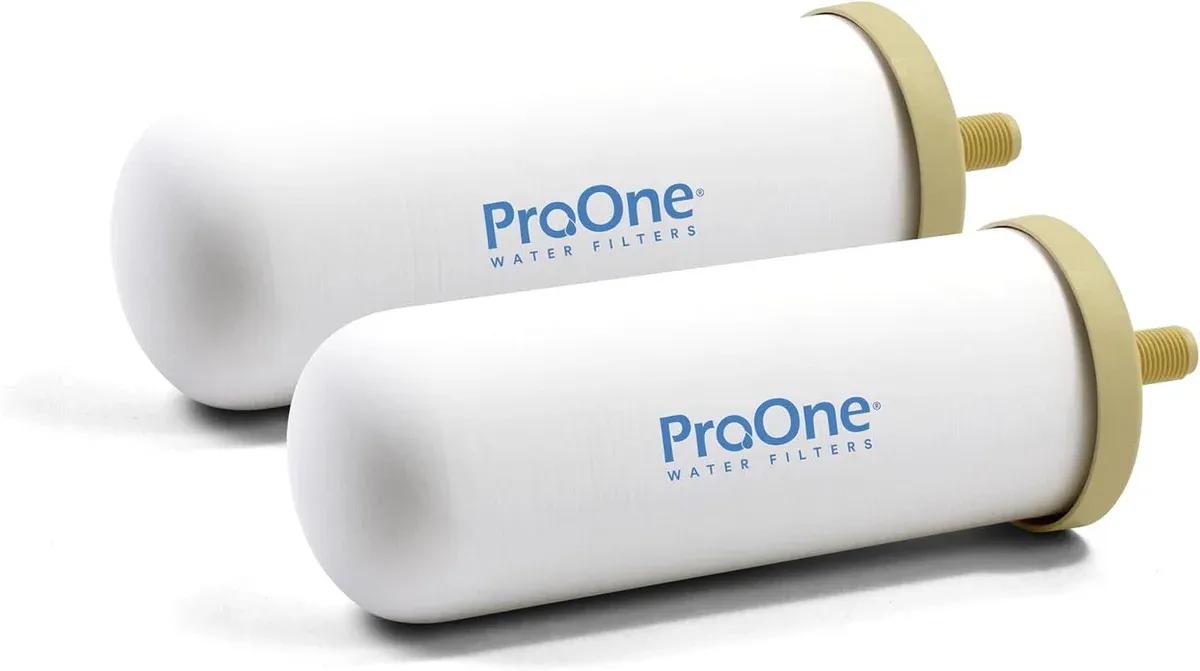
ProOne G-Series 7-Inch Gravity Filter Replacement (2-Pack)
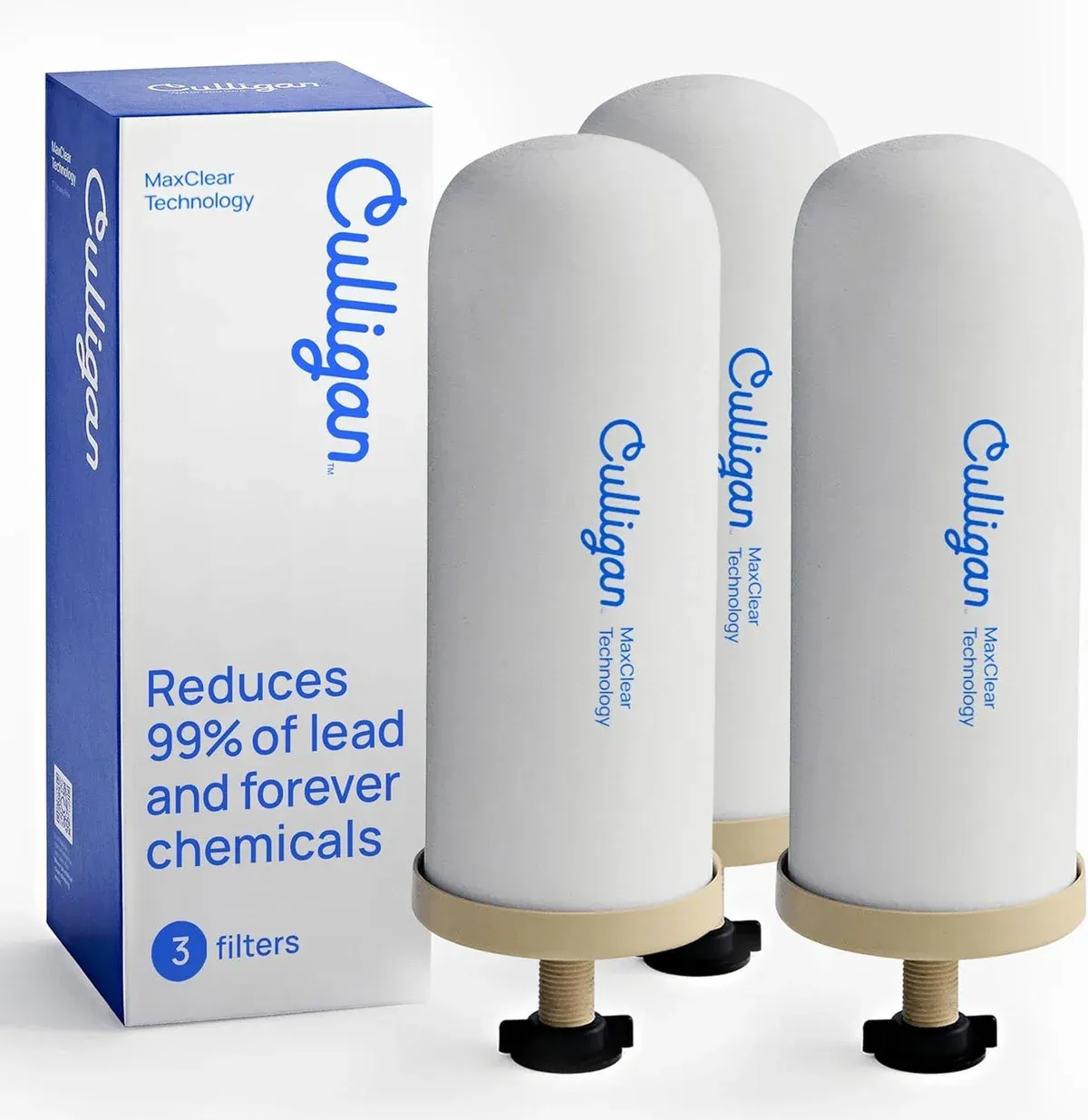
Culligan MaxClear 7-Inch Gravity Water Filter Replacement (2-Pack)
At a Glance
| Feature | Editor's Pick ProOne G-Series 7-Inch Gravity Filter Replacement (2-Pack) | Culligan MaxClear 7-Inch Gravity Water Filter Replacement (2-Pack) |
|---|---|---|
| Price | $100–$250 | $100–$250 |
| Filtration | 3-stage G3.0 (ceramic shell + carbon granular + carbon block core) | Ceramic outer shell + high-flow carbon block + GAC (coconut shell) |
| Filter Life | 1,000 gallons per filter | 50 gallons per filter (6 months) |
| Certifications | IAPMO — NSF 42/53/401/372/P231 | IAPMO — NSF 42/53/401 |
| Contaminants | 200+ including lead, fluoride, PFAS, microplastics, bacteria, chlorine, pharmaceuticals | Lead 99%, PFAS 99%, microplastics 96%, fluoride 100%, chlorine, pharmaceuticals |
| Dimensions | 7" tall x 2.75" diameter | 7" tall |
| Check Price | Check Price |
The ProOne 7-inch G-Series and Culligan MaxClear 7-inch share more than a price tag — the MaxClear is the official successor to ProOne's gravity filter line, built on the same ceramic + carbon block technology. But the transition has introduced a dramatic trade-off that fundamentally changes the ownership experience: a 20x reduction in filter lifespan. This comparison examines whether the Culligan brand name and some incremental improvements justify what amounts to the most expensive gravity replacement filter per gallon on the market.
Category-by-Category Breakdown
Filter Lifespan: The Elephant in the Room
The ProOne 7-inch G-Series is rated at 1,000 gallons per filter. The Culligan MaxClear 7-inch is rated at 50 gallons per filter. That is not a typo — the successor filter lasts 5% as long as the filter it replaces, at the same price. For a household with two filters processing 3 gallons per day, the ProOne pair lasts approximately 667 days. The Culligan pair lasts approximately 33 days. You would need to replace the Culligan filters every single month to maintain filtration performance.
To make this concrete with annual replacement costs: a household filtering 1,095 gallons per year needs about 0.55 ProOne 2-packs versus about 11 Culligan 2-packs. The annual spend difference is dramatic — and over three years, the cumulative gap is large enough to purchase a premium under-sink reverse osmosis system, a whole-house filtration setup, or a decade's worth of ProOne filters. That is not a rounding error; it is a fundamentally different budget category.
Culligan has not publicly explained why the MaxClear's lifespan dropped from the ProOne's 1,000 gallons to 50. Possible explanations include more conservative certification methodology (testing at peak performance rather than functional end-of-life), different media density or composition, or a deliberate shift toward a razor-and-blade business model where the filter body is affordable but ongoing replacement costs generate recurring revenue. Whatever the reason, the practical impact on household budgets is severe.
Cost Per Gallon
The math here is stark. Both the ProOne 7-inch G-Series 2-pack and the Culligan MaxClear 7-inch 2-pack sit in the same mid-range price tier — yet the ProOne delivers 2,000 total gallons while the Culligan delivers just 100. The Culligan costs roughly 20 times more per gallon of filtered water. At that per-gallon rate, you are approaching the cost of bottled water — which defeats the core economic proposition of gravity filtration entirely.
To frame this against the broader gravity replacement filter market: the Waterdrop BB9-2 costs approximately $0.011 per gallon, the British Berkefeld costs approximately $0.053 per gallon, the Doulton Super Sterasyl costs approximately $0.105 per gallon, the ProOne 7-inch costs approximately $0.073 per gallon, and the Culligan MaxClear costs approximately $1.46 per gallon. The Culligan is not just the most expensive option in this category — it is more expensive than every other gravity filter by an order of magnitude. In a market where competitors deliver water filtration for pennies per gallon, the Culligan charges a dollar and a half.
There is exactly one scenario where this cost structure makes sense: if the Culligan MaxClear delivers filtration performance so dramatically superior that no other filter can match it, and you value that performance enough to pay the premium. The question is whether 100% fluoride removal and Culligan's brand name justify a 20x cost premium over the ProOne that shares its technological DNA.
Fluoride Removal
Both filters include built-in fluoride removal — a key selling point of the ProOne G-Series technology that carried over to the Culligan MaxClear. Independent testing of the Culligan MaxClear showed 100% fluoride removal, which is the highest fluoride reduction measured among gravity replacement filters. The ProOne G-Series also removes fluoride, though ProOne's marketing does not cite a specific percentage — it is listed as part of the 200+ contaminant reduction claim.
If fluoride removal is your primary purchasing criterion, the Culligan MaxClear delivers verified 100% reduction. However, the ProOne G-Series also removes fluoride at a fraction of the per-gallon cost. Unless the difference between "removes fluoride" (ProOne) and "removes 100% of fluoride" (Culligan) matters enough to justify spending 20x more per gallon, the ProOne is the more rational choice for fluoride-conscious households.
For perspective: the average US municipal water supply contains 0.7 mg/L of fluoride. The WHO guideline is 1.5 mg/L maximum. Even a filter that removes 85-90% of fluoride brings the level well below any health concern threshold. The marginal benefit of going from 90% removal to 100% removal on water that starts at 0.7 mg/L is negligible in practical health terms — you are going from 0.07 mg/L to 0.00 mg/L, both of which are effectively zero from a health perspective.
Certifications
The ProOne 7-inch G-Series holds IAPMO certification to NSF 42, 53, 401, 372, and Protocol P231 — the broadest certification stack available in any gravity replacement filter. NSF P231 is particularly notable because it certifies microbiological purification: 99.9999% bacteria removal, 99.99% virus removal, and 99.9% cyst removal. This is the gold standard for biological protection in a gravity filter.
The Culligan MaxClear 7-inch holds IAPMO certification to NSF 42, 53, and 401 — a strong but narrower certification portfolio. Notably, the Culligan lacks NSF 372 (lead-free compliance) and Protocol P231 (microbiological purification). The absence of P231 is significant because it means the Culligan has not been independently verified for the same level of biological protection that made the ProOne a standout in the emergency preparedness and off-grid communities.
Both certifying bodies (IAPMO for both products) are ANSI-accredited and use the same NSF/ANSI testing standards. The difference is in scope, not credibility. The ProOne covers more standards, including the most demanding biological protection protocol. For treated municipal water, both certification stacks are more than adequate. For untreated or questionable water sources, the ProOne's P231 certification provides an additional layer of verified protection that the Culligan cannot match.
Independent Testing Concerns
Independent laboratory testing of the Culligan MaxClear 7-inch revealed a concerning finding: the filter introduced measurable levels of manganese and dichloromethane into filtered water that were not present in the source water. This means the filter media itself appears to be leaching these compounds into the water it is supposed to be purifying. Manganese in drinking water above the EPA's secondary standard of 0.05 mg/L can cause aesthetic issues (metallic taste, brownish discoloration) and at higher chronic exposure levels, potential neurological effects.
Dichloromethane (methylene chloride) is an industrial solvent classified by the EPA as a likely human carcinogen. Its presence in filter output — from the filter itself, not the source water — is a red flag that warrants scrutiny. It is possible this is a manufacturing residue that dissipates after the initial break-in period, but without Culligan publicly addressing the finding, buyers are left to draw their own conclusions.
The ProOne 7-inch G-Series has not shown similar issues in independent testing. ProOne's G3.0 technology has been on the market longer with a larger install base, and while some users report a chemical taste during the initial break-in period (first 3-4 fill cycles), no independent testing has found the filter introducing new contaminants into the water. For a product category where the entire purpose is water purification, a filter that introduces contaminants is a fundamental problem — and one that the ProOne does not share.
Brand Backing and Future Support
Culligan is one of the most recognized names in water treatment, with over 75 years of history and a nationwide dealer network. The Culligan brand carries weight with consumers who associate it with water quality — and that brand trust extends to the MaxClear product line. If the MaxClear develops issues, Culligan has the corporate infrastructure, customer service channels, and reputation incentive to address them. The brand's longevity provides reasonable confidence that replacement filters will remain available for years to come.
ProOne, by contrast, is actively transitioning its product line away from the G-Series and toward Culligan. The ProOne brand may continue to exist for other product categories, but for gravity replacement filters, the G-Series is being phased out. Once current inventory is depleted, there is no guarantee of restocking. ProOne's customer service for the G-Series may also decline as the company shifts focus to the Culligan partnership. Buying ProOne now is buying a product with a limited remaining shelf life in the market.
This is the one area where the Culligan genuinely wins: it is the future of this product lineage, while ProOne is the past. For buyers who want a gravity filter they can purchase and repurchase for the next decade without worrying about availability, the Culligan MaxClear has that advantage — even if the current lifespan and cost economics are unfavorable. Product specifications can change (and Culligan may well address the 50-gallon lifespan in future revisions), but a discontinued product cannot be improved.
Real-World Usability and Maintenance Burden
Beyond the raw numbers, the lifespan gap creates a meaningfully different day-to-day experience. With the ProOne G-Series, a typical household might replace filters two or three times per year — a minor inconvenience that fits easily into a seasonal maintenance rhythm. Most users set a calendar reminder, order a fresh 2-pack, and move on. The filter change itself takes a few minutes: unscrew the spent candle, rinse the housing, thread on the new candle, and run a break-in fill cycle.
With the Culligan MaxClear at 50 gallons per filter, that same household is replacing filters every three to four weeks. Monthly filter swaps become a recurring errand that requires keeping replacement stock on hand at all times. Running out of replacement filters means either drinking unfiltered water or making an emergency purchase — a friction point that adds up over time. For households that already struggle to maintain consistent filter replacement schedules, the Culligan's demanding cadence is a genuine quality-of-life concern, not just a cost issue.
Who Should Get Which?
Get the ProOne G-Series 7-Inch Gravity Filter Replacement (2-Pack) if...
- You want the best value — 20x the filter life at the same price
- P231 microbiological certification matters for your water source
- You are willing to stock up before the product is discontinued
- Independent testing concerns about the Culligan worry you
- You want proven G3.0 technology with years of community validation
Get the Culligan MaxClear 7-Inch Gravity Water Filter Replacement (2-Pack) if...
- You need verified 100% fluoride removal above all other priorities
- Long-term product availability matters more than per-gallon cost
- You trust Culligan's brand and expect lifespan improvements in future revisions
- Budget for ongoing filter replacement is not a constraint
- You want the latest iteration of this technology lineage
Pro Tip: If you currently own a gravity system and use ProOne filters, buy at least two extra 2-packs now. At 1,000 gallons per filter, two backup packs give you approximately 3-4 years of supply at a fraction of a penny per gallon more than bottled water alternatives. Waiting until the Culligan MaxClear is your only option means accepting a dramatically higher per-gallon cost — one that makes gravity filtration economically comparable to buying bottled water. Stockpiling is the rational move while inventory exists.
The Broader Context: What This Transition Means for Gravity Filter Owners
The ProOne-to-Culligan transition represents a significant inflection point in the gravity water filter market. For years, ProOne G-Series filters have been the go-to recommendation for gravity system owners who wanted certified filtration with built-in fluoride removal and reasonable per-gallon economics. The G-Series was the product that proved gravity filters could deliver serious, independently certified water purification — not just taste improvement.
The Culligan MaxClear's 50-gallon lifespan fundamentally changes that value proposition. At its current per-gallon cost, gravity filtration with the MaxClear costs more than many under-sink and countertop systems that deliver equal or superior filtration performance. A reverse osmosis system like the iSpring RCC7AK produces filtered water at a fraction of a penny per gallon — far cheaper than the Culligan MaxClear. The only advantage the gravity system retains is portability and independence from plumbing — meaningful for off-grid and emergency use, but not for the majority of gravity filter owners who use them as everyday countertop filtration.
For existing gravity system owners, the practical path forward depends on your timeline. Short-term (1-2 years): stock up on ProOne G-Series while available. Medium-term (2-5 years): monitor whether Culligan releases a MaxClear revision with improved lifespan. Long-term: consider whether gravity filtration still makes economic sense compared to plumbed-in alternatives, or explore other gravity replacement options like the Doulton Super Sterasyl (NSF certified, approximately $0.105/gallon) or even the budget-friendly Waterdrop BB9-2 (approximately $0.011/gallon for municipal water users).
The gravity filter market is not dead — but the loss of the ProOne G-Series removes its most compelling all-around option. The remaining choices require more deliberate trade-off analysis than simply recommending ProOne to everyone, which is why comparisons like this one matter more now than they did a year ago.
Frequently Asked Questions
Is the Culligan MaxClear really the successor to the ProOne G-Series?
Why does the Culligan MaxClear only last 50 gallons when ProOne lasts 1,000?
What are the manganese issues found in Culligan MaxClear testing?
Should I stock up on ProOne G-Series filters before they are discontinued?
Does the Culligan MaxClear remove fluoride?
Can I use ProOne and Culligan MaxClear filters interchangeably in the same system?
How does the ProOne G-Series compare to other gravity filters like Doulton or Berkey?
Our Final Recommendation
The ProOne 7-inch G-Series is the unequivocal winner for any buyer who can still find it in stock. At the same price tier, it delivers 20 times the filter life, broader certifications including P231 microbiological purification, no leaching concerns, and years of proven real-world performance. The discontinuation makes it a time-sensitive purchase, but the product itself is the best gravity replacement filter available by nearly every metric. Stock up while you can.
The Culligan MaxClear 7-inch is difficult to recommend at its current specifications. The 50-gallon lifespan creates an ongoing cost burden that undermines the economic case for gravity filtration. The independent testing concerns about manganese and dichloromethane leaching add a quality question that Culligan has not yet addressed. The 100% fluoride removal is genuinely impressive, and the Culligan brand provides long-term availability assurance — but these benefits do not overcome a 20x cost-per-gallon penalty for most households.
Our honest advice: buy ProOne now and re-evaluate the Culligan MaxClear in 12-18 months. Culligan is a serious company with the resources and incentive to improve the MaxClear's lifespan in future product revisions. If a MaxClear v2 arrives with a 200-500 gallon lifespan, it becomes a genuinely competitive product. At 50 gallons, it is not there yet.
Track Both Products
We'll email you if either price drops or availability changes.
Only when something changes. Unsubscribe anytime.