Brita Elite vs ZeroWater: Which Pitcher Filter Is Better in 2026?
Quick Verdict: The Brita Elite ($25–$50) is the better choice for most households — it removes 99% of lead, lasts 120 gallons per filter, and delivers among the lowest cost-per-gallon in the pitcher category. ZeroWater ($50–$100) achieves deeper TDS reduction (0 ppm) and removes fluoride, but filters deplete 5-8x faster and running costs are dramatically higher. Choose ZeroWater only if you need maximum TDS reduction or fluoride removal.
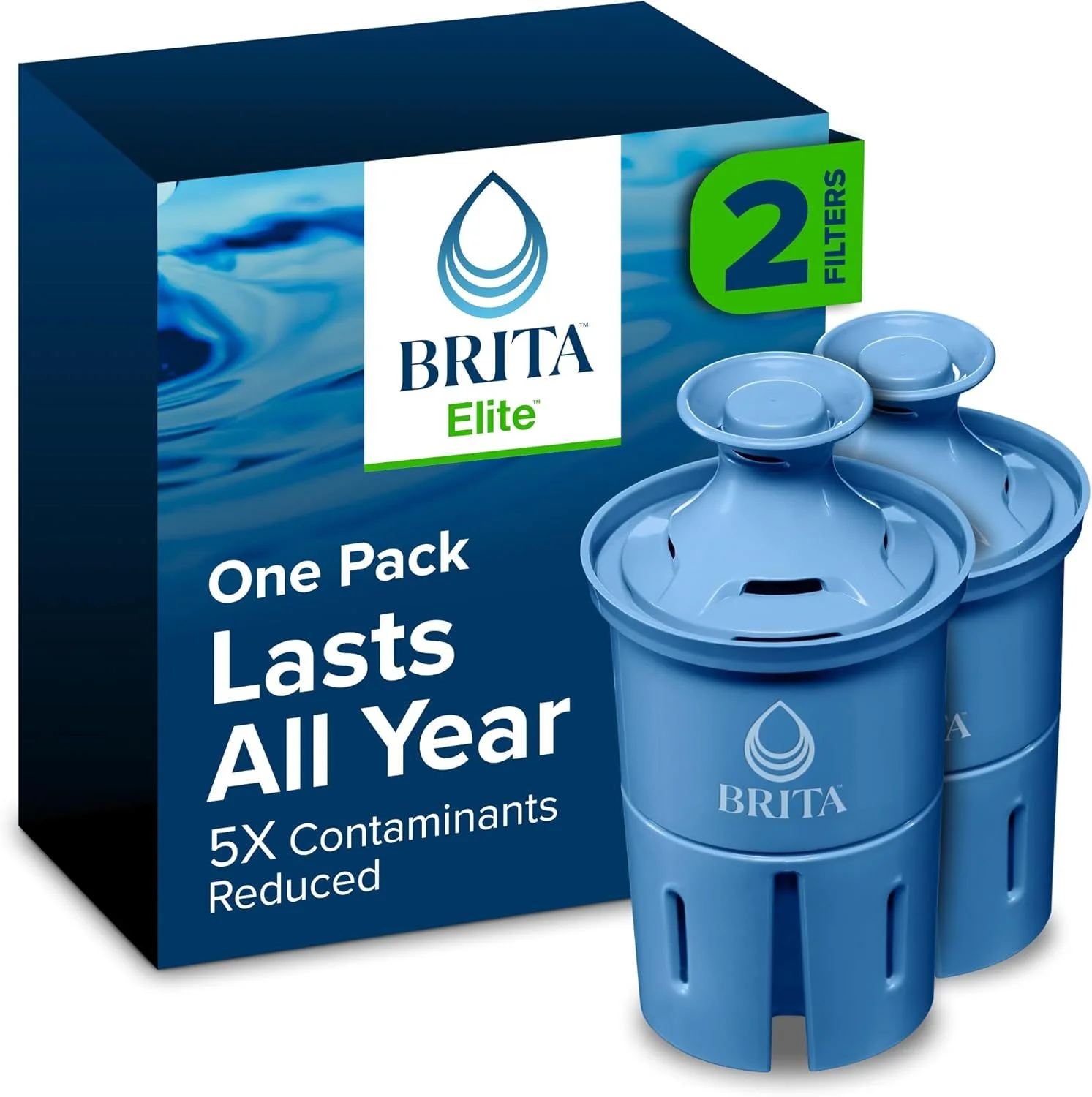
Brita Elite Replacement Filters (2-Pack)
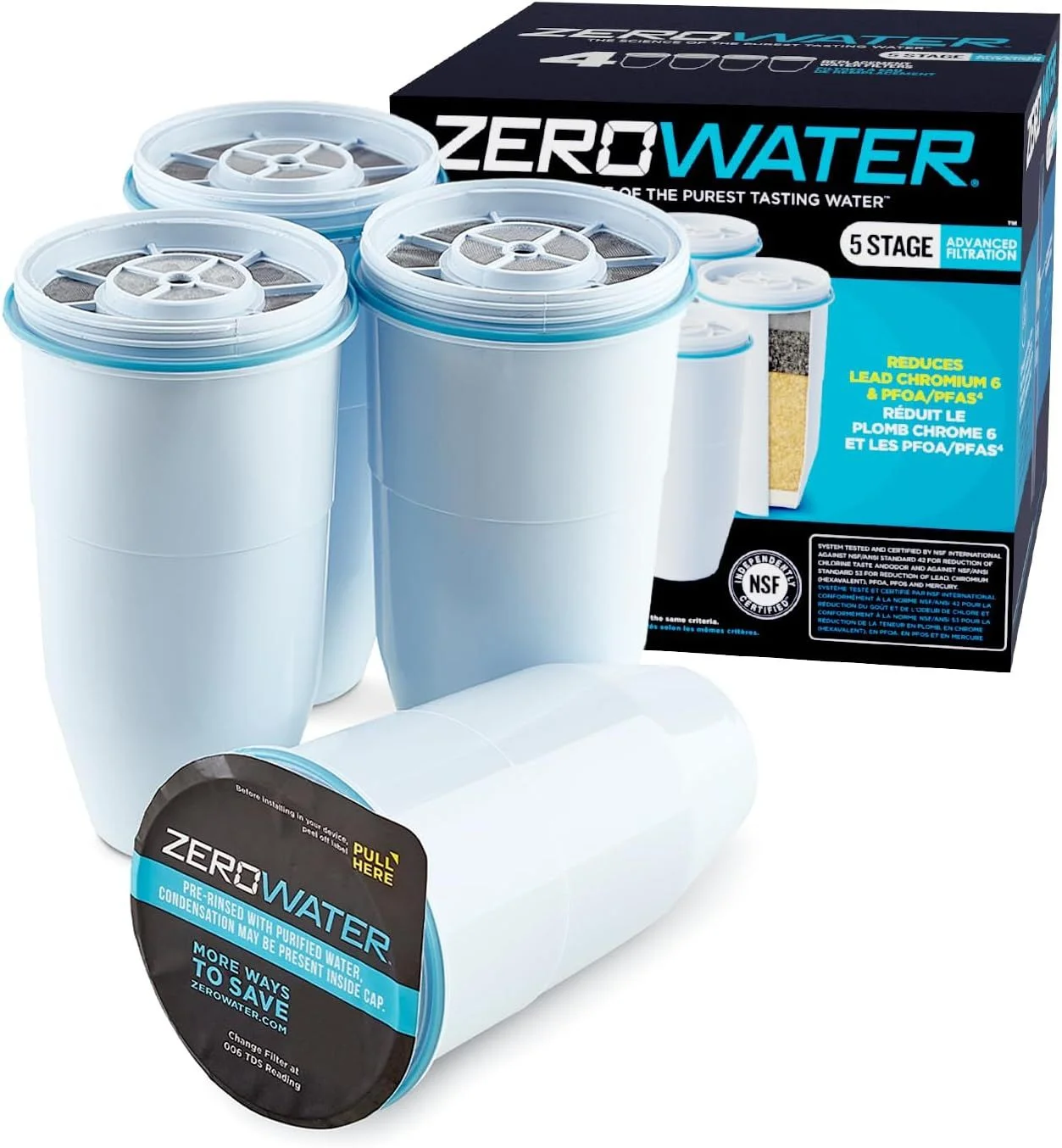
ZeroWater 5-Stage Replacement Filter (4-Pack)
At a Glance
| Feature | Editor's Pick Brita Elite Replacement Filters (2-Pack) | ZeroWater 5-Stage Replacement Filter (4-Pack) |
|---|---|---|
| Price | $25–$50 | $50–$100 |
| Pack Size | 2 | 4 |
| Capacity | 120 gallons per filter | ~15-25 gallons per filter (varies by source water TDS) |
| Certifications | NSF 42/53/401 | IAPMO (lead, chromium, PFOA, PFOS) |
| Filter Life | 120 gallons (~6 months per filter) | 15-25 gallons (2-8 weeks depending on TDS) |
| Filtration | Activated Carbon Block + Pleated Media | 5-Stage Ion Exchange + Activated Carbon |
| Check Price | Check Price |
Brita Elite and ZeroWater represent two philosophies: the Elite offers balanced, certified filtration at an economical per-gallon cost, while ZeroWater pursues laboratory-grade purity at the expense of filter life and ongoing costs. Both are significant upgrades over basic pitcher filters.
Category-by-Category Breakdown
Filtration Depth
ZeroWater achieves what no other pitcher filter can: 0 TDS water. Its 5-stage ion exchange system strips virtually every dissolved solid from water, including minerals, metals, salts, and chemicals. The Brita Elite removes 99% of lead and 30+ specific contaminants with NSF 42/53/401 certification, but does not achieve 0 TDS. For sheer filtration depth and measurable purity, ZeroWater is unmatched. However, many experts question whether 0 TDS is actually desirable for drinking water, since beneficial minerals are also removed.
It is worth understanding what each filtration technology is actually doing inside the filter housing. The Brita Elite uses a combination of activated carbon and ion exchange resin — the activated carbon targets chlorine, taste, odor, and organic chemicals, while the ion exchange component focuses on heavy metals like lead and cadmium. ZeroWater's 5-stage process layers coarse and fine filtration screens, an activated carbon stage, an ion exchange bed, and a final ultra-fine membrane screen. The ion exchange bed in the ZeroWater filter is far larger relative to filter size, which explains both its superior TDS removal and its faster exhaustion rate. Think of it like a sponge: ZeroWater's sponge is more absorbent but fills up much faster.
For households served by municipal water systems with relatively clean, treated water, the Brita Elite's certified contaminant list covers the vast majority of realistic threats. The 30+ contaminants it is NSF-certified to reduce — including lead, asbestos, benzene, select pharmaceuticals, and emerging contaminants under NSF 401 — represent the most clinically relevant risks in typical tap water. ZeroWater's broader TDS sweep is genuinely impressive, but for households not specifically concerned about fluoride or very high dissolved solids, it offers diminishing practical returns relative to its cost premium.
Filter Life & Convenience
This is where the Brita Elite dominates. Each Elite filter handles 120 gallons — lasting roughly 6 months for a typical household. Each ZeroWater filter manages only 15-25 gallons before the ion exchange resin is exhausted, lasting 2-8 weeks depending on source water TDS. In high-TDS areas (200+ ppm), ZeroWater filters can die in under 2 weeks. The constant filter replacement is ZeroWater's biggest practical drawback.
The practical implications of filter life extend beyond just cost — they affect how often you are touching, installing, and managing your filtration system. A Brita Elite user on a twice-annual replacement schedule might change filters in January and July and never think about it again. A ZeroWater user in a moderately hard water area might be swapping filters every three to four weeks, ordering replacements constantly, and monitoring the TDS meter routinely. For busy households, that friction adds up and can lead people to skip replacements or delay them — which defeats the purpose of filtered water entirely.
One underappreciated convenience factor: Brita Elite filters do not require any specific storage conditions between uses, and the pitcher design is low-maintenance. ZeroWater pitchers can develop an unpleasant fishy or acidic smell when filters are past their useful life — a known issue caused by bacterial growth in a depleted ion exchange resin bed. This odor problem is a reliable signal that replacement is overdue, but it is an unpleasant experience that Brita Elite users simply never encounter.
Cost Per Gallon
The Brita Elite 2-pack yields 240 total gallons, giving it one of the cheapest per-gallon costs in the pitcher category — pennies per gallon of filtered water. The ZeroWater 4-pack yields only 60-100 total gallons at best, driving per-gallon costs roughly 5-8x higher than Brita Elite. Over a year, a family filtering 3 gallons per day would spend a fraction with Brita Elite compared to ZeroWater, where annual filter costs can easily run five to eight times higher. That is a substantial, compounding difference.
To frame this more concretely without citing specific prices: a family of four that filters roughly three gallons daily — drinking water, coffee, cooking — will go through approximately 1,000 gallons of filtered water annually. At the Brita Elite's per-gallon rate, that volume is covered by roughly eight to nine filters over the course of a year, purchased across a few multi-packs. At ZeroWater's rate, assuming a moderate TDS source water, that same family would exhaust significantly more filters — potentially 40 or more — to cover the same volume. The difference in annual spending is not trivial; for many households it represents the gap between a budget-friendly system and a premium-tier ongoing expense.
A note on ZeroWater cost optimization: buying ZeroWater filters in larger bulk packs (available in 4, 8, and 12-packs) reduces the per-filter cost noticeably. If you are committed to ZeroWater, subscribing to auto-delivery on Amazon brings the effective per-filter cost down further. But even with aggressive bulk purchasing, ZeroWater's per-gallon cost remains substantially higher than Brita Elite's — the math of short filter life simply cannot be overcome by discount pricing alone.
Certifications & Testing
The Brita Elite carries NSF 42/53/401 certification — the gold standard for independent testing, verified by NSF International. ZeroWater uses IAPMO certification for lead, chromium, PFOA, and PFOS. While both are legitimate certifications, NSF is more widely recognized and trusted in the water filtration industry. The Brita Elite's triple NSF certification covers a broader range of tested contaminants across three separate standards.
Understanding what these standards actually mean helps clarify the gap. NSF/ANSI Standard 42 covers aesthetic contaminants — chlorine taste, odor, and particulates. Standard 53 covers health-related contaminants including lead, volatile organic compounds, and cysts. Standard 401 is the newest and covers emerging contaminants including pharmaceuticals, herbicides, and personal care product residues that were not addressed by the older standards. Holding all three simultaneously — as the Brita Elite does — means the filter has been independently tested and verified against a comprehensive and modern contaminant list. IAPMO certification is a credible alternative standard, but its contaminant coverage in ZeroWater's case is narrower in scope.
Taste
Taste is subjective, but most users report that Brita Elite water tastes more natural and pleasant because it retains some beneficial minerals. ZeroWater's 0-TDS output can taste flat, empty, or slightly acidic to some palates. Some people genuinely prefer ultra-pure water, but blind taste tests generally favor water with some mineral content. If you are used to spring water or mineral water, the Brita Elite will taste more familiar.
The science behind this is straightforward: naturally occurring minerals like calcium, magnesium, and trace bicarbonates contribute to water's mouthfeel and perceived sweetness. Water with very low TDS — below 50 ppm — is generally considered to taste thin and flat by most tasters, and water at 0 TDS falls well below this threshold. The World Health Organization has actually published guidance noting that extremely low TDS water may not be ideal for long-term consumption precisely because it lacks these mineral contributions. By contrast, most municipal water supplies fall in the 100–300 ppm TDS range, and Brita Elite-filtered water in this range tends to taste clean, bright, and refreshingly natural.
How Each Filter Handles Specific Contaminants
Beyond the headline numbers, it is useful to map each filter against the specific contaminants that concern buyers most. Lead is a top priority for households in older homes or areas with aging infrastructure — both filters address lead effectively, with Brita Elite NSF 53-certified for 99% removal and ZeroWater IAPMO-certified for lead reduction. For PFAS compounds (PFOA and PFOS), ZeroWater holds specific certification while Brita Elite's NSF 401 certification covers a broader class of emerging contaminants. For microplastics, Brita Elite's multi-stage filtration captures particulates, though neither filter is specifically certified for microplastic removal. For pharmaceuticals and hormones, Brita Elite's NSF 401 certification is the most directly relevant credential in this comparison.
One contaminant category worth calling out explicitly is arsenic. Neither the Brita Elite nor ZeroWater is certified for arsenic reduction. If your water source — particularly private well water — has elevated arsenic levels, neither of these pitcher filters is an adequate solution and a dedicated arsenic-rated reverse osmosis or specialized media filter should be used instead.
Who Should Get Which?
Get the Brita Elite Replacement Filters (2-Pack) if...
- You want the best balance of filtration, cost, and convenience
- You prefer changing filters every 6 months, not every few weeks
- Lead reduction and NSF certification are your priorities
- You prefer water with a natural mineral taste
Get the ZeroWater 5-Stage Replacement Filter (4-Pack) if...
- You need maximum TDS reduction — 0 ppm measured purity
- You want fluoride removal (Brita does not remove fluoride)
- You have specific PFOA/PFOS concerns and want verified removal
- You are willing to pay significantly more per gallon for the purest water
Who Should Skip Both and Look Elsewhere
As impressive as both filters are within the pitcher category, there are scenarios where neither is the right tool for the job. If your home has very high sediment in the tap water — visibly cloudy or brown water — a pitcher filter will clog rapidly and is not designed for that level of particulate load. A whole-house sediment pre-filter is a better first line of defense in that situation. Similarly, if you are concerned about microbial contamination — bacteria, viruses, or parasites — neither the Brita Elite nor ZeroWater is tested or certified for pathogen reduction. A UV purification system or a certified reverse osmosis unit with remineralization would be a more appropriate solution.
For households that consume very large volumes of filtered water — families of five or more, households that cook extensively with filtered water, or offices — the throughput limitations of any pitcher filter become a genuine bottleneck. Waiting for a pitcher to refill and filter is manageable for one or two people but grows frustrating quickly at scale. In these cases, an under-sink reverse osmosis system or a countertop filter with direct tap connection — such as the Clearly Filtered or Aquasana countertop models — provides unlimited filtered water on demand without the per-filter cost compounding of pitcher replacements.
Long-Term Ownership: Real-World Cost of Ownership Analysis
Beyond the per-filter sticker price, true cost of ownership for a pitcher filter includes the pitcher itself, the replacement filters over time, and the frequency of that replacement cycle. Both the Brita Elite and ZeroWater pitchers themselves fall in a similar price tier at retail — you are not paying dramatically more to get into either system. Where the costs diverge sharply is in the sustained filter replacement cycle over months and years.
Consider a two-year ownership window, which is a reasonable planning horizon for a household appliance. A household filtering two gallons daily — approximately the drinking water needs of two adults — will consume roughly 730 gallons per year, or about 1,460 gallons over two years. At Brita Elite's 120-gallon filter life, that requires roughly 12 filters over two years. At ZeroWater's 15–25 gallon filter life (using a moderate 20-gallon estimate for average source water TDS), that same household would need approximately 73 filters over the same period. Purchasing those in the most economical bulk packs available still leaves ZeroWater at a dramatically higher two-year cost. For households in hard water areas where ZeroWater filters last closer to 10–15 gallons, the filter count — and cost — rises even further.
The environmental dimension of this cost disparity is also worth acknowledging. Each ZeroWater filter contains ion exchange resin, activated carbon, and a plastic housing — all of which end up in the waste stream upon exhaustion. Using roughly six times as many filters as Brita Elite generates substantially more plastic waste over the course of a year. ZeroWater does offer a mail-in recycling program for used filters, which partially mitigates this concern, but the program requires effort from the consumer and the environmental math still favors Brita Elite's dramatically longer filter life.
Frequently Asked Questions
Is ZeroWater really better than Brita Elite for filtration?
Why do ZeroWater filters cost so much more per gallon than Brita Elite?
Does ZeroWater remove fluoride?
Why does ZeroWater taste different from Brita Elite?
Can I use ZeroWater filters in a Brita pitcher?
How do I know when to replace a ZeroWater filter?
Which filter is better for well water users?
Do either of these filters reduce chloramine, not just chlorine?
Is a ZeroWater pitcher worth it for a single person or small household?
How does Brita Elite compare to other top-rated pitcher filters like PUR Plus or Clearly Filtered?
Our Final Recommendation
After evaluating both filters across filtration depth, filter life, cost of ownership, certifications, and taste, the Brita Elite is the clear winner for the overwhelming majority of households. Its NSF 42/53/401 triple certification, 120-gallon filter life, and low per-gallon running cost make it one of the best-value pitcher filters on the market — not just better than ZeroWater, but better than nearly every competitor in its price tier.
ZeroWater earns a genuine recommendation in a narrower set of circumstances: households with documented high TDS or hardness in their source water, individuals who specifically want fluoride reduction, or those who find real value in being able to measure 0 TDS on a meter. The included TDS meter is a legitimately useful tool, and for the right buyer, ZeroWater's unmatched purity credentials are worth the premium running cost. Just go in with clear eyes about what that premium costs over time.
If you are still undecided, consider purchasing a Brita Elite multi-pack as your baseline and picking up a ZeroWater starter kit separately for comparison. Many households that do this end up sticking with Brita Elite for everyday use — but the hands-on experience of seeing 0 TDS on a meter is informative in a way that no review can fully replicate.