Best Whole House & Sediment Filters 2026: Expert Picks
Whole-house sediment filters are the unsung heroes of home water treatment — they silently protect your plumbing, water heater, and appliances from the sand, silt, rust, and debris that municipal pipes and well water deliver to your home. We evaluated 3 sediment filters and one commercial-grade bottle filling station filter to find the best options for residential, well water, and commercial applications.
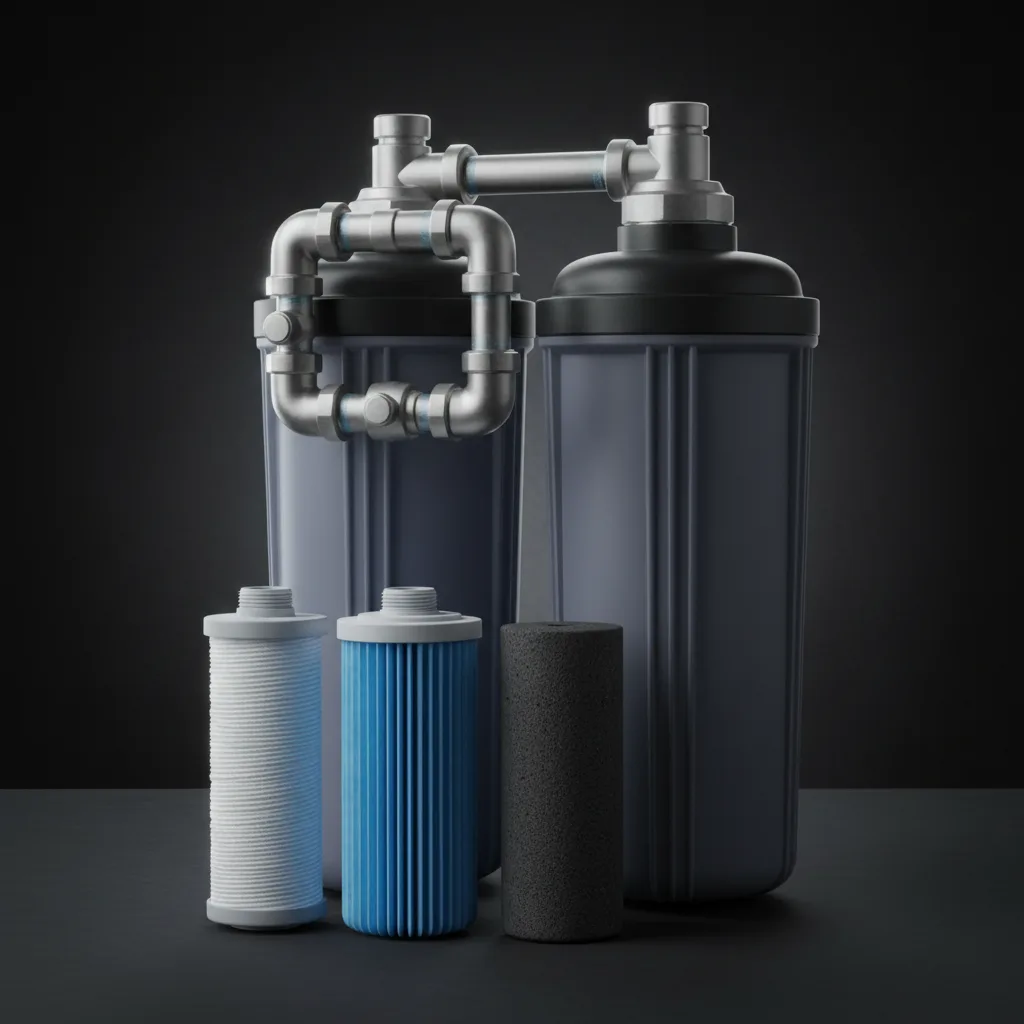
Quick Picks: Our Top Recommendations
| Feature | Editor's Pick Membrane Solutions 5-Micron String Wound Sediment Filter (6-Pack) | Universal 5-Micron Sediment Filter Cartridge | Elkay 51300C WaterSentry Plus Replacement Filter |
|---|---|---|---|
| Price Range | $25–$50 | $25–$50 | $50–$100 |
| Technology | String Wound Polypropylene | Polypropylene Sediment | Activated Carbon Block |
| Pack Size | 6 | — | — |
| Capacity | — | — | 3,000 gallons |
| Micron Rating | 5 | 5 | — |
| Filter Life | — | — | 3,000 gallons (6-12 months) |
| Fits | GE, DuPont, Culligan, Pentek, and most 10" standard housings | Standard 10" whole-house filter housings | Elkay ezH2O and HaloX bottle filling stations |
| Check Price | Check Price | Check Price |
The most effective home water treatment strategy uses a whole-house sediment filter as the first line of defense, followed by a point-of-use filter (under-sink RO or countertop) at your drinking water faucet. The sediment filter protects all your plumbing and extends the life of your drinking water filter. This two-stage approach costs very little per year in sediment cartridges and dramatically improves your overall water quality.
1. Membrane Solutions 5-Micron String Wound Sediment Filter (6-Pack) — Best Value Sediment Filter
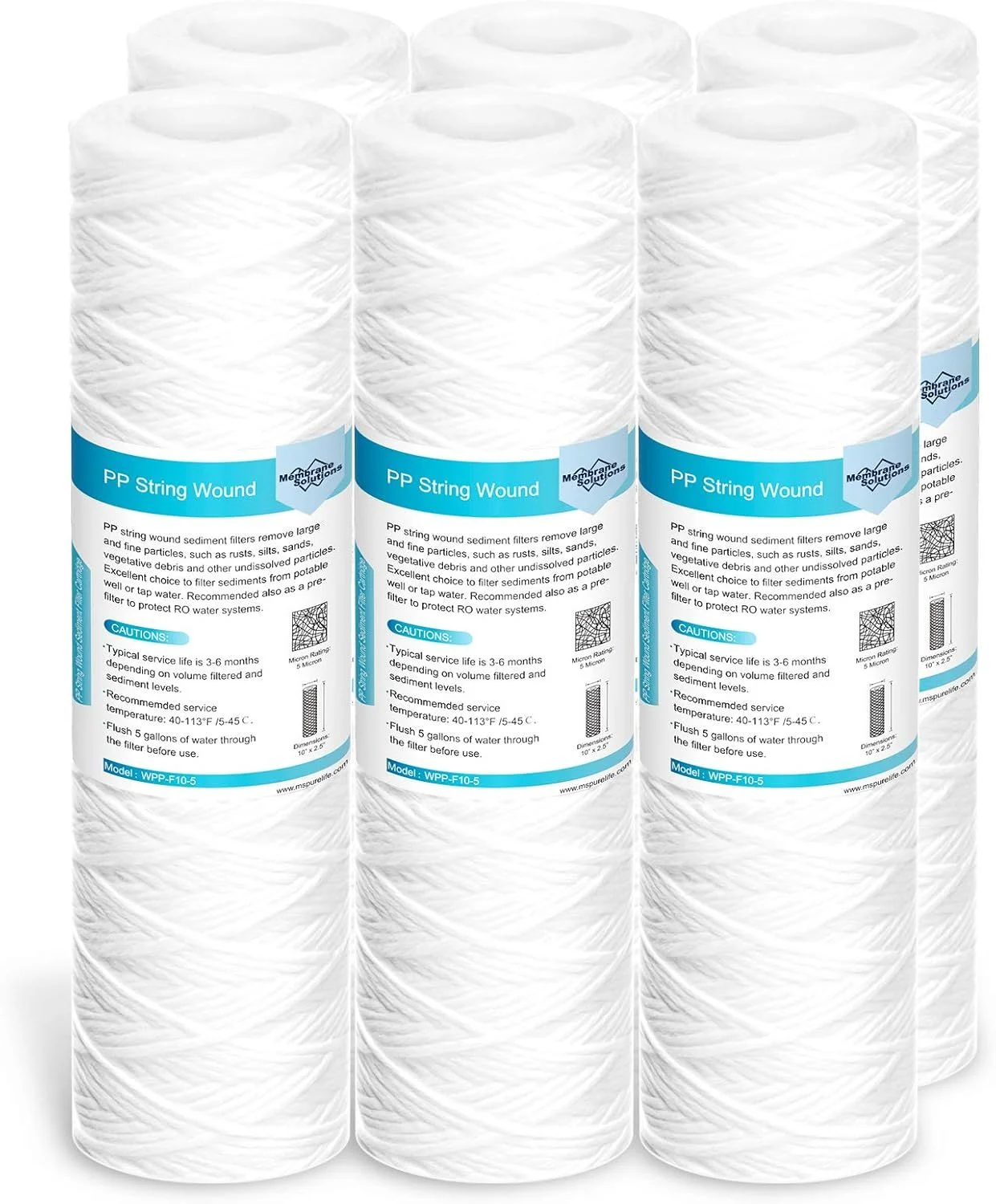
The Membrane Solutions 6-pack is the clear value leader in whole-house sediment filtration. At just a few dollars per filter, a full year of bi-monthly filter changes is remarkably affordable. The string wound polypropylene construction effectively traps sand, silt, rust, and sediment at 5 microns — the standard residential rating that balances filtration quality with adequate water flow and pressure.
The universal 10x2.5-inch form factor fits virtually every standard whole-house filter housing, including systems from GE, DuPont, Culligan, Pentek, and most generic housings available at hardware stores. With 7,200+ reviews and a 4.5-star rating, long-term reliability is well-documented across a wide variety of water conditions and housing brands.
The trade-off with string wound construction is dirt-holding capacity — these filters will clog faster than pleated alternatives in very sediment-heavy well water. They are also strictly disposable; you cannot rinse and reuse them. But at just a few dollars per replacement, the cost of frequent changes is minimal. For the vast majority of residential applications, this 6-pack delivers the best year-round sediment protection per dollar spent.
Who Should Buy the Membrane Solutions 6-Pack
Buy this if: You are on municipal water or a moderately clean well, you already own a standard 10x2.5-inch filter housing, and you want to set up a full year of replacements at once without thinking about it. This is also the right choice if you are introducing a whole-house sediment filter for the first time and want to verify the concept works for your home before committing to a more expensive system. Homeowners who change their filter on a regular schedule — rather than waiting for pressure drop — will consistently get the full expected life from each cartridge.
Skip this if: Your well water is heavily laden with sand or iron sediment that clogs a 5-micron filter within weeks. In that scenario, you need a two-stage setup with a coarser 20-micron prefilter, or a high-capacity pleated filter with greater dirt-holding capability. Similarly, if you have a 4.5-inch "big blue" housing, this 2.5-inch cartridge will not work — you need cartridges sized specifically for larger housings.
- Outstanding value — extremely affordable per filter in the 6-pack
- Universal 10x2.5" standard size fits virtually all standard housings
- String wound construction provides excellent sediment trapping
- String wound design has lower dirt-holding capacity than pleated
- Cannot be cleaned and reused — strictly disposable
2. Universal 5-Micron Sediment Filter Cartridge — Reliable Universal Prefilter
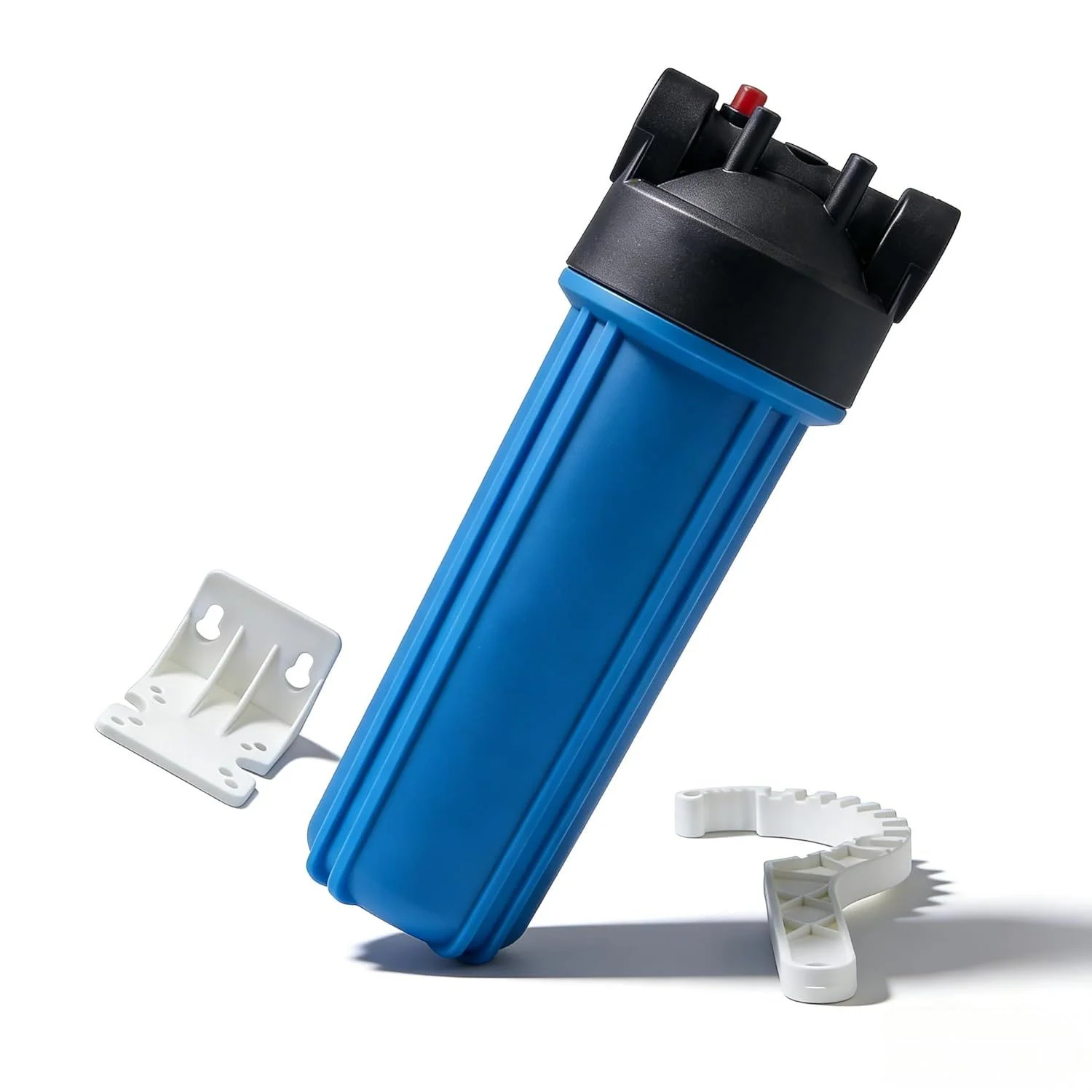
This universal 5-micron sediment cartridge serves as a reliable drop-in replacement for standard 10x2.5-inch whole-house filter housings. The polypropylene construction provides consistent sediment removal for sand, silt, rust, and scale particles. It functions well as a first-stage prefilter in multi-stage whole-house systems where subsequent stages handle chemical or biological filtration.
As a single filter at a significantly higher per-unit price, the economics are much less favorable than the Membrane Solutions 6-pack. The generic branding also means less consistency in manufacturing quality — some users report variation in filter density and effective life between batches. With only 1,500 reviews compared to 7,200 for the Membrane Solutions, the reliability track record is thinner.
This filter makes sense in two scenarios: you need a single replacement urgently and do not want to buy a 6-pack, or your local store carries this but not the Membrane Solutions. For planned purchases, the Membrane Solutions 6-pack is the better buy at less than one-seventh the per-filter cost. However, this filter will get the job done if you need it.
Who Should Buy This Filter
Buy this if: You need a single cartridge quickly — perhaps your filter has clogged ahead of schedule and you have not yet stocked a multi-pack. It also makes sense as a trial cartridge if you are testing a new housing setup and want to confirm fit and performance before ordering in bulk. For renters or homeowners who are uncertain how long they will stay at a property, buying a single unit avoids stocking filters you may not use.
Skip this if: You are planning more than one or two filter changes per year. The per-unit cost at this price tier makes it considerably more expensive annually than buying a multi-pack. Unless availability or convenience forces the issue, the Membrane Solutions 6-pack or a comparable multi-pack delivers far better value for ongoing residential use.
- Universal 10x2.5" compatibility — fits the most common housings
- Solid 5-micron filtration for standard sediment removal
- Works as effective first-stage prefilter in multi-stage systems
- More expensive per filter than Membrane Solutions multi-packs
- Generic branding with less quality consistency
3. Elkay 51300C WaterSentry Plus Replacement Filter — Best for Bottle Filling Stations
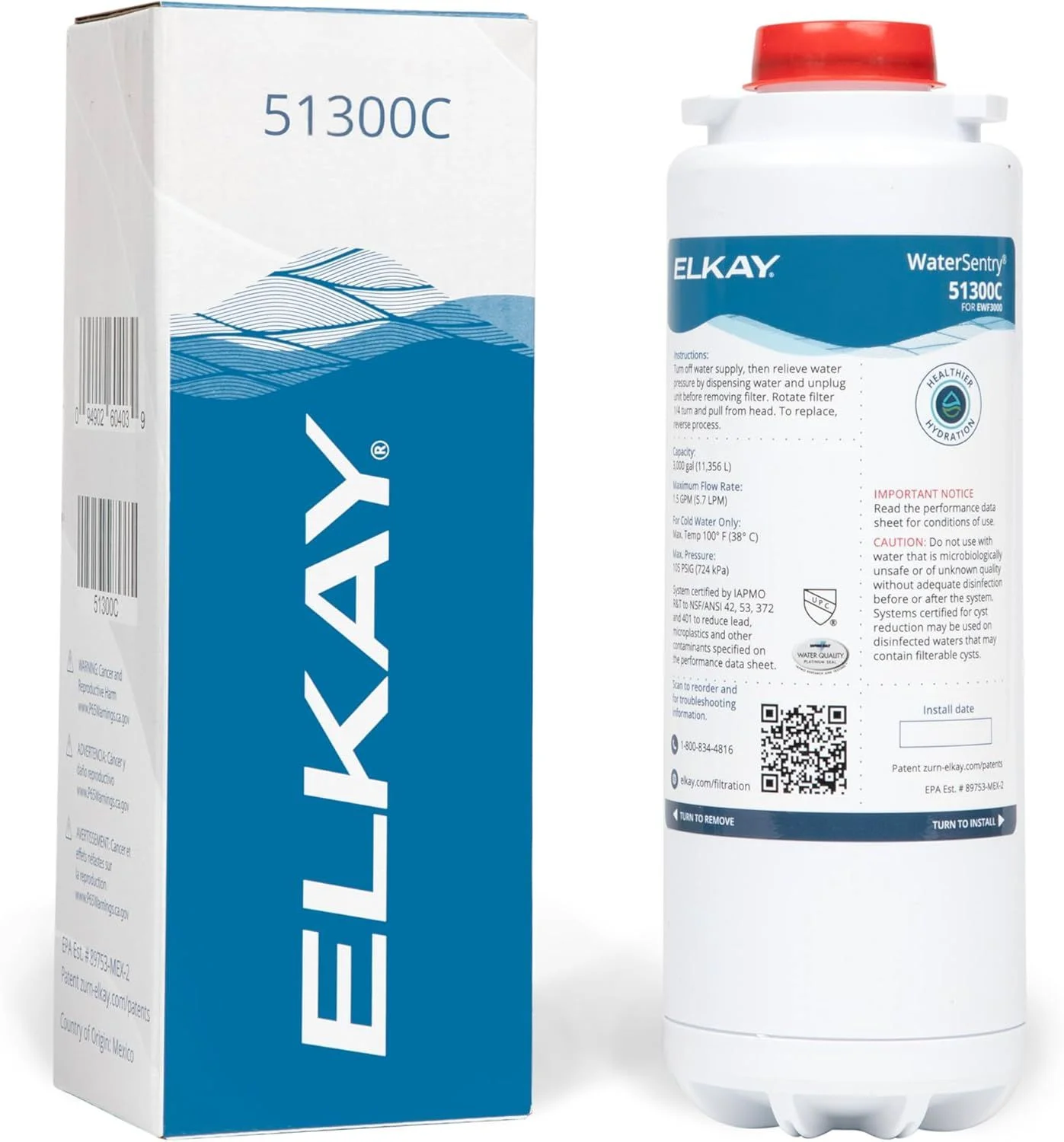
The Elkay 51300C occupies a unique niche in our lineup: it is not a whole-house filter but a commercial-grade replacement cartridge for Elkay ezH2O and HaloX bottle filling stations. These are the water stations you see in schools, airports, gyms, and offices that track how many plastic bottles have been saved. If you maintain one of these units, the 51300C is the required replacement.
The specifications are impressive by any standard: 3,000-gallon capacity, triple NSF 42/53/401 certification covering lead, microplastics, cysts, and pharmaceuticals. This filter provides dramatically more contaminant reduction than any residential sediment cartridge, which makes sense given it is filtering water people drink directly. It is a premium-priced cartridge, but the 3,000-gallon life means commercial installations may only need one or two replacements per year.
The critical limitation is compatibility: this filter only works with specific Elkay and HaloX filling station models. It will not fit any standard whole-house filter housing. Do not purchase this for residential use unless you specifically have an Elkay filling station. For those who do, this is a no-compromise replacement that maintains the high filtration standard these commercial units are known for.
Who Should Buy the Elkay 51300C
Buy this if: You are responsible for maintaining an Elkay ezH2O or HaloX bottle filling station in a school, office, gym, healthcare facility, or any other commercial or institutional setting. The triple NSF certification and 3,000-gallon capacity make this the appropriate — and in most cases the only compliant — replacement for these units. Facilities managers who oversee multiple filling stations benefit from ordering in small quantities to keep a spare on hand, since the filter change process is quick and having a replacement available avoids any downtime.
Skip this if: You are looking for a residential whole-house filter. The Elkay 51300C is purpose-built for a specific commercial platform and carries a price premium that reflects its multi-contaminant NSF certifications. It offers no benefit when used outside its intended application and physically will not fit a standard residential housing. Homeowners seeking lead or pharmaceutical reduction should look at dedicated under-sink reverse osmosis systems or NSF 53-certified point-of-use filters instead.
- Designed specifically for Elkay ezH2O bottle filling stations
- Massive 3,000-gallon capacity — lasts 6-12 months in commercial use
- Triple NSF certification (42/53/401) including lead and pharmaceuticals
- Only works with Elkay/HaloX filling stations — no universal compatibility
- Premium price for residential users who only need basic filtration
How We Chose Our Picks
Whole-house sediment filtration is more straightforward than other filter categories — the primary job is trapping physical particles effectively without excessively reducing water pressure. We evaluated on sediment capture effectiveness (how well does the 5-micron rating hold up in real-world conditions?), filter life consistency (does it last as long as claimed?), compatibility breadth (how many housings does it fit?), annual cost (what does a year of replacements actually cost?), and user satisfaction (do reviews indicate reliable performance?).
The residential sediment filter market is dominated by nearly identical 10x2.5-inch cartridges, so value and reliability data from real users became the primary differentiators. The Membrane Solutions 6-pack's combination of verified reviews, universal compatibility, and exceptional per-filter pricing made it the clear winner for residential applications.
We also weighted manufacturer transparency heavily. Filters that clearly state their actual micron rating, polypropylene grade, and NSF compliance status scored higher than those with vague marketing language. With sediment filters, the most meaningful quality indicator is whether the claimed micron rating is nominal (meaning it catches roughly 50–70% of particles at that size) or absolute (meaning it catches 99.9% of particles at that size). Most residential string wound filters are nominal-rated — which is fine for their intended purpose, but worth understanding when comparing specs on paper.
Cost of Ownership: What a Year of Whole-House Filtration Actually Costs
One of the most compelling arguments for whole-house sediment filtration is the extraordinarily low ongoing cost relative to the protection it provides. Understanding the full cost of ownership helps you compare options honestly and avoid being misled by low per-unit prices that require frequent replacements or high per-unit prices that look expensive in isolation.
Budget-friendly multi-packs (like the Membrane Solutions 6-pack) represent the lowest annual cost of any sediment filtration approach. At a replacement interval of every two months, a 6-pack covers a full year of protection. Even on a shorter replacement cycle — say, monthly for heavy well water sediment — a 6-pack at this price tier keeps annual costs minimal. This is the most economical choice for the vast majority of homeowners.
Mid-range single cartridges cost several times more per unit than multi-pack alternatives. If you are replacing filters every two to three months, the annual cost of single-cartridge purchasing approaches or exceeds the cost of a full multi-pack, with no quality advantage to justify the difference. Single-unit purchases make sense only when convenience or availability forces the issue, not as a routine purchasing strategy.
Premium commercial cartridges like the Elkay 51300C sit in a different cost category entirely — but the comparison is apples-to-oranges. A commercial bottle filling station filter serves hundreds of users daily and provides NSF 401 pharmaceutical removal and NSF 53 lead reduction that residential sediment filters are not designed to deliver. The higher price reflects the certification depth, the 3,000-gallon capacity, and the commercial application. Evaluated on a cost-per-gallon basis, the Elkay 51300C is actually reasonable for what it does.
Hidden costs to consider: Filter housing purchase or replacement (one-time, typically in the budget-to-mid-range tier for a standard 10-inch housing), a housing wrench for cartridge changes (inexpensive, usually included), a bypass valve installation (strongly recommended, modest plumbing cost), and occasional O-ring replacement on the housing sump. Over a five-year ownership period, the cartridge replacement cost dominates all other expenses for residential users — making the per-cartridge price the most important number to evaluate.
Install an inexpensive pressure gauge before and after your whole-house filter housing. Note the pressure differential when the filter is fresh. When the differential increases by 8–10 PSI, it is time to change the cartridge — regardless of calendar interval. This approach prevents both premature filter changes (wasted money) and overdue changes (reduced appliance protection). On municipal water, most homeowners find this confirms the 2–3 month guideline. On well water, the data often surprises people — sometimes filters need changing in three weeks, sometimes they last four months depending on season and rainfall.
Buying Guide: What to Look For in Whole-House Filters
Start with your water source. Municipal water typically has low to moderate sediment levels, making a single 5-micron sediment filter sufficient for whole-house protection. Well water varies dramatically — some wells produce clear water, while others deliver heavy sand and iron sediment that can clog a 5-micron filter in weeks. Test your well water or observe the current sediment level in a glass to gauge your filtration needs.
Match the filter to your housing. The standard residential size is 10 x 2.5 inches. Verify your existing housing dimensions before ordering. If you are installing a new housing, standard 10-inch systems are the most affordable and have the widest filter selection. Larger 4.5-inch "big blue" housings offer higher flow rates and longer filter life for large homes or heavy sediment conditions.
Understand what sediment filters do NOT do. Sediment filters remove physical particles only. They do not remove chlorine, chemicals, bacteria, lead, PFAS, or dissolved contaminants. For drinking water quality, pair your whole-house sediment filter with a point-of-use system (under-sink RO or countertop filter) at your kitchen faucet. Think of the sediment filter as protecting your plumbing and the point-of-use filter as protecting your health.
Consider your household flow rate requirements. A standard 10x2.5-inch housing at 5 microns typically handles flow rates in the range comfortable for most single-family homes. Larger families with simultaneous high-demand usage — multiple showers, irrigation running alongside indoor use — may notice pressure drop at the filter as it loads. If this is a concern, step up to a 4.5-inch diameter housing, which offers substantially more filter surface area and maintains flow rate even as the cartridge fills with sediment. The cartridges for larger housings cost more per unit, but the performance difference in high-demand situations is significant.
Evaluate nominal versus absolute micron ratings. Most residential sediment filters are rated nominally — they capture a percentage (typically 70–85%) of particles at the stated micron size. Absolute-rated filters capture 99.9% at the stated size and are more common in commercial or medical applications. For whole-house sediment pre-filtration, nominal 5-micron filters are entirely adequate. If you are protecting a sensitive downstream system like an RO membrane, look for filters with tighter nominal ratings or consider an absolute-rated cartridge for the final stage.
For well water with heavy sediment, install a two-stage filter housing: a 20-micron cartridge in the first stage to catch large particles, followed by a 5-micron cartridge in the second stage for fine filtration. This extends the life of both filters and prevents the fine 5-micron cartridge from clogging prematurely. The total annual cost of this approach remains very affordable.
Whole-House Sediment Filters vs. Alternatives
Whole-house sediment cartridge filters are not the only approach to managing particulate contamination in your home's water supply. Understanding how they compare to alternatives helps you make the right choice for your specific situation.
Spin-down sediment separators (sometimes called pre-filters or sediment separators) use centrifugal action to spin particles out of the water stream into a collection chamber that you periodically flush. They require no cartridge replacement and are particularly effective for large-particle sediment like sand and grit. However, they typically only capture particles above 100 microns and do not provide the fine 5-micron filtration that protects water heater elements and appliance valves. The best whole-home approach for heavy well water sediment is a spin-down separator followed by a cartridge sediment filter — the separator handles the bulk load, and the cartridge finishes the job.
Whole-house carbon block filters remove sediment down to 5 microns and also reduce chlorine, taste, and odor. They sound like an upgrade, but carbon blocks have lower flow rates than equivalent-sized sediment cartridges and clog faster when sediment loads are significant. Using a carbon block as your only whole-house filter when sediment is present wastes the carbon's chemical reduction capability on particle capture. The more efficient approach is a dedicated sediment prefilter protecting a downstream carbon block — each doing what it does best.
Water softeners are sometimes confused with filtration systems, but they work on a fundamentally different principle — ion exchange to remove calcium and magnesium hardness minerals. They do not filter sediment, though some softeners include a small sediment screen. If you have both hardness and sediment problems, a sediment cartridge filter installed before the softener protects the softener resin bed and prolongs its service life.
Reverse osmosis systems include their own sediment prefilter cartridge, but the flow rate of an RO system is far too low to serve whole-house needs. RO is a point-of-use solution for drinking and cooking water, not a whole-home sediment management tool. Installing a whole-house sediment filter upstream of your RO system protects the RO membrane and extends the life of the RO's internal prefilter cartridges — a worthwhile combination in homes with sediment-laden water.
Frequently Asked Questions
What does a whole-house sediment filter actually do?
How often should I replace my whole-house sediment filter?
What micron rating should I choose for my whole-house filter?
Do I need a whole-house filter if I have city water?
What is the difference between string wound and pleated sediment filters?
What size whole-house filter housing do I need?
Can the Elkay 51300C be used in a home setting?
Will a whole-house sediment filter reduce my water pressure?
Can I install a whole-house filter myself, or do I need a plumber?
Does a sediment filter affect water taste or smell?
How do I know if my water has a sediment problem?
Our Recommendation
For residential whole-house sediment filtration, the Membrane Solutions 5-Micron String Wound Sediment Filter 6-Pack is the definitive recommendation. As the most affordable multi-pack in our lineup, it provides a full year of filters at an unbeatable price — the most cost-effective way to protect your entire plumbing system from sediment damage. The universal 10x2.5-inch size fits virtually every standard housing, and 7,200+ positive reviews confirm reliable, consistent performance. Pair it with an under-sink RO system for complete home water treatment. For Elkay bottle filling station operators, the Elkay 51300C WaterSentry Plus is the required commercial-grade replacement with outstanding NSF certifications.
Check Top Pick on Amazon