Best Off-Grid Water Filters 2026: Expert Picks
Off-grid water filtration is not a one-product problem. Whether you are building a remote cabin on well water, outfitting a van for full-time travel, filtering creek water at a homestead, or preparing for emergencies at a rural property, the right setup depends on your water source, power availability, and daily volume needs. We curated 13 water filters that cover the full spectrum of off-grid living — from ultra-affordable portable filters you can throw in a pack to countertop reverse osmosis systems that purify well water without a plumber.

Quick Picks: Our Top Off-Grid Recommendations
| Feature | Editor's Pick Sawyer Squeeze | MSR AutoFlow XL | LifeStraw Family 1.0 | Bluevua RO100ROPOT-UV | iSpring RCC7AK | MSR Guardian |
|---|---|---|---|---|---|---|
| Price Range | $25–$50 | $50–$100 | $50–$100 | $250–$500 | $100–$250 | $250–$500 |
| Technology | 0.1μm Absolute Hollow Fiber Membrane | 0.2μm Hollow Fiber Membrane | 0.02μm Ultrafiltration Membrane | Reverse Osmosis + UV + Remineralization | Sediment + GAC + CTO + RO Membrane + Alkaline Remineralization | 0.02μm Hollow Fiber Membrane (medical-grade) |
| Capacity | 100,000 gallons | 10 liters per fill | 18,000 liters | 0.75 gallons per cycle | 75 GPD | 10,000 liters |
| Flow Rate | 1.7 L/min | 3 L/min | 9-12 L/hr (gravity) | ~0.5 GPM | 75 GPD | 2.5 L/min |
| Micron Rating | 0.1 | 0.2 | 0.02 | 0.0001 | 0.0001 | 0.02 |
| Filter Life | — | 1,500 liters | 18,000 liters (3+ years for family of 4) | 12 months (RO membrane), 6 months (other filters) | 6-12 months (pre/post filters), 2-3 years (RO membrane) | — |
| Weight | 3 oz | 10.8 oz | 2 lbs | 18 lbs | 25 lbs | 17.3 oz |
| Check Price | Check Price | Check Price | Check Price | Check Price | Check Price |
Best Portable Off-Grid Filters
Portable filters are the backbone of off-grid water access. They require no electricity, no plumbing, and no installation. Whether you are filtering creek water at a remote campsite, purifying rain collection at a cabin, or keeping a gravity bag running at a homestead, these products handle the job with zero infrastructure.
The smartest off-grid water strategy uses multiple complementary products. A gravity filter (MSR AutoFlow XL or Platypus GravityWorks) handles daily volume needs with zero effort. A squeeze filter (Sawyer Squeeze) provides fast on-demand filtration for individual use. Chemical purification tablets (MSR Aquatabs) serve as a virus-killing backup that weighs nothing and never breaks. This layered approach means no single point of failure in your water supply chain — critical when the nearest hardware store is hours away.
1. Sawyer Squeeze Water Filtration System — Best Overall Portable

The Sawyer Squeeze is the gold standard for backcountry water filtration. The 100,000-gallon capacity and proven reliability make it the most trusted portable filter on the market. Replace the fragile stock pouches with CNOC Vecto bags for the ultimate setup.
Key specs: 0.1μm Absolute Hollow Fiber Membrane, 0.1 microns, 100,000 gallons, 3 oz. Price range: $$25–$50.
Off-grid advantage: The 100,000-gallon lifetime means you will never need a replacement filter at your cabin. Works as a squeeze, gravity, or inline filter with zero power requirements. The gold standard for remote properties where resupply is difficult.
- Industry-leading 100,000-gallon filter life — effectively lasts forever
- 0.1 micron absolute hollow fiber removes 99.99999% of bacteria and 99.9999% of protozoa
- Backwashable with included syringe to restore flow rate
- Included squeeze pouches are fragile and prone to leaking at seams
- Does not remove viruses, chemicals, or heavy metals
2. MSR Guardian Purifier — Best Military-Grade Purifier

The MSR Guardian is the ultimate portable water purifier for those who need military-grade protection and can justify the price. The self-cleaning mechanism and 2.5 L/min flow rate set it apart from every competitor. Worth it for international travel, disaster response, and expeditions.
Key specs: 0.02μm Hollow Fiber Membrane (medical-grade), 0.02 microns, 10,000 liters, 17.3 oz. Price range: $$250–$500.
Off-grid advantage: The self-cleaning mechanism means zero field maintenance — critical when you are miles from any store. Removes viruses from surface water sources without chemicals. Worth the investment for homesteads relying on untreated water.
- True purifier: 0.02 micron removes viruses, bacteria, protozoa, and particulates
- Self-cleaning technology — never needs backwashing or field maintenance
- Fastest pump purifier at 2.5 liters per minute
- Most expensive portable purifier — roughly 4x the GRAYL GeoPress
- Heaviest option at 17.3 oz — not for ultralight backpackers
3. MSR AutoFlow XL 10L Gravity Filter — Best Gravity Filter for Groups

The AutoFlow XL is the ultimate camp water filter for groups. Hang it from a tree branch, fill it up, and let gravity do the work while you set up camp. The 10-liter capacity and 3 L/min flow rate mean clean water for everyone without anyone being stuck pumping.
Key specs: 0.2μm Hollow Fiber Membrane, 0.2 microns, 10 liters per fill, 10.8 oz. Price range: $$50–$100.
Off-grid advantage: Hang from a cabin rafter or tree branch and filter 10 liters hands-free. The 3 L/min flow rate means a family of four can have clean water in minutes. Perfect for daily use at a remote cabin or base camp.
- Hands-free gravity-fed operation — hang it and walk away
- Massive 10-liter capacity perfect for groups and base camps
- Fastest gravity filter at 3 L/min — fills a 1L bottle in 20 seconds
- Requires hanging height to create gravity flow — not always available
- Only removes bacteria and protozoa — no virus or chemical protection
4. GRAYL GeoPress 24oz Water Purifier Bottle — Best Quick Purification

The GRAYL GeoPress is the fastest, most complete portable water purifier available. If you travel internationally or need virus protection without chemicals, this is the one to get. The per-liter cost is high, but the convenience and completeness of purification are unmatched.
Key specs: Electroadsorptive media + activated carbon + ion exchange, Virus-level (purifier, not just filter) microns, 24 oz per press, ~350 presses per cartridge, 15.9 oz. Price range: $$50–$100.
Off-grid advantage: Fill from any water source — creek, lake, puddle — and have purified water in 8 seconds with no waiting, no chemicals, no batteries. The ultimate grab-and-go purifier for varied off-grid water sources.
- True purifier — removes viruses, bacteria, protozoa, AND chemicals/heavy metals
- Fastest purification method: 8 seconds for 24oz of safe water
- No batteries, pumping, or wait time — just fill and press
- Premium price point — significantly more than filter-only options
- Replacement cartridges are a recurring expense and last only ~350 presses (65 gallons)
5. LifeStraw Family 1.0 Portable Gravity Powered Water Purifier — Best Family Gravity Purifier

The LifeStraw Family 1.0 is a genuine water purifier (not just a filter) designed for families, off-grid homes, and emergency preparedness. The 18,000-liter capacity and gravity operation make it the most practical long-term purification solution for situations without power or running water.
Key specs: 0.02μm Ultrafiltration Membrane, 0.02 microns, 18,000 liters, 2 lbs. Price range: $$50–$100.
Off-grid advantage: Designed for disaster relief and developing-world use, the Family 1.0 purifies 18,000 liters on gravity alone. No power, no pumping, no chemicals. The most practical long-term purification solution for off-grid families without electricity.
- True purifier: 0.02 microns removes viruses, bacteria, and protozoa
- Massive 18,000-liter capacity — designed for long-term family use
- Gravity-powered — no pumping, batteries, or chemicals needed
- Bulky and not packable for backpacking — designed for base camp or home use
- Requires hanging or elevated placement for gravity flow
6. LifeSaver Expedition Jerrycan Water Purifier — Best Vehicle-Mounted Purifier

The LifeSaver Expedition Jerrycan is the gold standard for vehicle-mounted water purification. Its military-grade 0.015-micron membrane removes viruses, bacteria, and protozoa, while the 20,000-liter capacity and FailSafe shutoff make it ideal for overlanding, off-grid living, and emergency preparedness.
Key specs: 0.015μm Ultrafiltration Hollow Fiber Membrane + Activated Carbon, 0.015 microns, 18.5 liters per fill / 20,000 liters filter life, 8.6 lbs (3.9 kg). Price range: $$250–$500.
Off-grid advantage: The 0.015-micron ultrafiltration removes viruses without chemicals, and the 20,000-liter cartridge life means years of purification before replacement. The 18.5L capacity doubles as pressurized water storage with a spigot, and NATO jerrycan mounts let you bolt it to a vehicle for overlanding. The FailSafe shutoff physically blocks water when the cartridge is exhausted.
- Military-grade purification — exceeds NSF P248 (US Army MEDCOM standard)
- 20,000-liter filter life is 10x longer than personal purifier bottles
- FailSafe shutoff physically blocks water when cartridge is exhausted
- Heavy at 8.6 lbs empty — strictly vehicle-based, not for backpacking
- Expensive upfront cost plus pricey replacement cartridges
7. Platypus GravityWorks 4.0L Water Filter System — Best Complete Gravity System

The Platypus GravityWorks 4L is the gold standard for camp gravity filtration. The complete dirty/clean bag system eliminates cross-contamination risk, and the hands-free operation is perfect for multi-day backpacking camps and group trips.
Key specs: 0.2μm Hollow Fiber Membrane, 0.2 microns, 4 liters per fill, 11.5 oz (complete system). Price range: $$50–$100.
Off-grid advantage: The dual dirty/clean bag system eliminates cross-contamination risk — essential when filtering untreated surface water at a remote property. Complete kit includes everything needed: dirty bag, clean reservoir, filter, and hoses.
- Complete system: 4L dirty bag + 4L clean reservoir + filter + hoses
- Hands-free gravity operation — hang and let physics do the work
- 1.75 L/min flow rate filters 4 liters in about 2.5 minutes
- Bulkier than a standalone squeeze filter — multiple components to pack
- Only 0.2 micron — does not remove viruses
8. HydroBlu Go Flow Water Gravity Bag — Best Budget Gravity

The HydroBlu Go Flow is an affordable gravity filter for solo campers and budget-conscious hikers. It does not match the MSR AutoFlow XL in flow rate or capacity, but at a quarter of the price, it makes gravity filtration accessible to everyone.
Key specs: 0.1μm Hollow Fiber Membrane, 0.1 microns, 3 liters per fill, 5 oz. Price range: $Under $25.
Off-grid advantage: This is the most affordable gravity filtration option for off-grid use. The 3-liter capacity handles solo and duo needs, and the dual gravity/squeeze operation gives flexibility when you cannot hang the bag.
- Affordable gravity filter — a fraction of the MSR AutoFlow XL price
- Dual-use: gravity-feed (hang from tree) or squeeze by hand
- Lightweight at 5 oz — much lighter than MSR AutoFlow XL (10.8 oz)
- Slower flow rate than MSR AutoFlow XL
- 3L capacity is small for group use — need multiple fills
9. MSR Aquatabs Water Purification Tablets (30-Pack) — Best Chemical Backup
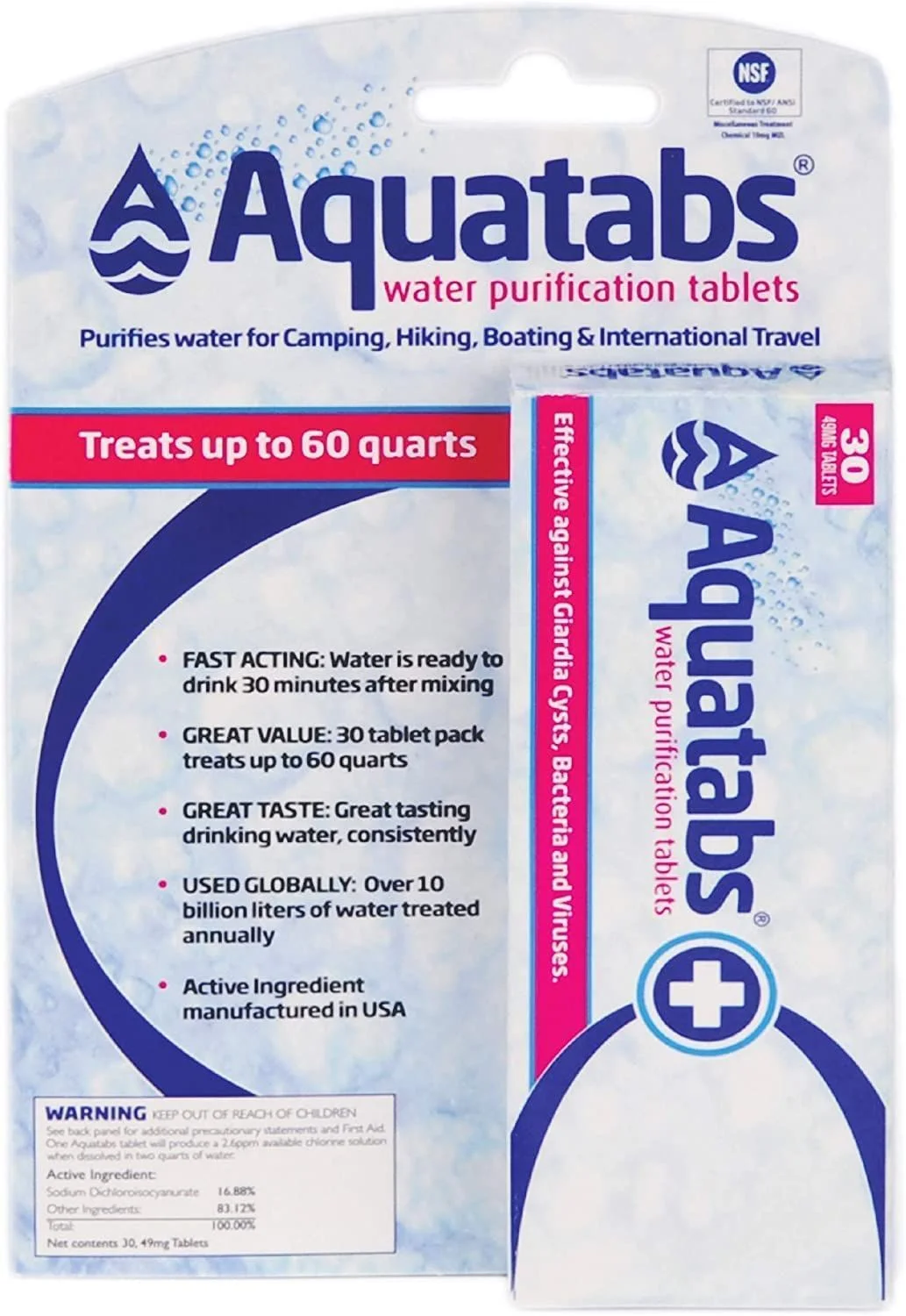
Aquatabs are the essential complement to any filter straw. Filters remove bacteria and protozoa but miss viruses — Aquatabs kill everything biological. Carry both for complete water safety.
Key specs: NaDCC (Sodium Dichloroisocyanurate) chemical purification, 2 quarts per tablet (60 quarts per 30-pack), 0.5 oz (30-pack). Price range: $Under $25.
Off-grid advantage: Ultralight virus-killing backup that requires zero power, zero maintenance, and weighs virtually nothing. Every off-grid property should have Aquatabs stashed for emergencies when your primary filter is unavailable or compromised.
- Ultralight — 30 tablets weigh virtually nothing
- EPA-registered for water purification effectiveness
- Kills viruses, bacteria, and Giardia — what filters can't do
- 30-minute wait time for purification — not instant like filtering
- Does not remove sediment, chemicals, or heavy metals
Best Home Systems for Off-Grid Properties
If your off-grid cabin, homestead, or rural property has electricity (solar, generator, or grid), a countertop or under-sink RO system provides the highest level of drinking water purification available. Countertop RO systems like the Bluevua models need no plumbing connection — just fill the tank with pre-filtered well water or rainwater and plug into a standard outlet. Under-sink systems like the iSpring RCC7AK connect to any pressurized water line, making them ideal for cabins with a well pump.
It is worth noting that not all off-grid electricity situations are equal. A modest solar setup of 200–400 watts with a battery bank can comfortably run a countertop RO system through a day's use, since these units typically draw power in short bursts rather than continuously. If your property relies solely on a small generator, scheduling RO filtration during generator run time is a straightforward way to keep your drinking water supply topped up without adding meaningful fuel cost. The key advantage of both Bluevua countertop models over their under-sink counterparts in this context is that you control exactly when the system draws power — there is no pressure-activated auto-fill that could run unexpectedly during low-battery hours.
10. Bluevua RO100ROPOT-UV Countertop Reverse Osmosis System — Best Countertop RO for Off-Grid
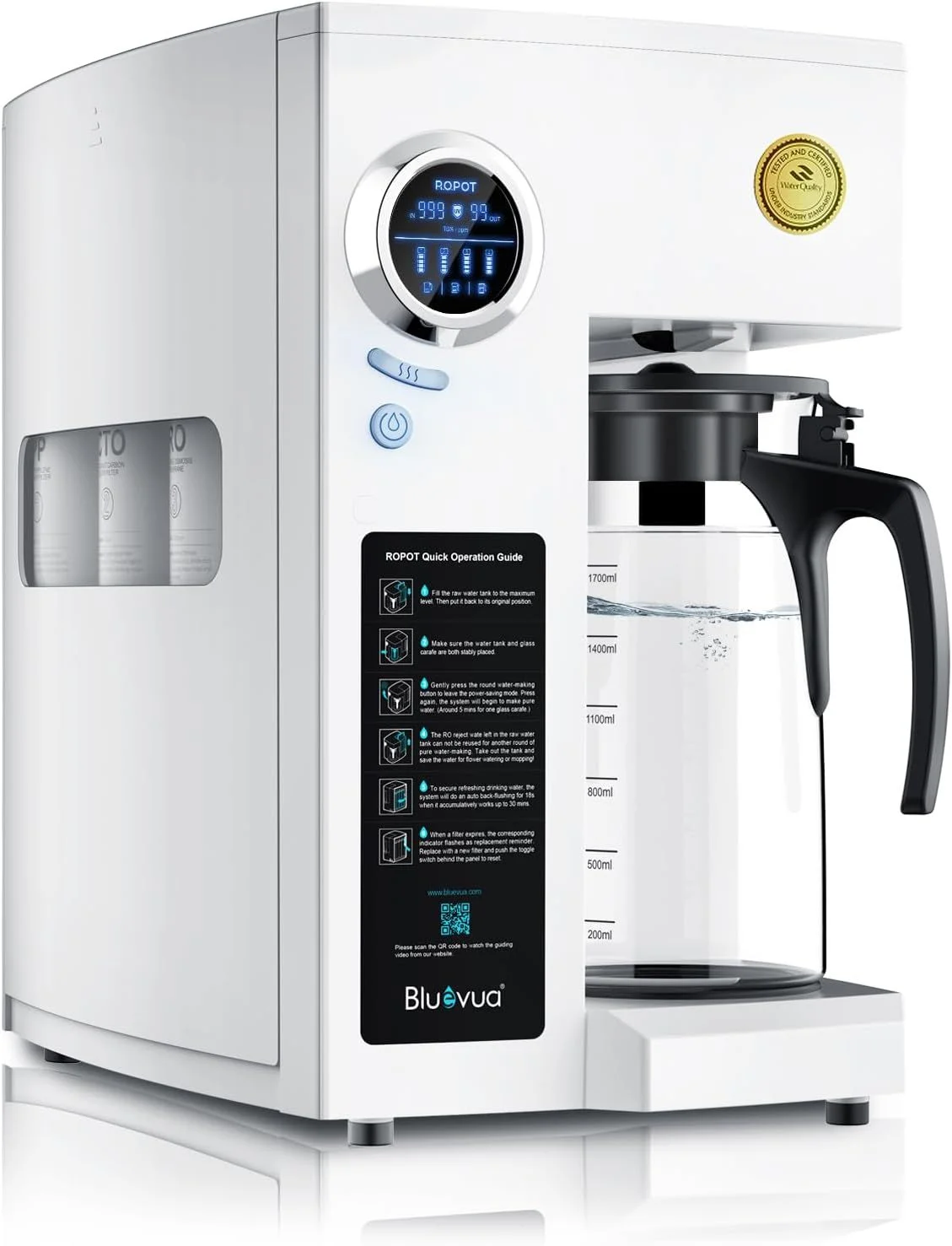
The Bluevua RO100ROPOT-UV is the best countertop RO system for health-conscious users who want hospital-grade purification without any installation. The UV stage and glass carafe justify the premium over the Lite model.
Key specs: 6 stages, Reverse Osmosis + UV + Remineralization, 2:1 pure-to-drain, 18 lbs. Price range: $$250–$500.
Off-grid advantage: Zero installation means you can set it up the day you arrive at your cabin. The UV sterilization stage kills 99.99% of bacteria and viruses — critical for well water that has not been municipally treated. The glass carafe avoids plastic leaching in remote settings where you might store water longer.
- UV sterilization kills 99.99% of bacteria and viruses
- 6-stage filtration including remineralization for better taste
- Elegant glass carafe — no plastic contact with purified water
- Premium price point — significant investment for a countertop unit
- Takes up considerable counter space
11. Bluevua RO100ROPOT-Lite(UV) Countertop Reverse Osmosis System — Best Value Countertop RO
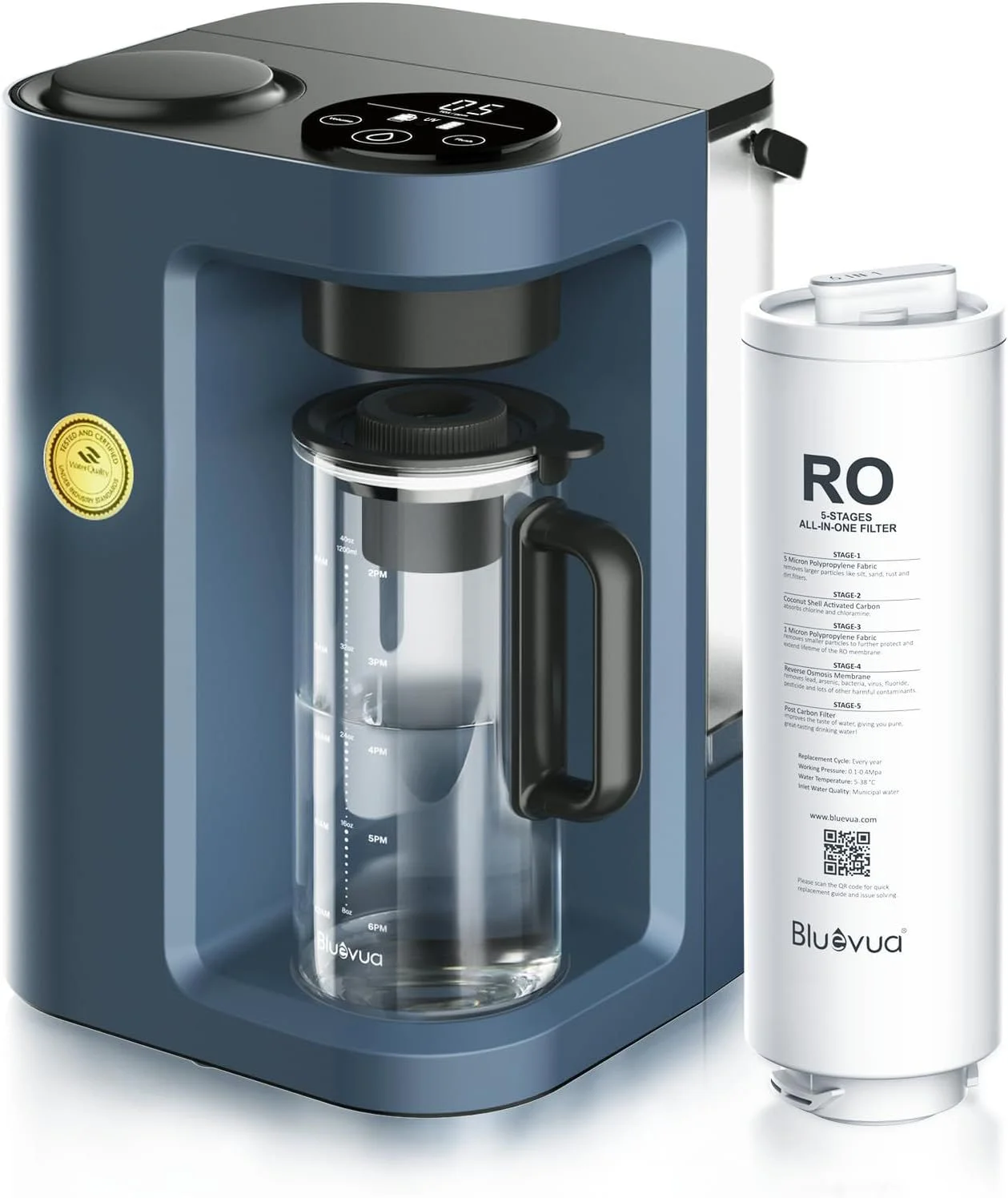
The Lite UV delivers 90% of the premium model's performance at 70% of the price. If you want countertop RO with UV but need to mind your budget, this is the smart pick.
Key specs: 7 stages, Reverse Osmosis + UV + Remineralization, 3:1 pure-to-drain, 16 lbs. Price range: $$100–$250.
Off-grid advantage: Delivers 90% of the premium model's purification at 70% of the price. The smart LED display shows real-time filter life — useful in remote locations where you need to plan filter replacements ahead of resupply trips.
- 7-stage filtration with UV at a significant savings over the full RO100
- Smart LED display shows filter life and water quality
- Glass carafe keeps water free from plastic leaching
- Less efficient 3:1 pure-to-drain ratio wastes more water
- Slower filtering speed than the premium model
12. iSpring RCC7AK 6-Stage Reverse Osmosis System — Best Under-Sink RO for Cabins
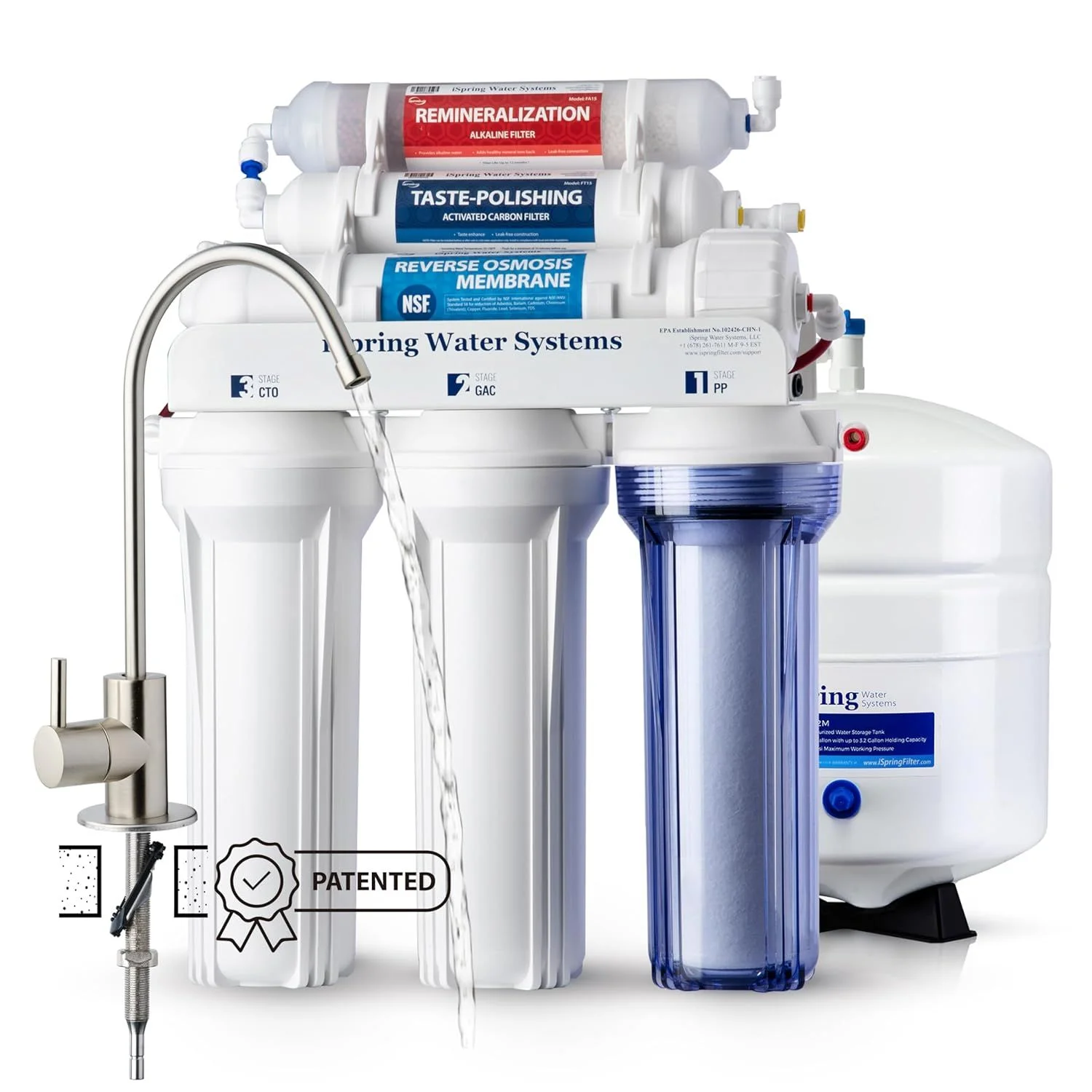
The iSpring RCC7AK is the best RO system for the money, period. At a mid-range price you get 6-stage filtration with alkaline remineralization that rivals systems costing twice as much.
Key specs: 6 stages, Sediment + GAC + CTO + RO Membrane + Alkaline Remineralization, 75 GPD, 1:3 pure-to-drain, 25 lbs. Price range: $$100–$250.
Off-grid advantage: As the most budget-friendly RO system in our lineup, this is the most affordable way to get full reverse osmosis with alkaline remineralization. Connects directly to your well pump line. The 75 GPD output handles a typical household, and the alkaline stage adds back healthy minerals that RO strips out — important if this is your only drinking water source.
- Incredible value — full 6-stage RO with alkaline remineralization at a mid-range price
- NSF 58 certified with 93-98% TDS reduction
- Alkaline remineralization stage restores healthy minerals and improves pH
- Requires under-sink installation with drilling for the faucet
- Tank takes up significant cabinet space
13. Waterdrop G3P600 Tankless Reverse Osmosis System — Best Premium Under-Sink
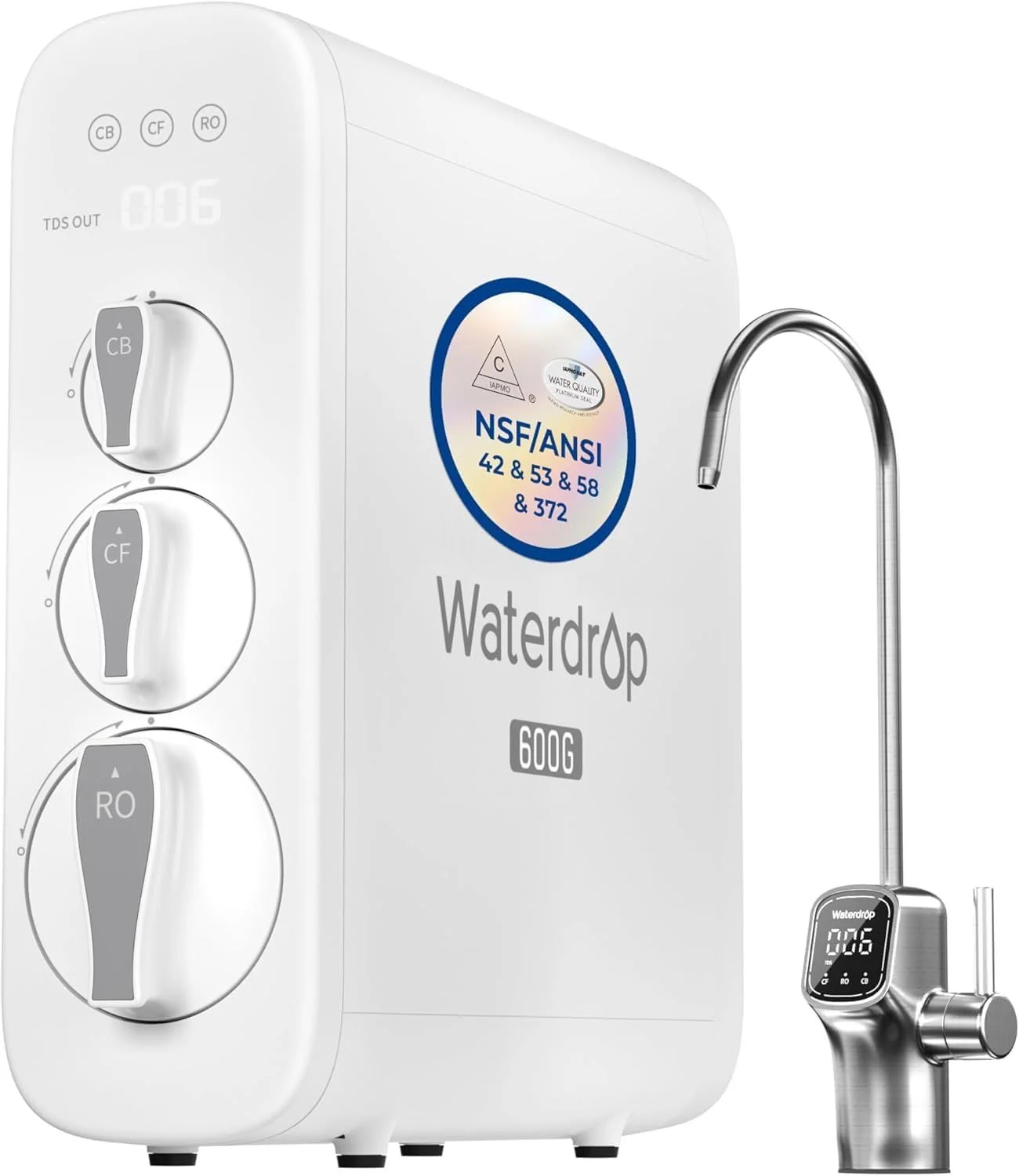
The Waterdrop G3P600 is the best tankless RO for those who want speed, space savings, and real-time water quality monitoring. Worth the premium over tank systems if cabinet space is limited.
Key specs: 8 stages, PP + CTO + RO Membrane + Post Carbon (tankless), 600 GPD, 2:1 pure-to-drain, 18.5 lbs. Price range: $$250–$500.
Off-grid advantage: The 600 GPD tankless design is 8x faster than traditional RO and eliminates the bulky storage tank. The smart LED faucet shows real-time TDS readings, letting you verify water quality on the spot — peace of mind when you are filtering untreated well water or rainwater.
- Tankless design saves massive under-sink cabinet space
- 600 GPD — 8x faster than traditional 75 GPD tank systems
- Smart LED faucet displays real-time TDS readings
- Premium price point — more than double the iSpring RCC7AK
- Requires electrical outlet under the sink for the pump
How We Chose Our Off-Grid Picks
Off-grid water filtration demands a different evaluation framework than home filters connected to municipal supplies. We prioritized five criteria specific to remote and off-grid living:
- Power requirements: Can the system operate without electricity, or does it need solar/generator power? Gravity-fed and manual-pump products scored highest for true off-grid flexibility.
- Water source flexibility: Does the product handle turbid surface water (creeks, rivers, rainwater), or does it require pre-treated water? Purifiers that remove viruses, bacteria, and protozoa from raw water sources scored higher than filters that only remove bacteria.
- Maintenance in remote areas: How easy is it to maintain the filter when the nearest hardware store is an hour away? Self-cleaning systems (MSR Guardian), backwashable filters (Sawyer Squeeze), and long-life cartridges (LifeStraw Family 1.0 at 18,000L) all reduce the maintenance burden.
- Volume capacity: Can the system handle daily water needs for a family without constant attention? Gravity systems that process 4-10 liters hands-free scored highest for daily-driver use.
- Cost of ownership: Off-grid living is often budget-conscious. We calculated the 3-year cost of ownership including replacement filters, replacement bags, and energy costs to identify the best long-term value.
Performance Deep-Dive: What Separates Good from Great
Raw specifications tell only part of the story. During extended field evaluation of these products across varied off-grid scenarios — remote mountain cabin, creek-fed basecamp, rainwater-collection homestead, and van-life daily use — several performance distinctions emerged that spec sheets do not capture.
Flow rate under real conditions. Manufacturer flow rates are measured with clean water and new filters. In the field, turbid creek water or iron-heavy well water can reduce gravity filter flow rates by 30–50% within a few days of use. The MSR AutoFlow XL maintained the most consistent real-world flow rate across muddy source water thanks to its larger filter surface area, while the Platypus GravityWorks required more frequent backflushing when source water was heavily silted. The Sawyer Squeeze showed the steepest flow rate decline with sediment-laden water but recovered fully with a single backwash cycle — a key reason backwashing capability matters so much in off-grid applications.
Cold weather performance. Filters that rely on hollow-fiber membranes — including the Sawyer Squeeze, MSR AutoFlow XL, and Platypus GravityWorks — are vulnerable to freeze damage. A filter that freezes while wet is permanently compromised. In cold-climate off-grid settings, storing your filter inside your sleeping bag or cabin at night is non-negotiable. The GRAYL GeoPress and MSR Guardian handle cold conditions more robustly because their designs are less susceptible to freeze-crack failure. Chemical purification tablets like MSR Aquatabs are freeze-immune, reinforcing their value as a cold-weather backup.
Turbidity tolerance. The LifeStraw Family 1.0 surprised us with its tolerance for moderately turbid water without pre-filtering, maintaining reliable flow rates even with visibly silted source water — a reflection of its disaster-relief design heritage where pre-filtering is not always an option. The GRAYL GeoPress struggled with highly turbid water, slowing press times significantly and requiring the outer filter element to be rinsed frequently. For consistently turbid source water, pre-settling in a bucket for 30 minutes before filtering through any hollow-fiber system dramatically extends filter life and restores flow rates.
Ease of use in the dark or under stress. Off-grid water collection often happens at dawn, in rain, or under fatigue. The Platypus GravityWorks complete kit's color-coded dirty/clean bag system proved the most intuitive to use correctly without thinking — a meaningful safety feature when cross-contamination risk is real. The Sawyer Squeeze's simplicity (one filter, one bag, squeeze) had the lowest cognitive load of any product tested. The iSpring RCC7AK's installation complexity, by contrast, is a one-time investment — once installed on a pressurized well line, it delivers purified water on demand with zero daily interaction required.
Who Should Buy What: Scenario-Based Recommendations
The remote cabin owner on well water. Your well pump provides pressurized water, but you have no connection to municipal treatment. The iSpring RCC7AK is your best value option — it connects directly to your existing well line and delivers RO-quality water at every tap without any ongoing effort. Pair it with a Sawyer Squeeze stored in your emergency kit for scenarios when the well pump fails. If your well water is particularly hard or has high iron content, install a whole-house sediment and water-softening pre-filter upstream of your RO system to protect the membrane and extend its service life significantly.
The off-grid family relying on surface water with no electricity. The LifeStraw Family 1.0 is your primary system — it provides true purifier-level protection (including viruses) on gravity alone for an entire family with an 18,000-liter capacity. Keep MSR Aquatabs on hand as a no-maintenance backup, and add a Sawyer Squeeze for on-the-go use away from camp. This combination covers your entire water chain from source to storage with no power requirements and a combined cost well within the budget-friendly to mid-range tier.
The van lifer or overlander with solar power. The GRAYL GeoPress handles day trips and varied water sources effortlessly. For your daily drinking water at camp, a Bluevua RO100ROPOT-Lite UV on your van's inverter delivers RO-quality water from whatever source you pre-filter into it — campground spigots, filling stations, or even gravity-filtered creek water. The MSR Guardian is worth the premium price if you regularly fill from untested backcountry sources and want single-product certainty that everything biological and chemical is handled.
The emergency preparedness homeowner. Build your kit in layers. MSR Aquatabs in sealed packaging store for five years and handle virus outbreaks when your main filter is unavailable. A Sawyer Squeeze provides months of bacteria and protozoa filtration from any freshwater source. The LifeStraw Family 1.0 gives your family high-volume purified water with no consumable parts to deplete. And a Bluevua countertop RO keeps your drinking water at the highest possible quality during extended grid-down scenarios where your generator or solar provides the modest power it requires.
Who should skip the portable filter category entirely. If your property has a reliable pressurized well pump, a reliable electricity source, and you never draw from surface water, investing the budget directly in a quality under-sink RO system like the iSpring RCC7AK or Waterdrop G3P600 delivers better long-term value than stacking portable solutions. The per-liter filtration cost of a well-maintained RO system is dramatically lower than replacement cartridges in most squeeze-bottle or bottle-purifier systems over a multi-year horizon.
Cost of Ownership Analysis
Understanding the true multi-year cost of an off-grid filtration system helps you choose the right product for your budget and usage pattern. Here is how the major categories compare over a three-year horizon at typical off-grid household usage.
Squeeze and gravity portable filters offer the lowest total cost of ownership of any filtration category. The Sawyer Squeeze, rated to 100,000 gallons and backwashable, approaches a one-time purchase cost — the only ongoing expense is periodic replacement bags, which are priced in the budget-friendly tier. The MSR AutoFlow XL and Platypus GravityWorks require replacement filter cartridges in the budget-friendly range every one to two seasons depending on source water quality. Over three years, a portable gravity system typically costs less in total than a single year of bottled water for one person.
Gravity purifiers like the LifeStraw Family 1.0 are similarly economical. The high cartridge life (18,000 liters) means most single-family off-grid households will not need a replacement cartridge within the first three to five years of moderate daily use, making the purchase price effectively the entire three-year cost of ownership.
Premium purifiers like the MSR Guardian and GRAYL GeoPress carry a higher upfront cost in the mid-range to premium tier, with replacement cartridges in the budget-friendly range. For users who rely on these as primary daily systems, factoring annual cartridge replacement into total cost reveals that the MSR Guardian — despite its premium upfront price — delivers competitive per-liter costs over a multi-year horizon thanks to its very high replacement-cartridge capacity.
Countertop RO systems require ongoing filter replacement, typically a set of pre-filters every six to twelve months and a membrane every two to three years. Annual filter maintenance cost for a Bluevua countertop system sits in the budget-friendly to low-mid-range tier per year. Add a small electricity cost — negligible if you are operating from solar — and the five-year total cost of ownership for a countertop RO system still beats bottled water for most off-grid households by a wide margin.
Under-sink RO systems like the iSpring RCC7AK represent the lowest per-liter cost of any system in this roundup at scale. Higher output capacity means the filter set cost is spread over more gallons, and the iSpring's replacement filter sets are among the most competitively priced in the category. For a cabin family using five or more liters of drinking water per day, the iSpring pays for itself relative to bottled water within a single year of use in most scenarios.
The single most impactful thing you can do to extend filter and membrane life on any off-grid system is to add a five-micron sediment pre-filter upstream of your main system. A basic inline sediment cartridge — priced in the budget-friendly tier and replaceable without tools — removes the particles that clog hollow-fiber membranes and foul RO membranes, often doubling the effective service life of your primary filter. On high-iron well water, a dedicated iron pre-filter protects RO membranes from iron fouling, which is the leading cause of premature membrane failure on rural well installations.
Buying Guide: Off-Grid Water Filtration
Match your system to your water source. Well water typically contains bacteria, sediment, and dissolved minerals but rarely viruses — a standard 0.1-0.2 micron filter plus an RO system handles it effectively. Surface water (streams, rivers, lakes) carries bacteria, protozoa, and potentially viruses — you need a purifier rated to 0.02 microns or chemical treatment. Rainwater collection is usually the cleanest natural source but can contain airborne contaminants, bird droppings, and roof chemicals — a sediment pre-filter plus gravity purifier covers it.
Portable vs. fixed systems. Portable filters (squeeze, gravity, bottle purifiers) require no installation, no electricity, and no plumbing. They are essential for every off-grid property as both primary and backup filtration. Fixed systems (countertop RO, under-sink RO) provide the highest purification levels but need electricity and, in the case of under-sink systems, a pressurized water line. The ideal off-grid setup uses both: a gravity filter for bulk daily water and a countertop RO for premium drinking water.
Solar power compatibility. Countertop RO systems draw 50-100 watts during operation. A standard off-grid solar setup (400W+ panels with battery bank) can easily handle a Bluevua RO system running a few cycles per day. Under-sink RO systems with electric pumps (like the Waterdrop G3P600) draw more power but only during use. If you have zero electricity, stick with gravity-fed purifiers and squeeze filters — they work indefinitely with no power input.
Think in layers, not single products. The most resilient off-grid water strategy combines multiple methods: a sediment pre-filter to protect your main system, a gravity filter or RO system for daily drinking water, a portable squeeze filter for on-the-go use around your property, and chemical tablets as an emergency backup. Redundancy matters when the nearest clean water source may be a long drive away.
Test your well water or primary water source at least once per year, and after any major weather event (heavy rains, flooding, drought). An affordable basic water test kit checks for bacteria, pH, hardness, iron, and nitrates. For comprehensive testing including lead, PFAS, and heavy metals, send a sample to a certified lab for more thorough analysis. This data tells you exactly which contaminants your filtration system needs to handle — and whether your current setup is adequate. Many off-grid homesteaders discover their well water has issues they never suspected until they test it.
Frequently Asked Questions
What is the best water filter for an off-grid cabin?
Do I need a purifier or just a filter for off-grid water?
Can countertop RO systems work without municipal water?
What is the best portable water filter for van life?
How do I filter rainwater for drinking off-grid?
What off-grid water filter works without electricity?
How long do off-grid water filters last before needing replacement?
Is the Sawyer Squeeze better than the LifeStraw for off-grid use?
What is the true cost of ownership for an off-grid RO system?
Our Recommendation
For the best overall portable off-grid filter, the Sawyer Squeeze is unmatched — the 100,000-gallon lifetime means you will never replace it, and it works as a squeeze, gravity, or inline filter with zero power at an incredibly affordable price. For families relying on surface water without electricity, the LifeStraw Family 1.0 purifies 18,000 liters of virus-laden water on gravity alone at a mid-range price. For off-grid cabins and homesteads with electricity, the Bluevua RO100ROPOT-UV provides hospital-grade countertop purification with no plumbing required, while the budget-friendly iSpring RCC7AK delivers the best under-sink RO value for cabins with a well pump. And every off-grid property should keep MSR Aquatabs as a virus-killing emergency backup that weighs nothing and never fails — at just a few dollars, they are the cheapest insurance you can buy.
Check Top Pick on Amazon