Waterdrop G5P500 vs G5P500A Alkaline: Is the Mineral Upgrade Worth It in 2026?
Quick Verdict: The Waterdrop G5P500A Alkaline (Flagship price) is the better buy for most households. For roughly 20% more than the base G5P500 (Flagship price), you get 8-stage filtration with alkaline mineral restoration — calcium, magnesium, sodium, and potassium — that produces noticeably better-tasting water at approximately pH 7.5. Same housing, same 500 GPD flow rate, same installation. The only reason to choose the base G5P500 is if you specifically want ultra-pure water without any minerals added back.
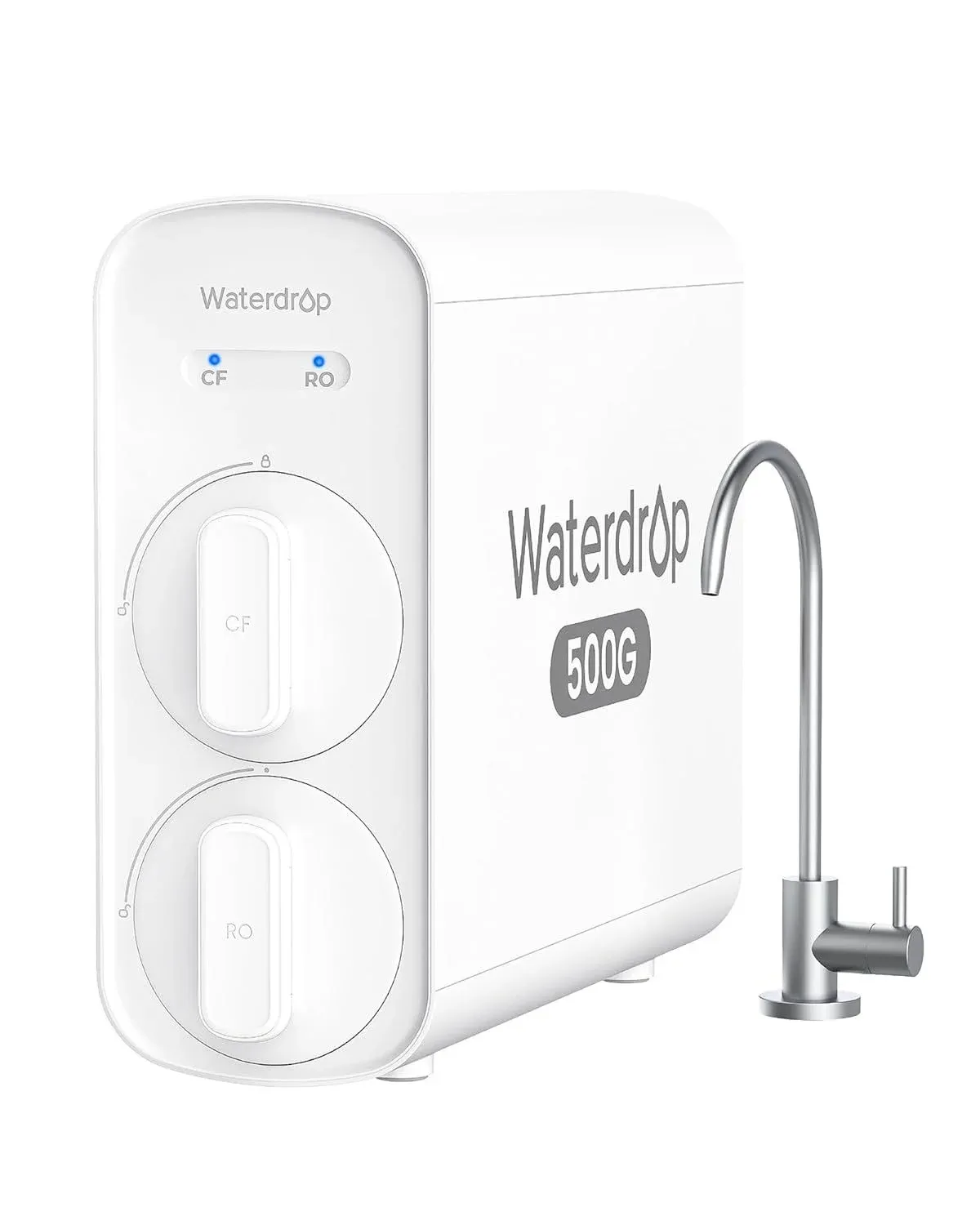
Waterdrop G5P500 Reverse Osmosis Water Filter 500 GPD
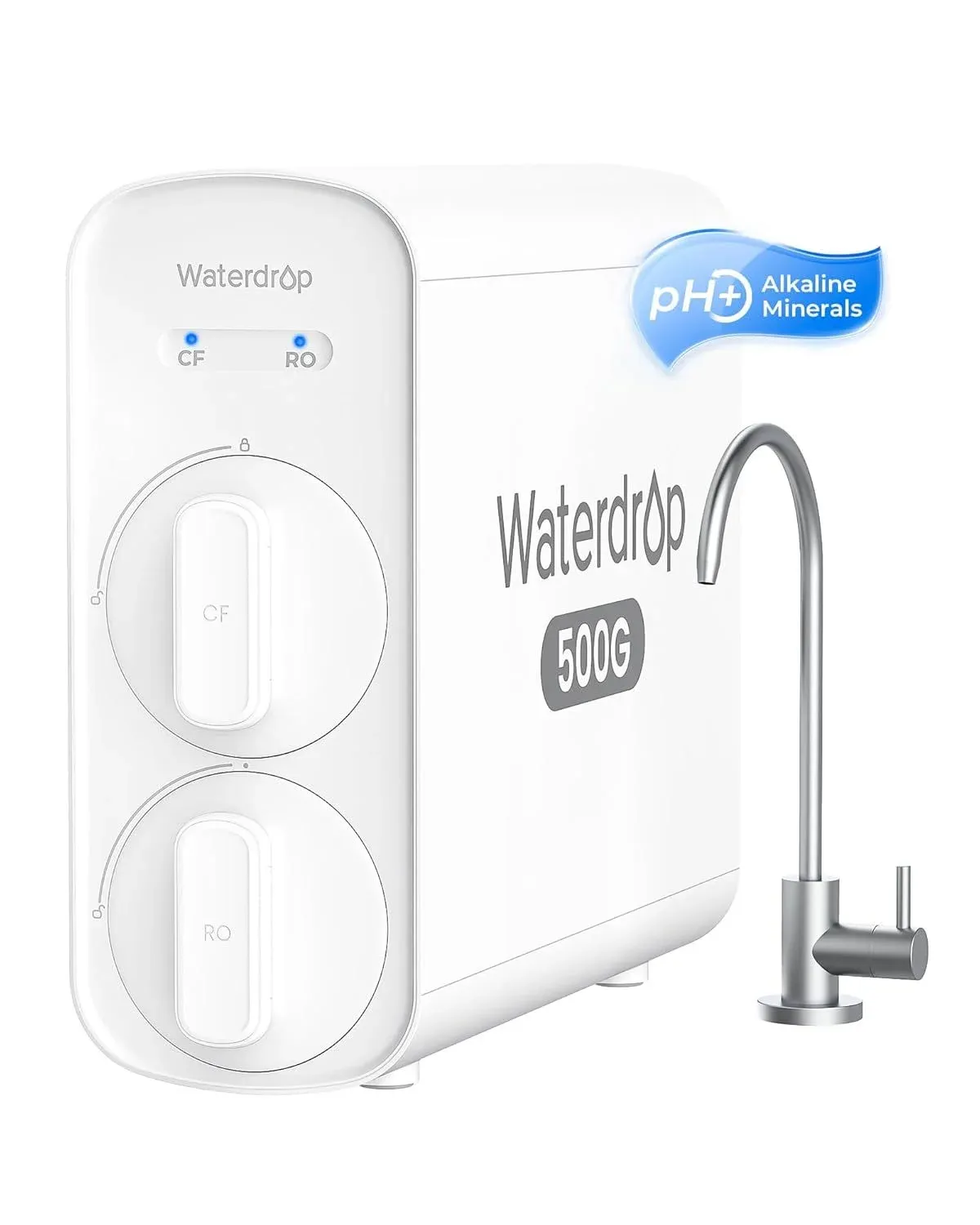
Waterdrop G5P500A Alkaline Mineral pH+ Reverse Osmosis System 500 GPD
At a Glance
| Feature | Waterdrop G5P500 Reverse Osmosis Water Filter 500 GPD | Editor's Pick Waterdrop G5P500A Alkaline Mineral pH+ Reverse Osmosis System 500 GPD |
|---|---|---|
| Price Band | Flagship | Flagship |
| Filtration Stages | 7-stage RO | 8-stage RO with alkaline mineralization |
| Flow Rate / GPD | 500 GPD | 500 GPD |
| Certifications | NSF 58/372 | NSF 58/372 |
| Contaminants Removed | 1,000+ impurities including TDS, PFOA/PFOS, chlorine, fluoride, lead, bacteria | 1,000+ impurities including TDS, PFOA/PFOS, chlorine, fluoride, lead — then remineralizes |
| Check Price | Check Price |
This is the simplest comparison on our site because these two systems are nearly identical. Same housing. Same dimensions. Same 500 GPD flow rate. Same 2:1 pure-to-waste ratio. Same tankless design. Same installation. The only meaningful difference is a single filtration stage: the G5P500A adds alkaline mineral restoration to its 8-stage process, while the base G5P500 stops at 7 stages of pure RO filtration. The question is whether that one additional stage — and the roughly 20% premium it commands — is worth it for your household.
Category-by-Category Breakdown
Water Taste & Mineral Content
The G5P500A's defining feature is its alkaline mineral stage, which adds calcium, magnesium, sodium, and potassium back into the water after the RO membrane removes essentially everything. The target pH output is approximately 7.5 — slightly above neutral — producing water that tastes fuller, rounder, and more natural than pure RO water. If you have ever compared flat distilled water to a quality spring water like Evian or Fiji, you have experienced the taste difference that minerals make. The G5P500A's remineralization aims to bridge that gap.
The base G5P500 produces ultra-pure RO water with near-zero TDS. This water is exceptionally clean — free of virtually all dissolved contaminants, minerals, and impurities. It is the kind of water that water quality purists appreciate for its absolute purity. However, the absence of all dissolved minerals gives it a taste profile that many people find flat, empty, or slightly off compared to the mineral-containing water their palate is accustomed to. Some people describe pure RO water as having a slight metallic aftertaste, though this is more about the absence of masking minerals than the presence of metallic compounds.
In our assessment, the taste difference between remineralized and non-remineralized RO water is not subtle — most people can identify it in a blind taste test. The minerals added by the G5P500A are not exotic additives; they are the same compounds found in tap water and spring water that your body uses daily. For drinking water, the G5P500A produces a genuinely more enjoyable product. For applications where mineral purity matters — espresso machines with specific water chemistry requirements, aquariums, humidifiers, CPAP machines, or certain cooking applications — the base G5P500's pure output may actually be preferable.
Filtration Performance & Purification
Both systems use the same RO membrane rated at 0.0001 microns, and both are certified to NSF 58 and NSF 372 standards. The core purification performance — removing TDS, PFOA/PFOS, chlorine, fluoride, lead, bacteria, and over 1,000 other impurities — is identical between the two models. The G5P500's 7-stage process covers sediment filtration, activated carbon pre-filtration, the RO membrane, and post-filtration polishing. The G5P500A adds its eighth alkaline stage after all purification is complete.
Critically, the alkaline stage does not reduce purification performance. The minerals are added after the water has already been fully purified through all seven filtration stages. You are getting the same level of contaminant removal as the base model, plus mineral restoration. The G5P500A does not compromise on purity to achieve its alkaline output — it adds to the base G5P500's process rather than altering it. Both systems remove the same contaminants to the same degree.
The one nuance worth noting is that the G5P500A's output water, because it contains added minerals, will register a higher TDS reading on a TDS meter than the base G5P500. This is not a sign of inferior filtration — it is the expected result of mineral restoration. If you use a TDS meter to verify your system's performance, the G5P500A's reading of 20 to 50 ppm (from added minerals) versus the G5P500's reading of 5 to 15 ppm does not indicate a problem. Both readings confirm the RO membrane is functioning properly.
🔬 Pro Tip: If you purchase a TDS meter to test your new system and the G5P500A reads noticeably higher than zero, do not panic. That elevated reading is the alkaline mineralization stage working exactly as designed. To confirm your RO membrane is functioning, test the water before it passes through the alkaline stage — if Waterdrop provides a test port — or compare your reading against your incoming tap water TDS. A reduction of 90% or more from tap to output confirms the membrane is healthy, regardless of what the mineral stage adds back afterward.
Price & Value Proposition
The G5P500 and the G5P500A both sit in the Flagship band, and the G5P500A costs roughly 20% more. In the context of an under-sink RO system that you will use multiple times daily for years, this is a small premium for a feature that affects every glass of water you drink. Spread over a three-year ownership period, the daily cost difference is negligible for water that tastes meaningfully better.
The ongoing filter replacement cost also differs modestly. The G5P500A's composite filter includes the alkaline mineralization media, which makes its replacement filter slightly more expensive than the G5P500's standard composite filter. Over a year, the difference in annual filter cost is a noticeable but minor addition to the total cost of ownership. For buyers tracking every dollar, the base G5P500 saves money both upfront and on replacements. For buyers who value taste and mineral content, the G5P500A's total cost premium over its lifetime is small relative to the daily experience improvement.
Context matters here. A 20% premium is not trivial. But consider what that premium buys: alkaline mineral restoration comparable to what premium bottled water brands like Evian charge a premium per bottle to deliver. If you currently buy mineral water or alkaline water, the G5P500A pays for its premium within weeks through eliminated bottle purchases. If you have never bought mineral water and do not care about minerals, the base G5P500 saves money without sacrificing purification quality.
It is also worth thinking about long-term filter subscription costs. Both Waterdrop systems are designed around a roughly six-month or annual filter replacement schedule depending on usage and incoming water quality. Households with higher daily consumption — families of four or more, or homes that use RO water for cooking in addition to drinking — will cycle through filters faster than a single-person household. At accelerated replacement frequency, the per-year cost difference between the two models' filter sets remains modest, which most families will find easy to absorb. The upfront unit cost difference remains the larger factor in the total ownership calculation.
Installation & Physical Design
The G5P500 and G5P500A share identical external dimensions (5.69 x 16.69 x 13.9 inches), identical weight (21.4 lbs), identical mounting hardware, and identical plumbing connections. The installation process is the same for both models down to every step — connect the cold water supply, attach the drain line, mount the dedicated faucet, and plug in the power adapter for the booster pump. If you have installed one, you could install the other with your eyes closed.
Both models feature the same tool-free filter replacement system — twist the old filter out, push the new one in, done in approximately three seconds. Both have LED indicator lights that signal when filter replacement is needed. The faucet design is the same between both models. From the outside, the two systems are visually indistinguishable once installed. The only way to tell them apart is by the model number on the filter cartridge or the product label on the unit itself.
This identical physical design is worth emphasizing because it means the G5P500A upgrade comes with zero installation compromise. You are not getting a larger unit, a more complex installation, or any additional plumbing requirements. The alkaline feature is entirely contained within the internal filter design — the external product is the same. This makes the comparison unusually clean: same box, different filter cartridge, better water, modest price premium.
🔧 Pro Tip: When installing either the G5P500 or G5P500A, take note of your under-sink cabinet's available depth before ordering. At nearly 17 inches tall and about 14 inches deep, these units need a reasonably clear cabinet. Most standard kitchen sink base cabinets have 22–24 inches of usable depth, which is sufficient — but if your cabinet is crowded with plumbing or cleaning supplies, measuring first saves a frustrating installation day. Both units mount vertically, so wall-mounted cabinet interiors with a central drain pipe typically require the unit to be positioned to one side.
Use Case Scenarios
The G5P500A is the better choice for households where the primary use of RO water is drinking, cooking, and making beverages. The mineral restoration makes every glass of water, every pot of rice, every cup of coffee slightly better. For families with children, the added calcium and magnesium are beneficial minerals that growing bodies need. For anyone who has switched to an RO system and been disappointed by flat-tasting water, the G5P500A solves that problem specifically.
The base G5P500 is the better choice for specific applications where mineral-free water is preferred or required. Espresso enthusiasts who follow Third Wave Water protocols may want to start with pure RO water and add their own precisely measured mineral packets. Aquarium owners — particularly those maintaining sensitive reef tanks or soft-water species — need zero-mineral RO water as a baseline. Humidifier users benefit from mineral-free water that does not leave white mineral dust on surrounding surfaces. CPAP machine owners should use distilled or pure RO water to prevent mineral buildup in the water chamber.
For the majority of buyers — those who want clean, great-tasting drinking water from their kitchen faucet — the G5P500A is the right choice. The base G5P500 is the right choice for specialty applications or for buyers who are genuinely indifferent to water taste and want to save the 20% premium. Both are excellent systems; the question is only whether the last mile of taste improvement matters to your specific use case.
How These Models Compare to the Broader Waterdrop Lineup
The G5P500 and G5P500A sit at the higher end of Waterdrop's tankless RO product range by flow rate. Buyers who are cross-shopping within the Waterdrop ecosystem should be aware that the company also offers the G2 and G3 series, which operate at lower GPD ratings — typically in the 400 GPD range — and come in both standard and alkaline variants as well. The G5 series' 500 GPD output makes it the better fit for larger households or anyone who wants near-instant water delivery from a tankless system. If your household uses under 50 gallons of purified water per day, the G2 or G3 series may save you money with comparable purification quality; if you run a busy kitchen with high water demand, the G5's faster output is worth the additional investment.
Outside the Waterdrop brand entirely, buyers sometimes consider systems like the APEC ROES-PH75 or the iSpring RCC7AK when researching remineralizing RO options. Those systems carry strong reputations and are certified to additional NSF standards, but they use traditional pressurized storage tanks and produce water at significantly lower flow rates. The tankless advantage of the G5P500A — no waiting for a tank to refill, no pressure drop as the tank empties — is a meaningful quality-of-life difference that tank-based systems cannot match at this price tier. For buyers prioritizing certifications above all else, traditional tank systems may offer a marginally stronger certification portfolio; for buyers prioritizing convenience, flow rate, and compact footprint alongside remineralization, the G5P500A remains the standout option.
Who Should Get Which?
Get the Waterdrop G5P500 Reverse Osmosis Water Filter 500 GPD if...
- You want ultra-pure RO water without any minerals added back
- You use RO water for specialty applications — aquariums, humidifiers, espresso, CPAP
- Budget is the primary concern — save upfront and on filter replacements
- You plan to add your own mineral blend (like Third Wave Water) for custom water chemistry
- You do not notice or care about the taste difference between pure and mineralized water
Get the Waterdrop G5P500A Alkaline Mineral pH+ Reverse Osmosis System 500 GPD if...
- You want the best-tasting drinking water — mineral restoration makes a noticeable difference
- You previously found RO water too flat or empty-tasting
- Your household drinks RO water daily and taste quality matters
- You want the health benefits of added calcium, magnesium, and potassium
- You are willing to pay a modest premium for a better daily drinking experience
Frequently Asked Questions
What exactly does the alkaline stage add to the G5P500A?
Does pure RO water without minerals taste bad?
Can I add an alkaline stage to the G5P500 later?
Are the G5P500 and G5P500A physically the same size?
Is the G5P500A worth the price difference over the G5P500?
Do both models use the same replacement filters?
How does the Waterdrop G5P500A compare to other remineralizing RO systems on the market?
Will the G5P500A affect the performance of my coffee maker or kettle?
Our Final Recommendation
The Waterdrop G5P500 vs G5P500A comparison is the most straightforward decision on our site. These are the same system in the same housing with the same performance — the only variable is whether the output water contains added minerals or not. For roughly 20% more, the G5P500A adds calcium, magnesium, sodium, and potassium to every glass of water you pour, transforming flat RO water into something that tastes like quality spring water.
For the vast majority of households buying an under-sink RO system for drinking water, the G5P500A Alkaline is the better purchase. The taste improvement is noticeable, the mineral additions are beneficial, and the 20% premium is small relative to the total system cost and the years of daily use you will get from it. If you are buying an RO system to improve your drinking water, there is almost no reason not to get the version that produces the best-tasting output.
The base G5P500 is the right choice only in specific scenarios: if you need ultra-pure water for aquariums, humidifiers, espresso with custom mineral packets, CPAP machines, or other applications where dissolved minerals are undesirable. It is also the right choice if you are genuinely budget-constrained and every dollar matters — the G5P500 delivers the same purification quality, just without the mineral restoration.
Our bottom line: if you are reading this comparison trying to decide between the two, get the G5P500A Alkaline. That premium is the best money you can spend on any water filtration upgrade. You will taste the difference every day, and over the years you will own this system, the per-day cost of the alkaline upgrade rounds to zero. It is not a close call for drinking water — the G5P500A is the one to buy.