Best Water Filters for Hard Water
Hard water affects an estimated 85% of American households, causing scale buildup, poor-tasting water, and frustrating white residue on fixtures. We test and recommend the filters that actually reduce TDS and hardness minerals for noticeably better water, from budget pitcher options to full reverse osmosis systems.
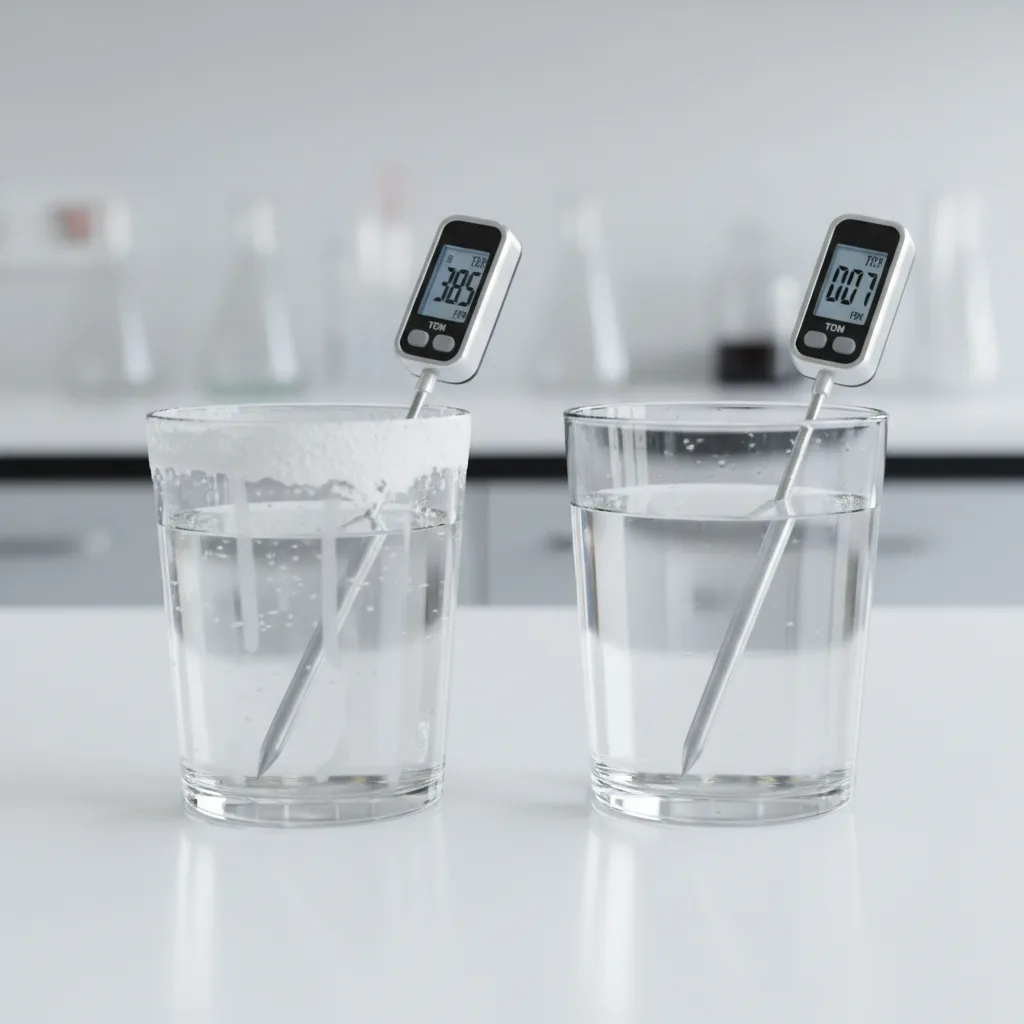
Understanding Hard Water and Why It Matters
Hard water contains elevated concentrations of dissolved minerals — primarily calcium and magnesium — picked up as groundwater passes through limestone, chalk, and dolomite formations. While not a health hazard (and potentially beneficial in moderate amounts), hard water creates practical problems that affect daily life:
- Scale buildup: White, chalky deposits accumulate on faucets, showerheads, and inside pipes, water heaters, and appliances. Over time, scale reduces pipe diameter and appliance efficiency, increasing energy bills and shortening equipment lifespan.
- Poor taste: Water above 300 TDS often tastes mineral-heavy, chalky, or slightly metallic. Coffee and tea taste noticeably different (worse) made with hard water.
- Soap inefficiency: Hard water minerals react with soap, creating scum instead of suds. You use more soap, shampoo, and detergent, and dishes and laundry may not feel fully clean.
- Dry skin and hair: Hard water deposits mineral film on skin and hair, causing dryness, irritation, and dull-looking hair.
- Shortened filter life: Hard water clogs all filter types faster, increasing replacement costs. This is especially impactful for pitcher filters that have limited capacity.
TDS (Total Dissolved Solids) is the most commonly used measure for hard water. An inexpensive TDS meter gives you an instant reading in parts per million (ppm). Below 150 ppm is considered soft to moderately hard; above 300 ppm is hard; above 500 ppm is very hard and typically warrants treatment.
What to Look For in a Hard Water Filter
Treating hard water for drinking requires specific filtration technologies. Standard carbon filters and most pitcher filters do not remove hardness minerals. Here is what works:
- Reverse osmosis: The most effective method for reducing TDS in drinking water. RO membranes reject 93-99% of dissolved minerals. The iSpring RCC7AK and Waterdrop G3P600 are our top RO picks for hard water.
- Ion exchange (ZeroWater): ZeroWater's 5-stage ion exchange process strips TDS to 0 ppm — the most complete mineral removal of any pitcher filter. The trade-off is dramatically shortened filter life in hard water.
- Water softeners (whole-house): Traditional salt-based softeners replace calcium and magnesium with sodium through ion exchange. They address the whole-house scale problem but add sodium to drinking water, which is why many people pair a softener with an RO system for drinking.
- Note on standard carbon filters: Brita Standard, Amazon Basics, and similar carbon/ion exchange pitcher filters do NOT significantly reduce hardness or TDS. They improve taste by removing chlorine but leave mineral content largely unchanged.
Top Picks for Hard Water
1. ZeroWater 5-Stage Replacement Filter (4-Pack) — Best Pitcher Filter for Hard Water
ZeroWater is the only pitcher filter system that achieves 0 TDS — literally removing every dissolved mineral from your water. The 5-stage ion exchange process strips calcium, magnesium, lead, chromium, PFOA, PFOS, and essentially everything else dissolved in your water. The included TDS meter lets you verify the result with every pour.
For hard water users, the 0 TDS result is transformative. Coffee and tea taste dramatically different. The mineral film on glasses disappears. Water tastes ultra-clean and pure — though some people find the completely mineral-free taste a bit flat.
The caveat is filter life. ZeroWater filters are rated for 15-25 gallons in normal water, but hard water cuts that significantly. At TDS levels above 300, expect 8-15 gallons per filter. At $50–$100 for the 4-pack, the cost per gallon ranges from roughly a dollar (in soft water) to several dollars (in very hard water). For small-volume drinking water in moderate hard water, ZeroWater delivers unmatched purity from a pitcher. For high-volume use in very hard water, RO is more economical.
Price Range: $50–$100 (4-pack) | Full Review | Check Price on Amazon
2. iSpring RCC7AK 6-Stage Reverse Osmosis System — Best Value RO for Hard Water
For households with hard water that want an economical long-term solution, the iSpring RCC7AK is the clear winner. Its 6-stage RO system reduces TDS by 93-98%, turning 400 ppm hard water into 8-28 ppm purified water. The dedicated sediment and carbon pre-filter stages protect the RO membrane from the scale deposits that hard water would otherwise cause.
The cost-per-gallon math heavily favors the iSpring over pitcher filters in hard water areas. At just pennies per gallon for RO water versus a dollar or more per gallon for ZeroWater filters in hard water, the iSpring pays for itself within a few months of heavy use. The alkaline remineralization stage adds back a controlled amount of beneficial minerals, giving the water a pleasant, slightly mineralized taste rather than the flat profile of pure RO water.
One important consideration for very hard water: the pre-filters will need more frequent replacement. Plan to change the sediment and carbon pre-filters every 3-6 months instead of the standard 6-12 months. The RO membrane itself is protected by these pre-filters and should still last 2-3 years.
Price Range: $100–$250 | Full Review | Check Price on Amazon
3. Waterdrop G3P600 Tankless Reverse Osmosis System — Best Premium RO for Hard Water
The Waterdrop G3P600 excels in hard water environments thanks to its smart LED faucet with real-time TDS monitoring. You can see your water's TDS reading every time you fill a glass — instant verification that the RO membrane is performing correctly. When the reading starts to rise, you know it is time for maintenance before water quality degrades.
The 600 GPD production rate means faster water availability than the iSpring's 75 GPD tank system, and the tankless design eliminates the storage tank that can accumulate scale in hard water over time. The 2:1 pure-to-drain ratio also wastes less water than the iSpring's 1:3 ratio — a meaningful difference in areas where water is expensive or limited.
At $250–$500, it is more than double the iSpring's price. For hard water users who want the convenience of tankless design, real-time monitoring, and superior water efficiency, the premium is warranted. For budget-conscious users, the iSpring delivers comparable water quality at a lower investment.
Price Range: $250–$500 | Full Review | Check Price on Amazon
4. Brita Elite Replacement Filters (2-Pack) — Best for Mildly Hard Water
If your water is only mildly hard (TDS 150-250 ppm) and you do not need full TDS removal, the Brita Elite offers a practical middle ground. While it does not significantly reduce TDS, its 120-gallon capacity and NSF 42/53/401 certification address chlorine taste, lead (99% reduction), pharmaceuticals, and 30+ other contaminants. The longer filter life compared to ZeroWater means less frequent replacement in hard water areas.
The Brita Elite will not make hard water soft, but it will make it taste better by removing chlorine and organic taste compounds. For users whose primary concern is taste rather than scale prevention, this may be sufficient. At $25–$50 for a 2-pack providing up to 240 gallons, the per-gallon cost is far lower than ZeroWater.
Price Range: $25–$50 (2-pack) | Full Review | Check Price on Amazon
Who Should Buy an RO System vs. a Pitcher Filter
Choosing between a reverse osmosis system and a pitcher filter for hard water is not just about budget — it is about how your household actually uses filtered water. Understanding which profile fits your situation prevents you from overspending on a system you do not need or underspending on one that cannot keep up with your demands.
Choose an RO system if you: use more than two gallons of filtered water per day, have TDS readings consistently above 300 ppm, want to reduce your ongoing filter replacement costs, do not want to think about filter changes every week or two, or plan to stay in your home long enough to recoup the upfront investment (typically six to eighteen months of regular use). Homeowners, families of three or more, and anyone who makes coffee, tea, or cooks with filtered water regularly will almost always find the per-gallon economics of RO decisively better.
Stick with a pitcher filter if you: rent and cannot install under-sink hardware, live alone and use less than a gallon of filtered water per day, have TDS readings below 250 ppm where the taste impact of mineral content is minimal, or need a portable solution for travel or a secondary space like an office. In these cases, the ZeroWater 4-pack delivers genuinely impressive filtration without a plumber or permanent installation.
Hard Water Filtration Tips
- Measure before buying: An inexpensive TDS meter pays for itself by directing you to the right solution. Do not buy an RO system if your TDS is only 120 ppm, and do not rely on a Brita Standard if your TDS is 400 ppm.
- Replace pre-filters more often: Hard water shortens the life of every filter stage. If your water is above 300 TDS, plan to replace pre-filters at roughly double the normal frequency to protect your RO membrane.
- Consider a softener + RO combo: For whole-house hard water treatment, a water softener addresses scale throughout your plumbing while an under-sink RO system provides mineral-free drinking water. The softener extends the life of the RO membrane and pre-filters.
- Clean your kettle and coffee maker monthly: Even with filtered water, small amounts of dissolved minerals accumulate over time. White vinegar descaling keeps your appliances performing well.
- Check your water heater annually: Hard water accelerates sediment buildup in water heaters. An annual flush extends the unit's lifespan and improves energy efficiency.
Frequently Asked Questions
What TDS level is considered hard water?
Is hard water dangerous to drink?
What is the difference between a water filter and a water softener?
Do ZeroWater filters work well with hard water?
Will reverse osmosis remove hardness from water?
Can hard water damage my water filter?
How do I know if my RO membrane needs replacing in hard water conditions?
Is it safe to cook with reverse osmosis water in a hard water area?
Our Top Pick for Hard Water
For most hard water households, the iSpring RCC7AK 6-Stage Reverse Osmosis System at $100–$250 is the best long-term solution. It reduces TDS by 93-98%, produces water that tastes better than bottled, and costs a fraction of the per-gallon expense of pitcher filters in hard water. For renters or those who want a zero-installation option, the ZeroWater 4-pack achieves the most complete mineral removal of any pitcher system — just be prepared for more frequent filter changes if your water is very hard.
Get Our Top 3 Picks
Get our top 3 picks for your budget — one email, then only updates.
Only when something changes. Unsubscribe anytime.