Samsung HAF-QIN vs everydrop Filter A: Which Refrigerator Filter Is Better in 2026?
Quick Verdict: The everydrop Filter A ($25–$50) is the objectively better filter with triple NSF 42/53/401 certification covering lead, pharmaceuticals, and pesticides. The Samsung HAF-QIN ($25–$50) is more affordable but only certified for chlorine taste and odor (NSF 42). As always with fridge filters, your refrigerator brand dictates your choice.
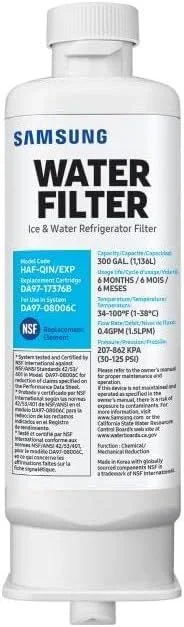
Samsung HAF-QIN/EXP Refrigerator Water Filter (DA97-17376B)
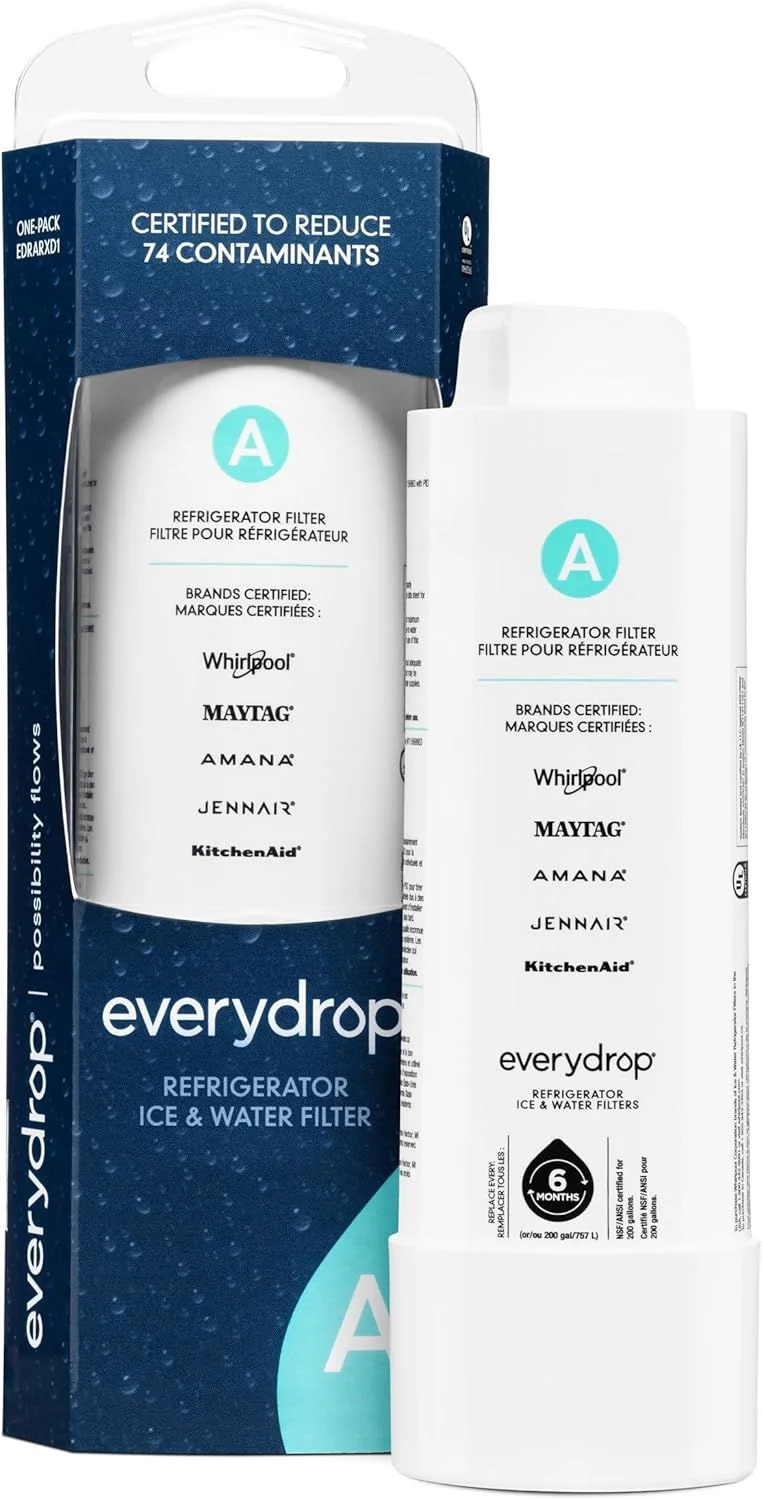
everydrop by Whirlpool Refrigerator Filter A (EDRARXD1)
At a Glance
| Feature | Samsung HAF-QIN/EXP Refrigerator Water Filter (DA97-17376B) | Editor's Pick everydrop by Whirlpool Refrigerator Filter A (EDRARXD1) |
|---|---|---|
| Price | $25–$50 | $25–$50 |
| Capacity | — | 200 gallons |
| Certifications | NSF 42 | NSF 42/53/401 |
| Filter Life | 6 months | 6 months or 200 gallons |
| Compatibility | Samsung French 4-door, side-by-side, 4-Door Flex models | Whirlpool, Maytag, Amana, KitchenAid, JennAir (Filter A models) |
| Filtration | Carbon Block | Activated Carbon Block |
| Check Price | Check Price |
These two filters represent opposite ends of the OEM refrigerator filter spectrum: the Samsung HAF-QIN offers basic filtration at the lowest OEM price, while the everydrop Filter A provides premium triple-certified contaminant reduction. Your fridge brand determines which one you buy, but understanding the differences can inform whether you need supplemental filtration.
Why This Comparison Matters
At first glance, comparing a Samsung filter to a Whirlpool-ecosystem filter might seem pointless — after all, compatibility locks most buyers into one option before they even read the specs. But this comparison is genuinely useful for two reasons. First, it illustrates how dramatically OEM filter quality can vary across refrigerator brands, which should inform your purchasing decision when you are in the market for a new refrigerator. If superior built-in water filtration matters to you, knowing that Whirlpool-family appliances ship with a more capable filtration platform is a relevant data point. Second, understanding what your installed filter does and does not remove helps you decide whether a supplemental filtration solution — such as an under-sink reverse osmosis system or a pitcher filter — is warranted for your household's water quality needs.
We also want to address a pattern we see frequently in consumer forums: buyers assuming that all refrigerator filters are roughly equivalent. They are not. The gap between NSF 42-only filtration and NSF 42/53/401 triple certification is not a minor marketing distinction — it represents a meaningful difference in what contaminants the filter has been independently verified to capture. In municipalities where lead service lines remain in place, or in homes with older copper plumbing joined with lead solder, that certification gap has real public health implications.
Category-by-Category Breakdown
Contaminant Removal & Certifications
The everydrop Filter A carries NSF 42/53/401 — the premium triple certification covering chlorine taste, lead and cysts (health contaminants), and emerging contaminants like pharmaceuticals and pesticides. The Samsung HAF-QIN has only NSF 42, which covers chlorine taste and odor and basic particulates. This is the most significant difference between these filters. If your water has known lead contamination, the Samsung filter will not adequately address it. Households in older neighborhoods or areas with aging municipal infrastructure should pay particular attention to this gap — the EPA's Lead and Copper Rule requires testing, but action levels are only enforced at the utility level, not at individual taps where contamination often originates.
To put the certification gap in practical terms: NSF 53 requires that a filter reduce lead concentrations by a minimum of 99% under standardized test conditions, and independently verifies cyst reduction as well. NSF 401 addresses 15 emerging contaminants including ibuprofen, naproxen, estrone, and several pesticide compounds that municipal treatment plants were not originally designed to remove. The Samsung HAF-QIN's NSF 42 certification, while meaningful for improving the taste and smell of chlorinated tap water, simply does not address this broader contaminant profile. Samsung fridge owners who are concerned about lead or pharmaceutical contamination should treat the HAF-QIN as a taste-improvement tool and pair it with a dedicated NSF 53-certified under-sink or countertop filter for health-contaminant reduction.
Price
The Samsung HAF-QIN is the most affordable OEM fridge filter in our catalog, while the everydrop Filter A commands a modest premium. For Samsung fridge owners on a budget, the lower price is welcome. However, the price difference reflects the gap in filtration capability. The everydrop's higher cost funds the more advanced activated carbon block media and the additional NSF testing and certification. When you factor in that NSF 53 and 401 testing alone costs manufacturers tens of thousands of dollars in laboratory fees, the small premium on the everydrop is a modest markup for substantially broader protection.
From a cost-of-ownership perspective, both filters recommend replacement every six months, which means you will purchase approximately two filters per year. Over a three-year period, the cumulative spend on Samsung HAF-QIN replacements remains solidly in the budget-friendly tier, while the everydrop Filter A falls into the lower end of the mid-range tier on an annualized basis. Neither filter will break the bank, but buyers who want to minimize ongoing consumable costs will consistently spend less with the Samsung — provided they are comfortable with its more limited contaminant reduction profile. It is also worth noting that multi-pack purchases of both filters are available on Amazon, and buying in two-packs rather than single filters typically reduces the per-filter cost by a meaningful margin for both products.
Capacity & Filter Life
The everydrop Filter A specifies a 200-gallon capacity with a 6-month recommended replacement cycle. Samsung does not prominently specify the HAF-QIN's gallon capacity — a transparency issue that makes it harder to calculate long-term costs. Both recommend 6-month replacement intervals, but without a specified capacity, Samsung owners must trust the time-based recommendation rather than a usage-based metric. This lack of gallon-based specification means heavy-use households — particularly those with active ice makers — have no reliable way to gauge whether the Samsung filter is depleted before the 6-month mark arrives.
For reference, the average American household of four uses roughly 50 to 100 gallons of filtered water per month when accounting for both dispensed water and ice production. At that usage rate, a 200-gallon filter like the everydrop Filter A should comfortably last the full six months. If your household uses more — say, a family of five or six that relies heavily on the ice maker for entertaining — you may want to plan for more frequent replacements regardless of which filter platform your refrigerator uses. The everydrop's stated 200-gallon capacity at least gives you a measurable benchmark to work with, which is a genuine advantage over the Samsung's time-only guidance.
Installation
The Samsung HAF-QIN uses a simple quarter-turn installation that takes under 30 seconds. It is widely praised as one of the easiest fridge filter replacements available. The everydrop Filter A uses a rotating knob design that is also tool-free but slightly more involved than a simple quarter-turn. Both are easy enough for anyone, but Samsung's quarter-turn simplicity wins on pure speed and intuitiveness.
One practical note on installation for both filters: always run approximately two gallons of water through the dispenser after installing a new filter before drinking from it. This flushes out any carbon fines — small particles of activated carbon media that can temporarily discolor the first batches of filtered water. The water is not harmful, but it can look grey or cloudy, which is alarming if you are not expecting it. This flush-out step applies equally to the HAF-QIN and the everydrop Filter A, and takes only a couple of minutes at the dispenser.
Brand Ecosystem & Compatibility
The Samsung HAF-QIN works across Samsung's French door, side-by-side, and 4-Door Flex lineups — broad compatibility within the Samsung brand. The everydrop Filter A is compatible with newer Whirlpool, Maytag, Amana, KitchenAid, and JennAir models — covering five major brands under one filter. For sheer brand reach, the everydrop's compatibility across the Whirlpool family gives it an edge in the replacement market.
This compatibility breadth also has a practical implication for replacement availability. Because the everydrop Filter A serves five major appliance brands, it tends to have stronger retail distribution — you are more likely to find it at local appliance stores or big-box home improvement retailers in addition to Amazon. The Samsung HAF-QIN is also widely available, but primarily through Samsung's own retail channels and online marketplaces. Neither filter is hard to find, but the everydrop's multi-brand footprint means broader stocking across more retail categories.
Performance in Real-World Use: What Owners Report
Beyond the spec sheet, it is worth examining what actual owners consistently report about each filter's day-to-day performance. The Samsung HAF-QIN earns consistently positive reviews for eliminating chlorine taste and odor from municipal tap water — the improvement in water palatability is the most commonly cited benefit, and it is a genuine one. Owners in cities with heavily chlorinated water supplies almost universally notice the difference immediately after installing a fresh HAF-QIN. Where reviews turn more critical is in areas with harder water or elevated mineral content; the HAF-QIN is not certified for TDS reduction and will not soften water or reduce scale-causing minerals, which occasionally surprises buyers who expected broader performance.
The everydrop Filter A draws praise for the same chlorine taste improvement, with the additional reassurance that owners in older homes feel about lead reduction. Many positive reviews specifically mention peace of mind as a deciding factor — knowing the filter is independently certified to reduce lead makes a measurable difference in how Whirlpool-family fridge owners feel about their drinking water. A smaller number of reviews mention slightly reduced water flow rate compared to no-filter operation, which is expected behavior with any activated carbon block filter and is not a defect. Both filters perform as designed within their respective certification scopes; the difference is simply in how wide that scope is.
Cost of Ownership: Three-Year Projection
Both filters recommend replacement every six months, yielding two filter purchases per year and six total over a three-year period. The Samsung HAF-QIN's budget-friendly per-filter price means three years of replacements stays well within the budget-friendly tier in aggregate — comparable to a few months of a premium bottled water habit. The everydrop Filter A's modest premium puts its three-year ownership cost in the low-to-mid range tier, still far less expensive than single-use bottled water at equivalent consumption volumes. Buying multi-packs — typically two-filter sets — reduces per-unit cost for both products and is the most economical approach for committed long-term users.
For households considering whether to supplement either filter with a secondary filtration system, it helps to frame the total filtration budget holistically. An entry-level NSF 53-certified under-sink filter in the budget-friendly tier, combined with the Samsung HAF-QIN, can provide comprehensive protection at a combined annual cost that still undercuts many premium whole-house filtration subscriptions. The everydrop Filter A, used as a standalone refrigerator filter, covers chlorine, lead, and emerging contaminants without requiring additional investment — which is part of why it represents strong value for Whirlpool-family fridge owners even at its slight price premium over the Samsung.
Who Should Get Which?
Get the Samsung HAF-QIN/EXP Refrigerator Water Filter (DA97-17376B) if...
- You own a Samsung French door, side-by-side, or 4-Door Flex refrigerator
- You want the most affordable OEM fridge filter replacement
- Your primary concern is chlorine taste and odor improvement
- Consider supplementing with an under-sink filter if lead/PFAS is a concern
Get the everydrop by Whirlpool Refrigerator Filter A (EDRARXD1) if...
- You own a newer Whirlpool, Maytag, Amana, KitchenAid, or JennAir fridge
- You want premium lead, pharmaceutical, and pesticide reduction
- NSF 42/53/401 triple certification gives you confidence in filtration quality
Who Should Skip Both and Consider Alternatives?
If you are dealing with well water, high sediment loads, hardness above 200 ppm, or confirmed PFAS contamination, neither of these refrigerator filters is the right primary solution. Both the HAF-QIN and the everydrop Filter A are designed for municipally treated water where chlorine, taste, and a limited set of regulated contaminants are the primary concerns. Well water often contains iron, manganese, hydrogen sulfide, or biological contamination that requires dedicated treatment upstream of any refrigerator filter. If your water report or a private lab test reveals any of these issues, a whole-house or point-of-use treatment system — sediment pre-filter, water softener, UV sterilizer, or reverse osmosis unit — is the appropriate first line of defense. The refrigerator filter should be a final polishing step, not the sole treatment mechanism.
Similarly, if you live in a community with documented PFAS contamination in the water supply, neither filter reviewed here will provide meaningful protection. NSF/ANSI 58-certified reverse osmosis systems and NSF 53-certified activated carbon block filters with specific PFAS test data are the vetted options for that contaminant class. Check the Environmental Working Group's Tap Water Database (ewg.org/tapwater) or your municipality's annual water quality report to understand what is actually present in your local water supply before deciding which filtration approach is appropriate.
Frequently Asked Questions
Is the everydrop Filter A better than the Samsung HAF-QIN?
Why is the Samsung HAF-QIN cheaper than the everydrop Filter A?
Does the Samsung HAF-QIN remove lead?
Can I use an everydrop filter in my Samsung refrigerator?
How do I know which filter my refrigerator needs?
Are third-party replacement filters a viable alternative to either of these OEM filters?
How often should I really replace my refrigerator water filter?
Will skipping filter replacements damage my refrigerator?
Does either filter reduce PFAS (forever chemicals)?
Track Both Products
We'll email you if either price drops or availability changes.
Only when something changes. Unsubscribe anytime.