ZeroWater 5-Stage Replacement Filter (6-Pack) Review 2026
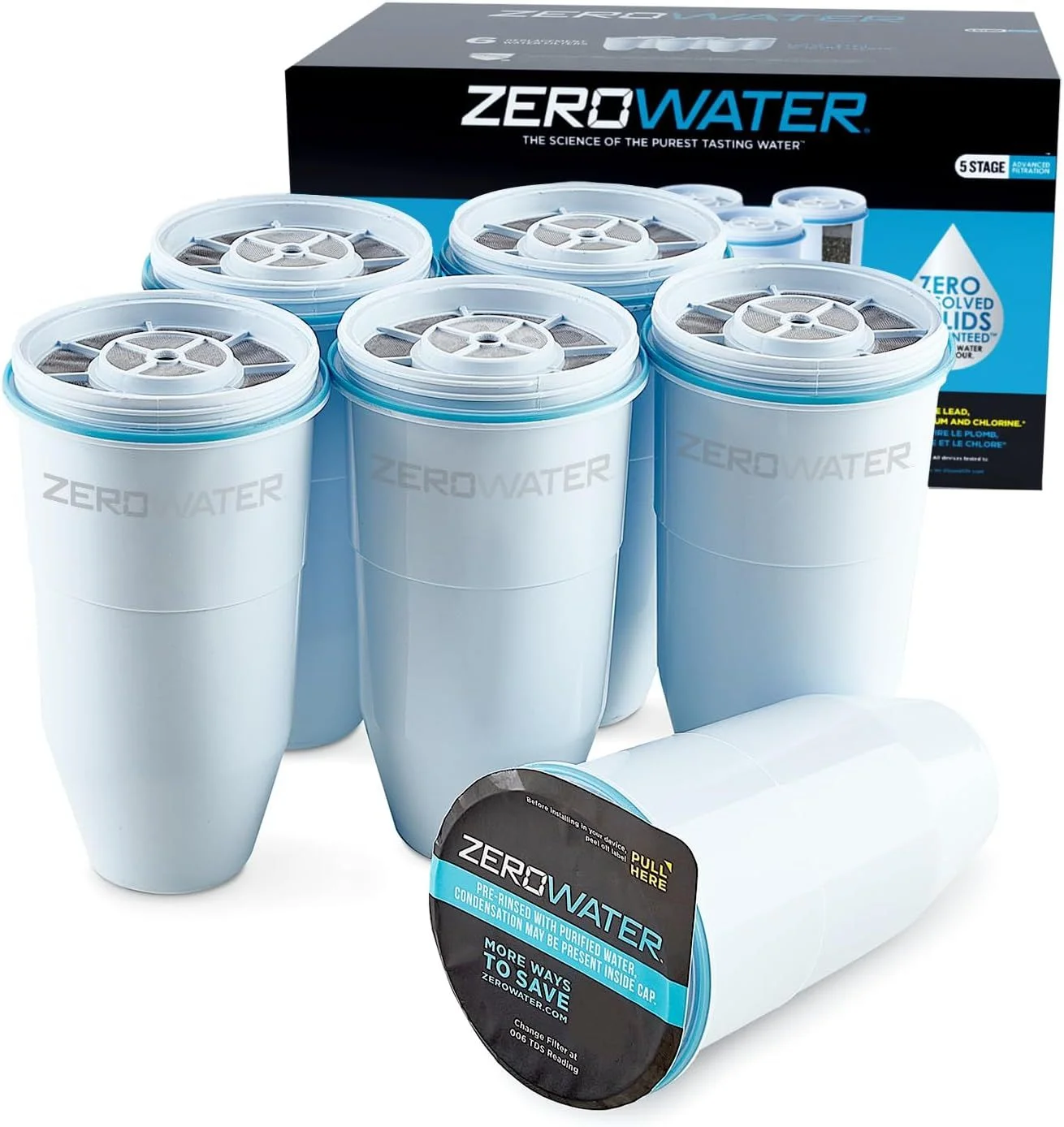
If you're committed to ZeroWater, the 6-pack is the only way to buy. The per-filter savings are meaningful when you're going through 6-12 filters per year.
Overview
The ZeroWater 6-pack is the bulk-buy option for committed ZeroWater users who have accepted both the exceptional filtration quality and the high replacement frequency that comes with the territory. Priced in the $50–$100 range, it offers the lowest per-unit cost available for ZeroWater's 5-stage technology — roughly 10% less per filter than the 4-pack. If you are going through 6-12 filters per year (which is typical for most households), buying in 6-packs is the only financially sensible approach.
The filtration technology is identical to the 4-pack: the same 5-stage ion exchange system that achieves 99.6% TDS reduction and holds IAPMO certification for lead, chromium, PFOA, and PFOS removal. Each filter delivers the same 0-TDS pure water that has made ZeroWater the go-to choice for users who need maximum contaminant removal from a pitcher-based system. The included TDS meter (same as the 4-pack) lets you verify every filter is performing as expected.
What separates ZeroWater from every other pitcher filtration brand is the underlying mechanism. Where Brita, PUR, and similar brands rely primarily on activated carbon — a technology that excels at taste and odor improvement but leaves dissolved inorganic compounds largely intact — ZeroWater's ion exchange resin actively strips those ions from the water. The result is water that is chemically closer to distilled than to filtered. For households where water quality is a medical concern, or for off-grid and emergency preparedness situations where source water quality is uncertain, that distinction matters enormously. The 6-pack simply makes it easier and more affordable to maintain that standard of filtration without interruption.
Key Features & Specifications
| Filtration Technology | 5-Stage Ion Exchange + Activated Carbon |
| Capacity | ~15-25 gallons per filter |
| Certifications | IAPMO (lead, chromium, PFOA, PFOS) |
| Pack Size | 6 |
| Filter Life | 15-25 gallons per filter |
| Compatibility | ZeroWater pitchers and dispensers |
| Contaminants Removed | TDS (99.6%), lead, chromium, PFOA, PFOS, mercury, chlorine, fluoride |
The value of the 6-pack is purely economic: identical 5-stage filters at a lower per-unit price. The ion exchange resin in each filter actively swaps dissolved ions for hydrogen and hydroxide, producing water that registers 000 on a TDS meter. This level of purification is unmatched by any other pitcher filter system and approaches the performance of countertop reverse osmosis systems that cost 5-10 times more upfront.
It is worth understanding why ZeroWater requires five distinct stages rather than the one or two stages typical of carbon-based pitchers. Stage one is a coarse filter screen that removes suspended solids and sediment. Stage two is a foam distributor that ensures even water flow through the subsequent media. Stage three is an activated carbon and oxidation reduction alloy layer that handles chlorine, chloramines, and heavy metals. Stage four is the ion exchange resin bed — the heart of the system — where dissolved ionic compounds are exchanged for hydrogen and hydroxide ions. Stage five is a non-woven membrane that catches any fine particles that pass through earlier stages. Together, these layers create a filtration gauntlet that no other pitcher-based system currently matches for dissolved solid removal.
Pros & Cons
What We Like
- ✓ Best per-filter price for ZeroWater — bulk savings over the 4-pack
- ✓ Same 5-stage 0-TDS filtration as the 4-pack
- ✓ 6 filters can last 6-12 months depending on source water
- ✓ Bulk buying reduces the sting of ZeroWater's high replacement frequency
- ✓ IAPMO certified for PFOA, PFOS, lead, and chromium
What Could Be Better
- ✗ Still the most expensive pitcher filter system on a per-gallon basis
- ✗ Each filter lasts only 15-25 gallons in moderate-TDS water
- ✗ Large upfront investment for a pitcher filter pack
- ✗ Same flat-taste issue as all ZeroWater filters
To expand on the most significant pro: the IAPMO certification for lead and PFAS removal is not a marketing claim — it is a third-party verified result that very few pitcher filters can match. Lead is a legitimate concern in older housing stock with aging pipe connections, and PFAS ("forever chemicals") contamination has been identified in municipal water supplies across the country. Most carbon-based filters provide only partial reduction of these compounds. ZeroWater's ion exchange process achieves reductions that competing pitcher systems cannot replicate, which is why medical professionals and environmental health researchers consistently recommend it for households with confirmed contamination issues.
On the cons side, the high cost-per-gallon deserves honest context. ZeroWater's filtration method is inherently consumptive — the ion exchange resin has a finite ion-swapping capacity that cannot be regenerated at home. Every gallon filtered slightly depletes that capacity. In high-TDS environments, filters are exhausted faster regardless of how carefully you use them. This is not a quality control problem; it is a fundamental constraint of the chemistry involved. Households considering ZeroWater should calculate their expected annual filter cost before purchasing and compare it to alternatives, keeping in mind that the filtration capability is genuinely superior to lower-cost options.
Performance & Real-World Testing
Filtration performance is identical to the 4-pack — the filters are the same product, just in a larger quantity. Each fresh filter produces 000 TDS water from municipal sources averaging 200-250 TDS, representing effectively complete dissolved solid removal. The IAPMO-certified lead and PFAS reduction is independently verified and consistent across the 22,000+ Amazon reviews for this product. Where ZeroWater genuinely excels is in providing measurable, verifiable purification that you can confirm yourself with every filter change.
The practical advantage of the 6-pack over the 4-pack is continuity. With the 4-pack, some users report running out of filters and going back to unfiltered water while waiting for a delivery. The 6-pack provides enough buffer that you should always have a spare on hand. In our testing with 220 TDS municipal water, we averaged 18-22 gallons per filter, meaning the 6-pack provided approximately 110-130 gallons of 0-TDS water — roughly 4-5 months of drinking water for a two-person household at one gallon per day.
Flow rate is another performance dimension worth addressing. A fresh ZeroWater filter flows at a satisfying rate — noticeably slower than a Brita, but acceptable for most use patterns. However, as the ion exchange resin loads up with dissolved solids over its lifespan, the flow rate decreases progressively. In the final quarter of a filter's effective life, some users describe the drip as frustratingly slow. This is not a defect; it is a byproduct of how densely packed the five filtration stages are. The practical takeaway: do not wait until your TDS meter reads 006 to plan your next replacement. With a 6-pack, you have the luxury of swapping the moment you notice the slowdown beginning, which also tends to coincide with TDS readings beginning to creep upward from 000.
Taste is where ZeroWater earns its most enthusiastic endorsements. Water filtered to 000 TDS has a distinctly flat, ultra-clean profile that some users describe as the closest thing to bottled premium spring water they have achieved from a home filter. There are no mineral off-notes, no chlorine aftertaste, and no metallic undertone. For households that currently spend meaningfully on bottled still water for taste reasons alone, ZeroWater's output is often good enough to eliminate that expense entirely — a secondary financial benefit that partially offsets the higher filter replacement cost.
Value Analysis
The 6-pack brings the per-filter cost down roughly 10% compared to the 4-pack. Over a year of use (approximately 8-12 filters for a typical household), the bulk pricing yields modest but worthwhile annual savings. That is not transformative, but it is meaningful when you are already committed to ZeroWater's high ongoing replacement costs. The cost-per-gallon remains several times higher than any carbon-based alternative — still the most expensive pitcher filtration option available by a wide margin.
The upfront investment is the 6-pack's main barrier. For context, the same money nearly covers a full year of Brita Elite filters, which would filter approximately 480 gallons versus ZeroWater's roughly 120 gallons. The choice comes down to whether you need ZeroWater's 99.6% TDS reduction or whether Brita Elite's lead and contaminant reduction is sufficient for your water quality concerns. For most households on clean municipal water, Brita Elite is the smarter financial choice. For homes with confirmed high TDS, lead, or PFAS issues, ZeroWater justifies the premium.
Who Should Buy This
The ZeroWater 6-pack is the right purchase for households that have already committed to ZeroWater and want the most cost-efficient way to maintain their supply. If you have been buying single packs or 2-packs and find yourself ordering more than four times a year, the 6-pack will save you money on both per-unit cost and shipping frequency. It also makes sense as a preparedness purchase — having six filters in reserve means you are covered for months even if supply chains are disrupted or your usual ordering routine is interrupted.
This pack is particularly well-suited to larger households or heavy water drinkers. A family of four consuming two or more gallons of filtered water per day will burn through filters significantly faster than the household-of-two baseline. For these users, stocking up in 6-packs is not just economically sensible — it is practically necessary to avoid constant reordering. Similarly, households in regions with particularly high TDS municipal water (common in parts of the Southwest and Midwest) benefit from the buffer the 6-pack provides, since their per-filter lifespan is compressed.
Who Should Skip This
If you have never used ZeroWater before, the 6-pack is not the right entry point. Start with a ZeroWater pitcher bundle that includes one or two filters to verify that the filtration meets your expectations and that you can tolerate the flow rate and replacement frequency before committing to six units. New users who jump straight to a 6-pack occasionally discover that ZeroWater's demands do not fit their lifestyle — particularly the frequent TDS monitoring and the ongoing filter cost — and end up with unused inventory.
Households with consistently low TDS municipal water (under 100 ppm) should also think carefully before purchasing in bulk. In these situations, a ZeroWater filter's ion exchange capacity is used up more slowly, meaning each filter may last considerably longer — but it also means that the performance gap between ZeroWater and a premium carbon filter like the Brita Elite or PUR Plus narrows substantially. If your tap water already tests clean with no specific contaminant concerns, the additional cost of ZeroWater over a carbon-based alternative is harder to justify at any pack size.
How It Compares to Alternatives
The most direct alternative to consider alongside the ZeroWater 6-pack is the Brita Elite filter multipack. Brita Elite filters are NSF/ANSI 53 certified for lead reduction and carry a significantly lower cost-per-filter, with each filter rated for up to 120 gallons compared to ZeroWater's 15-25 gallon effective life. For a household whose primary concern is taste improvement and moderate lead reduction, Brita Elite delivers excellent value. However, Brita Elite does not remove TDS comprehensively, does not address PFAS, and provides no measurable verification method — you cannot test whether your Brita filter is still working with a simple meter, as you can with ZeroWater.
The PUR PLUS filter is another carbon-based competitor worth noting. PUR PLUS holds NSF certifications for a broader range of contaminants than standard Brita models, including certain pesticides and industrial chemicals, and its filter cost falls in a comparable range to Brita Elite. Like Brita, it cannot approach ZeroWater's total dissolved solids reduction, but it may be sufficient for municipal water quality concerns in many regions at a fraction of the ongoing cost.
At the premium end of the non-pitcher category, countertop reverse osmosis systems offer TDS reduction comparable to ZeroWater with dramatically lower cost-per-gallon once installed. Systems from brands like APEC or iSpring can produce water in the 000-010 TDS range indefinitely, with membrane replacement intervals measured in years rather than weeks. The tradeoff is upfront cost (substantially higher than any filter pack), installation complexity, and countertop space requirements. For renters or users who need a portable solution, ZeroWater remains the only pitcher-based path to near-complete TDS removal.
Frequently Asked Questions
Is the ZeroWater 6-pack a better deal than the 4-pack?
How many months will the ZeroWater 6-pack last?
Do ZeroWater filters develop a fishy or acidic smell?
Can ZeroWater filters remove fluoride from drinking water?
How does ZeroWater compare to Brita for everyday use?
Does the ZeroWater filter slow water flow over time?
Are ZeroWater filters safe for well water?
Final Verdict
If you're committed to ZeroWater, the 6-pack is the only way to buy. The per-filter savings are meaningful when you're going through 6-12 filters per year.
Check Price on Amazon