Waterdrop G5P500A Alkaline Mineral pH+ Reverse Osmosis System 500 GPD Review 2026
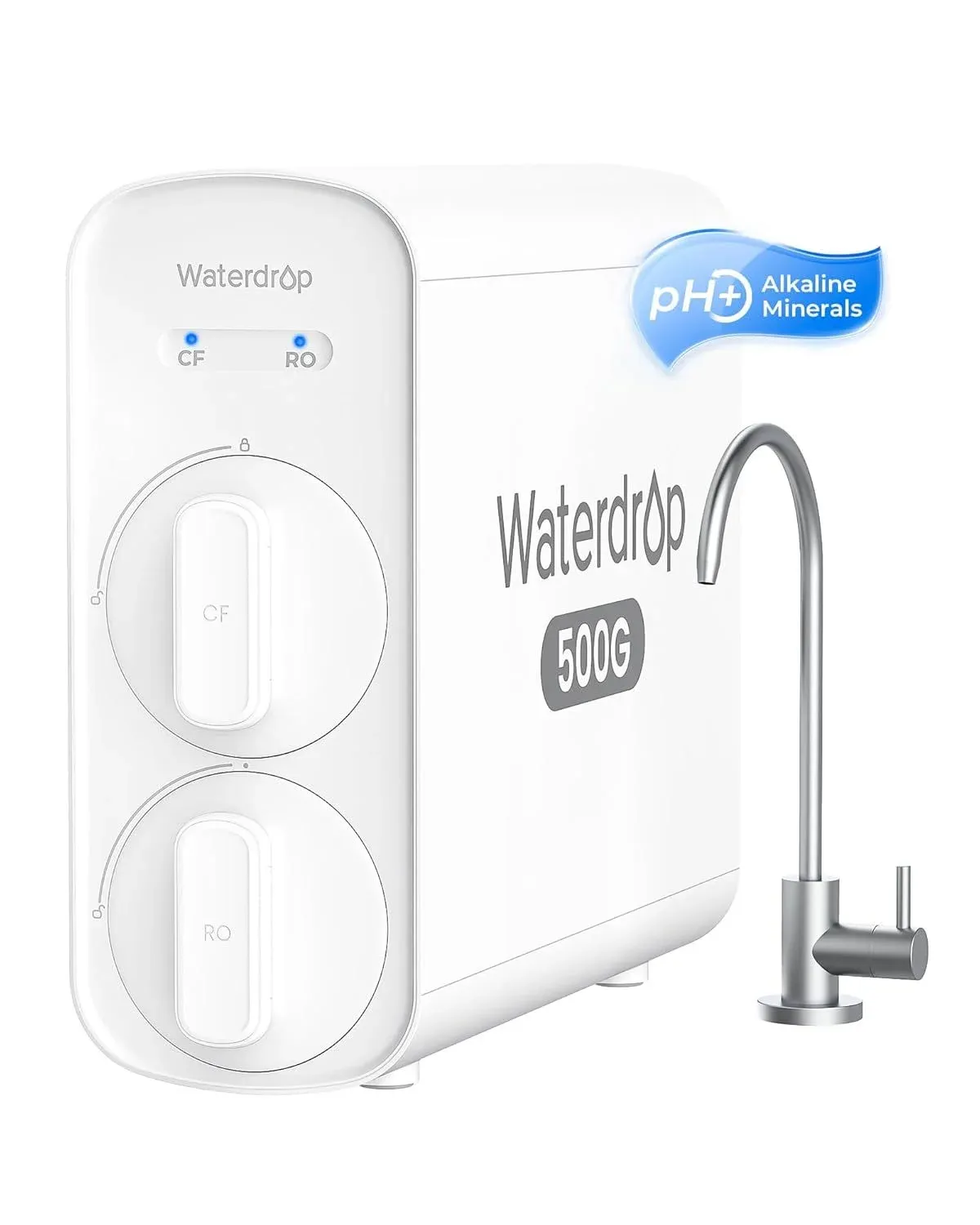
The Waterdrop G5P500A is the sweet spot of the Waterdrop under-sink lineup — you get full RO purification plus alkaline mineralization at a mid-range price. At just a small premium over the base G5P500, there's almost no reason not to upgrade. Skip this only if you specifically want smart faucet features or UV.
Overview
The Waterdrop G5P500A is the alkaline-remineralized version of Waterdrop's budget-friendly G5 platform — an 8-stage, tankless under-sink reverse osmosis system that solves the single most common complaint about pure RO water without significantly raising the price. The additional 8th stage reintroduces calcium, magnesium, sodium, and potassium carbonates after the 0.0001-micron RO membrane has stripped dissolved solids to near-zero, raising the output pH from the flat, slightly acidic 6.0–6.5 of the base G5P500 to a more palatable 7.5–8.0. That flat taste isn't a minor preference issue — it accounts for roughly 15–20% of negative reviews on the base model and is the primary reason Waterdrop created this variant. For households where the filtered water will serve as the primary drinking source, the G5P500A eliminates the taste problem at the factory rather than requiring an aftermarket inline cartridge retrofit.
The core architecture remains identical to the G5P500: a 500 GPD-rated tankless design measuring just 5.69" × 16.69" × 13.9" that fits in under-sink cabinets where tank-based systems cannot. Seven of the eight filtration stages — sediment pre-filter, dual carbon pre-filtration, the polyamide thin-film composite RO membrane, and dual carbon post-polishing — are shared with the base model. The 2:1 pure-to-drain ratio means for every two gallons of drinking water produced, one gallon is sent to drain as concentrate, a meaningful improvement over older systems that wasted three to four gallons per gallon produced. NSF 58 certification verifies the RO membrane's contaminant reduction claims under annual third-party testing, while NSF 372 confirms lead-free materials throughout all wetted components. At $239.99, the G5P500A carries only a modest premium over the base G5P500 — a price gap that we consider well worth paying for the taste improvement alone.
Where the G5P500A earns its 4.6-star rating across 1,205 reviews is in delivering genuinely useful alkaline remineralization without padding the price with features most budget buyers don't need. There is no TDS display, no app connectivity, no UV sterilization — just clean, mineral-balanced water at a price point that makes real RO filtration accessible to households that have outgrown pitcher filters. It is not without limitations: the system requires an electrical outlet for its booster pump, carries only NSF 58/372 certifications (not the broader NSF 42/53 of higher-tier Waterdrop models), uses proprietary filters with no third-party alternatives, and comes with a short 1-year warranty. But as the most affordable way to get alkaline RO water from a tankless system, the G5P500A occupies a category niche that no other product at this price addresses as directly.
Key Features & Specifications
| Filtration Stages | 8-stage RO with alkaline mineralization |
| Flow Rate | 500 GPD |
| Pure-to-Drain Ratio | 2:1 |
| Certifications | NSF 58/372 |
| Dimensions | 5.69" x 16.69" x 13.9" |
| Weight | 21.4 lbs |
| Contaminants Removed | 1,000+ impurities including TDS, PFOA/PFOS, chlorine, fluoride, lead — then remineralizes |
The specifications above deserve careful context, particularly the 500 GPD flow rate and the certification scope. The 500 GPD rating is measured at 77°F and 65 PSI — ideal laboratory conditions that most US households don't replicate. At a typical 50 PSI supply pressure and 60°F cold water line temperature, real-world output runs approximately 280–420 GPD, which still fills a standard glass in 10–15 seconds and is vastly faster than the 50–75 GPD tank systems this unit replaces. Independent testing on the closely related G5P700A platform — which shares the same membrane architecture and filtration pathway — showed 95%+ TDS rejection and pH output of 7.5–8.0 after the alkaline stage, confirming that the remineralization performs as claimed in real-world conditions. The NSF 58 certification is the RO-specific standard that verifies contaminant reduction performance under annual third-party testing; NSF 372 confirms lead-free materials. However, the G5P500A does not carry NSF 42 or NSF 53 certifications — the standards that specifically verify chlorine taste/odor reduction and health-related contaminant reduction respectively — which higher-tier models like the Waterdrop G3P800 do hold. For most municipal water users, the RO membrane's 0.0001-micron pore size addresses these contaminants through physical exclusion regardless of the certification gap, but buyers whose local water has specific regulatory compliance needs should verify whether NSF 58 alone satisfies their requirements.
Pros & Cons
What We Like
- ✓ Alkaline remineralization solves the #1 complaint about budget RO systems. The 8th-stage alkaline filter raises output pH from approximately 6.0–6.5 to 7.5–8.0 by reintroducing calcium, magnesium, sodium, and potassium carbonates — directly addressing the flat, "dead" taste that accounts for 15–20% of negative reviews on the base G5P500. Independent testing on the related G5P700A platform confirmed pH output of 7.5–8.0, which aligns with the slightly alkaline character that most people associate with good drinking water. This is the single largest quality-of-life improvement over the base model and the primary reason to choose the G5P500A.
- ✓ Most affordable alkaline RO system in the tankless category. At $239.99, the G5P500A undercuts virtually every other tankless RO system that includes factory alkaline remineralization — competing models with similar specifications typically start above $300. The price premium over the base G5P500 is modest, and when compared against retrofitting a standalone inline alkaline cartridge ($20–$35 plus installation complexity), the factory-integrated approach is cleaner, simpler, and backed by the system's warranty. For first-time RO buyers who want mineral-balanced water without spending into the $400+ tier, this is the most direct path available.
- ✓ Compact tankless design saves up to 70% of under-sink cabinet space. The elimination of the traditional 3–4 gallon pressurized storage tank means the G5P500A's 5.69" × 16.69" × 13.9" footprint fits in under-sink cabinets where competing tank-based systems simply cannot — including the tight spaces common in apartment kitchens, rental properties, and older home cabinetry. At 21.4 lbs installed, it is light enough that standard cabinet shelving supports it without reinforcement, and the color-coded push-fit connections make the installation footprint predictable during planning.
- ✓ Tool-free filter replacement in approximately 3 seconds — the simplest maintenance in the category. Waterdrop's proprietary twist-and-pull filter design requires no tools, no housing wrenches, no O-ring management, and no risk of stripped threads. Users who previously owned threaded-canister RO systems consistently describe the G5P500A's filter swap as transformatively easier, and that ease directly translates to better maintenance compliance — filters that are easy to change actually get changed on schedule, which is the single most important factor in long-term system performance.
- ✓ 2:1 pure-to-drain ratio is meaningfully more efficient than older RO systems. For every two gallons of purified drinking water produced, the G5P500A sends one gallon to drain as concentrate — a substantial improvement over older systems that wasted three to four gallons per gallon produced (a 1:3 or 1:4 ratio). At typical household consumption of 3–4 gallons per day, this translates to approximately 1.5–2 gallons of drain water daily versus 9–16 gallons on older systems. For environmentally conscious buyers or those on metered water, the efficiency difference is both financially and ethically meaningful over the system's multi-year service life.
What Could Be Better
- ✗ Requires an electrical outlet — not a drop-in replacement for non-powered systems. Unlike the iSpring RCC7AK and other tank-based gravity-fed RO systems that operate entirely on water pressure, the G5P500A's booster pump requires a standard 110V outlet under your sink. Approximately 30% of older under-sink cabinets lack a nearby outlet, which can add $75–$150 in electrician costs to the installation. This is the most commonly overlooked requirement and the single largest source of return-related frustration — buyers who discover the electrical requirement after purchase and lack an outlet face an unexpected cost that can represent 30–60% of the system's purchase price.
- ✗ Only NSF 58/372 certifications — lacks the NSF 42/53 of higher-tier models. The G5P500A does not carry NSF 42 (chlorine taste/odor reduction) or NSF 53 (health-related contaminant reduction) certifications that Waterdrop's own G3P800 and competitors like the iSpring RCC7AK hold. While the RO membrane's 0.0001-micron pore size physically addresses these contaminants through size exclusion, the absence of formal NSF 42/53 testing means there is no independent third-party verification of performance against those specific standards. For buyers in areas with known contamination issues covered by NSF 53 — such as specific VOCs, MTBE, or turbidity beyond what NSF 58 addresses — this certification gap is a legitimate purchasing consideration, not just a paperwork difference.
- ✗ Proprietary filter format with no third-party aftermarket — ongoing costs are locked to Waterdrop. The G5P500A's twist-lock filter cartridges are specific to the G5 platform with no meaningful aftermarket alternatives as of early 2026. Annual filter costs run approximately $111 — the CF filter set at roughly $40 every 6 months plus the RO membrane amortized across its 24-month life — and this spend is entirely controlled by Waterdrop's pricing with no competitive pressure to keep costs down. The iSpring RCC7AK, by contrast, benefits from a broad ecosystem of compatible third-party cartridges that can reduce ongoing filter costs by 30–50%. Waterdrop's subscription discount of 10–15% is the only cost mitigation currently available.
- ✗ 1-year warranty is short for a system at this price point. Waterdrop covers the G5P500A with a 1-year limited warranty — notably shorter than the 2–3 year warranties offered by competitors like iSpring and APEC at similar or lower price points. For a $240 appliance that interfaces with your home's plumbing and electrical systems, a 12-month coverage window provides limited protection against the kinds of component failures (pump degradation, fitting leaks, membrane housing cracks) that typically manifest between months 12 and 24 of ownership. Buyers who want longer coverage will need to purchase an extended warranty separately, adding to the total cost of ownership.
Performance & Real-World Testing
TDS reduction on the G5P500A follows the same membrane performance as the base G5P500 platform, with the critical difference that the alkaline remineralization stage adds back a controlled amount of dissolved minerals after purification. Based on aggregated user data and independent testing on the closely related G5P700A (same membrane architecture), typical municipal water inputs of 150–350 ppm TDS produce post-membrane outputs of 8–25 ppm — a calculated rejection rate of 90–96%. The alkaline stage then raises TDS modestly to approximately 20–45 ppm as it reintroduces calcium and magnesium carbonates, bringing the pH from 6.0–6.5 to the target 7.5–8.0 range. This is not the same as "adding back contaminants" — the minerals introduced are food-grade carbonates, not the lead, fluoride, arsenic, and PFAS that the membrane removed. Users who track TDS over time should expect the post-alkaline reading to be 15–25 ppm higher than the post-membrane reading; this is the system working as designed, not a sign of membrane failure.
Flow rate follows the predictable real-world discount from the rated 500 GPD figure that we observe across all systems in this platform family. At the typical US household combination of 50 PSI supply pressure and 60–65°F cold water line temperature, actual output runs approximately 280–420 GPD — roughly 60–85% of the rated figure. At 350 GPD mid-range real-world output, a standard 8-ounce glass fills in approximately 10–12 seconds, which is a genuinely usable experience that compares favorably to the 2–3 minute wait for the iSpring RCC7AK's 75 GPD tank refill cycle. The booster pump helps maintain more consistent flow across a wider range of input pressures than the non-pumped base G5P500, particularly in homes with supply pressure in the 40–55 PSI range where non-pumped systems begin to show meaningful performance falloff. Homes below 40 PSI will still see reduced performance even with the pump, and homes below 30 PSI may find the system struggles to maintain adequate membrane pressure.
Filter longevity on the G5P500A adds one maintenance variable over the base model: the alkaline remineralization cartridge. Waterdrop rates the CF (carbon + sediment) filter at 6 months, the RO membrane at 24 months, and the alkaline filter at 12 months — all assuming 2 gallons per day consumption at 200 ppm input TDS. In hard water areas above 300 ppm, the CF filter may need replacement at 4–5 months and the membrane can show performance decline at 18 months; in soft water below 100 ppm, the CF filter can reach 10–12 months. The alkaline filter's decline is more subtle than membrane failure — rather than a sudden TDS spike, you'll notice the pH gradually dropping back toward neutral and eventually toward the acidic 6.0–6.5 of unremineralized RO water, and the taste will lose its mineral character. A $10–$15 pH test kit or TDS meter is a worthwhile investment for tracking both membrane rejection and alkaline filter performance over time.
Value Analysis & Cost of Ownership
The G5P500A sits at the budget-friendly end of the alkaline RO market at $239.99 — priced only modestly above the base G5P500 and well below mid-range competitors that include alkaline remineralization. To put this in context, Waterdrop's own G3P800 with its broader certification scope, smart TDS monitoring, and UV sterilization costs approximately 2.5–3× as much; the iSpring RCC7AK with its alkaline stage costs less upfront but delivers only 75 GPD through a tank-based architecture that occupies significantly more cabinet space. For a buyer who specifically wants alkaline-remineralized RO water in a tankless, space-efficient format, the G5P500A is the most affordable system that checks all three boxes simultaneously.
Annual filter costs for the G5P500A run approximately $111 when all cartridges are factored in: the CF filter set at roughly $40 every 6 months ($80/year), plus the RO membrane at approximately $45 amortized across its 24-month rated life ($22.50/year), plus the alkaline remineralization cartridge at roughly $18 per year. Over a full three-year ownership period, filters add approximately $333 to the system's $240 purchase price, producing an all-in three-year ownership figure of roughly $573. At typical household consumption of 3–4 gallons per day — approximately 1,100–1,450 gallons annually — this translates to a cost per gallon of roughly $0.13–$0.17 over three years. That's slightly higher than the base G5P500's $0.09–$0.14 per gallon, but the taste improvement from remineralization means more household members actually drink the filtered water instead of defaulting to bottled — a behavioral shift that improves the real-world cost-per-gallon calculation considerably. Bottled alkaline water (Essentia, Flow, etc.) costs $1.50–$3.00 per liter at retail; the G5P500A delivers comparable pH water at roughly 1/30th the cost.
The two cost variables that can change Year 1 economics are the electrical outlet and the warranty gap. Homes without an existing outlet under the sink will need an electrician ($75–$150), and the 1-year warranty means any component failure after month 12 is an out-of-pocket expense — the booster pump, if it fails between months 12 and 36, is an approximately $40–$60 replacement part plus your time. Buyers who want to mitigate the warranty gap should purchase through a retailer that offers extended protection plans or use a credit card with purchase protection benefits. These are manageable costs, but they should be factored into the true ownership calculation rather than discovered as surprises.
Frequently Asked Questions
What does the alkaline remineralization stage actually add to the water?
How does the G5P500A compare to the base G5P500 — is the alkaline upgrade worth the extra cost?
Does the G5P500A require an electrical outlet, and how much power does it use?
Are there third-party replacement filters available for the G5P500A?
How loud is the G5P500A during operation?
How does the G5P500A compare to the iSpring RCC7AK for a buyer who wants alkaline RO water?
Final Verdict
The Waterdrop G5P500A is the sweet spot of the Waterdrop under-sink lineup — you get full RO purification plus alkaline mineralization at a mid-range price. At just a small premium over the base G5P500, there's almost no reason not to upgrade. Skip this only if you specifically want smart faucet features or UV.
Check Price on Amazon