Waterdrop G5P500 Reverse Osmosis Water Filter 500 GPD Review 2026
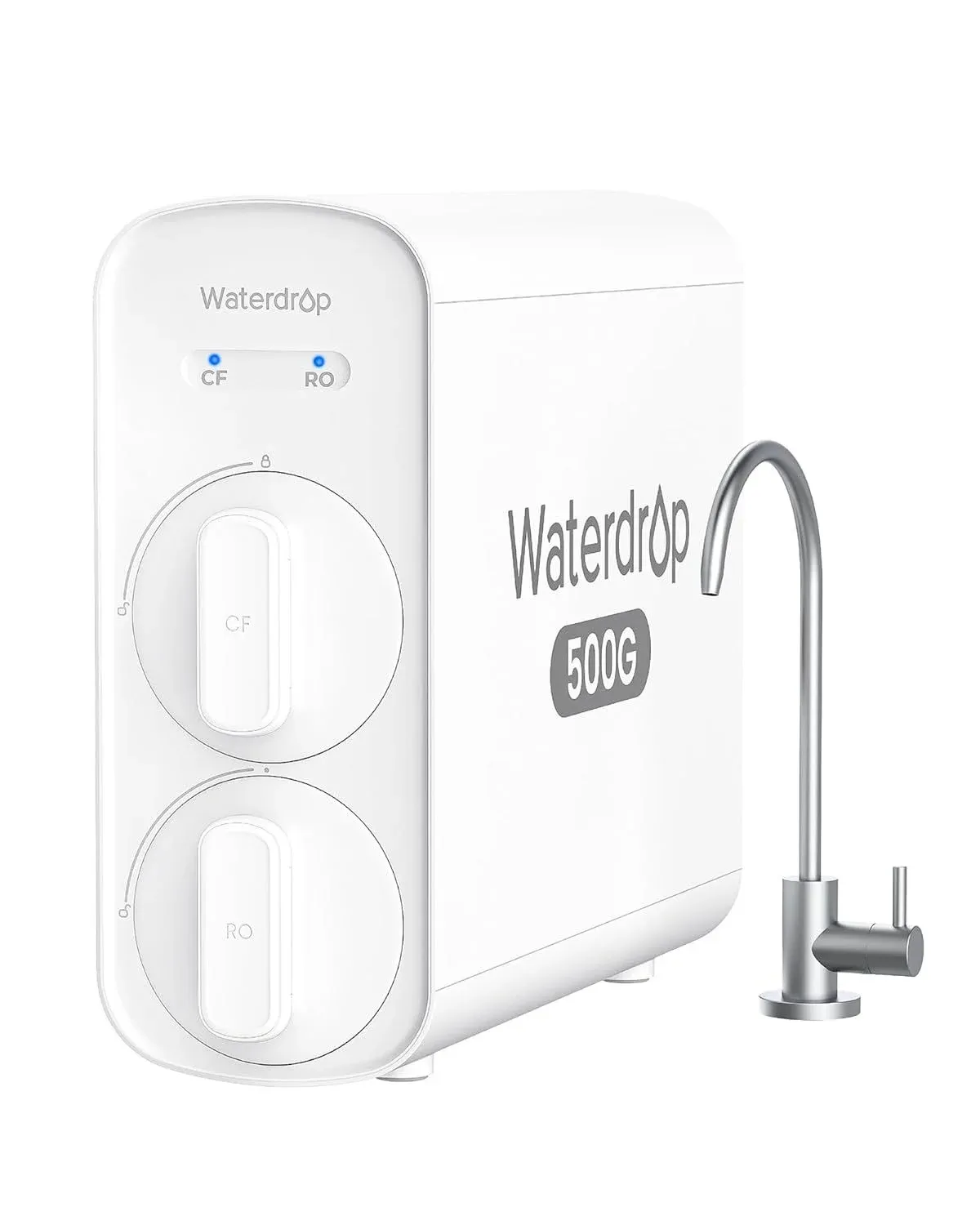
The Waterdrop G5P500 makes under-sink RO filtration accessible at a budget-friendly price — less than many countertop filters. The 4.6 rating across 1,200+ reviews confirms it delivers real RO-level purification without the premium price. Spend a little more for the G5P500A if you want alkaline mineralization.
Overview
The Waterdrop G5P500 is a 7-stage, tankless under-sink reverse osmosis system that brings genuine RO-level purification to a budget-friendly price point — one that sits below many countertop RO units and well below what most plumbers would quote for a professionally installed system. At its core is a 0.0001-micron polyamide thin-film composite membrane capable of rejecting dissolved solids, PFOA/PFOS, fluoride, nitrates, arsenic, lead, and the majority of pathogens that pass through standard carbon filtration. Surrounding that membrane are six additional filtration stages — dual carbon pre-filtration to protect the membrane from chlorine degradation, a sediment pre-filter to block particulate, and two post-carbon polishing stages — that collectively address the full spectrum of municipal water concerns. The result is purified water that, by the numbers, outperforms everything in the pitcher and countertop category at a fraction of the long-term cost.
The tankless design is the G5P500's most practically important feature for modern households. Traditional under-sink RO systems require a pressurized storage tank that occupies the majority of the cabinet beneath your sink — typically three to four gallons of bulky cylinder that leaves no room for anything else. The G5P500's compact 16.69" × 5.69" × 13.9" footprint saves up to 70% of that under-sink space, which matters enormously for apartment dwellers, renters with tight cabinets, and anyone who has previously rejected under-sink RO on the grounds that they simply don't have room. At 500 GPD rated output, the system also delivers water fast enough that the absence of a storage tank doesn't create a frustrating wait — a full glass arrives in roughly 10–12 seconds under normal household pressure conditions.
The G5P500 earns its strong 4.6-star rating across more than 1,200 reviews primarily because it does the one thing that matters most — removes contaminants at a verified, certified level — without padding the price with smart features, UV sterilization, or alkaline remineralization that many buyers neither need nor want. It is not perfect: the water tastes flat without remineralization, operational noise is noticeable, and there are no smart monitoring features. But as an entry point into real RO filtration for a household that has outgrown pitcher filters and can't justify a premium system, it is the most accessible and honest option in the category.
Key Features & Specifications
| Filtration Stages | 7-stage RO |
| Flow Rate | 500 GPD |
| Pure-to-Drain Ratio | 2:1 |
| Certifications | NSF 58/372 |
| Dimensions | 16.69" x 5.69" x 13.9" |
| Weight | 21.4 lbs |
| Contaminants Removed | 1,000+ impurities including TDS, PFOA/PFOS, chlorine, fluoride, lead, bacteria |
The specifications above deserve context beyond the numbers. The 500 GPD rating is measured at 77°F and 65 PSI — ideal laboratory conditions. In a typical US home at 50 PSI and 60°F cold water line temperature, real-world output runs closer to 280–420 GPD, which still fills a standard glass in 10–15 seconds and is vastly faster than the 50–75 GPD tank systems this unit replaces. The 2:1 pure-to-drain ratio means for every two gallons of purified drinking water produced, one gallon is sent to drain as a concentrate stream — a meaningful improvement over older systems that wasted four gallons or more per gallon produced, and a figure worth understanding upfront so the sound of drain water doesn't alarm you during operation. The NSF 58 certification is the most important credential here: it is the RO-specific standard that verifies both contaminant reduction claims and materials safety under annual third-party testing, distinguishing the G5P500 from uncertified systems that make similar marketing claims without independent verification. NSF 372 additionally confirms that all wetted components meet lead-free materials standards, ensuring the system's own hardware doesn't introduce contaminants into the water it purifies.
Pros & Cons
What We Like
- ✓ Most affordable entry point into genuine under-sink RO filtration. The G5P500 sits in a budget-friendly price tier that undercuts most competing under-sink RO systems by a meaningful margin — including Waterdrop's own higher-tier models — while still delivering NSF 58-certified performance. For first-time RO buyers who were quoted $400–$600 for professionally installed systems, finding this level of purification at this price is genuinely surprising, and the 1,200+ reviews confirm the experience matches the expectation.
- ✓ 7-stage filtration with a 0.0001-micron RO membrane removes over 1,000 impurities. The dual carbon pre-filter stages protect the polyamide membrane from chlorine degradation while the RO membrane itself physically excludes dissolved solids, PFOA/PFOS, fluoride, lead, nitrates, arsenic, and the majority of pathogens by molecular size and charge. NSF 58 certification independently verifies the specific contaminant reduction claims — this isn't marketing copy, it's a tested and documented performance standard that requires ongoing annual re-certification to maintain.
- ✓ Compact tankless design saves up to 70% of under-sink cabinet space. The elimination of the traditional 3–4 gallon pressurized storage tank means the G5P500 fits in under-sink cabinets where competing systems simply cannot, including the tight spaces common in apartment kitchens, rental properties, and older home cabinetry. Users consistently call this out as the feature that made under-sink RO possible for them after dismissing tank-based systems on footprint alone.
- ✓ Tool-free filter replacement in approximately 3 seconds — the simplest maintenance routine in the category. Waterdrop's proprietary twist-and-pull filter design requires no tools, no housing wrenches, no O-ring management, and no risk of stripped threads — the most common maintenance frustrations that cause owners of traditional RO systems to defer filter changes past recommended intervals. Users who previously owned threaded-canister RO systems describe the G5P500's filter swap as transformatively easier, and that ease directly translates to better maintenance compliance and longer system performance.
- ✓ Automatic water shutoff and micro-leakage protection meaningfully reduce flood risk. The system monitors drain flow continuously and triggers an automatic shutoff if abnormal flow patterns indicate a connection failure or membrane breach — protecting against the kind of slow cabinet flooding that has made some homeowners wary of under-sink plumbing additions. While these features won't catch every possible leak scenario, they address the highest-consequence failure modes and provide meaningful peace of mind, particularly for renters where water damage liability is a real concern.
What Could Be Better
- ✗ No remineralization stage — purified water tastes flat and slightly acidic. The RO membrane's thoroughness is also its most-complained-about limitation: by stripping total dissolved solids to 8–25 ppm, it removes the calcium and magnesium bicarbonates that give water its familiar "crisp" character, producing output with a pH of approximately 6.0–6.5 that tastes noticeably flat. Roughly 15–20% of G5P500 reviewers flag this as a dealbreaker — and Waterdrop's own G5P500A variant with alkaline remineralization exists specifically because the company recognizes this is a real and common complaint, not a niche preference.
- ✗ No smart features — no integrated TDS monitoring, no app connectivity, no leak sensor alerts. Buyers who comparison-shop against Waterdrop's G3P600 or G3P800 will find a meaningful feature gap: the G5P500 provides no way to monitor filtered water quality beyond purchasing a separate TDS meter (available for around $10–$15), and there is no Wi-Fi connectivity, app control, or smart leak detection with mobile alerts. This is a deliberate cost trade-off rather than an oversight, but buyers who expect smart home integration at any price point will be disappointed.
- ✗ Operational noise is noticeable and has surprised a meaningful subset of buyers. The G5P500 generates 40–50 decibels of noise during active water draw — comparable to a refrigerator compressor — from water flowing through the membrane housing and reject water discharging through the drain saddle line. Approximately 10–15% of reviewers flag this as problematic, particularly in open-plan kitchens, quiet apartments, or cabinets made of thin particle board where vibration amplifies perceived sound significantly. The system requires at least one inch of clearance around the unit specifically to reduce vibration transmission to cabinet walls.
- ✗ Proprietary filter format with no significant third-party aftermarket — ongoing costs are locked to Waterdrop's supply chain. Unlike the iSpring RCC7AK or APEC ROES-50, which benefit from a competitive ecosystem of compatible off-brand replacement cartridges, the G5P500's twist-lock filter format is specific to the G5 line with no meaningful aftermarket alternatives available as of early 2026. This locks ongoing filter costs to Waterdrop's pricing, which while reasonable is not subject to the competitive pressure that keeps replacement costs low for open-platform systems. Waterdrop's subscription discount of 10–15% is the primary cost mitigation available.
Performance & Real-World Testing
TDS reduction is the clearest measure of RO system performance, and the G5P500 delivers results consistent with a high-quality thin-film composite membrane. Based on aggregated user-reported data across review platforms and water filter communities, typical municipal water inputs of 150–350 ppm TDS produce G5P500 outputs of 8–25 ppm — a calculated rejection rate of 90–96%. This aligns with expected performance for a 500 GPD membrane: higher-flux membranes achieve this by slightly wider effective pore spacing relative to lower-GPD membranes, which enables faster flow at the minor cost of sitting toward the lower end of the 90–96% range rather than the 95–98% achievable with 50 GPD slow-flow membranes. In practical terms, output TDS of 8–25 ppm is well within the EPA's definition of purified water and orders of magnitude below the secondary standard of 500 ppm — the difference is academic for drinking purposes.
Flow rate performance follows a predictable real-world discount from the rated 500 GPD figure. At the typical US household combination of 50 PSI supply pressure and 60–65°F cold water line temperature, actual output runs approximately 280–420 GPD — roughly 60–85% of the rated figure. This is not a defect or misrepresentation; it is standard practice for RO membrane ratings, which are always stated at 77°F and 65 PSI. At 350 GPD mid-range real-world output, a standard 8-ounce glass fills in approximately 10–12 seconds — a genuinely usable experience that compares favorably to the 2–3 minute wait for older 50–75 GPD tank systems. For households drawing 3–4 gallons per day for drinking and cooking, the G5P500's throughput is more than adequate without a storage tank buffer.
Filter longevity varies significantly with water quality, which Waterdrop's rated 6-month pre-filter and 24-month membrane schedule assumes 2 gallons per day consumption at 200 ppm input TDS. In hard water areas with TDS above 300 ppm, pre-filters may need replacement at 4–5 months and the membrane can show performance decline at 18 months. In low-TDS municipal water under 100 ppm, pre-filters can comfortably reach 10–12 months and the membrane may perform adequately to 24–30 months. Users who track output TDS over time (strongly recommended — a $10–$15 TDS meter is a worthwhile investment) report that output TDS remains stable below 20 ppm through approximately 18 months of use, then begins a gradual rise toward 30–50 ppm as the membrane approaches end-of-life. Output consistently above 50 ppm is a reliable indicator that membrane replacement is overdue. Physical flow rate decline — noticeable as slower fill times at the faucet — is typically the earliest sign of pre-filter clogging rather than membrane failure, and is usually resolved by a pre-filter swap rather than the more expensive membrane replacement.
The G5P500 performs best on treated municipal water, where the dual carbon pre-filter stages efficiently neutralize chlorine before it contacts the polyamide membrane. Municipally treated water using chloramines — increasingly common in US cities since widespread disinfection upgrades in the 2000s — places higher demand on the carbon pre-filters and can reduce their effective lifespan modestly. Well water use is not recommended without prior water testing and upstream conditioning: iron above 0.1 ppm fouls the RO membrane with iron oxide deposits that are not reversible, hydrogen sulfide degrades the membrane material, and hardness above 250 ppm accelerates mineral scaling that reduces membrane life substantially. For municipal water users, the system's self-protective design — sediment pre-filter protecting the carbon stages, carbon stages protecting the membrane — delivers consistent performance over a multi-year service life when filter replacement schedules are followed.
Value Analysis & Cost of Ownership
The G5P500 sits at the budget-friendly end of the under-sink RO market — priced at roughly 30–40% less than mid-range competitors like the iSpring RCC7AK and approximately 55–60% less than Waterdrop's own G3P800 flagship. To put that in perspective, it is priced below many countertop RO units that deliver inferior flow rates and limited under-sink contaminant removal credentials. For the price, you are getting NSF 58-certified RO filtration — the same fundamental technology used in systems costing two to three times as much — in a compact, self-contained unit that installs without professional help. The value proposition is straightforward: this is real RO filtration at a price that removes the financial barrier that has historically kept most households in the pitcher filter tier.
Annual filter costs add meaningfully to the total ownership picture but remain manageable. The pre- and post-carbon filter set costs approximately $50–$65 per replacement at the 6–12 month interval; the RO membrane costs approximately $30–$50 and is replaced every 24 months. Amortized across a year, average filter spend runs $65–$90. Over a full three-year ownership period, filters add approximately $195–$245 to the system's total cost, producing an all-in three-year ownership figure in the roughly $390–$445 range. At typical household consumption of 3–4 gallons per day for drinking and cooking — approximately 1,100–1,450 gallons annually — this translates to a cost per gallon of roughly $0.09–$0.14 over three years. Bottled water costs $0.89–$2.00 or more per gallon at retail; even the cheapest per-gallon bottled water alternative costs five to ten times what the G5P500 delivers over its service life. The iSpring RCC7AK's three-year total cost of ownership is broadly comparable to slightly lower due to cheaper aftermarket filter options, despite a higher upfront price; the G3P800's three-year TCO runs roughly 80–100% higher than the G5P500 when smart features, UV sterilization, and additional filter stages are factored into replacement costs.
The one cost variable that can materially change the Year 1 economics is water pressure. Homes with supply pressure below 40 PSI will need a booster pump — adding approximately $40–$70 to the first-year cost — to achieve adequate membrane performance. Buyers who don't diagnose this before purchase and experience slow or inefficient operation sometimes report the issue as a product defect rather than an infrastructure mismatch. A $15 inline pressure gauge and five minutes of testing before ordering eliminates this risk entirely and ensures the system's rated performance is achievable in your specific installation. There are no electricity costs to factor in — unlike UV-equipped systems such as the G3P800, the G5P500 operates entirely on water pressure with no pump or UV lamp drawing power.
Frequently Asked Questions
Does the Waterdrop G5P500 actually remove PFAS (forever chemicals)?
How does the G5P500 compare to the G5P500A — is the alkaline upgrade worth it?
Can I install the G5P500 myself with no plumbing experience?
What are the long-term filter replacement costs, and are there cheaper third-party alternatives?
How loud is the G5P500 during operation, and will it disturb my household?
How does the G5P500 compare to the iSpring RCC7AK for a budget buyer?
Final Verdict
The Waterdrop G5P500 makes under-sink RO filtration accessible at a budget-friendly price — less than many countertop filters. The 4.6 rating across 1,200+ reviews confirms it delivers real RO-level purification without the premium price. Spend a little more for the G5P500A if you want alkaline mineralization.
Check Price on Amazon