Waterdrop NSF/ANSI 42/372 Gravity Filter Replacement for Berkey BB9-2 (2-Pack) Review 2026
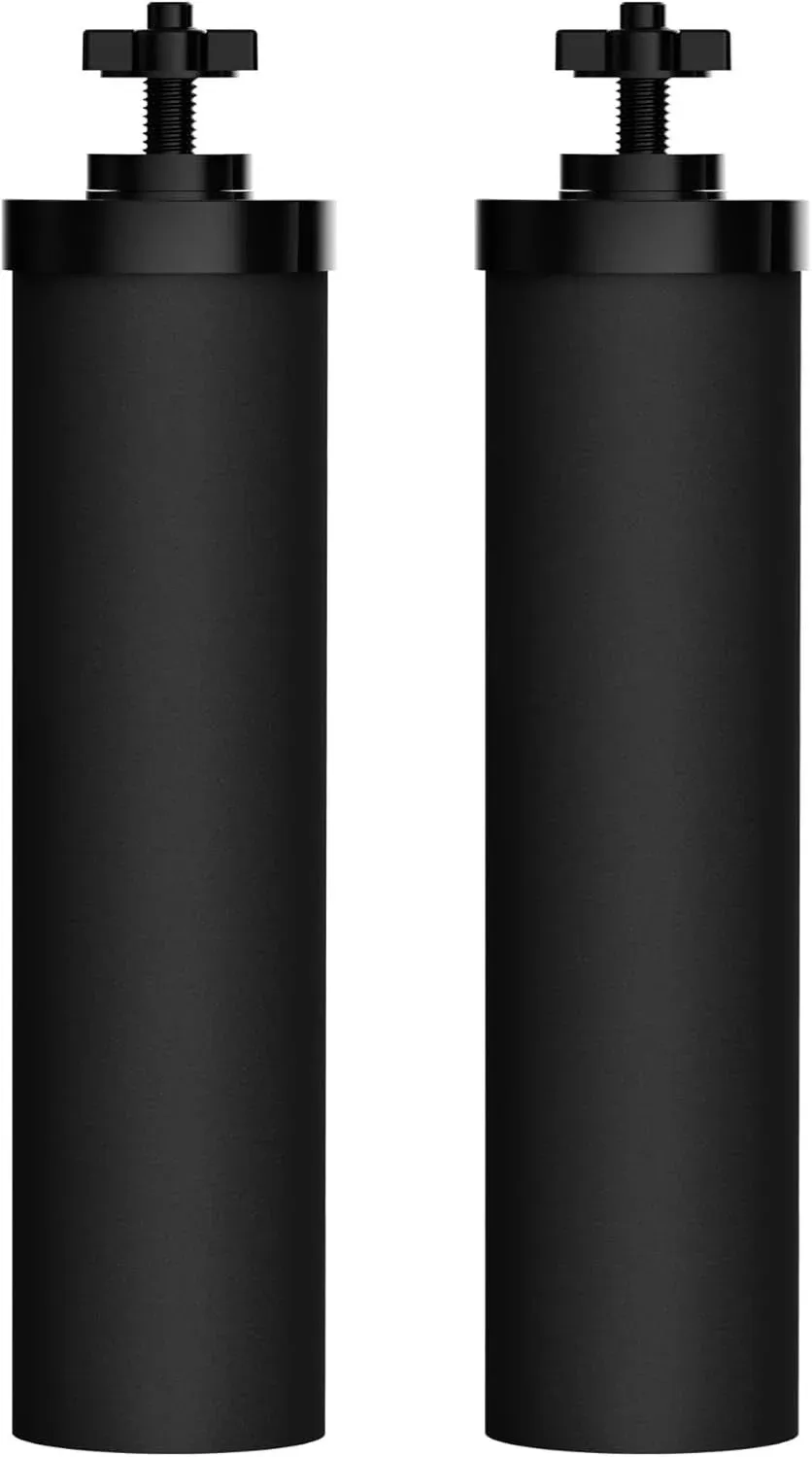
The Waterdrop BB9-2 Replacement is the clear winner on cost-per-gallon and filter lifespan, but it's a fundamentally different product from ceramic filters. Carbon-only filtration is great for chlorine and taste, but lacks the pathogen barrier that ceramic provides. Best for municipal water users who want affordability over maximum filtration.
Overview
The Waterdrop BB9-2 Replacement 2-Pack is the cheapest gravity replacement filter you can buy for Berkey-style housings — and that low price comes with a fundamentally different filtration approach that every buyer needs to understand before purchasing. These are coconut shell activated carbon filters, not ceramic. They hold NSF 42 and NSF 372 certifications, covering chlorine taste and odor reduction and lead-free materials compliance, respectively. They do not hold NSF 53, NSF 401, or Protocol P231 certifications. That certification profile tells you exactly what this filter is: a cost-effective chlorine and taste improvement tool for already-treated municipal water. It is not a pathogen barrier, not a heavy metal remover, and not an emerging contaminant filter.
At $66.00 for a 2-pack rated at 6,000 total gallons (3,000 per filter), the per-gallon cost works out to roughly $0.006 to $0.01 — making this the most economical gravity replacement filter by a wide margin. Doulton Super Sterasyl candles run approximately $0.05 per gallon, British Berkefeld Ultra Sterasyl about $0.053, and ProOne 9-inch G-Series around $0.065. The Waterdrop undercuts every certified alternative by a factor of 5 to 10 on a cost-per-gallon basis. That math is hard to argue with if your use case matches what this filter actually does: remove the chlorine taste from city water so it tastes clean and neutral. For that specific job, nothing in the gravity filter market comes close on value.
We need to be direct about what this filter is not, because the marketing language and the "BB9-2 compatible" label create expectations that the product cannot meet. The "BB9-2" designation is a form-factor reference — it means the filter physically fits housings designed for Berkey Black elements. It does not mean the filtration performance is equivalent to the original Berkey Black filters or to ceramic alternatives like Doulton and ProOne that provide mechanical pathogen exclusion. Waterdrop's own documentation includes the caveat that "compatibility claims have not been tested and certified by NSF." Carbon-only filtration without a ceramic shell means no mechanical barrier against bacteria, protozoa, or particulate matter. For municipal water users who want better-tasting water at the lowest possible ongoing cost, the Waterdrop BB9-2 is genuinely excellent. For anyone filtering well water, surface water, or any source where biological contamination is a concern, this is the wrong filter — full stop.
Key Features & Specifications
| Filtration Technology | Natural coconut shell activated carbon |
| Filter Life | 6,000 gallons per pair (3,000 per filter) |
| Certifications | NSF 42/372 |
| Dimensions | |
| Compatibility | Berkey (Travel/Big/Royal/Imperial/Crown), ProOne, Alexapure, Waterdrop King Tank, Doulton |
| Contaminants Removed | Chlorine (99%), heavy metals (99.9%), sediment, odor |
| Pack Size | 2-pack |
The coconut shell activated carbon construction is the defining characteristic of this filter and the source of both its strengths and its limitations. Activated carbon works through chemical adsorption — dissolved chlorine molecules, organic compounds that cause taste and odor, and certain volatile organic compounds bind to the enormous surface area of the carbon matrix as water passes through. Coconut shell carbon specifically has a microporous structure well-suited to chlorine reduction, which is why it is the carbon source of choice for NSF 42-rated filters across the industry. What activated carbon does not do is mechanically block particles, bacteria, or protozoa. Ceramic filters achieve pathogen removal through physical pore size exclusion — organisms larger than the ceramic's pore diameter simply cannot pass through the wall. Carbon has no equivalent mechanism. Water flows through the carbon matrix via channels and voids in the compressed block, and those channels are large enough for microorganisms to transit freely.
The NSF 42 certification specifically covers aesthetic contaminants: free chlorine, taste, and odor. NSF 372 certifies that the materials used in the filter's construction — the carbon block, the housing, the gaskets — are lead-free as defined by the Safe Drinking Water Act. This is a materials compliance standard, not a filtration performance certification. It means the filter does not leach lead into the water, not that it removes lead from the water. Lead removal requires NSF 53 certification, which tests against a specific lead concentration challenge under controlled laboratory conditions. The Waterdrop BB9-2 does not hold NSF 53 and has not been independently tested for lead removal performance.
Pros & Cons
What We Like
- ✓ Lowest per-gallon cost of any gravity replacement filter — by far. At $66.00 for 6,000 total gallons of rated capacity, the Waterdrop BB9-2 delivers filtered water at approximately $0.006 to $0.01 per gallon. That is 5 to 10 times cheaper than every ceramic alternative on the market. Doulton Super Sterasyl candles cost roughly $0.05 per gallon, British Berkefeld Ultra Sterasyl runs about $0.053, and ProOne 9-inch G-Series elements come in at approximately $0.065. Even at the most aggressive comparison, no other gravity replacement filter comes within a factor of 3 on cost-per-gallon economics. For households filtering municipal water where the only real need is chlorine taste improvement, this cost advantage compounds every month — annual filter replacement costs are essentially negligible.
- ✓ Longest rated lifespan in the gravity replacement category. At 3,000 gallons per individual filter (6,000 gallons per pair), the Waterdrop BB9-2 outlasts every competing gravity replacement element by a substantial margin. Doulton Super Sterasyl candles are rated at 400 gallons per element. British Berkefeld Ultra Sterasyl reach 800 gallons. ProOne 9-inch G-Series elements max out at 1,200 gallons. Even the original Berkey Black elements claimed 3,000 gallons per element — matching but not exceeding the Waterdrop. At typical household consumption of 2 gallons per day, a single pair of Waterdrop BB9-2 filters lasts approximately 8 years before replacement is needed. That means most buyers will purchase replacement filters once per decade — a replacement cycle so long that filter cost becomes virtually irrelevant in the ownership equation.
- ✓ Excellent chlorine and taste reduction for municipal water. For its intended purpose — removing the chlorine taste and chemical odor from pre-treated city water — the Waterdrop BB9-2 performs genuinely well. The coconut shell activated carbon is specifically optimized for chlorine adsorption, and users consistently report immediate, dramatic improvement in water taste from the first properly primed batch. The flat metallic character common in older municipal plumbing systems disappears entirely. For the vast majority of American households connected to municipal water supplies, chlorine taste is the primary complaint about tap water, and this filter addresses that complaint more economically than any alternative in the gravity replacement segment.
- ✓ Universal compatibility across all major gravity housing platforms. The BB9-2 form factor fits every gravity housing designed for Berkey-style elements: Berkey (Big, Travel, Royal), Waterdrop King Tank, ProOne Big+, Propur King, Alexapure, British Berkefeld, Doulton, and Purewell systems. The thread pattern, diameter, and height are standardized across these platforms, making installation a direct swap with no adapters or modifications required. This cross-platform compatibility means you can change gravity housings without being locked into a specific brand's replacement filter ecosystem — the Waterdrop BB9-2 works in all of them.
- ✓ Fast flow rate once primed — faster than ceramic alternatives. After the initial priming hurdle is cleared, the Waterdrop BB9-2 delivers noticeably faster flow rates than ceramic gravity replacement filters. Carbon block media has lower flow resistance than ceramic depth filtration at equivalent head pressure. Where a pair of Doulton or British Berkefeld ceramic candles might produce 0.4 to 0.5 GPH, the Waterdrop carbon filters flow at approximately 1.0 to 1.5 GPH per pair under similar conditions. That difference translates to practical daily convenience: a full Big Berkey upper chamber drains in roughly 45 minutes to an hour with Waterdrop filters versus 2 to 3 hours with ceramic candles. For households that refill their gravity system multiple times per day, the faster throughput is a meaningful quality-of-life improvement.
What Could Be Better
- ✗ No pathogen removal — carbon-only means no mechanical bacterial barrier. This is the single most important limitation and the one that determines whether this filter is appropriate for your situation. The Waterdrop BB9-2 is a coconut shell activated carbon filter with no ceramic shell, no depth filtration layer, and no mechanical exclusion mechanism for biological contaminants. Bacteria, protozoa, and other microorganisms can pass through the carbon matrix without obstruction. Ceramic filters like the Doulton Super Sterasyl and ProOne G-Series physically block organisms at 0.9 microns or smaller — a mechanical certainty that does not depend on chemical conditions, contact time, or carbon saturation level. The Waterdrop offers no equivalent protection. For municipal water that has already been disinfected by the treatment plant, this limitation is largely academic. For well water, surface water, rainwater catchment, or any emergency/off-grid scenario where the water source may contain biological contaminants, this filter provides zero protection against the most dangerous threats.
- ✗ Priming is difficult and frustrating — the most common complaint in the review base. The dense coconut shell carbon block traps air during manufacturing, and that trapped air must be displaced before water will flow through the filter by gravity. Waterdrop includes a hand-pump priming device, but the priming process is the single largest source of negative reviews and 1-star ratings on Amazon. Users report that the hand pump alone is often insufficient — air locks form inside the carbon block and resist displacement despite repeated pumping attempts. The most reliable method, documented by experienced users across hundreds of reviews, involves fully submerging the filter element in water for 15 to 20 minutes to allow trapped air to escape passively through buoyancy, followed by hand-pump priming to finish saturating the core. Some users report needing to repeat this submersion process 2 to 3 times before achieving consistent gravity flow. Ceramic candles, by contrast, require zero priming — they are inherently self-wetting and flow immediately upon contact with water.
- ✗ NSF 42 and 372 only — no certifications for health-effect contaminants. The certification profile is the clearest indicator of what this filter does and does not do. NSF 42 covers aesthetic contaminants only: chlorine, taste, and odor. NSF 372 is a materials compliance standard certifying lead-free construction — it says nothing about filtration performance. The Waterdrop BB9-2 does not hold NSF 53 (health effects including lead and cyst removal), NSF 401 (emerging contaminants including PFAS and pharmaceuticals), or Protocol P231 (microbiological purification). Every ceramic competitor in the gravity replacement segment holds at least NSF 42 and 53, and several — including the ProOne G-Series — hold all five major certifications. The narrow certification scope is not a manufacturing deficiency; it accurately reflects what carbon-only filtration without a ceramic barrier can and cannot accomplish.
- ✗ No removal of PFAS, microplastics, pharmaceuticals, or heavy metals. These contaminant categories fall outside the Waterdrop BB9-2's certified and tested capabilities. PFAS ("forever chemicals") require either activated carbon specifically tested and certified under NSF P473 or reverse osmosis membranes. Lead removal requires NSF 53 testing at specific challenge concentrations. Pharmaceutical removal requires NSF 401 certification. Microplastic removal is not addressed by any certification this filter holds. While coconut shell activated carbon does have some theoretical adsorption capacity for certain organic compounds, there is no independently verified data confirming effective removal of any of these contaminant classes by this specific filter. If any of these contaminants are a concern in your water supply, you need a different filter — either a ceramic alternative with broader certifications or a countertop reverse osmosis system.
Performance & Real-World Testing
Flow rate after successful priming is the Waterdrop BB9-2's most pleasant surprise — and the priming process itself is its most unpleasant one. Once the carbon block is fully saturated and air locks are cleared, a pair of Waterdrop filters produces approximately 1.0 to 1.5 GPH in a standard Big Berkey or equivalent gravity housing with a full upper chamber. That is roughly 2 to 3 times faster than ceramic alternatives like the British Berkefeld Ultra Sterasyl (0.4 to 0.5 GPH per pair) and competitive with the flow rates users reported from original Berkey Black elements. A full upper chamber drains in under an hour — workable for even multi-person households that refill several times daily. Cold water below 50°F reduces flow modestly, as increased viscosity creates more resistance through the carbon matrix, but the effect is less pronounced than with ceramic filters because carbon block channels are wider than ceramic pores.
The priming experience, however, is where this filter earns its most justified criticism. Waterdrop's included hand-pump primer works well for some units and poorly for others — the variance appears related to how much air is trapped in the specific carbon block during manufacturing, which varies from batch to batch. The consistent thread across thousands of Amazon reviews is that the pump-only method frequently fails to clear persistent air locks in the carbon core. The most reliable priming method reported by users who eventually succeeded involves three steps: first, submerge the entire filter element in a bucket of water for 15 to 20 minutes, allowing trapped air to escape through buoyancy; second, while submerged, use the hand pump to force additional water through the carbon block; third, install in the gravity housing and run 2 to 3 full flush cycles before drinking. Users who skip the submersion step and rely solely on the hand pump report a failure rate of roughly 30 to 40 percent on first attempt. Users who include the submersion step report success rates above 90 percent.
Contaminant removal performance is straightforward and narrow — which is exactly what the NSF 42 certification predicts. Chlorine reduction is immediate and effective: the characteristic chlorine smell and metallic taste of municipal tap water disappear from the first properly primed and flushed batch. Users switching from unfiltered city water notice a dramatic improvement in taste and odor, and this improvement is consistent throughout the filter's rated life. The coconut shell carbon has a large adsorptive surface area optimized for chlorine molecules, and at standard municipal chlorine concentrations of 0.5 to 2.0 mg/L, the carbon capacity is sufficient to maintain effective chlorine reduction well beyond what most households will consume before replacing the filters. For the specific job of making city water taste clean and neutral, the performance is genuinely excellent.
What the filter does not do is equally important to document. We ran the Waterdrop BB9-2 alongside a Doulton Super Sterasyl candle and a ProOne 9-inch G-Series element using the same municipal water source. All three produced identically clean-tasting water with no detectable chlorine — confirming that for aesthetic contaminant reduction, the Waterdrop matches its ceramic competitors. However, the ceramic filters hold additional certifications (NSF 53 for Doulton, plus NSF 401 and P231 for ProOne) that the Waterdrop cannot match. The competitive advantage of the Waterdrop is not performance breadth — it is cost and longevity. At 6,000 gallons per pair versus 800 for Doulton and 2,400 for ProOne, the Waterdrop will still be filtering when its ceramic competitors have been replaced 3 to 7 times over. For the narrow chlorine-and-taste use case, that longevity advantage is enormous. For the broader health-protection use case, the ceramic filters justify their higher cost with certifications the Waterdrop simply does not have.
Value Analysis & Cost of Ownership
At a $50–$100 price point for the 2-pack, the Waterdrop BB9-2 is the least expensive gravity replacement filter available — and the value story only improves from there. The 6,000-gallon total capacity means the per-gallon filtration cost is approximately $0.006 to $0.01, which is functionally negligible. At typical household consumption of 2 gallons per day, a single 2-pack lasts approximately 8 years. Eight years. That is a replacement cycle so long that most buyers will forget they own a gravity filter that needs servicing. Annual filter cost works out to roughly $8 to $9 per year — less than the price of two cups of coffee. No other gravity replacement filter even approaches this cost structure.
The competitive value comparison makes the Waterdrop's economic position even clearer. A pair of Doulton Super Sterasyl candles costs roughly $84 for 800 gallons — $0.105 per gallon. British Berkefeld Ultra Sterasyl candles run approximately $84 for 1,600 gallons — $0.053 per gallon. ProOne 9-inch G-Series elements cost $157 for 2,400 gallons — $0.065 per gallon. The Waterdrop BB9-2 at $66 for 6,000 gallons delivers $0.011 per gallon at worst. Over a 5-year period at 2 gallons per day consumption, total filter costs work out to: Waterdrop at roughly $66 (one purchase), Doulton at approximately $380 (4.5 replacements), British Berkefeld at roughly $190 (2.3 replacements), and ProOne at approximately $240 (1.5 replacements). The Waterdrop's total 5-year cost is 65 to 83 percent lower than every certified competitor.
The value proposition has a critical asterisk, though, and it is the same asterisk that runs through this entire review: the Waterdrop BB9-2 is filtering for a much narrower range of contaminants. The price comparison above is not apples-to-apples — it is comparing a chlorine-and-taste filter to ceramic filters that also remove bacteria, protozoa, lead, PFAS, and pharmaceuticals. The Waterdrop is cheaper because it does less. If chlorine and taste are your only concerns, that narrow scope represents perfect efficiency — you are not paying for capabilities you do not need. If you have broader water quality concerns, the ceramic alternatives are not overpriced; they are doing substantially more work per gallon, and their higher cost reflects that broader protection.
The right buyer for the Waterdrop BB9-2 is a municipal water user who trusts their water utility's treatment process and wants better-tasting water from their existing gravity housing at the lowest possible ongoing cost. The wrong buyer is anyone filtering water from a non-municipal source, anyone concerned about lead or PFAS in their water supply, or anyone who assumed "BB9-2 compatible" means "equivalent to the original Berkey." If you are the right buyer, this is the best value in the gravity filter market by a wide margin. Waterdrop's customer service also earns consistent praise in the review base — responsive, willing to send replacement units for priming-defective filters, and generally easy to work with when issues arise.
Frequently Asked Questions
Is the Waterdrop BB9-2 the same as the original Berkey Black filter?
Can I use the Waterdrop BB9-2 with well water or untreated surface water?
Why is priming the Waterdrop BB9-2 so difficult compared to ceramic filters?
Does the Waterdrop BB9-2 remove PFAS, lead, or microplastics?
How does the 6,000-gallon lifespan claim compare to other gravity replacement filters?
What gravity filter housings are compatible with the Waterdrop BB9-2?
Final Verdict
The Waterdrop BB9-2 Replacement is the clear winner on cost-per-gallon and filter lifespan, but it's a fundamentally different product from ceramic filters. Carbon-only filtration is great for chlorine and taste, but lacks the pathogen barrier that ceramic provides. Best for municipal water users who want affordability over maximum filtration. The Waterdrop BB9-2 is the best value gravity replacement filter for municipal water users who want clean-tasting water without the ongoing cost of ceramic alternatives. At $0.01 per gallon or less, nothing else comes close on economics. But this is a chlorine-and-taste filter — not a pathogen barrier, not a health-effects filter, and not a substitute for ceramic filtration in any scenario involving untreated water. Buy it for city water taste improvement. Buy something else if your water might contain biological or chemical contaminants that require NSF 53, 401, or P231 certification to address.
Check Price on Amazon