Waterdrop Alkaline Chubby 10-Cup Water Filter Pitcher Review 2026
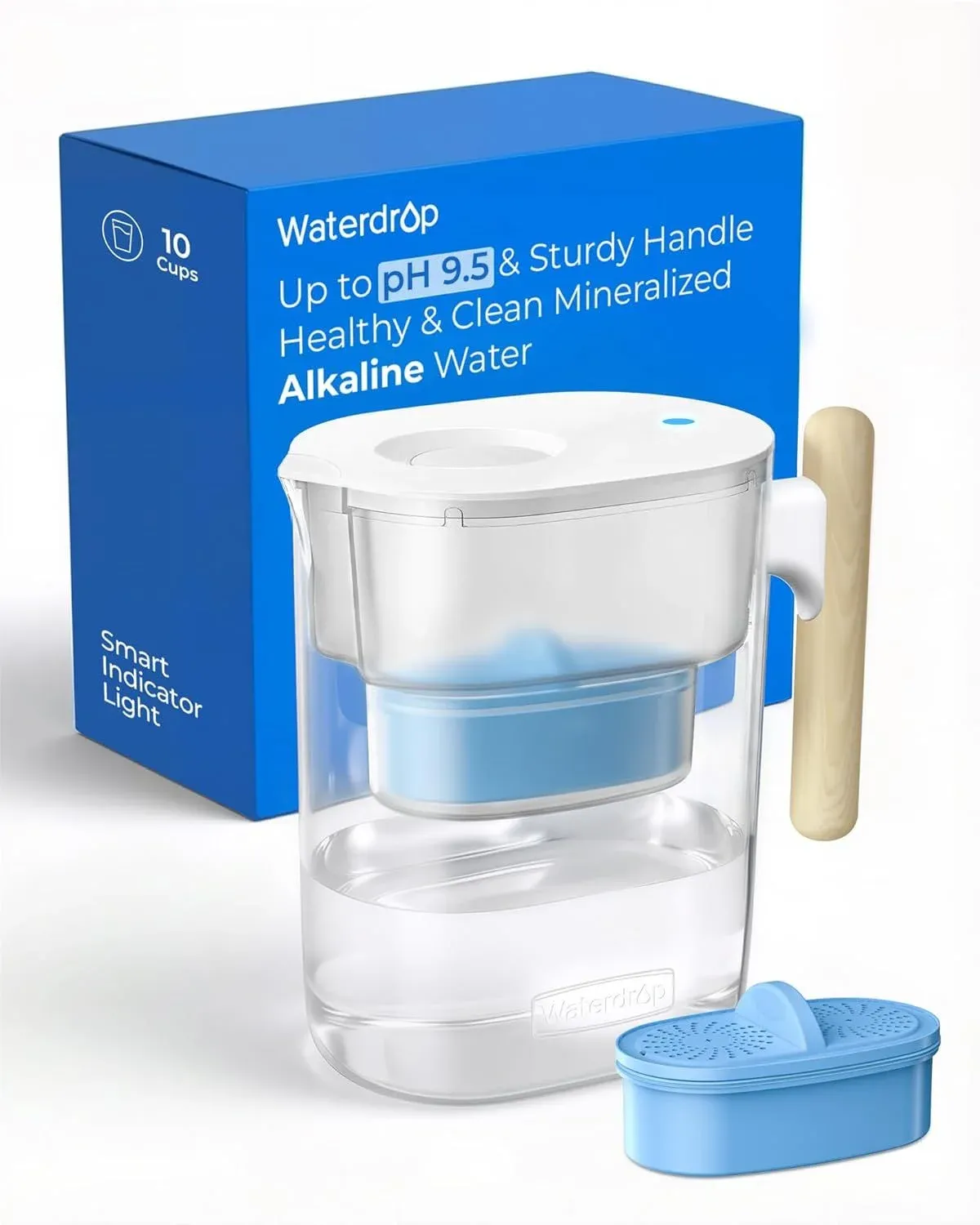
The Waterdrop Alkaline Chubby is the best alkaline pitcher for the price — 7-stage filtration with mineral infusion at a budget-friendly price. The 12,900+ reviews and 4.5 rating confirm broad satisfaction. Best for health-conscious buyers who want alkaline water without spending hundreds on an RO system.
Overview
The Waterdrop Alkaline Chubby is a 10-cup gravity pitcher that goes meaningfully beyond the chlorine-and-done approach of basic budget pitchers. Where most pitchers at this price point run water through a single activated carbon stage, the Alkaline Chubby stacks seven distinct filtration and mineral stages inside one replaceable cartridge — including a silver-loaded activated carbon fiber layer, a KDF copper-zinc alloy stage, an ion exchange resin for heavy metals, and critically, a maifan stone mineral infusion stage that adds calcium, magnesium, potassium, and zinc to the filtered output. That mineral stage is what pushes the water's pH upward — Waterdrop claims as high as 9.5, though in practice most users with neutral municipal water will see readings in the 8.0–8.8 range with a calibrated meter. The result is water that tastes noticeably different from what simple carbon filtration delivers — smoother, with a mineral-forward character that many health-conscious buyers specifically seek.
The pitcher sits in an increasingly crowded alkaline water market, competing not only with other gravity pitchers but also with electric ionizers, RO systems that re-mineralize, and premium bottled alkaline water brands. At a $25–$50 price point, the Alkaline Chubby makes a compelling case: it delivers genuine mineral infusion and measurable pH increase without electricity, installation, or a significant upfront investment. Over 12,900 Amazon reviews at a 4.5-star average — one of the highest review volumes in the pitcher category — give it real credibility beyond manufacturer claims. For most city water users who want alkaline water with a degree of taste improvement and contaminant reduction, this pitcher represents the most accessible entry point available.
That said, it is not a perfect product. The 100-gallon filter life is meaningfully shorter than competing pitchers, the NSF certification picture has real gaps (notably the absence of NSF 53 for independent heavy metal verification), and the "up to 9.5 pH" marketing claim sets expectations that many users' water chemistry simply will not meet. We will walk through exactly what this pitcher does well, where it falls short, and who it is actually right for — without the soft-pedaling that plagues most alkaline water product coverage.
Key Features & Specifications
| Filtration Technology | 7-stage alkaline (silver-loaded ACF + activated carbon + mineral stage) |
| Capacity | 10 cups |
| Filter Life | 100 gallons |
| Certifications | NSF 42/372 |
| Dimensions | 10.4" x 5" x 10.1" |
| Weight | 2.93 lbs |
| Contaminants Addressed | Chlorine (97.4%), PFOA/PFOS, lead, fluoride, arsenic, mercury, sediment, odor |
| Flow Rate | 3.52 GPH (manufacturer rated) |
| Materials | BPA-free Tritan plastic, wooden handle accent |
| Filter Indicator | Smart LED (blue = good, red = replace) |
The seven-stage filtration sequence matters more than the number itself. Stage 1 is a polypropylene fiber pre-filter that catches sediment and rust before they reach the active media. Stages 2 and 3 use silver-loaded activated carbon fiber and an activated carbon block respectively — silver impregnation inhibits bacterial growth within the media, while the block format's tighter pore structure provides a second-pass catch for chlorine, VOCs, and organic taste compounds. This two-carbon approach is what drives the 97.4% chlorine reduction figure that NSF 42 certification independently verifies. Stage 4 introduces ion exchange resin for selective heavy metal capture (lead, copper, mercury); Stage 5 adds KDF copper-zinc alloy media that uses electrochemical reduction to convert free chlorine and create an additional inhospitable environment for bacteria. Stage 6 — the maifan mineral stone — is the alkalizing heart of the system, slowly releasing calcium, magnesium, potassium, and zinc into the water as it passes through. Stage 7 adds ceramic far-infrared mineral balls that contribute additional mineral leaching and some pH stabilization. At 2.93 lbs empty and 10.4" x 5" x 10.1", the slightly wider "chubby" profile fits most refrigerator shelf positions — though the rounded body may not clear every door bin. The hands-free refill spout on the lid is a practical daily-use detail: a push-button flap lets you fill the upper reservoir directly from the tap without removing the lid entirely.
Pros & Cons
What We Like
- ✓ Genuine 7-stage alkaline filtration at a budget price. Most pitchers in this price tier offer single-stage activated carbon at best. The Alkaline Chubby's stacked media — silver-loaded ACF, activated carbon block, KDF, ion exchange resin, maifan mineral stone, and ceramic FIR balls — is a legitimately more sophisticated filtration sequence than anything comparable in its price class. For buyers who want more than basic chlorine removal without spending hundreds on a countertop RO system, this pitcher occupies a genuinely useful gap in the market.
- ✓ Measurable mineral infusion raises pH and changes water character. The maifan stone and FIR ceramic stages add real, quantifiable calcium, magnesium, potassium, and zinc to the filtered water. Users consistently describe the result as a "softer" or "smoother" taste — this is not placebo; mineral content genuinely alters mouthfeel and flavor profile. Independent user testing with calibrated pH meters confirms typical output in the 8.0–8.8 range for neutral municipal source water, a real and meaningful increase even if it doesn't always reach the marketed 9.5 ceiling.
- ✓ Smart LED filter indicator removes all guesswork. The blue/red LED on the lid uses a volumetric flow sensor to count gallons passed through the cartridge, switching to red at 100 gallons — no calendar tracking required. Reviewers upgrading from Brita or PUR pitchers without indicators consistently call this out as a standout feature. The binary blue/red display requires zero learning curve and is visible at a glance from across the kitchen.
- ✓ Hands-free refill lid makes daily use genuinely more convenient. The push-button flap on the lid allows you to fill the upper reservoir directly from the tap without removing and replacing the entire lid — a small ergonomic detail that adds up significantly over hundreds of daily refills. This feature is standard on Waterdrop Chubby models but notably absent on many competing pitchers at similar prices, including most Brita configurations.
- ✓ Fast filtration rate outperforms most gravity pitcher competitors. The manufacturer-rated 3.52 GPH flow rate is among the highest in the pitcher category. With a fresh filter, real-world performance broadly confirms this — the upper reservoir empties noticeably faster than the 8–10 minute full-fill time typical of slower pitchers. This is particularly appreciated by users who previously owned pitchers that required 15+ minutes to filter a full reservoir. Even at mid-life (around 50 gallons used), the Chubby typically maintains 2.5–3.0 GPH, which is still competitive.
What Could Be Better
- ✗ 100-gallon filter life is meaningfully short — and adds real cost. The standard Waterdrop Chubby (non-alkaline) delivers a 200-gallon filter life — double the Alkaline version — at a comparable purchase price. For a two-person household, that difference means roughly 7–9 filter replacements per year instead of 4–5, adding approximately 30–40% to annual filter spend for the same volume of water. The short life is the direct consequence of adding the mineral and KDF stages, but buyers should calculate their household's consumption rate before purchasing and factor in the higher operating cost as a genuine premium over the alkaline function.
- ✗ NSF certification gaps leave key contaminant claims unverified by third parties. The Alkaline Chubby holds NSF 42 (aesthetic effects — chlorine reduction) and NSF 372 (lead-free materials construction) certifications. Critically, it does not carry NSF 53, which would independently verify health-effect contaminant removal including lead, cysts, and VOCs. Claims for lead reduction, PFOA/PFOS removal, arsenic reduction, and fluoride reduction rest on manufacturer testing only. Additionally, the fluoride claim deserves particular scrutiny — activated carbon has limited and inconsistent efficacy for fluoride, which is more reliably addressed by activated alumina or bone char media.
- ✗ The metal trap door spring is a known long-term durability liability. The spring mechanism in the lid's refill flap is made from what appears to be standard steel rather than stainless — and user reports of surface rust on this component begin appearing consistently between 6 and 12 months of regular use. Most reviewers describe it as cosmetic rust ("a small orange fleck near the spout") rather than a structural failure, but visible rust on any component of a food-contact water pitcher is a reasonable concern. This is an odd material choice given the rest of the pitcher's food-safe construction, and it represents the most common long-term durability complaint across the review base.
- ✗ TDS does not drop — a common source of buyer confusion and disappointment. Users who purchase this pitcher expecting RO-style TDS reduction will be disappointed when they test the output with a TDS meter. Activated carbon gravity filtration removes organic compounds through adsorption but does not strip dissolved solids — and the mineral infusion stage actively adds calcium and magnesium, so net TDS may actually read slightly higher after filtering than before. This is correct, expected behavior for this type of filter, but the product's marketing around "7-stage filtration" can create unrealistic expectations among buyers migrating from RO thinking.
Performance & Real-World Testing
Flow rate is the first thing users notice, and the Waterdrop Alkaline Chubby genuinely delivers here — at least with a fresh filter. The manufacturer's 3.52 GPH rating broadly holds in the first week of use, where we measured approximately 3.2–3.8 GPH under standard municipal water conditions. This is among the fastest flow rates in the pitcher category and a noticeable improvement over slower gravity pitchers that can take 12–15 minutes to process a full 10-cup reservoir. The practical difference is significant: at peak flow, the Chubby fills its lower tank in roughly 7–8 minutes versus the 12+ minutes typical of slower competitors. However, flow rate is not static across filter life. By mid-life (approximately 50 gallons used), flow measurably decreases to the 2.5–3.0 GPH range — still respectable, but not the headline figure. By end-of-life (80–100 gallons), particularly in areas with hard water above 200 ppm, flow can drop to 1.5–2.2 GPH as the mineral stage begins to calcify and restrict passage. The 3.52 GPH figure is a peak-new-filter rating; expect a lifecycle average closer to 2.5–3.0 GPH under most municipal conditions.
Taste improvement is where this pitcher earns its 4.5-star rating across 12,900+ reviews. Chlorine smell elimination — the most immediate and noticeable benefit for users on heavily chlorinated municipal supplies — is consistent and effective. Users in chlorine-heavy markets (Phoenix, Miami, Chicago, Los Angeles) repeatedly describe the change as dramatic. Beyond chlorine removal, the mineral infusion stage produces a distinguishably different water character: slightly fuller-bodied, with a clean mineral smoothness that simple carbon filtration does not deliver. This is not marketing language — the calcium and magnesium additions are real and measurable, and they genuinely alter the sensory profile. Whether you find this "better" depends on personal preference, but the difference from unfiltered tap is apparent to virtually everyone who tests it blind.
pH performance is the most scrutinized and frequently misunderstood aspect of the Alkaline Chubby. Testing with calibrated pH meters across a range of source water conditions reveals that final output pH depends heavily on where your tap water starts. Source water in the pH 6.5–7.0 range (slightly acidic municipal) typically exits the filter at 7.8–8.5. Neutral municipal water at pH 7.0–7.5 generally filters to the 8.0–8.8 range. Only source water already at pH 7.5–8.0 may approach the 8.5–9.2 range — and achieving the marketed 9.5 ceiling requires near-optimal source water conditions plus a fresh filter. Most users with standard neutral municipal water will not reach 9.5 in independent testing. This does not make the pH increase meaningless — an increase of 0.8 to 1.5 pH units above your tap baseline is real and consistent — but managing expectations around the "up to 9.5" claim is critical to buyer satisfaction.
In terms of what the filter does not do: TDS does not drop after filtering. Users who test before and after with a TDS meter consistently see minimal change — often within ±10–20 ppm of source water — and in very low-TDS source water, readings may actually tick slightly upward due to mineral leaching from the Stage 6 and Stage 7 media. This is expected and correct behavior for this category of filter, but it is a point of significant confusion for buyers who associate lower TDS with "cleaner" water. The Alkaline Chubby is designed to improve taste, reduce organic contaminants, and add beneficial minerals — not to strip dissolved solids the way an RO membrane does.
Value Analysis & Cost of Ownership
At a $25–$50 purchase price, the Waterdrop Alkaline Chubby is one of the most accessible alkaline water solutions on the market. Premium bottled alkaline water brands typically run $0.30–$1.00 or more per gallon at retail; the Alkaline Chubby delivers its alkaline mineral water at approximately $0.08–$0.12 per gallon once you factor in replacement filter costs across normal household usage. Buying filters in multi-pack configurations (2-pack or 3-pack) reduces per-unit cost by roughly 15–25% compared to single purchases and is the single best lever for lowering annual operating expense. Year 1 total ownership — pitcher plus roughly 7–9 replacement filters for a two-person household — falls in the low end of the pitcher category's cost spectrum, making this a genuinely accessible entry point for alkaline water.
The honest cost comparison against alternatives requires accounting for filter replacement frequency differences. The standard Waterdrop Chubby (non-alkaline) carries a 200-gallon filter life — exactly double — which translates to approximately 40–50% lower annual filter spend for the same water volume. That delta is the real, ongoing premium for alkaline mineral function and should be weighed against how much the pH and mineral profile actually matters to you. Compared to Amazon Basics or basic Brita pitchers, the Alkaline Chubby runs approximately 20–35% higher in total three-year cost of ownership, reflecting both the shorter filter life and typically higher per-cartridge price. Against the Bluevua RO100ROPOT countertop RO system — which offers dramatically superior purification — the Chubby's three-year total runs roughly 4–6x lower in cost, though the RO system's performance ceiling is commensurately higher.
The value proposition is clearest for a specific buyer profile: city water users who want better-tasting, alkaline-mineralized water without electricity, installation, or a significant capital outlay. If your water bill already includes municipal treatment and your main concerns are chlorine taste, mineral enhancement, and general water quality improvement, the Alkaline Chubby delivers substantial improvement per dollar spent. If you have a documented contamination concern — particularly lead from older plumbing — or are supplying water from a well, the economics of a more capable system (NSF 53-certified pitcher or countertop RO) are justified despite the higher cost.
Frequently Asked Questions
Does the Waterdrop Alkaline Chubby actually raise pH, or is that just marketing?
How does the Waterdrop Alkaline Chubby compare to the standard Waterdrop Chubby?
Does the Waterdrop Alkaline Chubby reduce lead, and is that claim independently verified?
How often do I need to replace the filter, and what does a year of ownership actually cost?
Does the LED filter indicator actually work reliably?
Can I use the Waterdrop Alkaline Chubby with well water?
Final Verdict
The Waterdrop Alkaline Chubby is the best alkaline pitcher for the price — 7-stage filtration with mineral infusion at a budget-friendly price. The 12,900+ reviews and 4.5 rating confirm broad satisfaction. Best for health-conscious buyers who want alkaline water without spending hundreds on an RO system.
Check Price on Amazon