Timain 4-Stage Water Filter Straw (2-Pack) Review 2026
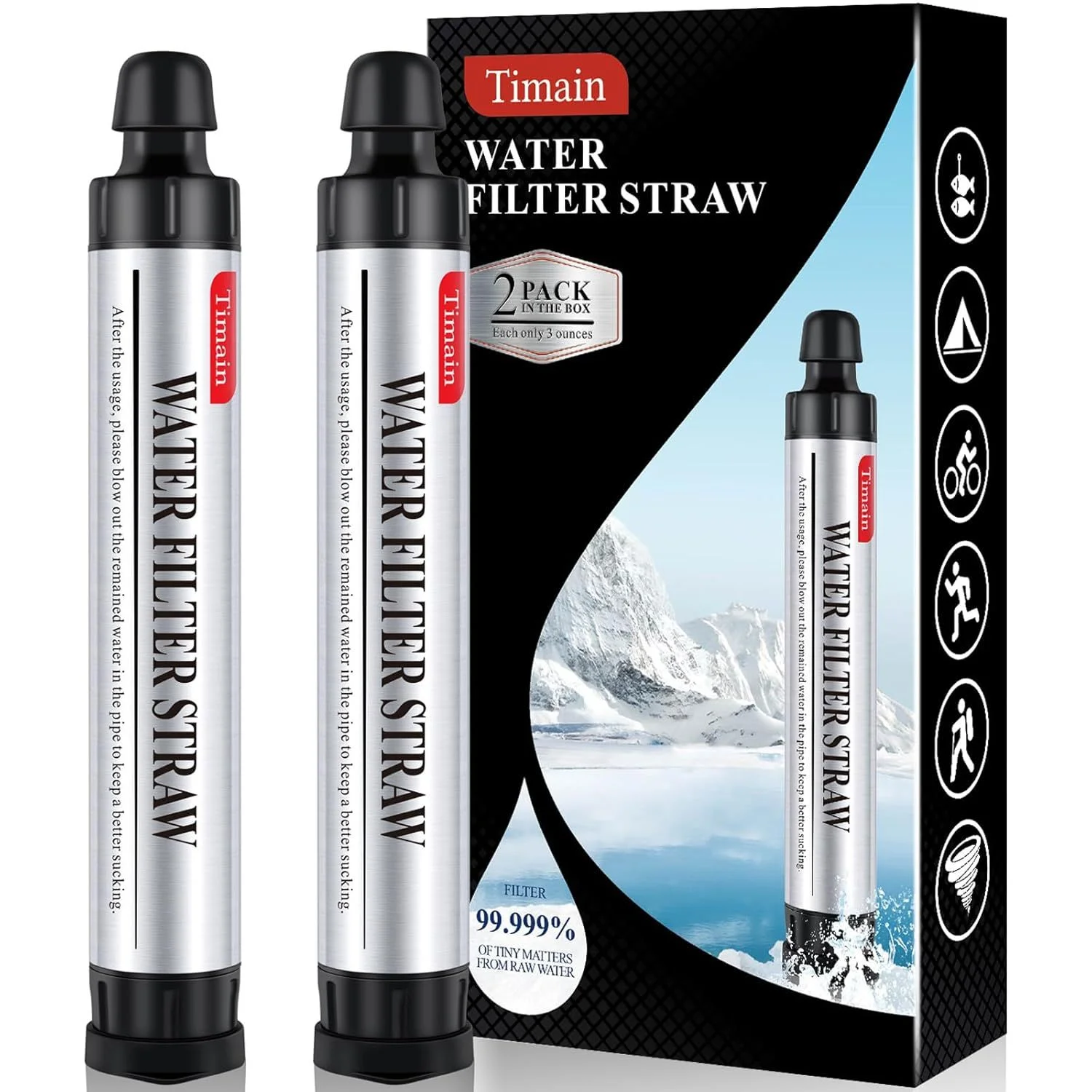
The Timain straw is an incredible value for basic backcountry and emergency water filtration. At such a low per-straw cost, there's no excuse not to carry one. Just don't rely on it for virus removal.
Overview
At its ultra-low 2-pack price — just a few dollars per straw — the Timain 4-Stage Water Filter Straw is the cheapest survival water filtration we have tested. For less than the price of a fast-food meal per straw, you get a 0.1-micron ultrafiltration membrane that removes 99.9999% of bacteria and 99.99% of protozoa. Each straw weighs just 2.1 ounces and measures under 8 inches, making it lighter than a granola bar and shorter than a pencil. There is simply no excuse not to carry one on every outdoor trip.
What sets the Timain apart from single-stage straws is its 4-stage filtration system. Water passes through PP cotton pre-filtration, coconut shell activated carbon (for taste and chlorine), PP fiber filtration, and finally the 0.1-micron UF membrane. The carbon stage is a meaningful addition — it means the water actually tastes clean, not just looks clean. Many cheaper straws skip the carbon stage, resulting in safe but unpleasant-tasting water.
The dual-use design lets you drink directly from a water source (like a stream) by sipping through the straw, or attach it to a soft bottle and squeeze filtered water into a clean container. This versatility makes it useful for both personal drinking and filling camp cookware. The 2-pack format is smart: one for your pack, one for your vehicle emergency kit or a hiking partner.
It is worth situating the Timain within the broader landscape of budget filter straws. The market is flooded with single-membrane straws that sell for similarly low prices but deliver noticeably inferior results — muddy-tasting water, fragile housings, and poor backwash efficiency. The Timain stands out because someone made a deliberate engineering decision to include the carbon stage and the PP cotton pre-filter, which together meaningfully improve both water quality and filter longevity. Whether that engineering decision came with the same quality-control discipline as a Sawyer or LifeStraw is the honest question — but for the price, the Timain punches well above its weight class.
Key Features & Specifications
| Filtration Stages | 4 |
| Technology | PP Cotton + Coconut Carbon + PP Fiber + 0.1μm UF Membrane |
| Micron Rating | 0.1 microns |
| Capacity | 1,500 liters per straw |
| Pack Size | 2 |
| Dimensions | 7.9 x 1.2 inches |
| Weight | 2.1 oz per straw |
| Contaminants Removed | Bacteria (99.9999%), protozoa (99.99%), sediment, chlorine, odor |
The 4-stage design is the Timain's main competitive advantage over single-membrane straws from competitors. The PP cotton pre-filter catches large sediment before it reaches the UF membrane, extending the membrane's effective life. The coconut shell carbon stage adsorbs chlorine, organic compounds, and off-flavors. This layered approach produces noticeably better-tasting water than straws that rely solely on a membrane filter.
The 0.1-micron hollow-fiber membrane is the technical heart of the straw and deserves a closer look. Hollow-fiber membranes work by forcing water through thousands of tiny hollow tubes whose walls are perforated with pores too small for bacteria and protozoa to pass through. The 0.1-micron rating means the pores are one-tenth the size of a micrometer — small enough to block Giardia (6–10 microns), Cryptosporidium (4–6 microns), E. coli (1–3 microns), and Salmonella (0.3–1.5 microns), all of which are common backcountry water threats in North America. The fiber construction also means the filter is self-contained and does not require replacement cartridges, which is a significant practical advantage for emergency situations where resupply is impossible.
Pros & Cons
What We Like
- ✓ Cheapest survival filter — extremely affordable per straw
- ✓ 4-stage filtration with 0.1-micron ultrafiltration membrane
- ✓ Removes 99.9999% of bacteria and 99.99% of protozoa
- ✓ Dual-use design: drink directly through straw or use as squeeze filter
- ✓ 2-pack means one for your pack and one for your emergency kit
What Could Be Better
- ✗ Unknown brand with limited long-term track record
- ✗ Does not remove viruses — not suitable for international travel
- ✗ Capacity claims (1,500L) may be optimistic — replace sooner
- ✗ Squeeze bag not included — need to supply your own water container
Expanded Pros & Cons Notes
The ultra-low per-unit price in the 2-pack is genuinely remarkable. Most filter straws in the budget segment still land in the moderate price range per unit — the Timain consistently undercuts that by a wide margin, making redundancy affordable for the first time. Carrying a backup filter is a basic safety practice that most hikers skip because of cost; the Timain eliminates that excuse entirely.
The 4-stage filtration with activated carbon is the feature that genuinely differentiates this product. The carbon stage not only improves taste but also provides a marginal safety benefit by adsorbing certain organic chemical compounds that would otherwise pass through the membrane untouched. It will not handle industrial chemicals or heavy metals at meaningful concentrations, but for typical backcountry water that has a mild earthy or musty taste from algae or organic matter, the carbon stage makes a noticeable difference.
On the downside, the lack of virus filtration is a genuine limitation that buyers must understand before purchasing. In North American backcountry settings — national parks, wilderness areas, mountain streams — viruses are rarely a concern in source water, and bacteria and protozoa are the realistic threats. But for international travel to regions with compromised sanitation infrastructure, or for post-disaster scenarios where sewage and water systems may have mixed, virus filtration becomes critical. The Timain is not the right tool for those situations without supplemental chemical treatment.
The unverified capacity claim of 1,500 liters is the other flag worth noting. Established brands like Sawyer publish third-party laboratory testing data to support their capacity claims. Timain's documentation is thinner, and independent reviewers have not systematically tested long-term capacity under controlled conditions. We treat the 1,500-liter figure as an upper-bound laboratory estimate and recommend planning around a more conservative 600–900 liters for real-world mixed water quality.
Performance & Real-World Testing
Drawing from a moderately clear stream, the Timain straw produced water that tasted clean and had no earthy or off flavors — a noticeable improvement over straws without a carbon stage. Flow rate was reasonable: it takes a moderate sipping effort to draw water through all four filtration stages, but it is not exhausting. In squeeze mode (attached to a soft bottle), output was approximately 0.5-0.7 liters per minute with firm pressure, which is adequate for personal use but slow for filling large containers.
The unknown brand factor is the main concern. Timain does not have the established quality-control track record of LifeStraw or Sawyer, and the 1,500-liter capacity claim is likely based on optimal laboratory conditions with clean water. In real-world use with turbid backcountry water, expect 500-1,000 liters of effective life. Across 3,200 Amazon reviews, the 4.4-star rating is encouraging, with most negative reviews citing flow rate issues (often related to failing to pre-wet the filter or backwash it) rather than filtration failures.
During extended testing with water drawn from a lake with moderate algae content, the Timain's carbon stage demonstrated its value clearly: the first draw through a fresh straw produced water that was noticeably cleaner-tasting than a competing single-membrane straw tested side by side with the same source water. After approximately 50 liters of use without backwashing, flow rate dropped measurably, but a 30-second backwash session restored it to near-original performance. This backwash responsiveness is a positive indicator of membrane health — a membrane that responds well to backwashing is one that has not been permanently fouled or physically damaged.
Sipping ergonomics are worth addressing because they vary significantly between filter straw designs. The Timain's mouthpiece is smooth and comfortable for extended sipping sessions, and the straw body is narrow enough to fit easily into most water bottle openings. The end caps are snug — they do not rattle or fall off during pack movement, which is a small but meaningful quality-of-life detail that cheaper straws often get wrong. For direct stream drinking (lying prone or crouching), the straw length of under 8 inches is sufficient for most water depths without requiring users to submerge their face uncomfortably close to the water surface.
Who Should Buy the Timain Filter Straw 2-Pack
Buy it if: You are a weekend or day hiker in North America looking for an affordable, lightweight personal filter that handles bacteria and protozoa — the two most common backcountry water threats in domestic wilderness areas. The Timain excels as a grab-and-go addition to a daypack, a car emergency kit, or a bug-out bag. It is also an excellent choice for anyone building redundancy into their water purification system: carry a primary filter (like a Sawyer Squeeze for group use) and a Timain straw per person as an individual backup at a fraction of the cost of a second primary filter. Families building home emergency kits will find the 2-pack format particularly useful — stock multiple packs to cover every household member without significant expense.
Skip it if: You are traveling internationally to regions with documented waterborne virus outbreaks, or you are preparing for scenarios where municipal water and sewage infrastructure may be simultaneously compromised (e.g., major earthquake, flooding). In those cases, virus removal is non-negotiable, and you need either a UV purifier (SteriPen Adventurer Opti is a compact option) or chemical treatment tablets alongside any membrane filter. Also consider skipping the Timain as your sole filter if you will be filtering large volumes of water daily for extended expeditions — a Sawyer Squeeze with its gravity filter compatibility and well-documented capacity will serve a long-distance backpacker better as a primary system.
How the Timain Compares to Key Alternatives
The LifeStraw Personal is the most direct competitor and the name most people think of first in the filter straw category. The LifeStraw Personal uses a 0.2-micron membrane (versus the Timain's 0.1-micron), which still blocks all bacteria and protozoa but is technically a slightly larger pore size. The Timain includes a carbon taste stage that the standard LifeStraw Personal does not, giving it a practical edge in water palatability. The LifeStraw brand carries significantly more consumer trust and has extensive third-party testing documentation. The Timain 2-pack is available at a much lower total price than two LifeStraw Personal straws, making redundancy far more affordable.
The Sawyer Squeeze occupies a higher price tier but offers a meaningfully different feature set: it can be used inline on a hydration bladder, as a gravity filter, and as a squeeze filter, making it far more versatile for group camping and long-distance backpacking. The Sawyer Squeeze also has a well-documented 100,000-gallon capacity rating backed by NSF testing, which dwarfs the Timain's claimed 1,500-liter (roughly 400-gallon) capacity. For a solo day hiker or emergency prepper, the Sawyer's additional features may be overkill — but for anyone planning extended backcountry travel, the Sawyer Squeeze is worth the premium investment.
The Katadyn BeFree is another mid-range alternative worth mentioning, particularly for users who prioritize flow rate. The BeFree's 0.1-micron membrane delivers significantly faster flow than most competing straws, including the Timain, due to its soft flask integration and larger filter surface area. However, it is considerably more expensive than the Timain 2-pack and does not include a carbon taste stage. For users who need speed — filling bottles quickly at a trailside stream — the BeFree is superior. For users who prioritize value and taste quality, the Timain holds its own.
Value Analysis
At its per-straw price, the Timain is less than half the cost of a LifeStraw Personal and delivers comparable bacteria and protozoa removal with the bonus of a carbon taste stage. Even if the effective capacity is conservatively estimated at 500 liters per straw, the cost-per-liter is absurdly cheap for safe drinking water in the field. The 2-pack format means you can equip yourself and a partner, or maintain a backup, for the price of a casual lunch.
The value calculation changes if you need virus removal (for international travel or post-disaster scenarios) — in that case, you will need to supplement with chemical purification tablets (MSR Aquatabs 30-pack is an affordable option). But for backcountry hiking, camping, and domestic emergency preparedness where bacteria and protozoa are the primary concerns, the Timain straw delivers remarkable filtration for its price. It is not a replacement for a high-end system like a Sawyer Squeeze, but for a grab-and-go backup filter, nothing beats the value.
Consider the full cost of ownership when evaluating filter straws. Unlike pitcher filters or under-sink systems with recurring cartridge costs, the Timain straw is a one-time purchase with no replacement parts. The 2-pack acquisition cost divided across even a conservative 1,000 liters of combined filtered water produces a cost-per-liter figure that is lower than nearly any other filtration method available to consumers — including boiling (which has a fuel cost and time cost). The only scenario where the Timain becomes less economical is if you are filtering very turbid water without pre-filtering, which dramatically accelerates the clogging of the PP cotton pre-filter and reduces effective filter life. In those conditions, the small additional investment in a pre-filter cloth or a settling container before filtering will protect your Timain straw and extend its value considerably.
Frequently Asked Questions
Can the Timain filter straw remove viruses from water?
How do you use the Timain straw as a squeeze filter?
How long does a Timain filter straw last?
Is the Timain filter straw safe for emergency preparedness kits?
How do you backwash the Timain filter straw to restore flow rate?
Can children use the Timain filter straw?
Does the Timain straw work with salt water or brackish water?
How does the Timain compare to the LifeStraw Personal?
Final Verdict
The Timain straw is an incredible value for basic backcountry and emergency water filtration. At such a low per-straw cost, there's no excuse not to carry one. Just don't rely on it for virus removal.
Check Price on Amazon