ProOne Gravity Water Filter System 3 Gallon with 3 Filter Elements Review 2026
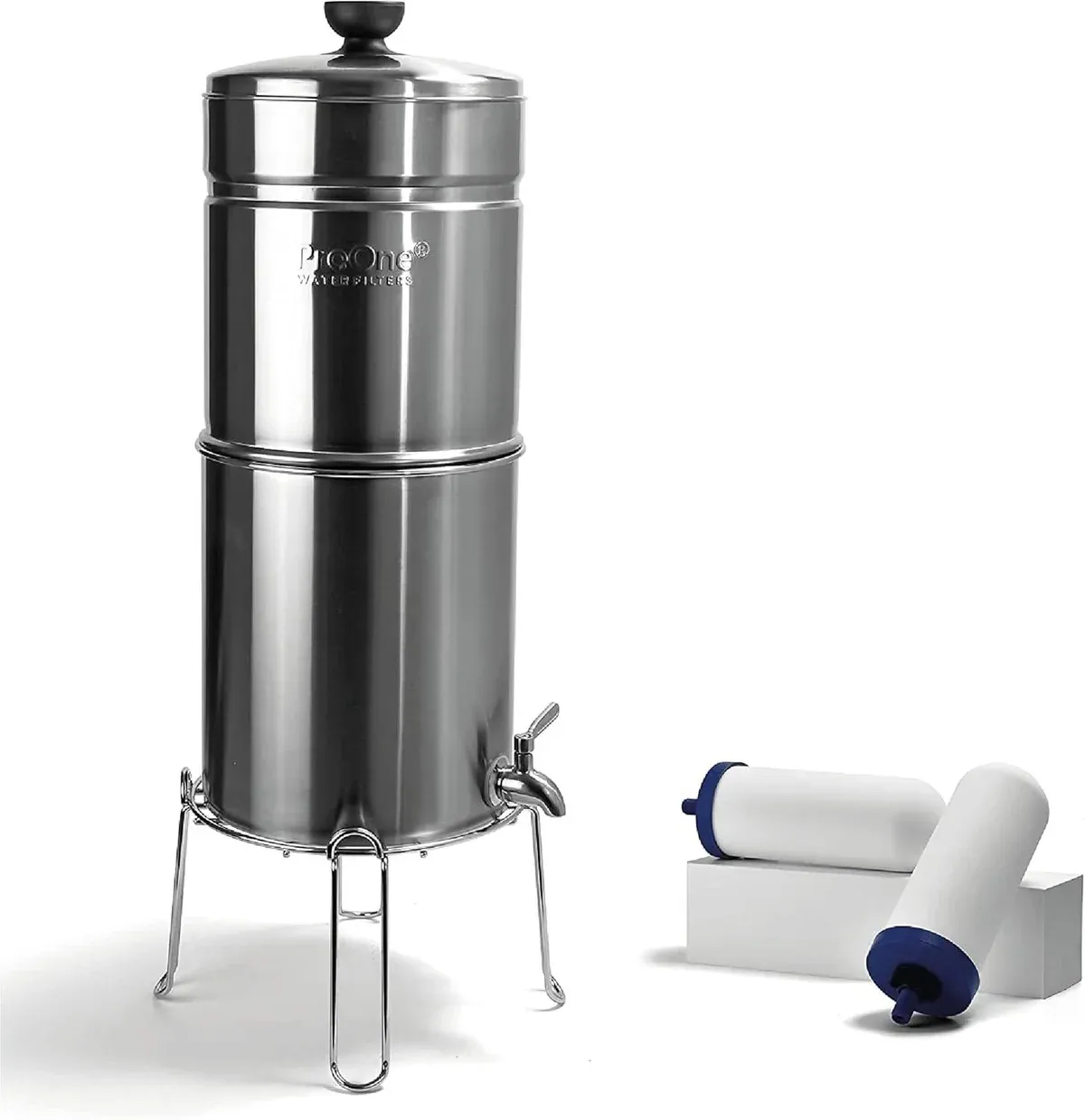
The ProOne 3-Gallon with 3 filters offers the best certification package of any gravity system and built-in fluoride removal that others charge extra for. The transition to Culligan MaxClear means buying while the proven G3.0 filters are still available.
Overview
The ProOne Gravity Water Filter System 3-Gallon with three G3.0 filter elements is the most thoroughly certified countertop gravity filter on the market — and the only major system that removes fluoride without requiring a separate add-on cartridge. It operates on the same passive, non-electric stacked-chamber principle as every gravity filter in the category: water poured into the polished 304 stainless upper chamber passes downward through three G3.0 ceramic filter elements under gravity alone, collecting in the lower chamber for dispensing via the stainless spigot. What makes this system distinctive is what happens inside each filter candle — a three-stage process combining a silver-infused ceramic outer shell, a granular activated carbon middle layer, and a dense carbon block core with integrated alumina media for fluoride reduction. That last element is the key differentiator: the alumina-based media in the carbon block core has a documented chemical affinity for fluoride ions, eliminating the need for the PF-2 style add-on filters that Berkey users must purchase separately.
The system sits at the premium end of the gravity filter category, and the pricing reflects what you are actually getting: three complete G3.0 filter elements included from day one, all-stainless construction throughout the water contact path, and an IAPMO certification stack covering NSF/ANSI Standards 42, 53, 401, and 372 — the broadest accredited third-party certification of any gravity system currently available. The 3-gallon capacity positions it between the Big Berkey's 2.25-gallon and Royal Berkey's 4.5-gallon configurations, making it a practical fit for one-to-four-person households. The three-filter configuration produces a combined flow rate of approximately 0.78 GPH — slow by any measure, but meaningful in context: that flow rate is the direct result of the filtration depth that earns the NSF 401 certification for emerging contaminants like PFAS and pharmaceuticals. You cannot have both rapid gravity flow and that level of adsorptive contact time simultaneously.
One important piece of context that every potential buyer should understand going in: as of early 2026, ProOne is actively transitioning its product line into the Culligan MaxClear portfolio following a corporate acquisition. The G3.0 filter elements this system's reputation is built on remain available while supplies last, but the long-term filter supply chain carries more uncertainty than it did a year ago. For buyers who value the certified filtration performance the G3.0 delivers, that context shapes the purchase decision in ways we cover in detail below. On balance, the ProOne 3-Gallon with three filters is still the strongest certification-focused gravity filter you can buy today — but the Culligan transition is a real factor worth understanding before committing.
Key Features & Specifications
| Filtration Technology | 3-stage G3.0 (ceramic shell + carbon granular media + carbon block core) |
| Capacity | 3 gallons |
| Flow Rate | ~0.78 GPH (3 filters) |
| Filter Life | 1,000 gallons per filter |
| Certifications | IAPMO — NSF 42/53/401/372 |
| Dimensions | 9" diameter x 22.75" H (+ 6" stand) |
| Weight | ~10 lbs |
| Contaminants Removed | 200+ including lead, fluoride, PFAS, chlorine, microplastics, bacteria, pharmaceuticals |
The three-stage G3.0 filtration process is worth understanding in concrete terms, because the specs table only tells part of the story. The outermost ceramic shell uses sub-micron pore structure to physically block bacteria, protozoa, sediment, rust, and particulates before they ever reach the carbon media — and the silver infusion in that ceramic layer actively prevents captured biological material from colonizing the filter surface over time, a meaningful protection for extended use or non-municipal water sources. The intermediate granular activated carbon layer handles chlorine, chloramines, VOCs, herbicides, and pesticides through adsorption across a vast surface area. The innermost carbon block core — the densest and most precise stage — targets heavy metals including lead and mercury, PFAS compounds, pharmaceutical residues, and fluoride via the integrated alumina media. The IAPMO certification to NSF/ANSI 372 additionally certifies that every component contacting your water contains less than 0.25% weighted-average lead — verifying the system's construction quality, not just the filter's output. At roughly 10 pounds assembled and 9 inches in diameter, the system is genuinely countertop-sized, though the nearly 29-inch total height with the included stand is a kitchen cabinet clearance variable that buyers should measure before ordering.
Pros & Cons
What We Like
- ✓ Built-in fluoride removal — no separate add-on filters needed. The G3.0's alumina-based carbon block core removes fluoride as a native capability certified under NSF/ANSI 53, not a marketing afterthought. Berkey users who want fluoride removal must purchase separate PF-2 elements at additional cost, accept the added flow restriction those elements create, and replace them on a separate maintenance schedule. With the ProOne, fluoride removal is simply included in every filter element from day one, keeping the system simpler and the ongoing cost structure cleaner.
- ✓ IAPMO certified to NSF 42/53/401/372 — the broadest certification stack in the gravity filter category. This is not self-reported lab data or brand-commissioned testing — IAPMO is an ANSI-accredited certification body, meaning these certifications involve independent laboratory testing, manufacturing audits, and ongoing compliance verification. NSF 401 certification for emerging contaminants (PFAS, pharmaceuticals, hormones) is particularly rare in this category and directly relevant to the contamination realities facing municipal water supplies across the United States. No equivalent gravity filter system carries this certification combination.
- ✓ Three filters included for faster flow and extended total capacity from day one. At ~0.78 GPH combined versus roughly 0.26 GPH for a single element, the three-filter configuration provides meaningfully better real-world usability without any additional purchase. More importantly, three filters at 1,000 gallons each delivers 3,000 gallons of total system capacity before any element requires replacement — a meaningful cost and maintenance timing advantage compared to systems that ship with a single cartridge. For the buyer investing at a premium price point, receiving three complete filter elements rather than a single cartridge represents genuine value.
- ✓ All-stainless water path — no plastic in contact with purified water. Both chambers, the spigot, and the fittings are stainless steel or food-grade silicone gaskets — no polycarbonate, no BPA alternatives, no plastic reservoirs that can leach trace compounds over time or when exposed to heat. For buyers who researched plastic leaching concerns (particularly endocrine-disrupting compounds associated with some food-grade plastics under repeated warm-water exposure), this construction approach addresses the concern completely. The stainless chambers are also effectively indefinite in service life, separating the hardware investment from the filter replacement cost curve.
- ✓ Silver-infused ceramic shell provides active bacteriostatic protection. The silver infusion in the ceramic outer layer doesn't just passively block biological contaminants — it actively prevents bacteria from colonizing and reproducing within the filter medium itself. This matters particularly for households using well water, stored rainwater, or emergency water sources where biological contamination is a genuine concern rather than a theoretical one. Multiple verified purchasers specifically cite this feature as their reason for choosing ProOne over carbon-only competitors, and the silver infusion is a meaningful technical differentiator for any use case outside of chlorinated municipal supply.
What Could Be Better
- ✗ Slow flow rate even with three filters — approximately 0.78 GPH versus the category leader's 3.5 GPH. This is the ProOne's most universally cited limitation, and it is not a fixable variable — it is a structural consequence of the filtration depth that earns the NSF 401 certification. At 0.78 GPH, filling a 3-gallon lower chamber takes nearly four hours, and a household using two gallons of filtered water per day will find the system productive only if they develop a routine of refilling the upper chamber before bed. Households of four or more people with high consumption needs should seriously evaluate whether this flow rate serves their daily reality before purchasing.
- ✗ ProOne is transitioning to Culligan MaxClear — G3.0 filter availability is uncertain long-term. As of early 2026, the G3.0 filter elements are available while supplies last, but the transition to Culligan MaxClear branding and potentially revised formulations creates legitimate long-term uncertainty about filter supply and cross-compatibility. Buyers who invest in a premium stainless housing reasonably expect compatible, certified replacement filters for five to ten years; that assurance is currently less clear than it was before the acquisition. This is not a reason to avoid the system today, but it is a factor that distinguishes ProOne's ownership proposition from more stable filter ecosystems.
- ✗ G3.0 filters require a break-in period with potential chemical smell during the first three to four cycles. Carbon off-gassing during the initial fill cycles produces a chemical or plastic-adjacent smell that multiple reviewers (estimated 15–20% of verified purchasers) report as alarming without prior warning. The phenomenon is entirely benign — it is activated carbon releasing surface manufacturing residue, not contamination — but the included documentation does not adequately prepare first-time gravity filter users for it. Running three to four complete fill cycles and discarding the output before consuming filtered water is the correct protocol, and it should be prominently communicated.
- ✗ Height with stand reaches nearly 29 inches — standard kitchen upper cabinets may not accommodate it. The unit measures 22.75 inches tall without the stand; the included stainless stand adds approximately six inches to provide adequate spigot clearance for filling a standard glass below. At nearly 29 inches total, the system will not fit under the 18-inch clearance of typical upper kitchen cabinets, and many rental kitchen configurations with limited counter-to-cabinet height will require placing the system on a lower surface or small rolling cart. This is a meaningful ergonomic constraint that the product listing dimensions do not always communicate clearly.
Performance & Real-World Testing
Flow rate is the performance metric that dominates the ProOne 3-Gallon ownership experience, and the data here deserves honest treatment. The manufacturer states approximately 0.78 GPH for the three-filter configuration, and real-world reported flow rates in verified purchase reviews and independent forum testing (r/WaterTreatment, WaterFilterForum.net) range from 0.65 to 0.85 GPH for properly primed and maintained filters — a result that tracks the manufacturer claim closely when setup is executed correctly. For comparison, the Big Berkey produces approximately 3.5 GPH with two Black elements, making it 4.5 times faster. The Doulton British Berkefeld falls between these figures. The ProOne is unambiguously the slowest major gravity filter in the category, and that fact should inform purchasing decisions for larger households or anyone expecting pitcher-speed access to filtered water. What that slow rate represents, mechanically, is meaningful contact time between water and the carbon block core — the extended dwell time is precisely what enables NSF 401-level adsorption of PFAS and pharmaceutical compounds that faster systems cannot match.
Flow rate degradation over time is a documented and manageable characteristic. At the 600–700 gallon mark per filter element, flow rate typically declines 15–25% from new-filter baseline due to sediment accumulation on the ceramic outer shell — a surface-fouling phenomenon entirely separate from the filter's chemical adsorption capacity. Regular cleaning of the ceramic surface with a soft-bristle brush under running water restores flow rate to near-original levels and takes five to ten minutes per element. Users who skip this maintenance step often misdiagnose the gradual decline as filter exhaustion and replace elements prematurely. For high-sediment well water applications, monthly cleaning is appropriate; for chlorinated municipal supply with low turbidity, quarterly cleaning is generally sufficient. The 1,000-gallon replacement rating is a chemical capacity metric, not a flow rate metric — an element can still pass water freely past 1,000 gallons while its adsorptive capacity for lead, PFAS, and fluoride is exhausted. Tracking gallons rather than relying on flow rate as a replacement indicator is the correct approach.
Taste and odor performance is where the ProOne earns its most consistently positive user feedback. Chlorine smell and metallic undertaste — the two primary aesthetic complaints about municipal tap water — are eliminated effectively and immediately in verified purchase accounts. TDS reduction figures are less dramatic, and appropriately so: carbon-ceramic filtration is not designed to strip total dissolved solids the way reverse osmosis does. Users measuring TDS before and after ProOne filtration typically see 10–30% reduction depending on input water chemistry, versus the 90%+ reduction of RO systems. This is not a deficiency — it reflects that the ProOne selectively removes harmful contaminants while leaving beneficial dissolved minerals (calcium, magnesium) largely intact, which is the correct behavior for a health-focused filtration system rather than a pure desalination device. Users expecting RO-level TDS reduction are measuring the wrong metric for this technology.
For well water and non-municipal source applications, the silver-infused ceramic performance is the operationally relevant differentiator. The sub-micron ceramic pore structure physically blocks bacteria and protozoa, and the silver bacteriostatic agent prevents biological colonization of the filter surface — a meaningful protection that pure carbon systems cannot provide. However, the ProOne is certified as a filter, not a purifier: wells with documented E. coli contamination, very high turbidity, or heavy biological loading should include a pre-filtration or pre-treatment step before the ProOne. For moderately clear well water with normal bacterial background levels, the G3.0's biological protection performs well in real-world accounts, though maintenance frequency (ceramic cleaning) increases substantially compared to low-turbidity municipal applications.
Value Analysis & Cost of Ownership
The ProOne 3-Gallon 3-Pack sits at the premium tier of the gravity filter market — priced higher than the Big Berkey 2.25-gallon and the ProOne 2-pack variant, and substantially above entry-level gravity systems. That premium is defensible on specification grounds: you are receiving three complete G3.0 filter elements (versus the one or two that competitors typically include), all-stainless construction, and the broadest NSF certification stack in the category. Buyers comparing sticker prices without accounting for what's included in the box are making an incomplete comparison. The Big Berkey, for instance, requires a separate fluoride filter add-on to match ProOne's fluoride removal capability — a purchase that narrows the price gap meaningfully and adds ongoing replacement cost. The ProOne 2-pack variant costs roughly 15–20% less at purchase but produces only ~0.52 GPH and requires filter replacement sooner given lower total installed capacity; for households of three or four people, the 3-pack's flow rate and capacity advantages justify the premium.
Filter replacement costs are where the long-term cost of ownership math becomes concrete. Individual G3.0 7-inch elements are priced in the mid-range cost tier — more per filter than Berkey's Black elements on a unit basis, broadly comparable to British Berkefeld elements. At 1,000 gallons per filter and three filters running simultaneously, the total system capacity is 3,000 gallons before any replacement is needed. A two-person household consuming approximately 1.5 gallons of filtered water daily reaches that threshold in roughly five and a half years — meaning Year 1 and Year 2 costs are dominated by the initial system investment, with filter replacement costs arriving later in the ownership curve. A three-to-four-person household at two to two and a half gallons daily reaches 3,000 gallons in three to four years, making the annual filter cost more present in the Year 3 and Year 4 budgets. Cost per filtered gallon, excluding initial system purchase, lands in the estimated $0.05–$0.10 range — competitive with Big Berkey and significantly below bottled water at any consumption level. The stainless chambers carry effectively indefinite service life with basic maintenance, meaning the hardware investment amortizes across the full replacement filter lifespan rather than requiring periodic housing replacement.
The Culligan MaxClear transition introduces a cost-of-ownership variable that is genuinely difficult to quantify today. If G3.0 filters are discontinued without a certified, cross-compatible successor, buyers may face a housing that cannot be re-filtered with the same NSF 401-certified elements — effectively resetting the purchase decision. This is not a certainty, and Culligan has commercial incentive to maintain filter availability for existing housing customers, but the uncertainty is real and documented across user communities. One practical hedge: purchasing one or two additional G3.0 filter sets while they remain available extends the effective system lifetime and locks in the certified performance specifications you purchased the system for. Given the per-filter cost in the mid-range tier and the 1,000-gallon longevity, this is a relatively modest insurance premium against supply chain uncertainty.
Frequently Asked Questions
Does the ProOne 3-Gallon actually remove fluoride, or is that a marketing claim?
How does the ProOne 3-Gallon compare to the Big Berkey for everyday household use?
What is the Culligan MaxClear transition and should it concern buyers?
Why is the flow rate so slow, and is there any way to improve it?
How does the ProOne compare to British Berkefeld systems on contaminant coverage?
What does long-term maintenance look like, and what does it cost annually?
Final Verdict
The ProOne 3-Gallon with 3 filters offers the best certification package of any gravity system and built-in fluoride removal that others charge extra for. The transition to Culligan MaxClear means buying while the proven G3.0 filters are still available. If certified contaminant removal, fluoride reduction without add-ons, and an all-stainless construction are your priorities — and your household can work with gravity-filter pacing rather than on-demand flow — this is the most comprehensively verified gravity system available today. Larger households needing faster flow or buyers uncertain about long-term filter supply should weigh those factors carefully before committing at this price point.
Check Price on Amazon