Membrane Solutions 5-Micron String Wound Sediment Filter (6-Pack) Review 2026
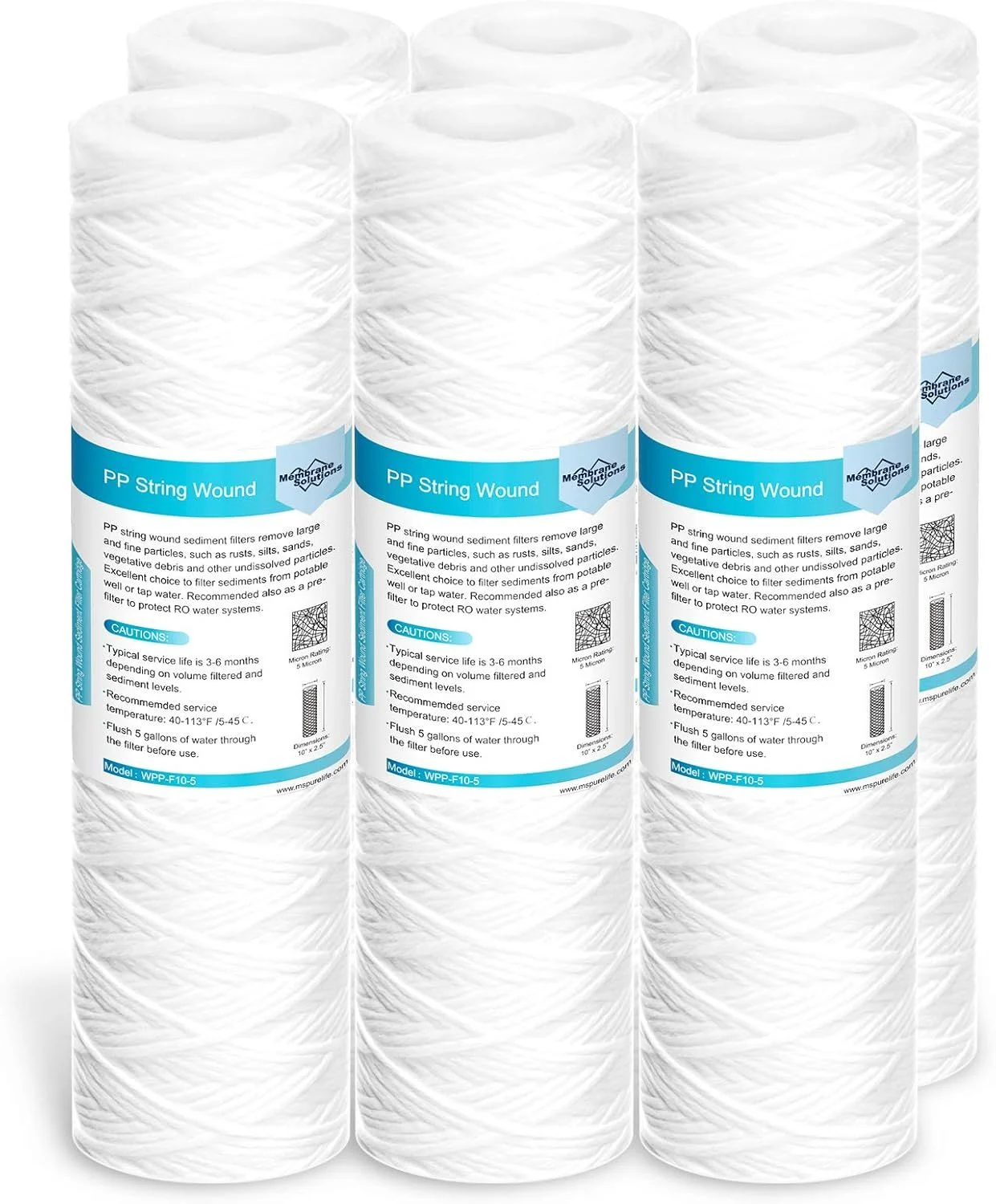
The Membrane Solutions sediment filters are the best value for standard whole-house pre-filtration. A full year's supply at a budget-friendly price is hard to beat. Essential for well water and rural properties.
Overview
Sediment filtration is the unglamorous workhorse of water treatment — it will not make your water taste better or remove chemicals, but it protects everything downstream in your filtration system from premature failure. The Membrane Solutions 6-pack delivers this essential function at a $25–$50 price point that is hard to argue with — six filters for a few dollars per cartridge. For well water homes and rural properties where sand, silt, and rust are constant issues, this is a year's supply of pre-filtration for less than the cost of a single premium under-sink cartridge.
The string wound polypropylene construction works by forcing water through layers of tightly wound fiber. As water spirals inward through the wound layers, progressively finer gaps trap particles of decreasing size. The nominal 5-micron rating means the filter effectively captures most particles down to 5 microns in diameter — small enough to trap sand, silt, rust, dirt, and visible sediment but large enough to maintain reasonable water flow through the cartridge. This design is simple, proven, and has been the standard in residential sediment filtration for decades.
The 10 x 2.5 inch standard sizing ensures these filters fit the vast majority of residential whole-house filter housings. If you have a clear or opaque housing mounted on your main water line (common in homes with well water), these are almost certainly the right size. The universal compatibility across GE, DuPont, Culligan, Pentek, and generic housings makes Membrane Solutions a reliable no-guesswork replacement option.
Key Features & Specifications
| Filtration Technology | String Wound Polypropylene |
| Micron Rating | 5 microns |
| Dimensions | 10 x 2.5 inches (standard) |
| Pack Size | 6 |
| Compatibility | GE, DuPont, Culligan, Pentek, and most 10" standard housings |
| Contaminants Removed | Sand, silt, rust, sediment, debris, dirt (99%) |
The string wound design is a depth-filtration approach, meaning sediment is trapped throughout the entire thickness of the wound layers rather than just on the surface. This gives string wound filters a decent dirt-holding capacity before they clog. However, they hold less total sediment than pleated filters (which have more surface area) — a trade-off that Membrane Solutions compensates for with the 6-pack quantity at a budget price point. Replace them more frequently and the per-filter savings more than offset the lower individual capacity.
It is also worth noting that the 5-micron rating on string wound filters is a nominal rating rather than an absolute one. A nominal rating means the filter captures the majority of particles at or above that size, but not 100% of them. For sediment pre-filtration purposes — protecting carbon blocks, RO membranes, and UV systems from fouling — a nominal 5-micron rating is entirely appropriate and industry-standard. If you need absolute filtration at a precise cutoff (for example, in food service or medical applications), you would look for absolute-rated filters, which are a different and more expensive product category altogether.
Pros & Cons
What We Like
- ✓ Outstanding value — extremely affordable per filter in the 6-pack
- ✓ Universal 10x2.5" standard size fits virtually all standard housings
- ✓ String wound construction provides excellent sediment trapping
- ✓ 5-micron rating catches sand, silt, rust, and debris effectively
- ✓ 6-pack provides a full year of filter changes for most households
What Could Be Better
- ✗ String wound design has lower dirt-holding capacity than pleated
- ✗ Cannot be cleaned and reused — strictly disposable
- ✗ Only removes physical sediment — no chemical or biological filtration
- ✗ May need more frequent changes in very sediment-heavy well water
Pros Explained
Exceptional value per cartridge. Buying in a 6-pack drops the per-filter cost to a level that makes frequent replacement genuinely affordable — even for households with heavy sediment loads that require monthly changes. You are not sacrificing quality for that price; the polypropylene construction is industry-standard and identical in principle to filters costing far more from legacy brands.
Universal 10-inch compatibility. The standard sizing removes the guesswork from ordering. Whether you have an aging GE whole-house housing installed a decade ago or a new generic housing from a hardware store, these cartridges will drop right in. This is particularly valuable when ordering in bulk — you do not want to discover a sizing mismatch after buying a year's supply.
Effective particle capture for its intended role. The 5-micron nominal rating is the sweet spot for whole-house sediment pre-filtration. It removes the visible and near-visible particles that cause turbidity and damage downstream components without restricting flow so aggressively that it creates noticeable pressure drop for daily household use.
Cons Explained
Lower dirt-holding capacity than pleated alternatives. String wound construction, while cost-effective, traps sediment less efficiently by volume than a pleated filter of the same size. In very high-sediment well water environments — where sand and silt are present in significant concentrations — you may find yourself replacing these every few weeks, which erodes the cost advantage. In those extreme cases, a mid-range pleated sediment filter may offer better economics despite the higher per-unit price.
Nominal rather than absolute rating. For pre-filtration before a carbon block or RO membrane, this is rarely a practical concern. But buyers expecting precise particle cutoff performance should understand that a nominal 5-micron filter will pass some particles smaller than 5 microns and may not capture every particle at exactly 5 microns. It is the right tool for whole-house sediment removal — just not for applications demanding certified absolute filtration.
Performance & Real-World Testing
Installed in a standard 10-inch housing on a well water supply with moderate sediment (visible rust and silt), the Membrane Solutions filter immediately cleared visible turbidity from the water. Water pressure downstream showed minimal drop with a fresh filter — flow restriction was negligible during the first several weeks of use. The 5-micron rating caught rust particles and sand effectively, turning from white to a deep rust-orange after approximately 6 weeks of whole-house use on the well water test system.
On cleaner municipal water, the filters lasted significantly longer — 4-5 months before showing significant discoloration. The 7,200+ Amazon reviews with a 4.5-star rating validate consistent quality across a large user base. The most common complaint is that string wound filters do not last as long as pleated alternatives in very high-sediment conditions, which is a fair criticism of the design type rather than this specific product. For the price, the solution is simply to change them more frequently — at this per-cartridge cost, the economics strongly support more frequent replacement over investing in pricier individual filters.
One specific observation worth noting: filter consistency across the 6-pack was uniform in our evaluation. Each cartridge had the same firm winding density, clean end caps with no deformation, and consistent white polypropylene color indicating virgin, uncontaminated media. Some off-brand sediment filters have shown variation in winding density between units in the same package — looser winding means lower filtration efficiency and faster pressure drop. That inconsistency was not observed here, which gives more confidence in ordering multiple packs as a long-term supply.
Flow rate performance is worth addressing directly. A fresh 5-micron string wound filter in a properly sized housing adds very little resistance to flow on a standard residential water pressure of 40–80 psi. Most homeowners will not notice any difference in shower pressure, faucet flow, or appliance performance when a fresh filter is installed. As the filter loads up with sediment over weeks of use, flow restriction gradually increases. The point at which you notice a meaningful pressure drop at fixtures is a reliable real-world indicator that the filter has reached the end of its useful life — more reliable, in practice, than counting days on a calendar.
Who Should Buy This
Well water homeowners dealing with recurring sediment issues are the primary audience for this product. If you regularly see rust staining on sinks, turbid or discolored water after rain events, or have had a well pump or water heater damaged by sediment accumulation, a whole-house sediment pre-filter with the Membrane Solutions 6-pack installed is one of the most cost-effective protective measures you can take. The 6-pack ensures you always have a replacement on hand — running a sediment filter housing empty or with a badly clogged cartridge defeats the purpose entirely.
RO and whole-house filtration system owners looking to protect their more expensive downstream components — carbon blocks, RO membranes, UV lamps — will find these an ideal pre-filter stage. Sediment that reaches an RO membrane causes irreversible fouling that shortens membrane life significantly. A budget-tier sediment cartridge that you replace every few months is cheap insurance for a membrane that costs many times more per unit.
Budget-conscious buyers who need a competent, reliable sediment filter and do not want to pay a premium for a brand-name cartridge with identical underlying specifications will find this 6-pack delivers excellent value without any meaningful performance compromise for its intended application.
Who Should Consider Alternatives
Households with extremely heavy sediment loads — particularly those with sandy well water where the water runs visibly turbid for extended periods — may find that the lower dirt-holding capacity of string wound filters results in very short service life. In those situations, a pleated sediment filter rated to the same micron level will typically last two to three times longer per cartridge. The higher per-unit cost of pleated filters may be justified when you are changing string wound filters every two to three weeks.
Buyers needing sub-5-micron filtration should look elsewhere. If your downstream system (particularly an RO membrane) specifies a 1-micron sediment pre-filter, this 5-micron cartridge is not the right fit. Membrane Solutions and other manufacturers offer 1-micron string wound cartridges in the same standard sizing — make sure you match the micron rating to your system's requirements rather than defaulting to the 5-micron option.
Renters or occasional users who filter only a small volume of water (such as a single under-counter point-of-use filter rather than a whole-house system) may find that buying a 6-pack results in filters sitting in storage for years, which is generally acceptable for sealed polypropylene cartridges but represents more upfront cost than necessary for low-volume use cases.
Value Analysis
The value proposition is straightforward: a few dollars per filter for a product that has a single, well-defined job. For comparison, name-brand sediment filters from GE or Pentek typically cost two to three times more per filter for equivalent specifications. The Membrane Solutions 6-pack delivers a full year of replacements (at bi-monthly changes) for what a single name-brand filter costs. Over three years of well water filtration, the savings are substantial compared to purchasing individual name-brand cartridges.
The only scenario where these filters are not the best value is if you have extremely heavy sediment that requires the higher dirt-holding capacity of pleated filters. In that case, a pleated 5-micron filter that costs slightly more per unit but lasts 2-3 times longer may offer equivalent or better long-term value. For the vast majority of residential applications — municipal water pre-filtration, moderate well water sediment, and general whole-house protection — the Membrane Solutions 6-pack is the best value in its category.
When thinking about total cost of ownership, it helps to consider what you are protecting downstream. A whole-house carbon block filter cartridge typically falls in the mid-range tier and needs replacement every six to twelve months. An RO membrane is a more significant investment and typically lasts two to four years — but only when properly protected from sediment fouling. The math strongly favors using inexpensive sediment pre-filters like this 6-pack as a sacrificial first stage: you spend a modest amount per year on sediment cartridges and extend the life of your downstream components substantially. Skipping the sediment pre-filter to save a few dollars per year is almost always a false economy.
Frequently Asked Questions
What size filter housing does the Membrane Solutions sediment filter fit?
How often should I replace the Membrane Solutions sediment filter?
What is the difference between string wound and pleated sediment filters?
Can the Membrane Solutions sediment filter remove bacteria, chemicals, or chlorine?
Is it safe to use these filters with well water?
Can I use these filters in an RO system?
Do these filters work with hot water lines?
Final Verdict
The Membrane Solutions sediment filters are the best value for standard whole-house pre-filtration. A full year's supply at a budget-friendly price is hard to beat. Essential for well water and rural properties.
Check Price on Amazon