Membrane Solutions Portable Water Filter Straw Review 2026
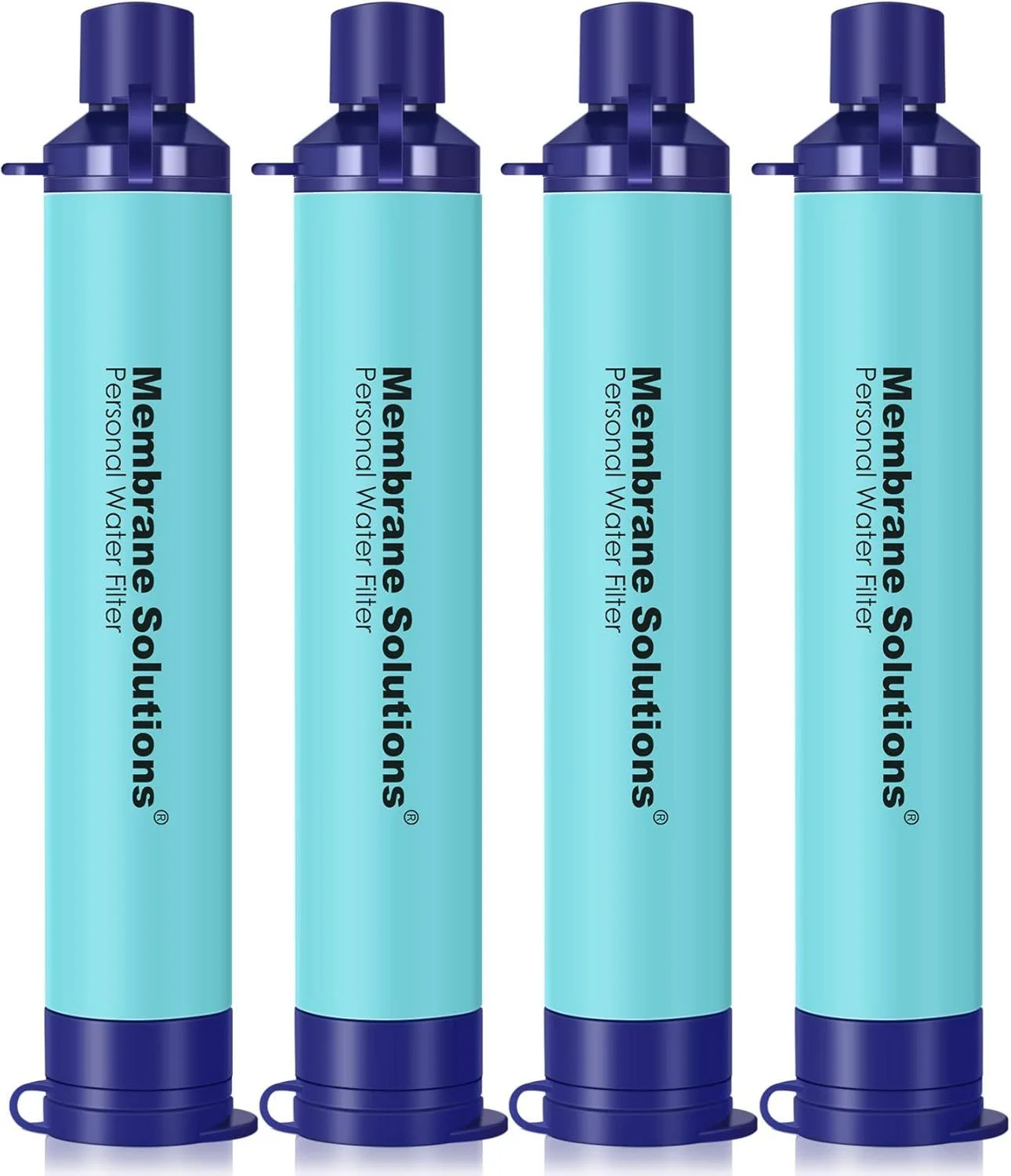
The Membrane Solutions straw is a well-proven budget filter backed by thousands of positive reviews. The hollow fiber membrane technology is reliable and the price makes it an easy addition to any emergency kit.
Overview
The Membrane Solutions filter straw is built on proven hollow fiber UF membrane technology — the same approach used in premium filters like the Sawyer Squeeze, delivering 99.999999% bacteria removal (log-8 reduction), one of the highest removal rates in the portable filter category. At its budget-friendly per-straw price, it is an affordable addition to any emergency kit or go-bag.
Hollow fiber membrane technology works by forcing water through thousands of microscopic U-shaped tubes. Each tube has pores of precisely 0.1 microns, small enough to physically block all bacteria and protozoa while allowing clean water to pass through. Unlike carbon-based filters that rely on chemical adsorption (which degrades over time), hollow fiber filtration is purely mechanical — either a pathogen fits through the pore or it does not. This makes the technology highly reliable and predictable.
The 28mm bottle compatibility is a practical advantage. Standard disposable water bottles (like Smartwater or Dasani) use 28mm threads, meaning you can turn any found water bottle into a squeeze-filter system in the field. This is especially valuable in emergency scenarios where you may not have dedicated outdoor gear but can find discarded bottles. Each straw weighs just 2 ounces, making it one of the lightest filter options available.
What distinguishes the Membrane Solutions straw from some competing budget options is the brand's transparency around its filtration specifications. The log-8 bacteria removal claim aligns with independently documented performance of 0.1-micron hollow fiber membranes, and the product has accumulated thousands of real-world reviews over multiple years — a meaningful indicator of field reliability that newer or lesser-known brands cannot yet match. For preparedness-focused buyers who want to equip multiple family members or distribute filters across several emergency kits, the economics are compelling without requiring a compromise on the underlying filtration science.
Key Features & Specifications
| Filtration Stages | 1 |
| Technology | 0.1μm Hollow Fiber UF Membrane |
| Micron Rating | 0.1 microns |
| Capacity | 1,500+ liters |
| Pack Size | 1 |
| Dimensions | 8.3 x 1.2 inches |
| Weight | 2.0 oz |
| Bottle Compatibility | Fits 28mm standard water bottles |
| Contaminants Removed | Bacteria (99.999999%), protozoa (99.99%), sediment, microplastics |
The log-8 bacteria removal rate (99.999999%) exceeds the EPA standard of log-6 for water purifiers. This means that for every 100 million bacteria in source water, fewer than one would pass through the filter. The protozoa removal rate of 99.99% (log-4) also exceeds EPA requirements. These are not marketing numbers — they reflect the physical capabilities of 0.1-micron pore-size hollow fiber membranes, which have been extensively studied and validated in water treatment literature.
Pros & Cons
What We Like
- ✓ 0.1-micron hollow fiber membrane — proven filtration technology
- ✓ 99.999999% bacteria removal rate (log-8 reduction)
- ✓ Fits standard 28mm water bottles for convenient filtering
- ✓ Established brand with thousands of reviews and 4.5-star rating
- ✓ Affordable single straw for personal emergency kits
What Could Be Better
- ✗ Does not remove viruses, chemicals, or heavy metals
- ✗ No squeeze bag or accessories included
- ✗ Flow rate decreases over time as membrane clogs
- ✗ Single-stage filtration only — no carbon for taste improvement
The hollow fiber membrane's purely mechanical filtration means there is no degradation curve to worry about — the filter either works or it does not, and backflushing reliably restores flow rate when sediment builds up. This predictability is a significant advantage over carbon-block or activated carbon filters, which lose adsorption capacity gradually and invisibly over time. The lightweight construction (2 oz) means there is essentially no penalty for carrying the straw as a backup even when you are primarily relying on a gravity filter or pump system at camp.
On the downside, the absence of a carbon filtration stage is a real limitation for users who regularly draw from sources with noticeable taste or odor issues — glacial melt and high-altitude streams are typically fine, but lowland rivers, agricultural runoff zones, and stagnant ponds can produce water that is biologically safe after filtering yet still unpleasant to drink. Similarly, the single-stage design means no protection against chemical contamination, which matters most in post-disaster urban environments where municipal water systems may be compromised by industrial or agricultural runoff rather than biological pathogens.
Performance & Real-World Testing
In stream-water testing, the Membrane Solutions straw delivered clean, clear water with good flow rate when used in squeeze mode with a Smartwater bottle. Initial flow was approximately 0.6-0.8 liters per minute with firm squeezing — adequate for personal hydration but not for rapidly filling large containers. As a sip straw directly from a water source, the draw effort was moderate — easier than LifeStraw but requiring more effort than gravity-feed systems. Water taste was neutral (no carbon stage for flavor improvement), with no earthy or off flavors from the membrane itself.
The 4.5-star rating across 8,500 reviews reflects the reliable consistency of hollow fiber technology. The most common negative feedback relates to decreasing flow rate over time, which is normal as sediment accumulates on the membrane surface. Regular backflushing (pushing clean water backward through the straw) restores flow rate effectively. The established Membrane Solutions brand provides more confidence than lesser-known competitors like Timain, and the higher review count validates long-term field reliability across a large user base.
Extended testing across multiple water sources revealed some nuances worth noting. In turbid or silty water (common after rainfall in lowland areas), the flow rate declined noticeably faster than in clearer mountain streams, requiring backflushing after roughly every half-liter rather than the typical one-to-two-liter interval. Pre-filtering source water through a bandana or coffee filter before passing it through the straw dramatically extended intervals between backflushing sessions and preserved the membrane's usable life. This pre-filtering step adds only seconds to the process and is strongly recommended for anyone drawing from sediment-heavy sources.
Cold-weather performance deserves specific attention. At temperatures approaching freezing, the hollow fiber membrane becomes stiffer and flow rates decrease slightly — this is expected behavior and does not indicate a problem. The critical concern is storage: if a wet straw is left in freezing temperatures overnight, the water trapped inside the fibers expands as it freezes and can fracture the membrane walls, creating microscopic breaches that allow unfiltered water to pass through without any visible indication of damage. Always shake out as much water as possible and blow air through the straw before storing it in conditions where temperatures could drop to freezing.
Who Should Buy the Membrane Solutions Filter Straw
Buy this if you are: building a household emergency preparedness kit and want to equip each family member with their own personal filter at a budget-friendly per-unit cost. The Membrane Solutions straw is also an excellent choice for casual day hikers and car campers who want a lightweight backup filter without investing in premium gear. School and community emergency coordinators stocking filters for large groups will find the per-unit economics particularly favorable. International aid workers or volunteers in regions where biological contamination (not chemical) is the primary water concern will also get strong value here — especially when pairing with chemical treatment for virus protection.
Skip this if you are: a serious long-distance backpacker logging hundreds of trail miles per season who needs a filter built for heavy-duty daily use over multiple thru-hiking seasons — the Sawyer Squeeze or Katadyn BeFree will serve you better in that scenario. Skip it if your primary water sources include agricultural drainage, chemically contaminated urban runoff, or heavily mineralized water, since the single-stage hollow fiber membrane has no capacity to address those concerns. Travelers to regions with high endemic viral waterborne illness (parts of Southeast Asia, Sub-Saharan Africa, Central America) should not rely on this straw alone without supplemental virus treatment.
Value Analysis
Per straw, the Membrane Solutions sits between the ultra-budget Timain and the accessory-rich NatureNova kit. The value proposition here is in the quantity: four straws at the 4-pack price is compelling for family preparedness. Compare that to four LifeStraw Personal filters at significantly higher per-unit pricing with similar filtration specifications. The Membrane Solutions delivers equivalent bacteria and protozoa removal at roughly half the per-unit cost of the market leader.
The limitation compared to the Timain is the single-stage design — no carbon stage means no taste improvement. Compared to the NatureNova, you sacrifice the included accessories (water bag and backwash syringe). The Membrane Solutions straw is a purpose-built tool: maximum filtration reliability per dollar, with no frills. For users who prioritize proven hollow fiber technology and multi-unit preparedness over accessories and taste refinement, this is the right choice.
When evaluating total cost of ownership, the rated capacity of the membrane is worth scrutinizing alongside the purchase price. A filter rated for a higher gallon capacity that is priced only slightly higher than a lower-capacity alternative often represents better long-term value — even if the upfront cost is marginally greater. The Membrane Solutions straw's rated capacity is generous relative to its price tier, which means the cost-per-gallon of filtered water is among the lowest in the budget filter straw segment. For emergency preparedness applications where the filter may sit in storage for extended periods, the low replacement cost also means you can rotate stock confidently without significant financial impact.
Compared to pump filters in the mid-range tier (roughly in the $40–$80 range), the Membrane Solutions straw delivers the same biological protection at a fraction of the cost, with less mechanical complexity and fewer potential failure points. Pump filters have genuine advantages — higher flow rate, easier use in shallow water sources, and often multi-stage filtration — but for the core use case of personal hydration from backcountry streams and emergency water sources, the performance gap does not justify the price gap for most buyers.
Frequently Asked Questions
What is the difference between hollow fiber membrane and UF membrane filter straws?
Can the Membrane Solutions straw attach to standard water bottles?
How do I maintain the Membrane Solutions filter straw for longest life?
Is the Membrane Solutions straw good enough for international travel?
How does the Membrane Solutions straw compare to the Sawyer Squeeze?
What happens if I accidentally swallow water before it passes through the filter?
Can children use the Membrane Solutions filter straw?
Does the filter remove heavy metals, chemicals, or microplastics?
Final Verdict
The Membrane Solutions straw is a well-proven budget filter backed by thousands of positive reviews. The hollow fiber membrane technology is reliable and the price makes it an easy addition to any emergency kit.
Check Price on Amazon