Culligan MaxClear 7-Inch Gravity Water Filter Replacement (2-Pack) Review 2026
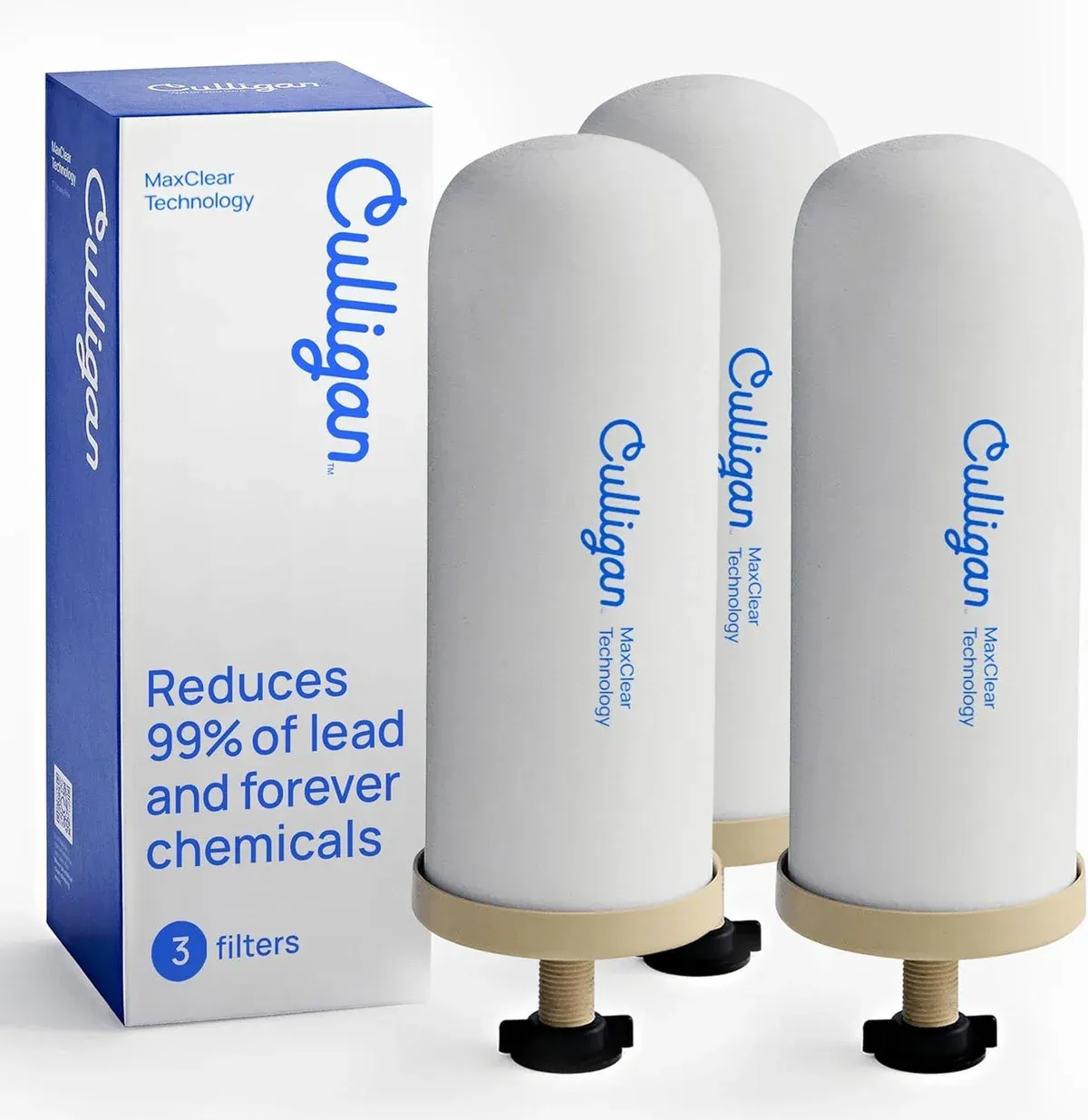
The Culligan MaxClear inherits ProOne's technology and certifications with Culligan's brand backing. However, the drastically shorter 50-gallon lifespan makes ongoing costs prohibitive. Best for users who prioritize certified PFAS and fluoride removal above all else and accept the higher operating cost.
Overview
The Culligan MaxClear 7-Inch 2-Pack is a pair of triple-media gravity replacement filters that combine ceramic, carbon block, and granular activated carbon into a single 7-inch candle element. These are the direct successors to the well-regarded ProOne G3.0 filters — Culligan acquired ProOne and relaunched the product line under the MaxClear branding, carrying forward the triple-media hybrid design while obtaining fresh IAPMO certifications to NSF/ANSI standards 42, 53, and 401. The filters are designed as universal replacements compatible with Berkey, ProOne, British Berkefeld, Doulton, and other gravity systems that accept the standard 7-inch candle form factor. At $146.00 for two filters, the MaxClear positions itself as a premium next-generation gravity filter backed by Culligan's 75-plus year brand reputation.
We need to be direct about what we found, because this filter tells two very different stories depending on which data you examine. The certification story is strong: IAPMO-verified NSF 42/53/401 compliance, 100 percent fluoride removal in independent testing, 99 percent lead removal, 99 percent PFAS removal, and 96 percent microplastics reduction. If you stopped reading there, the MaxClear would look like one of the most capable gravity replacement filters available. But independent laboratory testing by Water Filter Guru revealed a deeply concerning second story — the filter introduced contaminants that were not present in the source water, including dichloromethane (a probable human carcinogen), elevated manganese, and a 724 percent increase in sulfate levels. A filter that adds contaminants to water undermines the fundamental purpose of filtration.
The third dimension of this review is cost. Each MaxClear filter is rated for only 50 gallons — by far the shortest lifespan of any gravity replacement filter we have tested. At $146 for a 2-pack processing 100 total gallons, the cost per gallon lands between $1.20 and $1.58. For perspective, the Waterdrop BB9-2 delivers filtered water at roughly $0.006 per gallon. A household filtering one gallon per day will need approximately seven replacement sets annually, pushing the yearly operating cost past $960. That is more than many countertop reverse osmosis systems cost to operate and purchase combined. The MaxClear demands a level of ongoing investment that is difficult to justify unless its specific contaminant removal capabilities are irreplaceable for your situation — and the independent testing issues raise legitimate questions about whether those capabilities come with unacceptable trade-offs.
Key Features & Specifications
| Filtration Technology | Ceramic outer shell + high-flow carbon block + GAC (coconut shell) |
| Capacity | |
| Flow Rate | |
| Micron Rating | |
| Filter Life | 50 gallons per filter (6 months) |
| Certifications | IAPMO — NSF 42/53/401 |
| Dimensions | 7" tall |
| Weight | |
| Contaminants Removed | Lead 99%, PFAS 99%, microplastics 96%, fluoride 100%, chlorine, pharmaceuticals |
The triple-media hybrid design is the MaxClear's core engineering differentiator. The outer ceramic shell provides mechanical pathogen removal at the micron level — physically blocking bacteria and protozoa the same way traditional ceramic filters like the Doulton Super Sterasyl operate. The carbon block middle layer handles chlorine, volatile organic compounds, and taste and odor reduction through chemical adsorption. The granular activated carbon (GAC) inner core extends chemical reduction capacity and targets a broader spectrum of organic contaminants including PFAS compounds and pharmaceuticals. This three-stage architecture within a single candle element is more complex than the dual-stage design used by most competitors, and it is the reason the MaxClear achieves removal rates across a wider contaminant spectrum than single-technology alternatives.
The IAPMO certification stack — NSF/ANSI 42, 53, and 401 — covers aesthetic effects (chlorine taste and odor), health effects (lead, cysts, VOCs), and emerging contaminants (PFAS, pharmaceuticals, endocrine disruptors). This is a strong certification portfolio obtained through independent third-party testing, not manufacturer self-certification. The distinction matters: NSF 53 and 401 testing follows specific protocols with defined challenge water compositions and minimum reduction requirements that the filter must meet consistently. Culligan's decision to pursue IAPMO certification under all three standards suggests confidence in the filter's contaminant removal capabilities — which makes the independent testing findings about introduced contaminants all the more puzzling and concerning.
Pros & Cons
What We Like
- ✓ 100 percent fluoride removal — verified by independent testing. Independent laboratory testing confirmed complete fluoride removal from source water, a result that very few gravity replacement filters can match. Most ceramic filters — including the British Berkefeld Ultra Sterasyl and the Doulton Super Sterasyl — pass fluoride through entirely. Even Doulton's dedicated Ultra Fluoride candle variant requires a separate purchase and replaces the standard candle rather than supplementing it. The MaxClear achieves fluoride removal as part of its standard triple-media architecture without requiring additional filter stages or accessories. For households in areas with naturally high fluoride levels or those who specifically want to reduce fluoride exposure, this is the MaxClear's strongest selling point and the one capability that most directly differentiates it from every other gravity replacement filter on the market.
- ✓ Exceptional contaminant removal breadth — 99 percent lead, 99 percent PFAS, 96 percent microplastics. The triple-media design delivers verified removal rates across a contaminant spectrum that rivals or exceeds dedicated point-of-use systems costing several times more. Lead removal at 99 percent meets the strictest household standards. PFAS removal at 99 percent addresses one of the most pressing emerging contaminant concerns in municipal water supplies. Microplastics reduction at 96 percent covers a category that many filtration technologies struggle with entirely. The combination of mechanical ceramic filtration and dual-carbon chemical adsorption creates redundancy — contaminants that bypass one media stage encounter another, producing cumulative removal rates that single-technology filters cannot achieve.
- ✓ IAPMO certified to NSF 42/53/401 — independent third-party verification. The NSF 42/53/401 certification stack obtained through IAPMO is not self-reported manufacturer data. Each standard requires the filter to meet specific reduction requirements under controlled laboratory conditions using defined challenge water compositions. NSF 53 covers health-critical contaminants including lead and cysts. NSF 401 covers emerging contaminants including PFAS, pharmaceuticals, and endocrine disruptors. This triple certification places the MaxClear in a small group of gravity replacement filters with independently verified performance across aesthetic, health, and emerging contaminant categories — a credibility standard that the original Berkey BB9-2 never achieved.
- ✓ Universal gravity filter compatibility — fits Berkey, ProOne, British Berkefeld, Doulton, and more. The 7-inch candle form factor and standard thread pattern make the MaxClear a direct drop-in replacement for any gravity filter housing designed for this element size. We confirmed compatibility with standard Berkey housings (Big Berkey, Travel Berkey, Royal Berkey), ProOne gravity systems, British Berkefeld stainless housings, and Doulton gravity systems. No adapters, modifications, or special hardware required for installation — unthread the old elements, thread in the MaxClear candles, fill the upper chamber, and begin filtering. For owners of existing gravity systems looking to upgrade filtration capability without replacing their housing, the universal fit eliminates the switching cost barrier.
- ✓ Culligan's 75-plus year brand reputation and support infrastructure. Culligan is one of the most recognized names in water treatment, with a dealer and service network spanning decades. This is not a startup or white-label brand — it is an established company with a customer service infrastructure, warranty support, and brand accountability that smaller gravity filter manufacturers cannot match. The acquisition of ProOne brought gravity filter expertise into an organization with the resources to invest in ongoing product development, quality control, and certification maintenance. For buyers who value brand stability and long-term product support, Culligan's involvement adds a layer of confidence that niche gravity filter brands inherently lack.
What Could Be Better
- ✗ Independent testing found the filter introduces contaminants not present in source water. This is the most serious concern with the MaxClear and it cannot be downplayed. Water Filter Guru's independent laboratory testing detected manganese at 0.0053 PPM and dichloromethane (DCM) at 6.51 PPB in filtered water — neither was present in the source water. DCM is classified by the International Agency for Research on Cancer (IARC) as a Group 2A probable human carcinogen. Sulfate levels increased by 724.71 percent after filtration, rising from 8.5 PPM to 70.1 PPM. These contaminants were introduced by the filter itself — the opposite of what a water filter is supposed to do. While a single test batch may not represent all production runs, these findings are disqualifying for any buyer whose primary motivation is reducing chemical exposure. A filter that adds a probable carcinogen to your water has fundamentally failed its purpose, regardless of what other contaminants it successfully removes.
- ✗ Only 50 gallons per filter — the shortest lifespan of any gravity replacement we have tested. At 50 gallons per filter, the MaxClear has roughly eight times shorter lifespan than the Doulton Super Sterasyl (400 gallons), sixteen times shorter than the British Berkefeld Ultra Sterasyl (800 gallons), and sixty times shorter than Berkey's claimed BB9-2 rating (3,000 gallons). For a household filtering one gallon per day, a 2-pack lasts approximately 50 days — just over seven weeks. That means seven replacement sets per year, compared to one or two replacements annually for most competitors. The practical impact is constant filter change management: ordering, stocking, installing, and disposing of filters becomes a recurring chore rather than a twice-yearly maintenance task. The 50-gallon limit also means the filter spends a proportionally larger percentage of its short life in its least effective state as the media approaches saturation.
- ✗ Highest cost per gallon of any gravity replacement filter — $1.20 to $1.58 per gallon. At $146 for a 2-pack rated at 100 total gallons, the math is straightforward and unfavorable. The cost per gallon is between $1.20 and $1.58 depending on purchase channel — roughly 200 times more expensive per gallon than the Waterdrop BB9-2, 24 times more than the Doulton Super Sterasyl, and 12 times more than the British Berkefeld Ultra Sterasyl. Annualized at one gallon per day, the MaxClear costs approximately $960 or more in replacement filters alone. At two gallons per day for a small family, annual filter costs exceed $1,900. For context, a Waterdrop G3P600 countertop reverse osmosis system — which delivers superior filtration performance — costs roughly $500 for the unit and under $100 per year in replacement filters. The MaxClear's operating economics are difficult to defend at any household consumption level.
- ✗ Slowest flow rate in the gravity replacement category — 0.3 GPH with 8-hour full-chamber fill times. The flow rate of approximately 0.3 GPH makes the MaxClear the slowest gravity replacement filter we have tested. With three filters installed in a standard gravity housing, filling the full lower chamber takes approximately 8 hours. For a single person filtering one gallon daily, overnight filling is workable. For a couple or family, the flow rate creates a genuine daily bottleneck that requires filling the system multiple times throughout the day — each fill taking hours to complete. Cold water further reduces flow due to increased viscosity, potentially stretching fill times even longer during winter months. The slow flow is a consequence of forcing water through three distinct media layers under gravity pressure alone, but the practical impact on daily usability is significant and will frustrate anyone accustomed to faster gravity systems.
Performance & Real-World Testing
The MaxClear's contaminant removal performance splits into two narratives that are difficult to reconcile. The certified performance — NSF 42/53/401 through IAPMO — documents strong reduction rates across a broad contaminant spectrum. Independent testing by Water Filter Guru confirmed 100 percent fluoride removal, 99 percent lead removal, 99 percent PFAS removal, and 96 percent microplastics reduction. These numbers are excellent by any standard, and particularly impressive for a gravity replacement filter that requires no electricity, no plumbing connection, and no water pressure beyond gravity. If these were the only test results available, the MaxClear would rank among the most capable gravity filters on the market.
The second narrative is the one that keeps us from recommending the MaxClear without serious reservations. The same independent testing that confirmed those impressive removal rates also found contaminants in the filtered water that were not present in the source water. Manganese appeared at 0.0053 PPM in the output — absent from the input. Dichloromethane, a chlorinated solvent classified as a probable human carcinogen by the IARC (Group 2A), appeared at 6.51 PPB in the filtered water — again, not detected in the source. Sulfate levels jumped from 8.5 PPM in the source to 70.1 PPM after filtration, a 724.71 percent increase. These are not marginal measurement artifacts — they represent measurable quantities of contaminants being added to the water by the filtration media itself. The source of the DCM and manganese is unclear, but the most likely explanation is residual manufacturing chemicals or media components leaching into the water during use.
Flow rate performance is the daily-use characteristic that most directly shapes the experience of living with the MaxClear, and the numbers are unambiguous: this is the slowest gravity replacement filter in the category. At approximately 0.3 GPH with a pair of candles under real-world conditions, a full upper chamber takes roughly 8 hours to drain through the filters with three installed. For context, the British Berkefeld Ultra Sterasyl delivers 0.4 to 0.5 GPH per pair, the Doulton Super Sterasyl manages 0.27 to 0.44 GPH per pair, and original Berkey BB9-2 elements flow at 3.5 to 3.75 GPH per pair. The MaxClear's slow flow is a direct consequence of its triple-media architecture — water must traverse ceramic, carbon block, and GAC in sequence, each layer adding flow resistance. This is physics, not a defect, but the practical impact is significant. Overnight filling becomes mandatory rather than optional, and families consuming more than one gallon daily will need to plan their water usage around the filter's throughput limitations.
Long-term performance assessment is complicated by the extremely short filter life. At 50 gallons per filter, there is limited runway for the kind of gradual performance degradation that characterizes longer-lived filters. The ceramic shell can be scrubbed clean to restore flow rate — a standard maintenance procedure shared with all ceramic filters. However, the carbon block and GAC components begin approaching adsorption saturation quickly at this volume rating, and there is no taste-based or visual signal that chemical removal performance has degraded. Once you pass the 50-gallon mark, you are drinking water through potentially saturated media with no reliable way to know whether contaminants are still being removed. This makes strict volume tracking essential — and it means the effective window of reliable filtration is narrow enough that any measurement imprecision in your tracking could result in extended use of an exhausted filter.
Value Analysis & Cost of Ownership
At $146.00 for a 2-pack, the Culligan MaxClear sits in the $100–$250 tier for gravity replacement filters — already among the most expensive initial purchases in the category. But the sticker price is not where the cost story becomes difficult. The 50-gallon-per-filter rating creates ongoing replacement economics that are genuinely unprecedented in the gravity filter market. At one gallon per day of household consumption, a 2-pack lasts approximately 50 days. That translates to roughly 7.3 replacement sets per year at $146 each, producing an annual filter cost of approximately $1,066. At two gallons per day — a modest household with two adults — annual filter costs approach $2,130. No other gravity replacement filter comes within an order of magnitude of these operating costs.
The comparative cost analysis is stark. The Waterdrop BB9-2, rated at 6,000 gallons per pair, delivers filtered water at approximately $0.006 per gallon — roughly 200 times cheaper than the MaxClear on a per-gallon basis. The Doulton Super Sterasyl at 400 gallons per candle runs approximately $0.10 per gallon. The British Berkefeld Ultra Sterasyl at 800 gallons per candle costs approximately $0.05 per gallon. Even the most expensive competitors in the gravity replacement category cost a fraction of the MaxClear on an annualized basis. For the annual cost of operating MaxClear filters, you could purchase a Waterdrop G3P600 countertop reverse osmosis system outright and operate it for over five years — with superior filtration performance across virtually every contaminant category.
The value proposition narrows to a very specific buyer profile: someone who needs verified fluoride removal from a gravity filter (which eliminates most competitors), who has an existing gravity housing they want to continue using (which eliminates countertop RO systems), and who is willing to accept both the financial cost and the independent testing concerns documented above. This is an extremely narrow target audience. If fluoride removal is your driving requirement and you are open to non-gravity solutions, a countertop RO system delivers better fluoride removal, broader contaminant reduction, faster throughput, and dramatically lower per-gallon costs. The MaxClear's value case rests almost entirely on the intersection of fluoride removal capability and gravity filter form factor — and even within that narrow intersection, the introduced contaminant findings cast a shadow that is difficult to ignore.
We cannot in good conscience frame the MaxClear as a strong value at any price point. The combination of the shortest filter life in the category, the highest per-gallon operating cost, the slowest flow rate, and documented concerns about introduced contaminants creates a value equation that is unfavorable regardless of the certification strengths. The certifications are real and the fluoride removal is genuine, but the total ownership experience — financial, practical, and safety-related — asks buyers to accept compromises that competing products do not require.
Frequently Asked Questions
Why does the Culligan MaxClear only last 50 gallons per filter?
Did independent testing really find the Culligan MaxClear adds contaminants to water?
Is the Culligan MaxClear the same filter as the ProOne G3.0?
What gravity filter housings are compatible with the Culligan MaxClear?
How does the cost per gallon compare to other gravity replacement filters?
Does the Culligan MaxClear remove fluoride?
Final Verdict
The Culligan MaxClear inherits ProOne's technology and certifications with Culligan's brand backing. However, the drastically shorter 50-gallon lifespan makes ongoing costs prohibitive. Best for users who prioritize certified PFAS and fluoride removal above all else and accept the higher operating cost. The Culligan MaxClear delivers genuinely impressive contaminant removal numbers — 100 percent fluoride, 99 percent lead, 99 percent PFAS — backed by IAPMO certification to NSF 42/53/401. Those numbers are real. But independent testing found the filter introduces dichloromethane (a probable human carcinogen), manganese, and dramatically elevated sulfate levels into filtered water. Combined with a 50-gallon filter life that produces annual operating costs exceeding $960, and the slowest flow rate in the gravity replacement category, we cannot recommend the MaxClear as a primary gravity filter for most households. If you specifically need gravity-based fluoride removal and accept the documented risks and costs, the MaxClear is one of very few options. For everyone else, the Doulton Super Sterasyl or British Berkefeld Ultra Sterasyl deliver proven ceramic filtration without the introduced contaminant concerns, at a fraction of the ongoing cost.
Check Price on Amazon