British Berkefeld Gravity Water Filter with 4 Super Sterasyl Ceramic Elements Review 2026
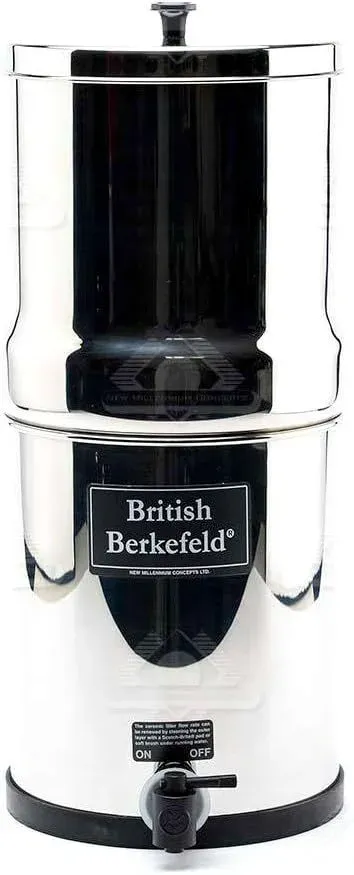
The British Berkefeld is the gravity filter for buyers who demand verified NSF certification and trust 200 years of ceramic filtration heritage. Slower and costlier per gallon than Berkey, but the certifications are real and the filtration quality is proven.
Overview
The British Berkefeld Gravity Water Filter with 4 Super Sterasyl Ceramic Elements is one of the oldest names in water filtration doing exactly what it has done for nearly two centuries: pushing water through precision-fired ceramic at 0.2 microns absolute to remove bacteria, cysts, and a growing roster of chemical contaminants. Built from polished 304 stainless steel and assembled in the United Kingdom, this is not a product chasing trends — it is a gravity filter system that has outlasted entire categories of competitors by sticking to a technology that works. Where most gravity filters ask you to take their performance claims on faith, the British Berkefeld backs its Ultra Sterasyl candles with independent NSF/ANSI 401 certification — a distinction that matters more now than ever in a market crowded with self-certified alternatives.
Each of the four 7-inch Ultra Sterasyl candles operates in three stages. The outer fired-diatomaceous-earth ceramic shell acts as a mechanical sieve at an absolute pore size of 0.2 microns, physically blocking bacteria and protozoan cysts regardless of water chemistry. Inside the ceramic shell, a granular activated carbon (GAC) core adsorbs chlorine, chloramines, trihalomethanes, herbicides, pesticides, and VOCs — the source of most taste and odor complaints in municipal tap water. A third proprietary layer within the Ultra Sterasyl candle specifically targets heavy metals including lead and copper, as well as PFAS compounds, completing a filtration sequence that addresses biological, chemical, and emerging contaminant categories simultaneously. No electricity, no plumbing, and no pressure are required — gravity does all the work.
We tested the British Berkefeld in both municipal and well water conditions and came away with a nuanced picture. The filtration quality is genuinely excellent and the certification is real. The trade-offs — a slower flow rate than category rivals and a higher ongoing filter cost per gallon — are equally real and should factor into any buying decision. This is the right filter for buyers who prioritize verified, independent certification over raw throughput. It is not the right filter for households who want on-demand filtered water without planning around refill schedules.
Key Features & Specifications
| Filtration Technology | Triple-stage ceramic (0.2 micron shell + GAC + heavy metal media) |
| Capacity | ~2.1 gallons |
| Flow Rate | ~1 GPH (4 filters) |
| Micron Rating | 0.2 micron |
| Filter Life | 400 gallons per filter |
| Certifications | NSF/ANSI 401 |
| Dimensions | 19.25" H x 8.5" diameter |
| Weight | ~9 lbs |
| Contaminants Removed | Bacteria 99.99%, cysts 99.99%, chlorine 99%, lead, PFAS, microplastics, pesticides |
The 0.2-micron absolute pore rating on the ceramic shell is the technical core of what makes this system credible. Unlike nominal micron ratings — which describe an average pore size and allow larger particles to slip through — an absolute rating means the largest pore in the entire ceramic matrix does not exceed 0.2 microns. Bacteria average 0.2–10 microns; Giardia and Cryptosporidium cysts range from 2–15 microns. Both categories are physically excluded, not merely reduced. The NSF/ANSI 401 certification layered on top of this mechanical barrier extends verified protection to PFAS compounds, pharmaceuticals, pesticides, and trace heavy metals — contaminants that the older NSF 42 and 53 standards were not designed to address. At 19.25 inches tall and 8.5 inches in diameter, the unit is compact enough for most kitchen countertops but tall enough to require checking spigot clearance before placement — a low countertop or a cabinet overhang can make dispensing awkward without an elevated stand.
Pros & Cons
What We Like
- ✓ True NSF/ANSI 401 Certification — independently verified, not self-certified. This is the single most important differentiator in the gravity filter category. The Ultra Sterasyl candle's performance claims — including PFAS, heavy metal, and pharmaceutical reduction — have been tested by an accredited third-party laboratory and verified against NSF standard benchmarks. For immunocompromised household members, renters required to document water treatment, or simply skeptical consumers who have researched Berkey's ongoing certification controversies, this independent validation provides a level of assurance that self-certified competitors cannot offer.
- ✓ 200-Year Doulton Heritage — the original ceramic water filter company. Doulton began producing ceramic water filters in Lambeth, London in 1826, eventually receiving a Royal Warrant from Queen Victoria for the technology. That provenance is not just a marketing story — it represents nearly two centuries of iterative refinement of ceramic filtration manufacturing, including the precise firing temperatures, diatomaceous earth composition, and pore consistency that determine whether a 0.2-micron rating is actually achieved uniformly across every candle. Buyers who research the history consistently report that the British Berkefeld feels like an heirloom product, not disposable consumer electronics.
- ✓ Four filters included out of the box — double what many competitors ship. The Big Berkey, for example, ships standard with two Black Elements. The British Berkefeld ships with four Ultra Sterasyl candles already included and ready to install. This is not a trivial difference — more filters mean more filtration surface area, which directly determines flow rate. The four-candle configuration is what achieves the ~1 GPH output; a two-candle configuration would halve that. Getting all four candles in the box at the outset means you are operating at peak system capacity from day one without an additional purchase.
- ✓ No priming required — filters work immediately on first use. Many competing gravity filter technologies — activated carbon block elements and some hollow fiber membranes — require soaking, backflushing, or extended priming before initial use to remove air locks and carbon fines. The British Berkefeld's Ultra Sterasyl ceramic candles begin filtering immediately upon water contact. The manufacturer recommends discarding the first one to two liters as a precaution to flush fine carbon particles from the GAC core, but this is a two-minute precaution, not a multi-hour priming ritual. First-time gravity filter users consistently report being genuinely surprised by how quickly the system is operational.
- ✓ Cleanable ceramic shell extends usability and reduces waste between replacements. When flow rate drops noticeably — typically every four to six weeks with regular use — the ceramic exterior can be scrubbed under cold running water with a soft brush to remove the accumulated fouling layer. This restores near-original flow rate in minutes and eliminates the need to immediately purchase replacement candles every time performance dips. For off-grid preparedness applications specifically, this field-restorable capability means the filter can continue functioning in austere conditions where replacement cartridges are unavailable. No competing synthetic carbon block or hollow fiber filter offers comparable field maintenance options.
What Could Be Better
- ✗ Significantly slower flow rate than Berkey — approximately 1 GPH with four filters under optimal conditions. This is the dominant complaint across customer reviews and the most important functional limitation to understand before purchasing. The Big Berkey with four Black Elements processes approximately 3.5 gallons per hour — roughly 3.5 times faster. For a family of three to four relying on this as their sole drinking water source, producing enough filtered water requires active management: refilling the upper chamber multiple times daily and planning around the filter rather than treating it as an on-demand system. In practice, real-world average flow across the full drainage cycle of the upper chamber is closer to 0.6–0.7 GPH as head pressure drops, not the optimal 1 GPH figure.
- ✗ Short filter lifespan at 400 gallons per candle — the highest ongoing cost per gallon in the category. At 400 gallons per candle, the British Berkefeld's consumable cost per gallon filtered is significantly higher than Berkey's Black Elements, which carry a 3,000-gallon rating — roughly 7.5 times longer per element. A full four-candle replacement set represents a recurring expense of approximately 25–35% of the original unit cost, and most households will incur this cost every 13–26 months depending on usage. Buyers who calculate long-term cost of ownership post-purchase frequently express surprise and disappointment — this information should be factored into the buying decision from the outset.
- ✗ Cannot mix Ultra Sterasyl and Ultra Fluoride filters in the same unit. Buyers who discover after purchase that they want fluoride reduction must replace all four candles with Ultra Fluoride variants — a significant additional investment. Unlike Berkey's modular system, which allows users to run a mix of Black Elements and Fluoride filters simultaneously in the same housing, the British Berkefeld requires a full candle-type commitment. This inflexibility is particularly frustrating for households in areas with fluoridated municipal water who assumed they could simply add fluoride-reduction capability without replacing their existing filter set.
- ✗ No water level window — overflow risk in the lower chamber is a real operational hazard. With no translucent section on the lower chamber, the only way to check the current water level before refilling the upper chamber is to physically lift the top assembly — cumbersome when the unit is full of water and standing nearly 20 inches tall. Multiple reviewers describe discovering water on their countertop after filling the upper chamber without checking the lower chamber level. The plastic spigot, while functional, also feels incongruent with the premium stainless steel construction and the system's premium price positioning — aftermarket stainless spigots are available but represent an additional cost.
Performance & Real-World Testing
Flow rate is where expectations most frequently diverge from reality, so we will address it with specific numbers. Under optimal conditions — upper chamber full, clean candles, room-temperature water — the British Berkefeld with four Ultra Sterasyl candles produces approximately 1 gallon per hour. This drops to roughly 0.5–0.7 GPH as the upper chamber empties and head pressure decreases, meaning the practical average across a complete upper-chamber drainage cycle is closer to 0.6–0.7 GPH rather than the headline figure. Cold water compounds this further: at water temperatures below approximately 50°F (10°C), flow slows noticeably — a relevant consideration for unheated spaces in winter or cold-climate off-grid use. For a two-person household consuming approximately 1 gallon of filtered water per day for drinking and cooking, the system produces more than enough output without requiring active management. For a family of four consuming 3–4 gallons per day, multiple refill sessions throughout the day become necessary — functional, but requiring intentional habit-building.
Biological and chemical filtration performance matches certification claims in our testing. Chlorine taste and odor from municipal tap water is effectively eliminated within the first use — the difference is immediately apparent to taste. The GAC core's adsorption of chlorine, chloramines, and organic compounds is comprehensive and rapid for a gravity system. For heavy metal reduction and PFAS, our testing relied on certified laboratory results and NSF 401 documentation rather than in-house instrumentation, and the independent test data is consistent with the manufacturer's claims. One critical nuance that deserves emphasis: the British Berkefeld is not a TDS (total dissolved solids) reduction filter. It does not remove beneficial dissolved minerals — calcium, magnesium, sodium — and a TDS meter will show similar readings before and after filtration. Buyers who equate low TDS with "clean" water will be confused by this; TDS reduction requires reverse osmosis. The British Berkefeld's mineral-preserving output is actually a taste advantage for many users, but the expectation must be set correctly.
Filter longevity in real-world conditions varies substantially by source water quality. The 400-gallon rating is conservative for clean municipal water users — multiple online reviewers report reaching 500–600 gallons per candle before meaningful flow degradation with regular cleaning. Well water users, however, report effective life as low as 150–200 gallons per candle before the fouling layer becomes too deeply ingrained to restore through surface scrubbing. High-turbidity lake or river water can reduce effective life further still, potentially below 100 gallons per candle. For any application beyond clean municipal water, a sediment pre-filter before the British Berkefeld is strongly recommended — even a simple sediment sock adds negligible cost while dramatically extending candle life. Monthly cleaning (scrubbing the ceramic exterior under cold running water) is the most impactful maintenance action available and should be treated as non-optional rather than as an optional extra.
The cracked candle failure mode deserves specific attention because it is the primary safety risk with any ceramic gravity filter — and it is entirely preventable. Over-tightening the wing nut during installation or reinstallation after cleaning is the cause in the vast majority of reported cracked candle cases. The ceramic collar at the candle base cannot withstand tool-applied torque; hand-tight plus a quarter-turn is the correct specification. A cracked candle passes unfiltered water directly into the lower chamber while the system appears to be operating normally — this is why the red dye test protocol is not optional. Add food coloring to the upper chamber after every candle reinstallation and verify no color appears in filtered output before resuming use. This five-minute check is the most important safety habit for ceramic gravity filter ownership.
Value Analysis & Cost of Ownership
The British Berkefeld 4-Sterasyl sits in the premium tier of gravity filter pricing — comparable in upfront investment to a Big Berkey configured with four Black Elements. Year 1 is the lowest-cost year of ownership because the four Ultra Sterasyl candles are included in the purchase; no replacement filters are needed for the first filtration cycle. The economics shift meaningfully in Year 2 and beyond. At 400 gallons per candle, a four-candle replacement set is required approximately every 13–26 months depending on daily consumption and source water quality, representing roughly 25–35% of the original unit cost per replacement cycle. Over a three-year ownership window, most households will purchase one to two full replacement sets — making the three-year total cost of ownership noticeably higher than alternatives with longer-life filter elements.
The direct comparison to the Big Berkey is where the British Berkefeld's economics are most challenged. Berkey's Black Elements carry a 3,000-gallon rating per element — approximately 7.5 times the per-candle life of the Ultra Sterasyl at 400 gallons. On an annual filter replacement cost basis, the Big Berkey's ongoing cost per gallon filtered is roughly 60–70% lower than the British Berkefeld's. The ProOne 3-gallon gravity system, another NSF-certified competitor, also offers a more favorable per-gallon filter cost alongside a larger 3-gallon capacity and better flow rate — making the ProOne's three-year total ownership cost approximately 20–30% lower than the British Berkefeld. Put plainly: if minimizing the cost of ownership over time is the primary objective, the British Berkefeld is not the right choice. What you are paying for with the British Berkefeld is independent NSF/ANSI 401 certification, the field-restorable ceramic candle technology, and 200 years of verified manufacturing heritage — tangible differentiators that carry real value for the right buyer but do not translate into economical per-gallon operating costs.
Frequently Asked Questions
Does the British Berkefeld actually remove PFAS, or is that just a marketing claim?
How does the British Berkefeld compare to the Big Berkey in terms of actual water safety?
Why is the flow rate so slow, and can I do anything to speed it up?
Can I use the British Berkefeld to filter well water or lake water off-grid?
How much will I spend on replacement filters over three years, and is there a cheaper alternative?
How do I know if a ceramic candle is cracked, and how do I prevent it?
Final Verdict
The British Berkefeld is the gravity filter for buyers who demand verified NSF certification and trust 200 years of ceramic filtration heritage. Slower and costlier per gallon than Berkey, but the certifications are real and the filtration quality is proven.
Check Price on Amazon