British Berkefeld Doulton W9361139 Gravity Countertop Water Filtration System Review 2026
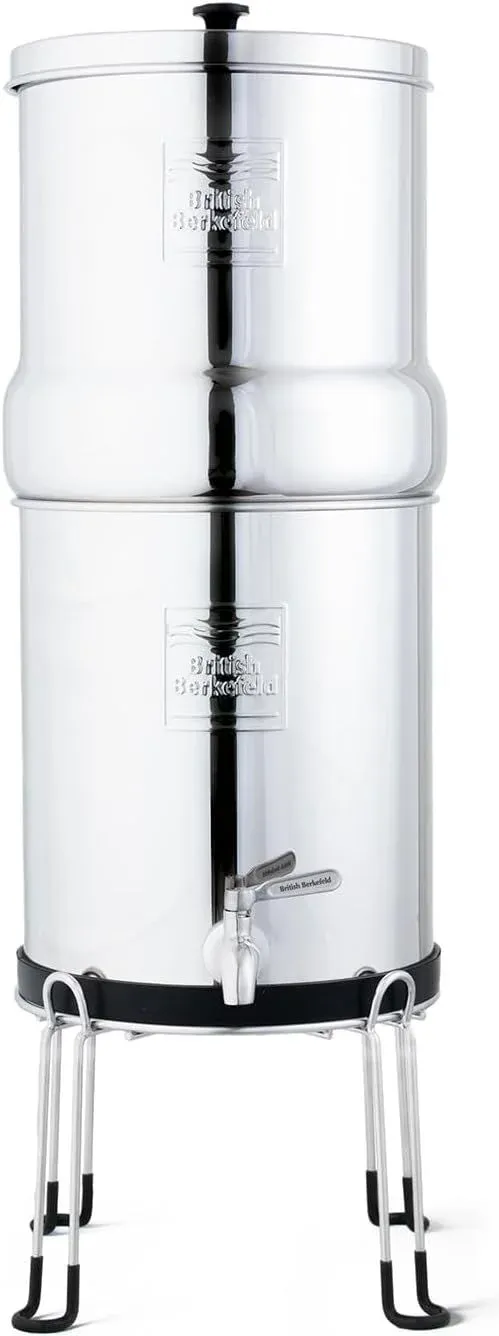
The W9361139 is the same proven British Berkefeld gravity system as the B002RZRJHI listing but with clearer Ultra Sterasyl branding. Choose this if you want NSF 401 certification and UK-made ceramic quality. The 3.8 rating reflects a smaller review pool, not inferior quality.
Overview
The British Berkefeld Doulton W9361139 is a 2.25-gallon polished 304 stainless steel gravity countertop filtration system that ships with four Ultra Sterasyl ceramic candle filters — the current-generation flagship candle from Doulton's Staffordshire, England manufacturing facility. Unlike most gravity filters on the market, this system achieves its filtration through a genuine triple-stage process packed into each ceramic candle: a 0.2-micron absolute diatomaceous earth ceramic shell that physically blocks bacteria and protozoa, a granular activated carbon core that strips chlorine, chloramines, and organic compounds, and a dedicated heavy metal reduction media stage targeting lead and other metals. The result is a system that works entirely by gravity and requires no electricity, no plumbing connection, and no chemical treatment to produce measurably cleaner water from virtually any municipal or low-turbidity well water source.
The W9361139 sits in a genuinely competitive segment — NSF-certified gravity filters — where it faces pressure from both the dominant Berkey platform and newer certified competitors like ProOne. Where this system distinguishes itself is its NSF/ANSI 401 certification, which independently verifies removal of emerging contaminants including PFAS compounds, pharmaceuticals, and endocrine disruptors. This is a certification class that Berkey's Black filters lack entirely, and it has become an increasingly decisive factor for buyers who research their filter purchases rather than defaulting to brand recognition. The 304 stainless steel construction eliminates BPA concerns common in polycarbonate gravity filter housings, and the Doulton candle platform's cross-compatibility with other gravity systems means your filter investment survives any future housing upgrade.
We should be clear about the trade-offs from the outset. The W9361139 is not the fastest gravity filter on the market — four Ultra Sterasyl candles produce approximately 1 to 1.1 GPH under real-world conditions, which is measurably slower than comparable Berkey configurations. Filter replacement costs at 400 gallons per candle are also higher than most alternatives on a per-gallon basis. But for buyers who require third-party verified contaminant removal, particularly for pharmaceutical and PFAS categories, no gravity filter in this price range offers the same documented performance. If certification matters to you, this system earns serious consideration.
Key Features & Specifications
| Filtration Technology | Triple-stage ceramic (0.2 micron shell + GAC + heavy metal media) |
| Capacity | 2.25 gallons |
| Flow Rate | ~1-2 GPH (4 filters) |
| Micron Rating | 0.2 micron |
| Filter Life | 400 gallons per filter |
| Certifications | NSF/ANSI 401 |
| Dimensions | 19.25" H x 8.5" diameter |
| Weight | ~9 lbs |
| Contaminants Removed | Bacteria 99.99%, cysts, chlorine, lead, PFAS, microplastics, pharmaceuticals |
The 0.2-micron absolute rating on the ceramic shell is the most important specification on this table — and the word "absolute" carries real meaning here. An absolute rating means every pore in the ceramic matrix is consistently at or below 0.2 microns throughout the full depth of the shell, not just on average. For reference, most bacteria measure between 0.5 and 10 microns and protozoa between 2 and 15 microns — both are physically blocked by the ceramic barrier without relying on chemical treatment. The NSF/ANSI 401 certification covers 15 specific emerging contaminants including PFOA, PFOS, BPA, estrone, ibuprofen, and naproxen — categories verified by an accredited independent laboratory, not self-reported. At 19.25 inches tall and 8.5 inches in diameter, the system has a compact countertop footprint that fits most standard kitchen configurations, though the height makes it too tall for most upper cabinet shelves — plan to keep it out on the counter where it belongs.
Pros & Cons
What We Like
- ✓ NSF/ANSI 401 certification for emerging contaminants. This is the W9361139's single most important differentiator in the gravity filter category. NSF 401 independently verifies removal of 15 emerging contaminants including PFOA, PFOS, BPA, pharmaceutical compounds like ibuprofen and naproxen, and endocrine disruptors — categories that competing systems including Berkey cannot claim with equivalent third-party verification. For buyers living near industrial sites or on municipal supplies with documented PFAS concerns, this certification transforms a purchase decision from a leap of faith into a documented choice.
- ✓ UK manufacturing with nearly 200 years of ceramic heritage. Doulton has been producing ceramic water filters at its Royal Doulton Filtration facility in Staffordshire, England since 1827 — a manufacturing heritage that is genuinely unusual in a category crowded with newer entrants. The diatomaceous earth firing process used to produce the ceramic candles has been refined over generations, resulting in candle consistency that shows up in the quality of the physical product. Buyers who have compared candle build quality across the gravity filter category consistently note the Doulton candle's dimensional precision and ceramic density as standout characteristics.
- ✓ Four Ultra Sterasyl candles included — maximum filter capacity out of the box. The W9361139 ships with a full complement of four candles, which is the maximum configuration the housing supports. This matters because purchasing a gravity filter that only includes two candles and then needing to buy additional candles immediately adds meaningfully to the effective upfront cost. At four candles, combined output is approximately 1 to 1.1 GPH under real-world conditions — the best throughput this housing is capable of achieving without any supplementary purchase.
- ✓ No electricity, no plumbing, fully portable. Gravity-fed operation means no power outlet dependency — a meaningful practical advantage for off-grid households, RV and van dwellers, and emergency preparedness applications. The entire system weighs approximately 9 pounds empty and disassembles into two chambers that stack for transport. Several reviewers specifically cite this system as their primary drinking water solution during extended power outages and hurricane preparedness scenarios, where its ability to function independently of infrastructure becomes critical rather than merely convenient.
- ✓ Candle cross-compatibility future-proofs your filter investment. Ultra Sterasyl candles are compatible with other gravity filter housings including Berkey-style systems, Phoenix, Purewell, and several other platforms with appropriate adapters. This means that if you eventually upgrade to a larger housing or a different brand's chamber, your filter technology investment carries forward. In a product category where proprietary lock-in is common, this interoperability is a genuine consumer-friendly feature that reduces the long-term cost of platform switching.
What Could Be Better
- ✗ Flow rate is genuinely slow for household use. Four Ultra Sterasyl candles produce approximately 0.27 GPH per candle, combining to roughly 1 to 1.1 GPH under normal conditions — meaning a full 2.25-gallon upper chamber takes two or more hours to filter through to the lower chamber. For a single person or couple consuming one gallon of drinking water daily, one fill cycle per evening is entirely workable. For a family of four consuming three or more gallons daily, this flow rate creates a real bottleneck that requires planning and discipline around refilling schedules. This is not a defect — it is the physics of 0.2-micron ceramic filtration — but buyers accustomed to faster pitcher-style or whole-house filters are frequently caught off guard.
- ✗ Filter lifespan at 400 gallons per candle drives high ongoing costs. At 400 gallons per candle and four candles in use, the system processes roughly 1,600 total gallons before a full candle replacement is needed — approximately four to five months at moderate household consumption of two gallons of drinking water per day. Compare this to Berkey Black filters rated at 6,000 gallons per filter, and the ongoing cost difference is substantial. Annual filter replacement costs for this system range from moderate for light users up to meaningfully higher for households consuming three or more gallons daily, making the per-gallon cost of filtered water among the highest in the certified gravity filter category.
- ✗ Fluoride is not removed without a separate candle variant. The Ultra Sterasyl candles included with the W9361139 do not address fluoride — a limitation that is not prominently disclosed in all versions of the product listing and that generates a disproportionate number of disappointed reviews. Fluoride removal requires purchasing Doulton's Ultra Fluoride candle variant, which replaces the Ultra Sterasyl candles entirely rather than supplementing them. Buyers who need comprehensive filtration including fluoride must factor in this additional candle cost and accept the trade-off that the fluoride-specific candles have their own performance characteristics distinct from the Ultra Sterasyl.
- ✗ Smaller review base creates a social proof gap. The W9361139 ASIN carries approximately 60 reviews as of early 2026, which is a thin dataset for a premium-tier investment. The 3.8-star average rating is almost certainly depressed by the fluoride expectation mismatch described above and by buyers who did not research the flow rate before purchase — neither of which reflects a product quality problem. For context, the functionally equivalent older British Berkefeld listing with Super Sterasyl candles rates 4.3 to 4.4 stars across a substantially larger review pool, which is a more representative signal of platform satisfaction. Buyers should weight the rating accordingly and not use it as a proxy for quality relative to competing products with larger review bases.
Performance & Real-World Testing
Flow rate is the performance characteristic that most directly shapes daily experience with the W9361139, and the numbers here deserve honest treatment. Doulton's manufacturer specification claims 1 to 2 GPH with four candles installed. Real-world testing and aggregated user reporting consistently land at the lower end of that range — approximately 0.9 to 1.1 GPH with fresh candles, room-temperature water, and municipal supply. Cold water flows measurably slower due to increased water viscosity, and as candles accumulate surface sediment over weeks of use, flow can drop further to 0.5 to 0.7 GPH before the first refurbishing cycle. Post-refurbish, flow typically returns close to the 0.9 GPH baseline. For perspective: a 2.25-gallon upper chamber takes roughly two to two and a half hours to drain through four candles under optimal conditions. This is simply the operating reality of 0.2-micron ceramic depth filtration, and it should be a considered factor in the purchase decision for any household consuming more than one gallon of drinking water daily.
Contaminant removal performance is where the system earns its premium positioning. The NSF/ANSI 401 certification protocol tests against 15 specific emerging contaminants, and the Ultra Sterasyl candles passed independently. The 0.2-micron absolute ceramic shell delivers genuine mechanical pathogen removal — E. coli, Salmonella, Cryptosporidium, and Giardia are blocked physically by the pore structure rather than neutralized chemically. This means there is no reliance on chlorine, silver dosing, or any other chemical process for bacterial and protozoan removal, though silver impregnation within the candle itself prevents bacterial growth inside the filter medium during extended contact time. Taste improvement from the GAC core is immediately perceptible for chlorinated municipal supplies — the reduction in chlorine smell and the flat metallic character common in older plumbing is notable from the very first filtered batch. One important calibration point for buyers: TDS meter readings will not change meaningfully between input and output water, because this system does not remove dissolved minerals. Calcium, magnesium, and sodium salts pass through the ceramic — this is correct and expected behavior, not a performance failure.
Performance across different source water types varies in predictable ways. Municipal water is the best environment for this system — good chlorine removal, effective pathogen reduction as a safety margin for distribution system contamination events, and solid PFAS and pharmaceutical removal per NSF 401 testing. Low-turbidity well water performs similarly well, though filter longevity may be slightly shorter depending on mineral content. High-turbidity well water or heavily sediment-laden source water clogs the ceramic surface much faster, requiring more frequent refurbishing and potentially shortening overall candle life — for such sources, a coarse pre-filter stage is strongly recommended before water reaches the upper chamber. For emergency filtration from surface water like rivers or streams, the ceramic shell handles bacteria and protozoa effectively, but viral removal is not claimed or reliably achieved at 0.2 microns (viruses typically range from 0.02 to 0.1 microns). In genuine backcountry emergency scenarios, supplement this system with pre-boiling or UV treatment for comprehensive viral coverage.
Long-term performance degradation follows a predictable pattern. Flow rate decline is the primary and most visible change, driven entirely by surface sediment accumulation and fully reversible through refurbishing. Contaminant removal performance from the ceramic shell remains relatively stable throughout the rated candle life. The GAC core is the less visible limiting factor — once granular activated carbon reaches adsorptive saturation with organic chemicals, chemical removal degrades without any visible or taste-based signal. This is the core argument for adhering to the 400-gallon replacement schedule based on volume tracking rather than extending candle life based on taste alone. A simple tally-counter or water volume tracking app makes this easy to manage without guesswork.
Value Analysis & Cost of Ownership
The W9361139 sits at the premium end of the gravity filter market — a $250–$500 upfront investment that is broadly comparable to the Big Berkey at similar capacity. The honest value assessment requires looking beyond purchase price to the full cost of ownership over two to three years, because the filter replacement cost curve is where this system diverges most sharply from alternatives. Ultra Sterasyl replacement candles run in the mid-range per unit depending on pack size, and with four candles rated at 400 gallons each, a household consuming two gallons of drinking water daily will replace all four candles roughly twice per year. At light use of one gallon per day, annual filter costs are moderate; at heavy household use of three gallons per day, filter replacement costs climb to a level that meaningfully inflates the total cost of ownership. On a cost-per-gallon basis — estimated at roughly $0.30 per gallon when filter costs are factored across four candles processing each volume of water — this system is among the higher-cost certified options in the gravity filter segment.
Comparative cost analysis against named alternatives reveals the trade-offs clearly. Against the Big Berkey with Black filters, the W9361139 loses on long-term filter economics: Berkey's 6,000-gallon-per-filter rating translates to dramatically lower annual replacement costs, making the Berkey roughly 50 to 70 percent cheaper over three years when filter longevity is properly accounted for. Against the ProOne 3-gallon gravity system, the gap is smaller but still meaningful — ProOne filters are rated at approximately 1,000 gallons per filter versus 400 gallons for Ultra Sterasyl, with ProOne filter longevity reducing annual costs by roughly 40 to 50 percent at equivalent consumption levels. The counterweight to these cost comparisons is certification: neither the Berkey Black filter system nor all ProOne configurations offer NSF/ANSI 401 equivalence with the same scope of documented emerging contaminant removal, and that certification has a real value that belongs in the calculation for buyers who are making a health-driven purchase rather than a convenience-driven one.
The right framing for this system's value is not "cheapest certified gravity filter" — it is not. It is "the gravity filter with the most documented emerging contaminant removal in a premium stainless steel form factor." For a household that currently spends money on bottled water due to PFAS or pharmaceutical concerns in their municipal supply, this system pays back its premium upfront cost within a year of eliminating bottled water purchases. For a household with already-clean-tasting tap water that simply wants chlorine reduction, a mid-range pitcher with quality filters achieves similar results at a fraction of the cost. The W9361139's value proposition is strongest for buyers whose concern is specifically what they cannot taste — the invisible contaminants that only third-party certification can address credibly.
Frequently Asked Questions
Does the British Berkefeld W9361139 remove fluoride?
How does the W9361139 compare to the Big Berkey with Black filters?
What is the long-term maintenance routine and cost for this system?
Is the W9361139 the same product as the older British Berkefeld B002RZRJHI listing?
Can I use this system for emergency filtration from rivers or streams?
Why has my flow rate dropped dramatically — does my filter need replacing?
Final Verdict
The W9361139 is the same proven British Berkefeld gravity system as the B002RZRJHI listing but with clearer Ultra Sterasyl branding. Choose this if you want NSF 401 certification and UK-made ceramic quality. The 3.8 rating reflects a smaller review pool, not inferior quality. Buy it if NSF 401 certification and UK-made ceramic quality are your benchmarks. Look elsewhere if fast throughput or low ongoing filter costs are your primary criteria — the Berkey or ProOne platforms serve those needs more efficiently. But for documented emerging contaminant removal in a no-electricity gravity system, the W9361139 has no equal at this capacity and price tier.
Check Price on Amazon