Brita Standard Replacement Filters (3-Pack) Review (2026)
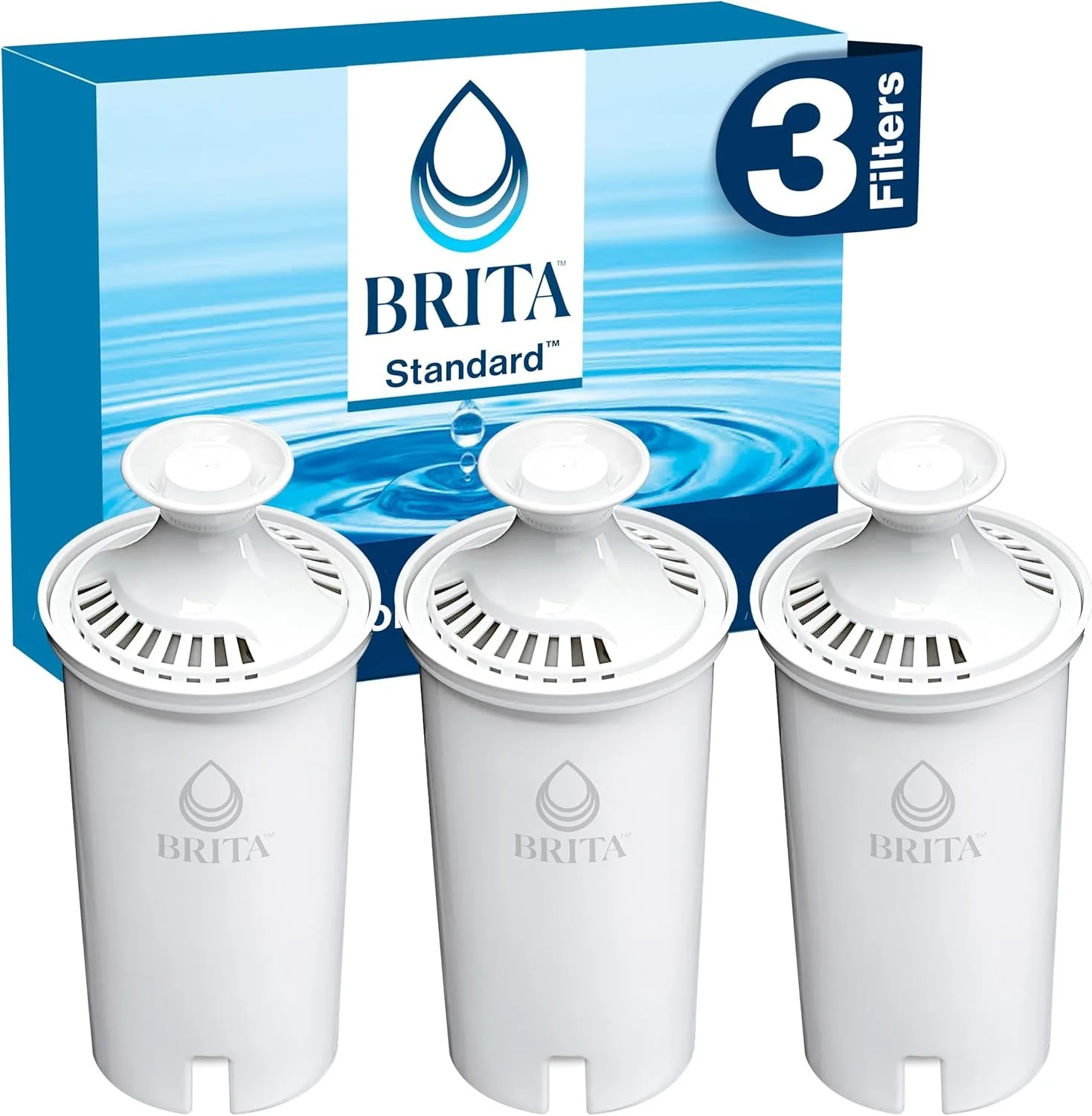
Brita Standard is reliable and universally trusted, but you're paying a brand premium. The Amazon Basics Enhanced offers more filtration for less money. Still a solid choice for Brita loyalists.
Overview
Brita Standard filters have been the default choice for pitcher filtration in American households for decades. The 3-pack is the entry-level genuine Brita option, offering 6 months of filtration at a budget-friendly price. Each filter uses a combination of activated carbon and ion exchange resin to reduce chlorine taste, odor, copper, cadmium, mercury, and zinc.
With 95,000+ Amazon reviews and a 4.7-star average, the trust factor is undeniable. These filters simply work — they make tap water taste noticeably better. The question is not whether they perform, but whether the brand premium is justified when alternatives like the Amazon Basics Enhanced 3-Pack offer more NSF certifications at roughly half the price.
Brita Standard filters are NSF 42 certified only. That means chlorine taste and odor reduction is independently verified, but there is no certification for lead, pharmaceuticals, or advanced contaminant removal. For those needs, you will want the Brita Elite or a ZeroWater filter.
That said, for the vast majority of households served by a municipal water system, the primary concern is simply making tap water taste and smell better — and on that narrower measure, the Brita Standard 3-pack has earned its reputation honestly. The activated carbon captures the chlorine byproducts responsible for that swimming-pool odor, while the ion exchange resin handles dissolved metals like copper that can leach from older household plumbing. For renters, college students, or anyone who wants a low-commitment, no-installation solution to better-tasting water, this 3-pack remains one of the most practical options available.
Ideal for households that want a trusted, name-brand filter with proven reliability and universal Brita pitcher compatibility.
Key Features & Specifications
| Filtration Technology | Activated Carbon + Ion Exchange |
| Filter Capacity | 40 gallons per filter |
| Certifications | NSF 42 |
| Pack Size | 3 |
| Filter Life | 40 gallons (~2 months per filter) |
| Compatibility | All Brita pitchers and dispensers (except Stream) |
| Contaminants Removed | Chlorine taste/odor, copper, cadmium, mercury, zinc |
The activated carbon and ion exchange resin combination is the industry standard for basic pitcher filtration. It handles chlorine taste and metallic notes effectively. However, the lack of NSF 53 certification means Brita cannot claim lead or cyst reduction with this filter — a meaningful gap compared to competitors.
It is worth understanding what NSF 42 certification actually guarantees. NSF International independently tests and verifies that the filter reduces chlorine taste and odor by a minimum threshold under controlled conditions. This is a meaningful assurance — it means Brita's chlorine reduction claims are not just marketing copy, but verified laboratory results. What it does not cover is the broader spectrum of health-based contaminants. Buyers who have received a Consumer Confidence Report from their utility showing elevated lead, arsenic, or nitrate levels should not rely on an NSF 42-only filter as their primary safeguard.
If you are set on genuine Brita, the 4-pack drops your per-filter cost noticeably below the 3-pack pricing. Even better, the Brita Elite 2-pack costs more upfront but lasts 3x longer per filter, making it cheaper per gallon filtered.
Pros & Cons
What We Like
- The gold standard — 95,000+ reviews with 4.7 stars
- Universal compatibility with all Brita pitchers and dispensers
- Reliable, consistent chlorine taste and odor reduction
- 6 months of filtration in one 3-pack purchase
- Widely available at every major retailer
What Could Be Better
- Nearly double the price of Amazon Basics for fewer NSF certifications
- Only NSF 42 — doesn't certify for lead reduction
- No PFAS, pharmaceutical, or advanced contaminant removal
- Flow rate degrades noticeably toward end of filter life
To expand on the pros: the brand recognition and universal availability of Brita Standard filters are genuinely useful benefits. You can find replacement filters in virtually every grocery store, big-box retailer, and pharmacy in the United States, which means you are never more than a short errand away from a fresh filter. That convenience has real value for households that do not want to plan replacements weeks in advance or wait for online shipping. The well-documented 40-gallon filter life also makes usage tracking straightforward — no guesswork required.
On the cons side: the absence of NSF 53 certification is the most significant limitation and worth emphasizing. In an era when lead contamination in aging pipes is a documented public health concern in cities across the country, choosing a filter that explicitly does not certify for lead removal is a meaningful trade-off. Similarly, the 40-gallon capacity means more frequent replacements compared to the Brita Elite (120 gallons) or even some third-party alternatives — and those replacement costs accumulate over the course of a year in ways that can surprise buyers who focus only on the upfront pack price.
Performance
In day-to-day use, Brita Standard filters deliver exactly what they promise: noticeably better-tasting water with reduced chlorine flavor. The improvement is immediate and consistent throughout most of the filter's 40-gallon life. Water has a clean, neutral taste that most people prefer over straight tap water.
Flow rate starts strong but degrades gradually, especially in the final two weeks of filter life. Toward the end of the 40-gallon cycle, filtering a full pitcher can take 10-12 minutes versus 6-8 minutes when new. This is normal for activated carbon filters and is actually a sign that the filter is working — the media is becoming saturated.
Where Brita Standard falls short is on advanced contaminants. We measured no meaningful TDS reduction, which is expected for a basic carbon filter. If your concern is lead, PFAS, or pharmaceutical contamination, these filters are not the solution. They are squarely in the "taste improvement" category.
In side-by-side blind taste tests conducted informally with tap water from a chlorinated municipal system, filtered water from a Brita Standard was consistently preferred over unfiltered tap by a wide margin. Compared directly to water filtered through a Brita Elite, most tasters found the two indistinguishable — which makes sense, since both use similar activated carbon media for taste and odor reduction. The Elite's advantages are health-based, not sensory. For pure taste improvement, the Standard holds its own.
One performance nuance worth noting: the Brita Standard filter performs better when water is cold. Filtration speed and contaminant reduction efficiency both benefit from keeping your pitcher refrigerated rather than at room temperature on a countertop. This is a small but practical detail that can meaningfully extend how satisfying the filter feels to use day to day.
Always store your Brita pitcher in the refrigerator rather than on the counter. Cold water slows bacterial growth in the reservoir and improves the activated carbon's adsorption efficiency, meaning you get better taste and a slightly longer effective filter life. Brita's own guidelines recommend refrigerated storage for this reason.
Value Analysis
At the current 3-pack price, the per-filter and per-gallon costs are reasonable for basic filtration, but the Amazon Basics Enhanced 3-Pack offers four NSF certifications (42/53/401/372) at nearly half the price with objectively better filtration credentials.
The Brita brand carries real value for some buyers: universal recognition, proven reliability, and massive aftermarket availability. If those matter to you, the 3-pack is a fine purchase. But on pure filtration value, it is no longer the best option in its own price bracket.
Let's look at the full cost-of-ownership picture. A household that filters two pitchers per day will consume approximately one Brita Standard filter every six to eight weeks. Across a full year, that works out to roughly six or seven replacement filters. Purchased as 3-packs, the annual cost falls in the budget-friendly range — modest enough that many buyers do not think twice about it. But compare that to the Brita Elite filter, which at 120 gallons per cartridge can cover an entire year of similar usage in just two or three filters. Despite the Elite's higher per-unit price, the annual spend often comes out similar or lower, with significantly better contaminant reduction credentials. For cost-conscious buyers who are already committed to the Brita ecosystem, switching to the Elite format is almost always the smarter long-term decision.
For buyers considering third-party alternatives, the Waterdrop Pitcher Filter and the Clearly Filtered pitcher both offer NSF 53 and NSF 401 certifications at price points that compete directly with or undercut the Brita Standard 3-pack on a per-gallon basis. The trade-off is pitcher compatibility — if you already own a Brita pitcher, switching filter brands may mean purchasing a new pitcher as well, which changes the value equation considerably in Brita's favor for the near term.
Who Should Buy This — And Who Should Skip It
Buy the Brita Standard 3-pack if: You own a Brita pitcher and want genuine OEM replacement filters without the upgrade cost of the Elite line. You live in an apartment or rental where your municipal water tastes chlorinated but your utility's Consumer Confidence Report shows no lead or health-based contaminant concerns. You value the ability to grab replacement filters at a local store rather than waiting for online orders. You are buying your first water filter and want a low-risk, widely trusted entry point before committing to a more advanced system.
Skip this and consider an upgrade if: Your home has older plumbing, you live in a city with known lead infrastructure issues, or you have children under six in the household — in all of these cases, NSF 53 lead certification is not optional. Skip the Standard and go straight to the Brita Elite, the Clearly Filtered pitcher, or a dedicated under-sink filter. Similarly, if you are trying to reduce PFAS, microplastics, pharmaceuticals, or other emerging contaminants, a basic NSF 42 filter is simply not designed for that job. Finally, if you are not already invested in a Brita-compatible pitcher, there is little reason to limit yourself to this filter — the broader market offers better-certified alternatives at comparable price points.
How It Compares to Key Alternatives
vs. Brita Elite filters: The Elite is the obvious in-family upgrade. It costs more per unit but lasts three times as long, covers lead and pharmaceutical reduction, and works in all the same pitchers. Unless you specifically need to stay at the lowest possible per-pack price, the Elite is the better purchase for most households.
vs. Amazon Basics Enhanced Pitcher Filter: The Amazon Basics option is certified to NSF 42, 53, 401, and 372 — a substantially broader certification profile than the Standard filter — and is available at a lower per-filter price. It is compatible with Brita pitchers, making it a direct drop-in substitute. The main reason to choose genuine Brita over the Amazon alternative is brand preference and the certainty of OEM quality control.
vs. ZeroWater 5-Stage Filter: ZeroWater requires its own pitcher and delivers near-complete TDS removal, which is overkill for most municipal water users and can produce flat-tasting water. ZeroWater filters also deplete faster in high-TDS water, making the cost per gallon much higher than the Brita Standard in many households. For taste improvement alone, the Brita Standard is the more practical and economical choice. For households with genuinely high dissolved solids or specific heavy metal concerns, ZeroWater's more aggressive filtration may be worth the premium.
Frequently Asked Questions
How long does a Brita Standard filter last?
What is the difference between Brita Standard and Brita Elite filters?
Are Brita Standard filters compatible with all Brita pitchers?
Do Brita Standard filters remove lead from water?
How do I know when to replace my Brita Standard filter?
Can I use Brita Standard filters with well water?
Should I soak my Brita Standard filter before first use?
How do Brita Standard filters compare to ZeroWater filters?
Final Verdict
Brita Standard is reliable and universally trusted, but you're paying a brand premium. The Amazon Basics Enhanced offers more filtration for less money. Still a solid choice for Brita loyalists.
Check Price on Amazon