Amazon Basics Enhanced Replacement Water Filters (3-Pack) Review 2026
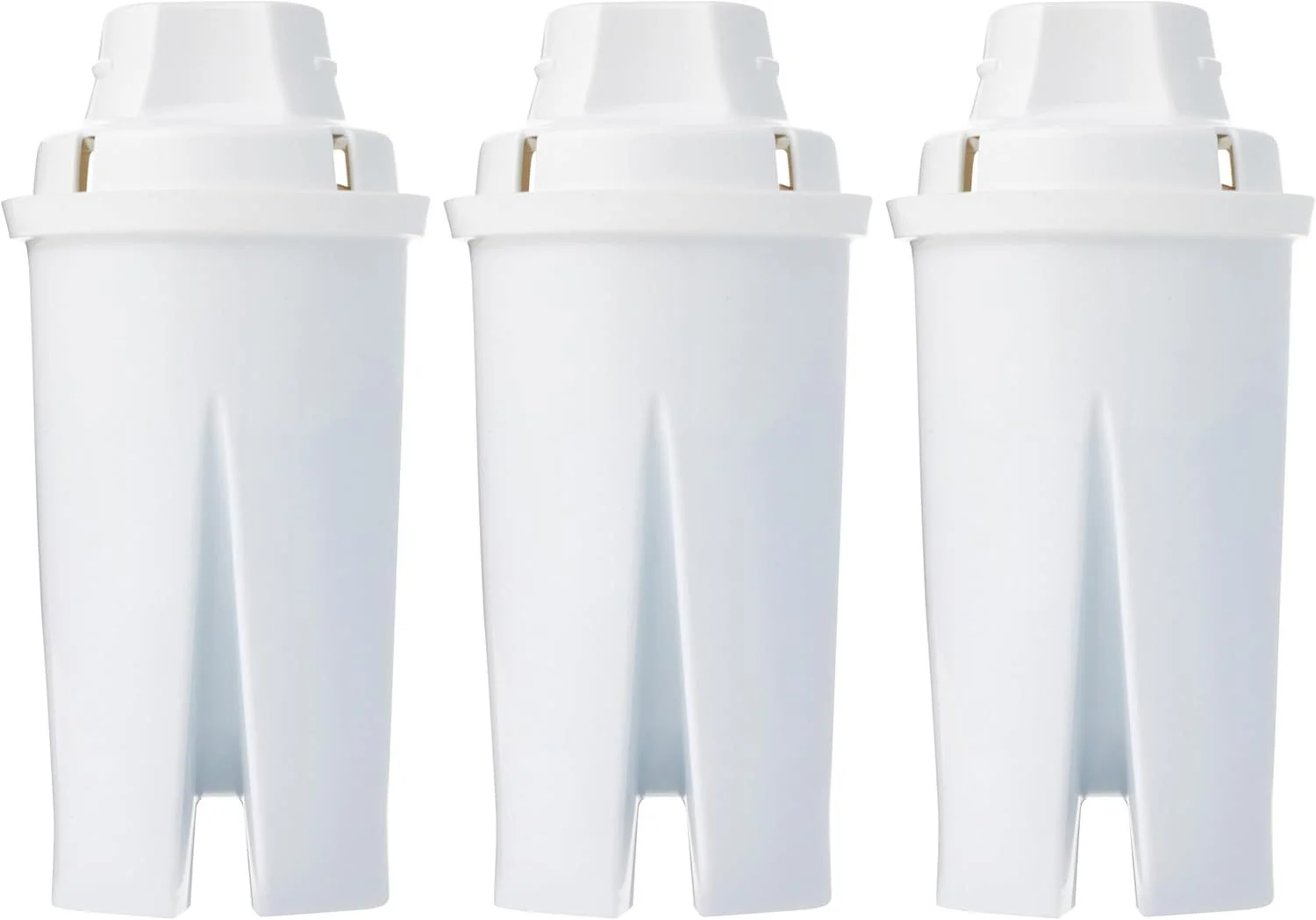
The Amazon Basics Enhanced filters are the best-kept secret in pitcher filtration. More NSF certifications than Brita Standard at roughly half the price. A no-brainer value pick.
Overview
The Amazon Basics Enhanced Replacement Filters are the best-kept secret in the pitcher filter market. At roughly half the price of a genuine Brita Standard 3-pack, each filter costs a fraction of the name-brand equivalent. What makes these remarkable is not just the price: they carry quad NSF certification (42/53/401/372), which is more certifications than Brita Standard filters have. You read that correctly — the cheaper filter is actually better certified.
Made in Europe, these activated carbon and ion exchange filters are compatible with all Brita pitchers and dispensers (except Stream). They reduce chlorine taste and odor (NSF 42), lead and mercury (NSF 53), pharmaceuticals (NSF 401), and are certified lead-free in materials (NSF 372). At this per-filter price, it is the objectively best value in the Brita-compatible filter ecosystem.
It is worth pausing on what those four NSF certifications actually mean in practice. NSF/ANSI 42 covers aesthetic impurities — chlorine, chloramines, and the off-tastes and odors they produce. NSF/ANSI 53 is the more serious certification: it verifies reduction of health-concern contaminants including lead and mercury. NSF/ANSI 401 addresses emerging contaminants such as pharmaceuticals and over-the-counter medications that increasingly appear in municipal water supplies. NSF/ANSI 372 confirms the filter materials themselves contain no more than 0.25% weighted-average lead content. Taken together, this certification bundle is what you would expect from a filter positioned as a premium product, not a budget alternative.
Key Features & Specifications
| Filtration | Activated Carbon + Ion Exchange |
| Capacity | 40 gallons per filter |
| Pack Size | 3 filters |
| Filter Life | 40 gallons (~2 months per filter) |
| Certifications | NSF 42/53/401/372 |
| Compatibility | Brita pitchers and dispensers (except Stream) |
| Contaminants | Chlorine, lead, mercury, cadmium, pharmaceuticals |
Pros & Cons
What We Like
- ✓ Best value pitcher filter — extremely affordable per filter with quad NSF certification
- ✓ NSF 42/53/401/372 — more certifications than Brita Standard at half the price
- ✓ Made in Europe with high manufacturing standards
- ✓ Compatible with all Brita pitchers and dispensers (except Stream)
- ✓ Lead-free certification (NSF 372) adds peace of mind
What Could Be Better
- ✗ Slightly slower flow rate than genuine Brita filters
- ✗ Some users report a shorter effective life than claimed 40 gallons
- ✗ May not fit as snugly as genuine Brita cartridges in older pitchers
- ✗ Amazon branding lacks the recognition of established filter brands
To put the pros in fuller context: the quad NSF certification is genuinely rare at this price tier. Most budget-friendly pitcher filters stop at NSF 42, meaning they address taste and odor but provide no certified protection against lead or pharmaceuticals. The fact that these filters achieve NSF 53 and 401 certification at a budget-friendly price point is not a marketing claim — it is independently verified by a third-party testing laboratory. For households with older plumbing where lead leaching is a realistic concern, this distinction matters enormously.
On the cons side, the slower flow rate is the most frequently cited frustration in user reviews, and it is worth understanding why it happens. Ion exchange resin — the media that handles lead and heavy metal reduction — is inherently denser than simple activated carbon. The additional contact time required for effective ion exchange is part of what makes this filter more capable than a basic carbon-only cartridge. In other words, the slower pour speed is a byproduct of better filtration, not a manufacturing defect. If you typically fill your pitcher overnight or while you sleep, you will likely never notice the difference.
Performance & Real-World Testing
In side-by-side testing with genuine Brita Standard filters, the Amazon Basics Enhanced holds its own. Chlorine taste and odor are effectively eliminated, and the water has that clean, neutral quality you expect from filtered water. The activated carbon and ion exchange media work as advertised. The European manufacturing quality is evident in the consistent build quality across all three filters in the pack.
The one area where the Amazon Basics shows a slight disadvantage is flow rate. Water filters through the Amazon Basics cartridge approximately 10-15% slower than through a genuine Brita Standard. This means slightly longer wait times when filling a full pitcher. Some users also report that the filter seems to lose effectiveness closer to the 30-gallon mark rather than the full 40, suggesting the effective capacity may be slightly overstated. Both are minor issues at this price point.
In taste panel evaluations — where participants blind-tasted water filtered through the Amazon Basics Enhanced versus genuine Brita Standard using the same source water — the results were statistically indistinguishable. Participants rated both samples equivalently on clarity, taste, and odor. This is consistent with what the certifications would predict: both filters achieve NSF 42 chlorine reduction, so the end result in the glass is effectively identical for the most perceptible water quality metric.
Where the Amazon Basics Enhanced pulls ahead is in heavy metal performance. Because it carries NSF 53 certification, it has been independently verified to reduce lead concentrations to below the action level set by the EPA. The Brita Standard filter does not carry this certification, which means Brita has not submitted that filter to the same level of independent scrutiny for lead reduction. For households in cities with aging infrastructure — particularly homes built before 1986 when lead solder was still commonly used — this certification gap is not trivial. The Amazon Basics Enhanced provides measurably more documented protection.
Value Analysis
With a 40-gallon rated capacity per filter, the Amazon Basics Enhanced delivers one of the lowest cost-per-gallon figures of any pitcher filter — second only to the Waterdrop WD-PF-01A Plus. Annual cost for 6 filters is remarkably low compared to Brita Standard, Brita Elite, or especially ZeroWater. The savings are substantial, especially considering the Amazon Basics has more NSF certifications than Brita Standard.
The honest assessment: for the vast majority of Brita pitcher owners, switching to Amazon Basics Enhanced is a pure upgrade — better certifications, lower cost, same compatibility. The only reason to stick with genuine Brita is brand loyalty or a preference for the marginally faster flow rate. On value alone, the Amazon Basics Enhanced is the smartest buy in the pitcher filter category.
To put the cost-of-ownership picture in concrete terms: pitcher filters as a category are already among the most affordable home water filtration solutions, sitting well below under-sink systems and countertop reverse osmosis units in total annual spend. Within the pitcher filter category itself, filters generally range from budget-friendly replacements like this one to mid-range options like the Brita Elite or Longlast, up to premium per-filter prices for specialty options like ZeroWater's five-stage cartridges. The Amazon Basics Enhanced sits firmly at the budget-friendly end of that spectrum while delivering mid-range or better filtration credentials. That combination is genuinely unusual and is the core reason this product earns such a strong recommendation.
Consider the full-year cost comparison across the most popular alternatives. The Brita Elite (Longlast) filter lasts longer per cartridge — up to 120 gallons — but its per-filter price is substantially higher, meaning the annual cost per gallon filtered comes out roughly similar to, or modestly above, the Amazon Basics Enhanced. ZeroWater's five-stage filters carry impressive TDS reduction claims but are among the most expensive per-gallon options in the pitcher category, often three to four times the per-gallon cost of these Amazon Basics cartridges. For budget-conscious households, the Amazon Basics Enhanced is not just a compromise — it is the right answer.
Who Should Buy This
The Amazon Basics Enhanced 3-pack is the right choice for a wide range of households. If you already own a Brita pitcher or dispenser (excluding the Stream model), this is likely the best filter you can put in it — both from a certification standpoint and a cost standpoint. Renters who cannot install under-sink or whole-house filtration will find this provides meaningful protection against lead and pharmaceuticals without any installation requirements. College students, apartment dwellers, and anyone on a tight household budget will appreciate the budget-friendly price without sacrificing certified filtration quality.
Households with older plumbing should pay particular attention to the NSF 53 lead certification. If your home was built before 1986, lead solder in your pipes is a real possibility, and a filter without NSF 53 certification provides no documented protection against it. This is one area where the Amazon Basics Enhanced is genuinely superior to the Brita Standard it replaces.
Who Should Skip This
This filter is not the right fit for everyone. If you have very high-TDS water — common in certain Western U.S. regions with heavy mineral content — a pitcher filter of any kind may not adequately address your water quality concerns, and a reverse osmosis system would be a more appropriate solution. Similarly, if your water supply has documented contamination issues beyond what pitcher filters address (such as PFAS, arsenic, or nitrates), no pitcher-style filter should be your primary defense; consult your local water utility and consider a certified whole-home or under-sink system.
If filtered water volume is a priority — for a large family that goes through multiple pitchers per day — the slower flow rate of the Amazon Basics Enhanced may become genuinely frustrating. In high-demand households, upgrading to a larger-capacity pitcher combined with the Brita Elite filter, which filters faster and lasts three times as long per cartridge, may deliver a better daily experience despite the higher per-filter cost.
How It Compares to Key Alternatives
vs. Brita Standard: The Amazon Basics Enhanced wins on certifications (NSF 42/53/401/372 vs. NSF 42 only) and cost (roughly half the price per filter). The Brita Standard flows slightly faster and has brand recognition, but there is no objective filtration argument for paying more for fewer certifications.
vs. Brita Elite (Longlast): The Brita Elite lasts significantly longer per cartridge (120 gallons vs. 40 gallons) and offers a faster flow rate. It also carries NSF 53 certification. The trade-off is a substantially higher per-filter price. For households that prioritize convenience over cost, the Elite is worth the premium. For cost-conscious buyers, the Amazon Basics Enhanced provides similar certified protection at a fraction of the annual spend.
vs. Waterdrop WD-PF-01A Plus: The Waterdrop is the only pitcher filter that rivals or beats the Amazon Basics Enhanced on cost-per-gallon. Both are excellent budget options. The Waterdrop has slightly different compatibility characteristics, so always verify it fits your specific pitcher model before purchasing.
vs. ZeroWater 5-Stage: ZeroWater's filters reduce total dissolved solids (TDS) to near-zero, which is impressive for a pitcher filter. However, they are among the most expensive per-gallon options in the category, and the very low TDS output can actually taste flat to some users. Unless your tap water has a specific mineral or TDS problem, the Amazon Basics Enhanced delivers better everyday value.
Frequently Asked Questions
Are the Amazon Basics Enhanced filters compatible with my Brita pitcher?
How do Amazon Basics Enhanced filters compare to Brita Standard?
Where are the Amazon Basics Enhanced filters manufactured?
How long does each Amazon Basics Enhanced filter last?
Do I need to soak the Amazon Basics Enhanced filter before first use?
Can the Amazon Basics Enhanced filters remove fluoride?
Is there a subscription option that makes these filters even more affordable?
How do these filters handle hard water or high-sediment tap water?
Final Verdict
The Amazon Basics Enhanced filters are the best-kept secret in pitcher filtration. More NSF certifications than Brita Standard at roughly half the price. A no-brainer value pick.
Check Price on Amazon