ProOne 9-Inch vs 7-Inch G-Series: Which Size Filter Should You Buy in 2026?
Quick Verdict: The ProOne 9-inch G-Series ($157/2-pack) is the better buy for ProOne Big+ owners — 20% more capacity per filter (1,200 vs 1,000 gallons), faster flow from larger surface area, and only $11 more per pair. The 7-inch G-Series ($146/2-pack) is the smart choice for universal compatibility — it fits more gravity systems natively, including compact housings where the 9-inch physically will not fit. Both filters share identical G3.0 technology, the same five certifications, and the same built-in fluoride removal. With both sizes being discontinued, this may be your last chance to choose.
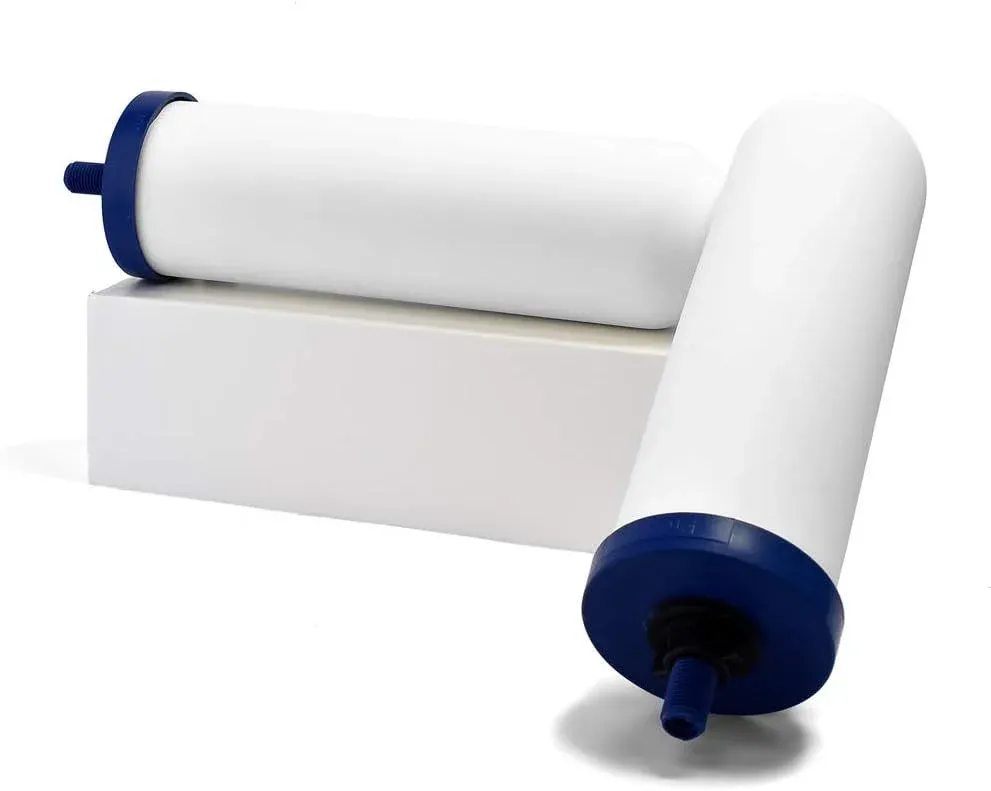
ProOne 9-Inch Gravity Water Filter Replacement G-Series (2-Pack)
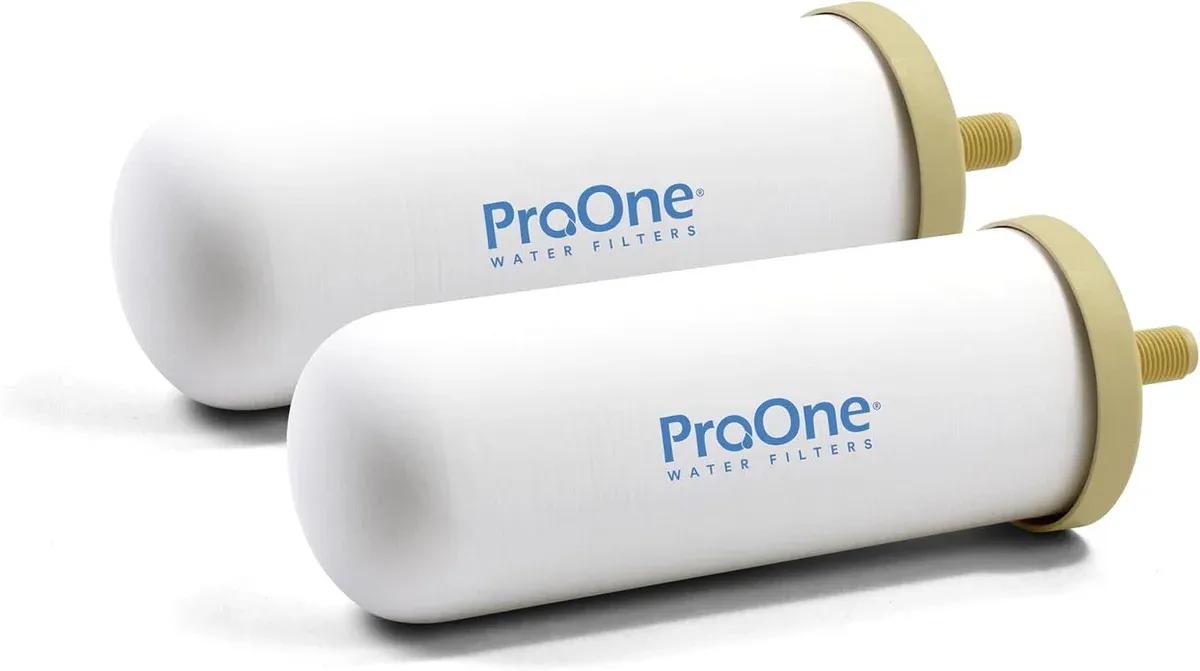
ProOne G-Series 7-Inch Gravity Filter Replacement (2-Pack)
At a Glance
| Feature | Editor's Pick ProOne 9-Inch Gravity Water Filter Replacement G-Series (2-Pack) | ProOne G-Series 7-Inch Gravity Filter Replacement (2-Pack) |
|---|---|---|
| Price (2-Pack) | $100–$250 | $100–$250 |
| Filtration | 3-stage G3.0 (ceramic shell + carbon granular + carbon block core) | 3-stage G3.0 (ceramic shell + carbon granular + carbon block core) |
| Filter Life | 1,200 gallons per filter | 1,000 gallons per filter |
| Certifications | IAPMO — NSF 42/53/401/372/P231 | IAPMO — NSF 42/53/401/372/P231 |
| Dimensions | 9" tall x 2.75" diameter | 7" tall x 2.75" diameter |
| Contaminants | 200+ including lead, fluoride, PFAS, microplastics, bacteria, chlorine, pharmaceuticals | 200+ including lead, fluoride, PFAS, microplastics, bacteria, chlorine, pharmaceuticals |
| Check Price | Check Price |
This is the most unusual comparison on our site: two filters from the same brand, using the same G3.0 technology, carrying the same five certifications, removing the same 200+ contaminants, and offering the same built-in fluoride removal. The ProOne 9-inch and 7-inch G-Series filters are identical in every way that matters for water quality. The only differences are physical size, filter capacity, and which gravity housings they fit. And yet, with both sizes being discontinued as ProOne transitions to Culligan MaxClear, choosing the right size for your last stockpile purchase has never mattered more.
What Is Identical Between These Two Filters
Before we discuss what is different, it is important to establish just how similar these filters are. Both the 9-inch and 7-inch G-Series filters use ProOne's G3.0 three-stage filtration architecture: a silver-impregnated ceramic outer shell (providing physical barrier filtration and bacteriostatic protection), a middle layer of granular activated carbon (for chemical adsorption of chlorine, VOCs, and organic contaminants), and an inner carbon block core (for fine contaminant removal including lead, PFAS, and pharmaceuticals). Both filters incorporate activated alumina media for fluoride adsorption.
Both sizes carry identical IAPMO certification to five standards: NSF 42 (aesthetic effects), NSF 53 (health effects), NSF 401 (emerging contaminants), NSF 372 (lead-free materials), and Protocol P231 (microbiological purification). The certification testing was performed independently on each filter size — the 7-inch certification is not extrapolated from the 9-inch results or vice versa. Both filters remove the same 200+ contaminants including lead, fluoride, PFAS, microplastics, bacteria, chlorine, and pharmaceuticals. Both use the same 2.75-inch diameter, the same threading for gravity system mounting, and the same break-in procedure (discard the first 2-3 batches to flush the carbon media).
In terms of water quality, these two filters produce identically purified water. If you blindly taste-tested water from a 9-inch filter and a 7-inch filter, you would not be able to distinguish them. The choice between sizes is about capacity, flow rate, physical fit, and cost — not about filtration quality.
Category-by-Category Breakdown
Filter Capacity & Longevity
The ProOne 9-inch G-Series is rated for 1,200 gallons per filter — 2,400 gallons per 2-pack. The 7-inch G-Series is rated for 1,000 gallons per filter — 2,000 gallons per 2-pack. The 9-inch filter delivers 20% more capacity per element, which translates directly to longer intervals between filter replacements and lower cost-per-gallon over the system's lifetime.
At typical household consumption of 2 gallons per day, a pair of 9-inch filters lasts approximately 3.3 years. A pair of 7-inch filters lasts approximately 2.7 years. That is a 7-month difference per replacement cycle — meaningful for maintenance scheduling and for buyers who want to minimize the number of filter changes over a 10-year ownership horizon. Over a decade, you would need approximately 3 replacement pairs of 9-inch filters versus approximately 3.7 pairs of 7-inch filters.
The 20% capacity advantage is a direct function of physical size. The additional 2 inches of height means more filtration media — more carbon, more ceramic surface area, more activated alumina for fluoride. This is not a marketing distinction; it is a physical reality of having more filter material to work with. The 9-inch filter does not filter more aggressively — it filters the same way for a longer period before the media is exhausted.
Flow Rate & Throughput
The 9-inch filter has approximately 28% more surface area than the 7-inch, based on the additional 2 inches of height at the same 2.75-inch diameter. More ceramic surface area means more pore openings for water to pass through simultaneously, resulting in proportionally faster gravity-fed flow. ProOne does not publish individual per-filter flow rate specifications, but the physics are straightforward: a larger filter passes more water per hour.
In a standard 2-filter ProOne Big+ configuration, the flow rate difference between 9-inch and 7-inch filters is modest — perhaps 0.05-0.10 GPH faster with the larger elements. This translates to roughly 15-20 minutes less time to filter a full batch. At 2-3 gallons per day of household consumption, most users will not notice a dramatic difference in their daily refill routine.
The flow rate distinction becomes more meaningful in 3-filter configurations. If your gravity system supports three filter elements, the cumulative effect of three 9-inch filters (versus three 7-inch) produces a noticeably faster daily throughput. For families who consume 4+ gallons per day and find the standard ProOne flow rate frustrating, upgrading to 9-inch filters in a 3-element setup maximizes the system's throughput potential within the G3.0 ecosystem.
It is worth noting that both filter sizes are slow by gravity filter standards. Even the 9-inch filters in a 2-element configuration produce well under 1 GPH — far slower than the Big Berkey's 3.5 GPH or even the British Berkefeld's 1 GPH with four ceramic candles. The flow rate difference between the two ProOne sizes matters at the margins, but neither size transforms the ProOne into a fast-flowing system.
Compatibility & System Fit
The 7-inch G-Series filter fits in virtually every gravity water filtration system on the market. The 7-inch height is the industry-standard form factor — compatible with ProOne Big+, ProOne Traveler+, ProOne Big II, Berkey Travel, Berkey Big, Berkey Royal, AlexaPure Pro, British Berkefeld, Doulton, Purewell, and dozens of other gravity housings from large to compact. If you own a gravity filter, the 7-inch almost certainly fits.
The 9-inch G-Series filter requires systems with at least 9.5 inches of internal clearance in the upper chamber. This eliminates compact and travel-sized gravity systems entirely. The ProOne Big+ was designed for the 9-inch filter and accommodates it without issue. Most full-size Berkey models (Big, Royal, Imperial, Crown) also have adequate clearance. But the Berkey Travel, ProOne Traveler+, and other compact gravity systems physically cannot accommodate the 9-inch filter — it is too tall to mount through the upper chamber floor with the lower chamber in place.
If you own a single full-size gravity system and have no plans to change, the 9-inch filter is the obvious choice. If you own multiple gravity systems of different sizes, or if you want the flexibility to move your filters to a different housing in the future, the 7-inch offers universal compatibility that the 9-inch cannot match. This is particularly relevant as the ProOne brand transitions to Culligan MaxClear — if you end up with a different housing down the road, 7-inch filters will fit. The 9-inch is a bet on your current system staying in service for the life of your filter stockpile.
Price & Cost Per Gallon
The 9-inch 2-pack costs $157. The 7-inch 2-pack costs $146. The $11 difference represents a 7.5% price premium for the larger filter. But the 9-inch delivers 20% more capacity (1,200 vs 1,000 gallons per filter). On a cost-per-gallon basis, the 9-inch is the clear winner.
Cost per gallon for the 9-inch: $157 / 2,400 gallons = $0.065 per gallon. Cost per gallon for the 7-inch: $146 / 2,000 gallons = $0.073 per gallon. The 9-inch filter saves approximately $0.008 per gallon — a seemingly small amount that compounds over years of ownership. Over 10,000 gallons of household consumption (roughly 4-5 years at 2 gallons per day), the 9-inch saves approximately $80 in filter replacement costs compared to the 7-inch.
For buyers stockpiling before the discontinuation, the cost-per-gallon advantage of the 9-inch is even more relevant. If you plan to purchase 4-6 replacement pairs, the cumulative savings from choosing 9-inch over 7-inch amount to several hundred dollars over the total stockpile lifespan. The only scenario where the 7-inch is the better financial choice is when compatibility constraints force the smaller size — in that case, the $146 price for 2,000 gallons of certified filtration is still excellent value by any gravity filter standard.
Stockpiling Strategy Before Discontinuation
Both the 9-inch and 7-inch ProOne G-Series filters are being discontinued as the brand transitions to Culligan MaxClear. The Culligan MaxClear 7-inch filters are entering the market, but initial listings show a 50-gallon filter lifespan versus ProOne's 1,000-1,200 gallon ratings — a 20-24x reduction in per-filter capacity that dramatically changes the cost-per-gallon economics. Until Culligan establishes a higher-capacity replacement or the 50-gallon rating is confirmed as accurate, buying ProOne G3.0 filters while available is a prudent hedge.
Sealed ProOne G3.0 filters have an indefinite shelf life in their original packaging. The ceramic shell does not degrade in dry storage, and the carbon media remains inert until activated by water contact. Purchasing 2-4 extra 2-packs (1-2 years of replacement capacity) is reasonable insurance against availability gaps during the brand transition. Beyond that, over-stockpiling carries opportunity cost — the Culligan MaxClear filters may ultimately prove to be adequate replacements, even if the specifications differ from the current G3.0.
If you are deciding which size to stockpile: choose the 9-inch if your system fits it. The 20% capacity advantage and lower cost-per-gallon compound over every replacement cycle. If compatibility is uncertain, the 7-inch is the safer bet — it will work in whatever gravity housing you end up owning, even if you switch brands or downsize your system in the future.
Who Should Get Which?
Get the ProOne 9" G-Series 2-Pack if...
- You own a ProOne Big+ or other full-size gravity system with 9.5"+ internal clearance
- You want 20% more capacity per filter — 1,200 gallons vs 1,000 gallons
- You want the lowest cost-per-gallon — $0.065/gal vs $0.073/gal
- You want the fastest possible flow rate within the G3.0 ecosystem
- You plan to stockpile before the discontinuation and want maximum gallon-per-dollar
- Your gravity system is your permanent daily-use filter (no plans to switch housings)
Get the ProOne 7" G-Series 2-Pack if...
- You own a compact gravity system (Berkey Travel, ProOne Traveler+, small Doulton) that cannot fit 9-inch filters
- You own multiple gravity systems of different sizes and want one filter that fits all
- You want maximum flexibility — the 7-inch fits virtually every gravity housing ever made
- You are uncertain about your long-term gravity system and want the safest compatibility bet
- The $11 price savings per 2-pack matters for your budget
- You are buying a single replacement pair (not stockpiling) and want the lower entry cost
Pro Tip: If you are stockpiling ProOne G3.0 filters before the discontinuation, consider buying a mix of both sizes: 9-inch for your current system and one 2-pack of 7-inch as insurance. The 7-inch filters serve as a universal backup that works in any gravity system — if you ever need to lend someone a filter, set up a secondary system, or switch to a different housing, the 7-inch will fit. At $146 for 2,000 gallons of certified, fluoride-removing filtration, one backup pair of 7-inch filters is inexpensive peace of mind.
The Discontinuation Timeline: What We Know
ProOne has confirmed the transition of its product line to the Culligan MaxClear brand. Culligan, with over 75 years in the water treatment industry, is acquiring and rebranding ProOne's gravity filter technology. The current ProOne G3.0 filters — both 9-inch and 7-inch — are available while supplies last, with no confirmed end-of-production date announced publicly.
The Culligan MaxClear 7-inch replacement filter is already listed on Amazon with IAPMO certification to NSF 42/53/401. However, the initial listing shows a 50-gallon filter lifespan — compared to the ProOne 7-inch's 1,000-gallon rating, this represents a 95% reduction in per-filter capacity. If this specification is accurate and not a listing error, the Culligan MaxClear filters will cost approximately $1.46 per gallon of filtered water versus the ProOne 7-inch's $0.073 per gallon. That is a 20x increase in operating cost.
We are monitoring the Culligan MaxClear product line closely and will update this comparison as more information becomes available. In the meantime, the pragmatic advice is straightforward: if you use ProOne G3.0 filters and value their certified 1,000-1,200 gallon lifespan, purchase spare filters while current inventory remains available. The sealed filters store indefinitely, and the worst-case scenario is that the Culligan replacements turn out to be equivalent — in which case you have a comfortable multi-year buffer of proven filters at a known cost.
Frequently Asked Questions
Will the 9-inch ProOne filter fit in my gravity system?
Are the ProOne 9-inch and 7-inch filters being discontinued?
Do the 9-inch and 7-inch filters have the same certifications?
Can I mix 9-inch and 7-inch filters in the same system?
How much faster is the 9-inch filter compared to the 7-inch?
Which size should I stock up on before the discontinuation?
Our Final Recommendation
For ProOne Big+ owners and anyone with a full-size gravity system, the 9-inch G-Series at $157 per 2-pack is the better buy. You get 20% more filter capacity per element, faster flow from the larger surface area, and a lower cost-per-gallon that compounds over every replacement cycle. The $11 premium over the 7-inch pays for itself many times over in extended filter life.
For owners of compact gravity systems, the 7-inch G-Series at $146 per 2-pack is the correct choice by default — the 9-inch physically will not fit. But the 7-inch is also the right choice for buyers who prioritize flexibility: it fits every gravity housing on the market, making it the safest bet if you plan to change systems, share filters, or maintain multiple gravity setups.
With both sizes being discontinued as ProOne transitions to Culligan MaxClear, this comparison carries an urgency that most filter comparisons do not. The current G3.0 filters represent a known, proven, independently certified filtration technology with a generous per-filter capacity. The Culligan MaxClear successor's dramatically different specifications make the current G3.0 inventory worth securing. Whichever size fits your system, the time to buy is while you still can.