History of Water Filtration: Ancient to Modern
Humans have been purifying water for over 4,000 years — from ancient Egyptian sand filters to modern reverse osmosis membranes. The story of water filtration is a story of public health, scientific discovery, and the gradual recognition that clean water is foundational to human civilization. Understanding this history helps us appreciate how far the technology has come and why today's options are so effective.
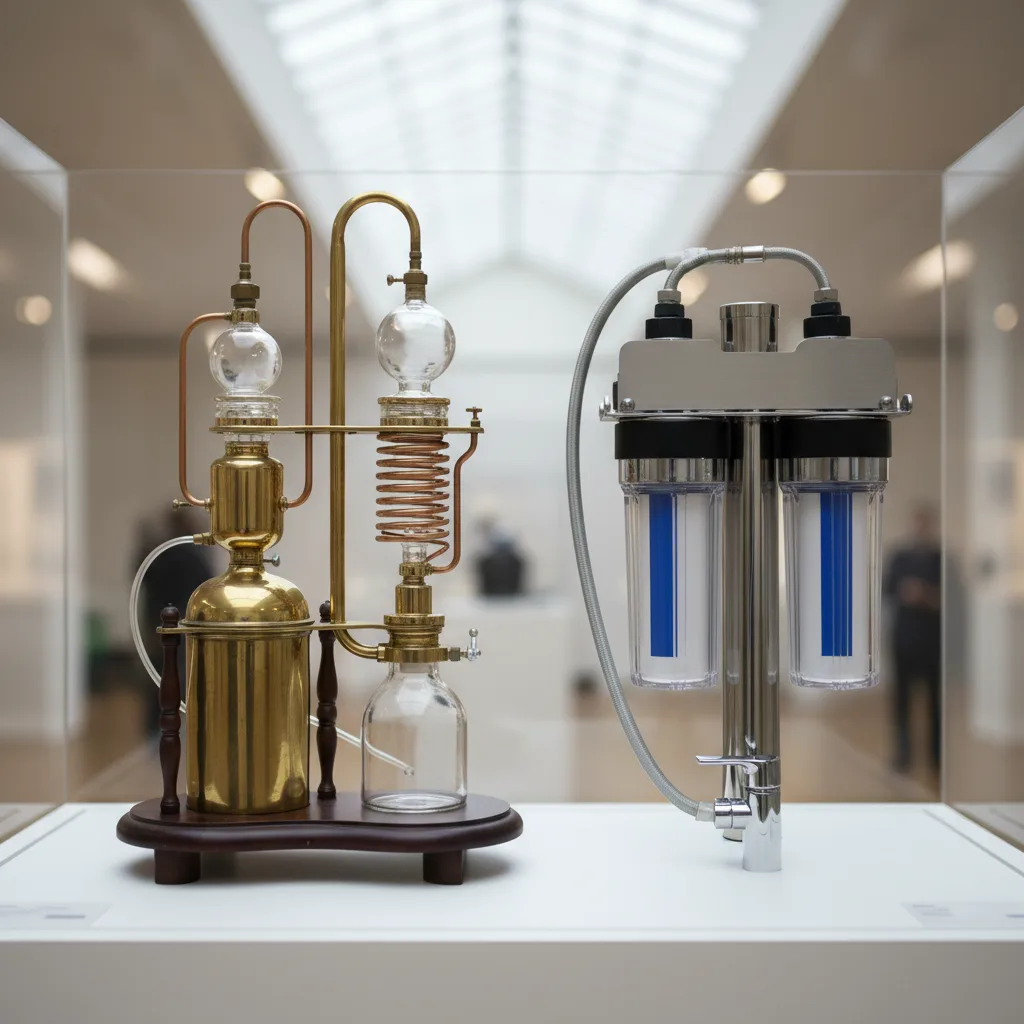
Ancient Water Purification (2000 BCE - 500 CE)
The earliest water purification methods were simple but surprisingly effective for their time. Ancient civilizations recognized that not all water was equally safe to drink, even without understanding the microbiological reasons.
Egypt and Mesopotamia (2000 BCE)
Ancient Egyptians were among the first to develop systematic water treatment. Tomb inscriptions from around 1500 BCE depict water being clarified using a siphon device. Egyptian alum (potassium aluminum sulfate) was used as a coagulant to settle suspended particles — a technique so effective that it is still used in modern water treatment plants today.
Sand and gravel filtration beds were constructed along the Nile to remove visible sediment and improve water clarity. While these methods could not remove dissolved contaminants or kill bacteria, they significantly improved the aesthetic quality of water and likely reduced some illness by removing large parasites and organic matter.
Ancient India (1500 BCE)
The Sanskrit text Sushruta Samhita, one of the foundational documents of Ayurvedic medicine, describes multiple water purification methods: boiling water, exposing it to sunlight, immersing heated copper vessels in water, and filtering through sand and coarse gravel. Remarkably, both boiling and UV exposure from sunlight are scientifically valid purification methods — the ancient Indians had identified effective techniques thousands of years before the germ theory of disease.
Ancient Greece and Rome (500 BCE - 500 CE)
Hippocrates, the father of medicine, created the "Hippocratic sleeve" around 400 BCE — a cloth bag used to strain boiled rainwater. This was essentially the first documented fabric filter. Roman aqueducts incorporated settling basins where water velocity slowed, allowing suspended particles to settle out before water was distributed to the city. Romans also recognized that lead pipes could make water taste sweet and potentially cause illness, leading some to prefer clay or stone channels — an early recognition of lead contamination.
The Dark Ages and Early Modern Period (500 - 1800 CE)
After the fall of Rome, water treatment knowledge stagnated in Europe for centuries. The connection between contaminated water and disease would not be scientifically established until the 19th century, and waterborne disease killed millions during the medieval period.
Medieval Methods
Medieval Europeans relied primarily on boiling and wine or beer as alternatives to suspect water. The alcohol in fermented beverages killed many pathogens, making beer genuinely safer than water in many cities — a fact that contributed to widespread consumption of low-alcohol "small beer" by all ages, including children.
Sir Francis Bacon (1627)
Francis Bacon conducted some of the first documented scientific experiments on water filtration, including attempting to desalinate seawater by filtering it through sand. While his desalination experiments were unsuccessful (sand cannot remove dissolved salts), his documentation of the process contributed to the emerging scientific method and inspired later researchers.
The Age of Discovery: 1800 - 1900
The 19th century saw the scientific foundations of modern water treatment laid down, driven by devastating cholera epidemics in rapidly industrializing cities.
First Municipal Sand Filter (1804)
Robert Thom designed and built the first municipal water treatment plant in Paisley, Scotland in 1804. It used slow sand filtration — water passed slowly through beds of fine sand, and a biological layer (called a "schmutzdecke") formed on the sand surface that trapped and digested bacteria and organic matter. The Paisley plant was followed by similar systems throughout Britain and Europe. Slow sand filtration remains in use today and is remarkably effective — removing 90% to 99% of bacteria without any chemicals.
John Snow and the Broad Street Pump (1854)
The most famous moment in water safety history. During a severe cholera outbreak in London's Soho district, physician John Snow traced the source to a single contaminated water pump on Broad Street. By mapping cholera cases and identifying their shared water source, Snow demonstrated that cholera was waterborne — not spread through "bad air" (miasma) as was commonly believed. His removal of the pump handle is one of the founding stories of epidemiology and public health.
Snow's work provided the scientific justification for large-scale investment in water treatment infrastructure. London subsequently built the world's most extensive sewage and water treatment systems, setting the model for cities worldwide.
Pasteur, Koch, and Germ Theory (1860s - 1880s)
Louis Pasteur's demonstrations that microorganisms cause disease (1860s) and Robert Koch's identification of specific bacterial pathogens including the cholera bacterium Vibrio cholerae (1883) provided the scientific framework for understanding why water treatment worked. Once the microbial causes of waterborne disease were identified, targeted treatment methods could be developed.
Activated Carbon Recognition (1862)
While charcoal had been used for water treatment since ancient times, the adsorptive properties of activated carbon were formally studied in the 19th century. Carbon treatment was adopted for removing taste, odor, and color from municipal water supplies. The first large-scale use of granular activated carbon in municipal water treatment occurred in the early 1900s, establishing the technology that underlies the majority of consumer water filters sold today — including every Brita, PUR, and Amazon Basics filter on the market.
The Chlorination Revolution (1908 - 1950)
No single innovation in water treatment has saved more lives than chlorination.
Jersey City, 1908
Dr. John L. Leal and engineer George Warren Fuller introduced continuous chlorination of the Jersey City, New Jersey water supply in 1908. The results were dramatic — typhoid fever rates plummeted. Within a decade, chlorination spread across the United States. By the 1940s, waterborne typhoid, cholera, and dysentery — diseases that had killed tens of thousands annually — were virtually eliminated in chlorinated water systems.
The Centers for Disease Control and Prevention has called water chlorination and filtration "the most significant public health advance of the 20th century." Life expectancy in the US increased by approximately 50% during the 20th century, and water treatment is estimated to account for nearly half of that increase.
The Safe Drinking Water Act (1974)
The first comprehensive federal law regulating public drinking water quality. It authorized the EPA to set national standards for drinking water contaminants and required public water systems to monitor and report their water quality. This law established the regulatory framework that protects US drinking water today and is discussed in more detail in our Is Tap Water Safe? guide.
Modern Water Filtration Technology (1950 - Present)
Reverse Osmosis (1959 - 1981)
The development of practical reverse osmosis membranes is one of the most important water treatment breakthroughs of the modern era. Sidney Loeb and Srinivasa Sourirajan at UCLA created the first practical RO membrane in 1959-1960 using cellulose acetate. Their membrane made desalination economically feasible for the first time.
John Cadotte's invention of the thin-film composite (TFC) membrane in 1981 revolutionized the field. TFC membranes offered dramatically better salt rejection (98%+ vs 96% for cellulose acetate), higher flow rates, wider pH tolerance, and longer life. Virtually every modern RO system — from the iSpring RCC7AK to the Waterdrop G3P600 — uses TFC membrane technology.
Residential RO systems became commercially available in the 1970s and 1980s, initially as large under-sink systems. Today, countertop models like the Bluevua RO100ROPOT-UV make RO accessible without any installation.
Consumer Pitcher Filters (1966 - Present)
Heinz Hankammer founded Brita in Germany in 1966, creating the first consumer water filter pitcher. Brita launched in the US market in 1988 and quickly became a household name. PUR entered the market in the 1990s, and ZeroWater introduced its 5-stage ion exchange system in 2003. The pitcher filter market democratized water filtration — for the first time, anyone could improve their water quality for a modest investment.
UV Purification (1980s - Present)
While UV light's germicidal properties were discovered in the early 1900s, practical UV water purification systems for consumer use emerged in the 1980s. UV purification is now integrated into advanced systems like the Bluevua RO100ROPOT-UV and is widely used in municipal treatment as a chemical-free disinfection alternative to chlorine.
Portable Hollow Fiber Filters (2000s - Present)
LifeStraw (2005) and Sawyer (2000s) pioneered affordable hollow fiber membrane filters for personal water purification. These 0.1-micron filters weigh ounces and remove 99.9999% of bacteria, making safe drinking water accessible for hikers, travelers, and humanitarian applications. Today, products like the Timain Filter Straw provide this technology at remarkably low prices per straw.
Key Lessons from 4,000 Years of Water Filtration History
Looking across the full arc of water purification history, a few patterns stand out. First, necessity has consistently driven innovation — major advances almost always followed public health crises. Second, older techniques rarely disappear entirely; slow sand filtration, activated carbon, and alum coagulation are all still in use today alongside cutting-edge membrane technology. Third, no single method has ever solved every problem, which is why modern treatment plants and high-end home systems layer multiple technologies in sequence. Understanding this layered philosophy helps explain why multi-stage home filters consistently outperform single-stage options in independent testing.
The Future of Water Filtration
Several emerging technologies may reshape residential water treatment in the coming decades:
- Graphene oxide membranes: Potentially 100x faster than conventional RO membranes while achieving similar or better rejection rates. Could make tankless RO systems even more practical and reduce water waste.
- Nanotechnology filters: Nanoparticle-enhanced filters targeting specific contaminants like PFAS, arsenic, and heavy metals with higher efficiency and lower pressure requirements.
- Smart filtration systems: IoT-connected filters with real-time water quality monitoring, automatic filter replacement alerts, and data logging. The Waterdrop G3P600 with its TDS-monitoring smart faucet represents an early version of this trend.
- PFAS-destruction technology: Rather than just filtering PFAS, new processes using electrochemical oxidation and supercritical water oxidation can actually break down the carbon-fluorine bonds, permanently destroying forever chemicals.
- Solar-powered purification: Advances in solar-powered desalination and purification are making off-grid water treatment more practical for remote communities, emergency response, and developing nations.
Frequently Asked Questions
When was water filtration first invented?
Who invented the modern water filter?
When was chlorination of water supplies first used?
When was reverse osmosis invented?
When did home water filters become popular?
What is the future of water filtration technology?
How has water filtration technology reduced disease over time?
Get Filter Picks Delivered
One email per week. Honest reviews, no spam.
Only when something changes. Unsubscribe anytime.