Water Filter Cost Analysis: True Cost of Ownership
The price on the box is only the beginning. Replacement filters, water waste, electricity, and maintenance all contribute to the true cost of owning a water filter. We calculated the 1-year and 5-year total cost of ownership for every major filter type in our catalog — from budget pitchers to premium RO systems — so you can make a genuinely informed decision about where your money goes.
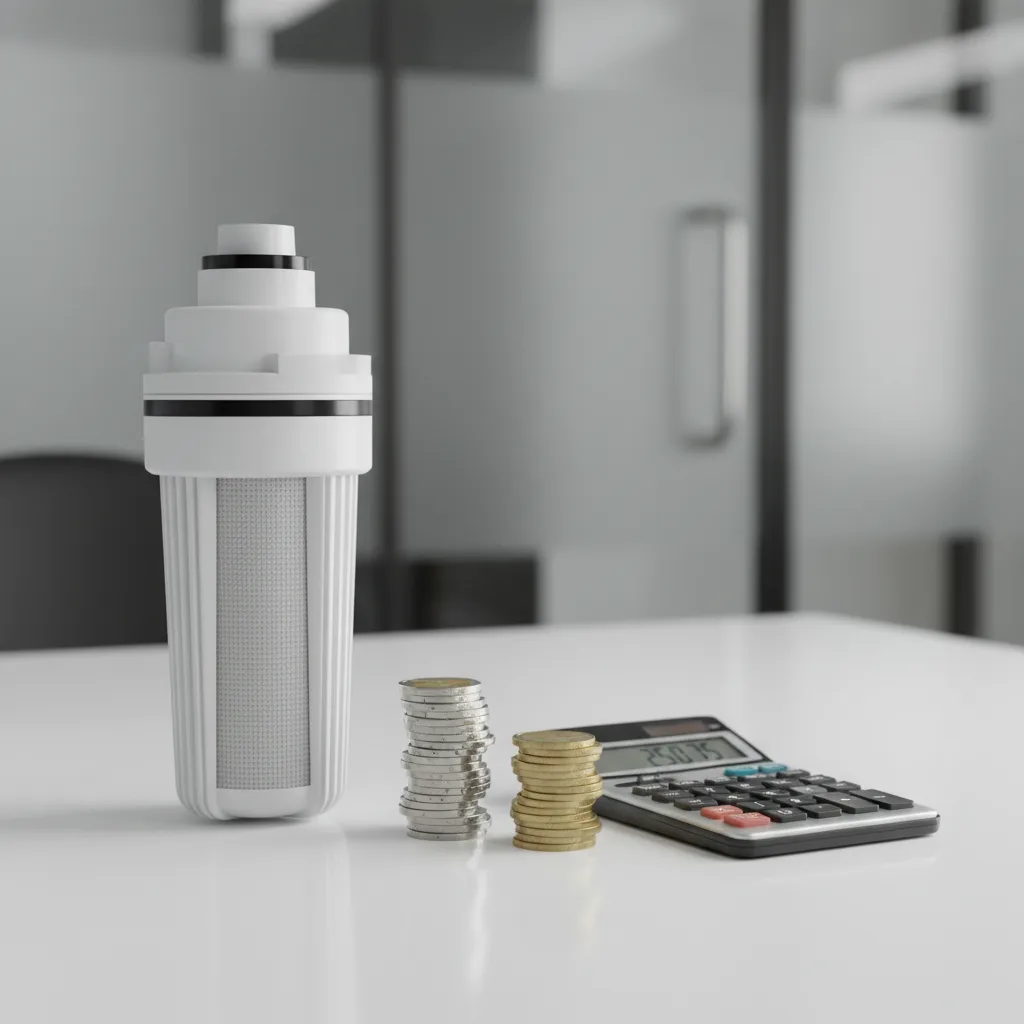
The Cost Components Most People Miss
Every water filter has four cost components. Most buyers only consider the first one:
- Purchase price: The upfront cost of the filter system itself.
- Replacement filters: The ongoing cartridge cost. This is almost always the largest expense over time.
- Water waste: RO systems produce wastewater. At typical municipal water rates, this adds a modest but non-trivial amount per year.
- Electricity: Tankless RO and countertop systems need power. The electricity cost is minimal — a negligible line item in your annual budget.
Our analysis assumes a family of 4 consuming approximately 3 gallons of filtered water per day (1,095 gallons per year). Adjust proportionally for your household.
Pitcher Filter Systems: Cost Breakdown
Amazon Basics Pitcher + Amazon Basics Enhanced Filters
The budget champion.
- Pitcher: Under $25
- Replacement filters: Under $25 for 3-pack (among the cheapest per filter, 40 gallons per filter)
- Filters needed per year (family of 4): ~27 filters (1,095 gallons / 40 gallons per filter)
- Annual filter cost: the lowest of any pitcher system we tested
- Year 1 total: the most affordable first-year cost of any filter system
- 5-year total: the cheapest long-term pitcher option in our catalog
- Cost per gallon: the lowest per-gallon cost of any pitcher filter
Brita UltraMax + Brita Standard Filters
The most popular option.
- Dispenser: $25–$50
- Replacement filters: Under $25 for 3-pack (40 gallons per filter)
- Filters needed per year: ~27 filters
- Annual filter cost: moderate — higher than Amazon Basics but typical for brand-name filters
- Year 1 total: budget tier
- 5-year total: mid-range — roughly 1.5x the Amazon Basics system
- Cost per gallon: roughly fifteen cents
Brita UltraMax + Brita Elite Filters
The smart upgrade — cheaper per gallon than Standard.
- Dispenser: $25–$50
- Replacement filters: $25–$50 for 2-pack (120 gallons per filter — 3x the Standard's lifespan)
- Filters needed per year: ~9 filters (1,095 / 120)
- Annual filter cost: slightly less than the Standard despite higher per-filter cost
- Year 1 total: budget tier
- 5-year total: roughly 15% less than the Brita Standard system
- Cost per gallon: roughly twelve cents — cheaper than Standard
ZeroWater Pitcher + 5-Stage Filters
The premium pitcher — with a painful cost surprise.
- Pitcher: budget tier (varies by model)
- Replacement filters: $50–$100 for 4-pack (~20 gallons per filter at average TDS — very short lifespan)
- Filters needed per year: ~55 filters (1,095 / 20)
- Annual filter cost: extremely high — multiple hundreds of dollars due to rapid filter depletion
- Year 1 total: premium tier — approaching the cost of bottled water
- 5-year total: several thousand dollars — by far the most expensive pitcher system
- Cost per gallon: roughly seventy-five cents — comparable to bottled water brands
ZeroWater delivers 0-TDS purity but at a staggering annual cost. In high-TDS areas (300+ ppm), filters may last only 15 gallons, pushing costs even higher. ZeroWater can approach or exceed the per-gallon cost of many bottled water brands.
Under-Sink RO Systems: Cost Breakdown
iSpring RCC7AK (75 GPD, Tank-Based)
The best overall value for serious filtration.
- System: $100–$250
- Annual filter replacement: modest — a set of pre-filters, post-carbon, and remineralization cartridge once per year
- RO membrane replacement: every 2-3 years (a small additional cost amortized annually)
- Water waste cost: minimal (1:3 pure-to-drain ratio adds a small amount at average municipal water rates)
- Electricity: none (uses water pressure only)
- Year 1 total: mid-range — the upfront system cost is the bulk of it
- 5-year total: comparable to a budget pitcher system — remarkable for RO-level filtration
- Cost per gallon: roughly ten cents — among the cheapest serious filtration options
The iSpring's total cost of ownership over 5 years is lower than the Brita UltraMax with Standard filters — while providing dramatically better filtration (6-stage RO vs. basic carbon).
Waterdrop G3P600 (600 GPD, Tankless)
The premium choice with higher ongoing costs.
- System: $250–$500
- Annual filter replacement: higher than the iSpring — CF filter every 6 months, MRO every 12 months, CB every 24 months
- Water waste cost: lower than tank-based systems (2:1 efficient ratio)
- Electricity: minimal (pump requires power but consumption is negligible)
- Year 1 total: premium tier — the high upfront cost dominates
- 5-year total: roughly 65% more than the iSpring over the same period
- Cost per gallon: roughly seventeen cents — still far cheaper than bottled water
The Waterdrop G3P600 costs more per gallon than the iSpring, but you are paying for tankless on-demand water, smart TDS monitoring, and space savings. Whether the premium is worth it depends on your priorities.
Countertop RO Systems: Cost Breakdown
Bluevua RO100ROPOT-UV
- System: $250–$500
- Annual filter replacement: moderate (RO membrane every 12 months, other filters every 6 months)
- Water waste cost: minimal (2:1 ratio)
- Electricity: negligible
- Year 1 total: mid-range — system cost plus first year of filters
- 5-year total: competitive with premium pitcher systems
- Cost per gallon: roughly fourteen cents
Bluevua RO100ROPOT-Lite UV
- System: $100–$250
- Annual filter replacement: moderate — slightly less than the premium Bluevua model
- Water waste cost: slightly higher than the premium model (3:1 ratio vs 2:1)
- Electricity: negligible
- Year 1 total: mid-range — lower upfront cost offsets slightly higher waste
- 5-year total: among the best values in countertop RO
- Cost per gallon: roughly twelve cents — matching the Brita Elite
The Lite UV offers the best value in countertop RO, combining no-install convenience with a competitive per-gallon cost.
Commercial-Grade Under-Sink: Cost Breakdown
Pentair Everpure H-1200 (Cartridge Replacements)
- Cartridges: $250–$500 (requires existing filter head)
- Replacement frequency: Every 12 months (1,000 gallons)
- Water waste: none (not RO)
- Electricity: none
- Year 1 total: premium tier (cartridges only; filter head adds more the first time)
- 5-year total: the highest of any system in our analysis — several times the iSpring RO
- Cost per gallon: roughly thirty-seven cents — the most expensive per-gallon option
The Pentair Everpure is the most expensive per-gallon option, but delivers commercial restaurant-grade filtration quality. It is best suited for those who prioritize absolute taste quality and have the budget to support it.
Refrigerator Filters: Cost Breakdown
OEM Route (GE XWFE or everydrop Filter 1)
- GE XWFE at $25–$50 every 6 months — roughly a hundred dollars per year
- everydrop Filter 1 at $50–$100 every 6 months — similar annual cost
- 5-year OEM cost: several hundred dollars total
Aftermarket Route (AQUACREST 3-Pack)
- AQUACREST 3-Pack at budget-tier pricing — a fraction of the per-filter OEM cost, 2 filters per year
- 5-year aftermarket cost: a small fraction of the OEM route — roughly one-tenth
The aftermarket savings are dramatic, but you give up NSF 53/401 certification (lead, pharmaceuticals). If your main concern is taste, aftermarket is fine. If you need contaminant reduction, stick with OEM.
The Bottled Water Comparison
For perspective, here is what bottled water costs a family of 4 consuming 3 gallons per day:
- Budget store brand: several hundred dollars per year
- Mid-range brand: approaching a thousand dollars per year
- Premium brand: well over a thousand dollars per year
- 5-gallon delivery service: several hundred dollars per year
Every single filter system in our analysis — even the expensive ZeroWater — is cheaper than mid-range bottled water in year two. And unlike bottled water, you eliminate plastic waste, microplastic ingestion from bottles, and the hassle of buying and carrying heavy packs.
5-Year Cost Comparison Summary
Here is every system ranked by total 5-year cost of ownership for a family of 4:
- Amazon Basics pitcher + Amazon Basics filters: lowest 5-year cost (~9 cents/gallon) — Best budget value
- iSpring RCC7AK under-sink RO: close second (~10 cents/gallon) — Best overall value for serious filtration
- Bluevua Lite UV countertop RO: mid-range (~12 cents/gallon) — Best no-install RO value
- Brita UltraMax + Elite filters: mid-range (~12 cents/gallon) — Best premium pitcher
- Bluevua RO100ROPOT-UV countertop: mid-range (~14 cents/gallon) — Best premium countertop
- Brita UltraMax + Standard filters: above mid-range (~15 cents/gallon) — Most popular (but not most economical)
- Waterdrop G3P600 tankless RO: premium (~17 cents/gallon) — Best premium under-sink
- Pentair Everpure H-1200: high premium (~37 cents/gallon) — Commercial-grade quality
- ZeroWater pitcher: highest cost (~75 cents/gallon) — Maximum purity, maximum cost
Key Takeaways
- Pitcher filters are only cheap upfront. Over 5 years, some pitcher systems cost more than under-sink RO due to frequent filter replacements.
- Under-sink RO is the best value for serious filtration. The iSpring RCC7AK's 5-year cost is barely more than a budget pitcher system, while delivering dramatically better water quality.
- Brita Elite saves money vs. Brita Standard. Despite costing more per filter, the Elite's 3x longer life makes it cheaper per gallon. It is the rare upgrade that actually saves you money.
- ZeroWater is extremely expensive long-term. Great for specific applications (very high TDS water), but impractical for most households — its per-gallon cost approaches bottled water pricing.
- Any filter beats bottled water. Even the most expensive filter system costs less per gallon than the cheapest bottled water brand.
Frequently Asked Questions
What is the cheapest water filter to own long-term?
Is a reverse osmosis system worth the investment?
How does filtered water compare to bottled water cost?
Do RO systems cost more in water waste?
Which pitcher filter has the lowest cost per gallon?
Should I factor in electricity costs for RO systems?
How much does it cost to maintain a refrigerator water filter?
Invest in the Right System
The cheapest filter to buy is not always the cheapest filter to own. Use the cost breakdowns above to find the system that matches both your water quality needs and your budget over time. For help choosing the right type, start with our Complete Buying Guide. If you are budget-constrained, see our Best Filters Under $50. And for full product rankings, visit our Best Countertop Filters and Best Under-Sink Filters roundups.
Get Filter Picks Delivered
One email per week. Honest reviews, no spam.
No spam. Unsubscribe anytime.