Reverse Osmosis vs Carbon Filters: Which Do You Need?
Reverse osmosis and activated carbon are the two dominant water filtration technologies on the market. They work in fundamentally different ways, remove different contaminants, and come at different price points. This guide explains the science behind each, compares their strengths and weaknesses, and helps you decide which one your household actually needs.
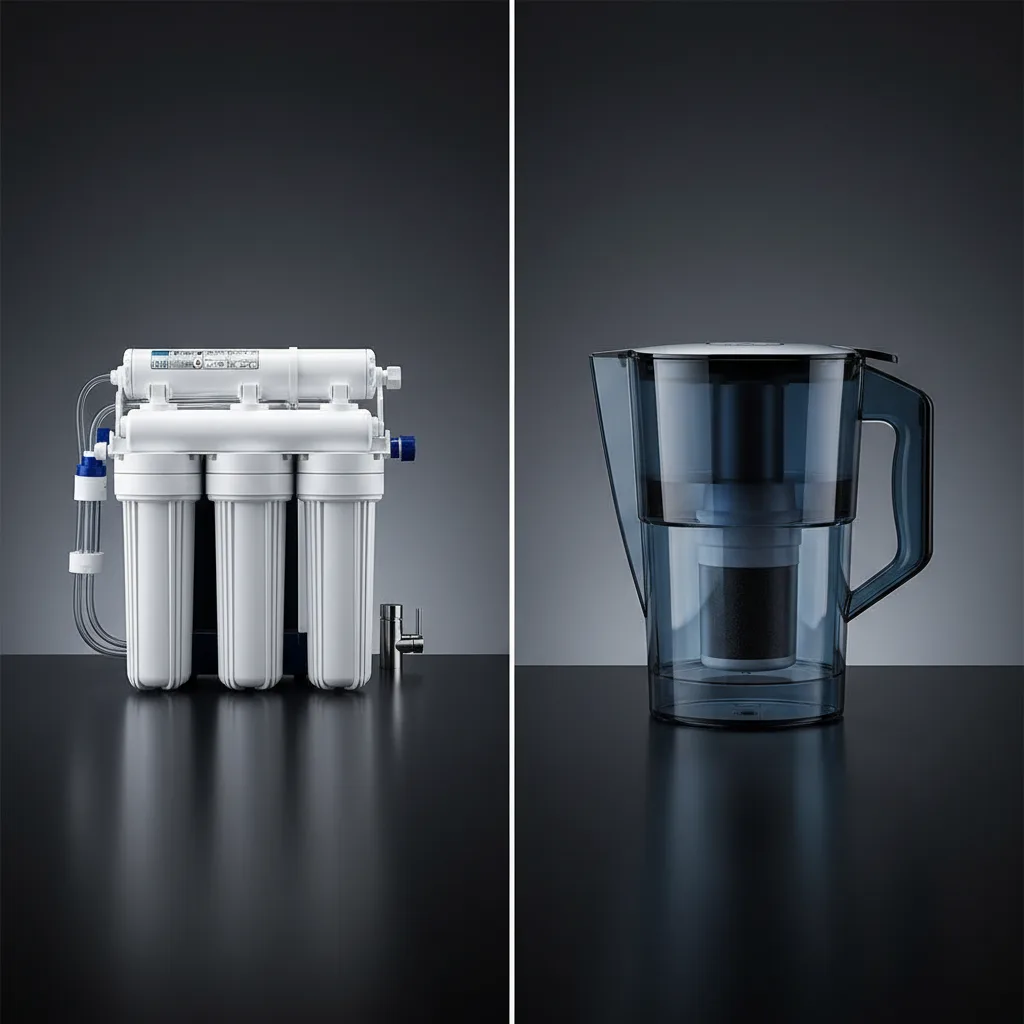
How Carbon Filtration Works
Activated carbon filtration is the most common water treatment technology in consumer products. It appears in pitcher filters, faucet-mount filters, refrigerator filters, and as a stage within RO systems.
The process relies on adsorption — not absorption. Contaminants chemically bond to the surface of the carbon, sticking to millions of tiny pores in the filter material. Activated carbon has an enormous surface area: a single gram contains roughly 3,000 square meters of surface area, giving contaminants plenty of opportunity to latch on.
Carbon filters come in two main forms:
- Granular Activated Carbon (GAC): Loose carbon granules. Found in basic pitcher filters like Brita Standard. Water flows around and between the granules. Effective for chlorine and basic taste improvement, but has gaps where water can bypass without contacting carbon.
- Carbon Block: Compressed carbon formed into a solid block. Found in premium filters like the Brita Elite, refrigerator filters, and under-sink systems. Denser structure means better contact time and more thorough filtration. Can be rated for lead and cyst removal (NSF 53).
What Carbon Removes Well
- Chlorine taste and odor (the #1 reason people buy filters)
- Volatile organic compounds (VOCs) — pesticides, herbicides, industrial solvents
- Some pharmaceuticals and endocrine disruptors (NSF 401 certified filters)
- Lead (carbon block with NSF 53 certification only)
- Sediment and particulates (when mechanically rated, e.g., 0.5 micron)
- Some PFAS compounds (advanced carbon block filters with specific certification)
What Carbon Cannot Remove
- Total dissolved solids (TDS) — minerals, salts, metals in solution
- Fluoride
- Nitrates and nitrites
- Sodium
- Most heavy metals in dissolved form (unless specifically certified)
- Bacteria and viruses (carbon is not a disinfectant)
How Reverse Osmosis Works
Reverse osmosis uses pressure to force water through a semi-permeable membrane with pores roughly 0.0001 microns in size — small enough to block individual molecules. For context, a human hair is about 75 microns in diameter. The RO membrane is 750,000 times finer.
In a typical RO system like the iSpring RCC7AK, water passes through multiple stages:
- Sediment pre-filter: Removes sand, silt, and particles to protect the membrane.
- Carbon pre-filter(s): Removes chlorine, which damages RO membranes, plus VOCs.
- RO membrane: The heart of the system. Removes 93-98% of dissolved solids.
- Post-carbon filter: Polishes taste after the tank.
- Remineralization (some systems): Adds beneficial minerals back for taste and health.
What RO Removes
- Everything carbon removes, plus:
- Total dissolved solids (TDS) — 93-98% reduction
- Fluoride (90-95% reduction)
- Lead (>98.9% reduction)
- PFAS / forever chemicals (96-99% reduction)
- Arsenic, chromium, and heavy metals
- Nitrates and nitrites
- Bacteria (when combined with UV or proper system design)
- Sodium
RO Limitations
- Wastes water (1:3 to 3:1 pure-to-drain ratio depending on system)
- Removes beneficial minerals (calcium, magnesium) unless remineralization stage is included
- Slower water production than carbon-only systems (tank-based systems have limited on-demand supply)
- Higher upfront cost (mid-range to premium pricing for under-sink, mid-range for countertop)
- More complex installation and maintenance
- Some systems require electricity (tankless models, countertop systems)
Head-to-Head Comparison
Contaminant Removal
Winner: Reverse Osmosis. RO removes virtually everything that carbon removes, plus dissolved solids, fluoride, nitrates, and a wider range of heavy metals. If you want the most comprehensive filtration possible, RO is unmatched.
Cost (Upfront)
Winner: Carbon. A Brita UltraMax dispenser costs $25–$50. A carbon-block under-sink filter like the Pentair Everpure H-1200 costs more, but basic pitcher carbon filters are among the most affordable filtration options available. The most affordable RO system in our catalog is the iSpring RCC7AK at $100–$250.
Cost (Long-Term Per Gallon)
Winner: Depends on usage. Carbon pitcher filters cost roughly ten to fifteen cents per gallon in filter replacements. Under-sink RO systems cost just a few pennies per gallon because their filters serve far more water before replacement. Over 3-5 years, the total cost of ownership can actually be lower for RO if you consume significant volumes.
Ease of Installation
Winner: Carbon. Pitcher filters require zero installation. Countertop carbon filters may need a faucet adapter. Under-sink RO systems require drilling a faucet hole and connecting to the cold water line — typically a 1-2 hour DIY job. However, countertop RO systems like the Bluevua RO100ROPOT-UV close this gap by offering RO with no installation at all.
Water Waste
Winner: Carbon. Carbon filters produce zero wastewater. Every drop that enters comes out filtered. RO systems by definition produce concentrated wastewater as contaminants are flushed away. Modern systems have improved this — the Waterdrop G3P600 achieves a 2:1 pure-to-drain ratio, but older systems can waste 3-4x the water they produce.
Water Taste
Winner: Tie (with caveats). Carbon filters produce great-tasting water with natural mineral content preserved. RO systems produce extremely pure water that can taste "flat" — but systems with remineralization (iSpring RCC7AK, both Bluevua models) add minerals back for a balanced, crisp taste. Without remineralization, many people find RO water less satisfying.
Maintenance Complexity
Winner: Carbon. Swap a pitcher filter every 2 months — done. RO systems have 3-6 different filter stages on different replacement schedules (6 months, 12 months, 2-3 years). Smart systems like the Waterdrop G3P600 mitigate this with LED alerts, but there is inherently more to manage.
When to Choose Carbon Filtration
A carbon-only filter is the right choice if:
- Your municipal water is reasonably clean and your main issue is chlorine taste
- Your budget for the system is modest and you want low ongoing costs
- You are renting and cannot modify plumbing
- Your water testing shows low TDS (under 200 ppm) and no concerning contaminants
- You want the simplest possible maintenance
- Water waste is a concern for you
Carbon filtration is also an excellent interim solution. If you are considering a whole-house upgrade or planning a kitchen renovation that would make under-sink installation easier, a quality pitcher or countertop carbon filter handles day-to-day taste improvement at low cost while you plan your longer-term approach. Renters in particular benefit from this flexibility — a pitcher or countertop unit moves with you, requires no landlord approval, and delivers a meaningful improvement over unfiltered tap water with zero commitment.
Our carbon filter recommendations:
- Best pitcher: Brita UltraMax 27-Cup Water Filter Dispenser ($25–$50) with Brita Elite filters
- Best under-sink carbon: Pentair Everpure H-1200 ($250–$500)
- Best fridge filter: GE XWFE Refrigerator Water Filter ($25–$50)
When to Choose Reverse Osmosis
An RO system is the right choice if:
- Your water has high TDS (above 300 ppm) or hard water issues
- Testing shows lead, PFAS, fluoride, arsenic, or nitrates
- You are on well water with multiple contaminant concerns
- You want the most thorough filtration possible regardless of cost
- You are willing to handle slightly more complex maintenance
- You plan to stay in your home long enough to recoup the investment
RO is also worth serious consideration for households with infants, pregnant women, elderly family members, or anyone with a compromised immune system. These groups are more vulnerable to low-level contaminants that healthy adults might tolerate without noticeable effect. The additional protection an RO membrane provides — particularly for lead, nitrates, and PFAS — is not theoretical; it is backed by NSF/ANSI testing standards that verify real-world removal rates. For families in this situation, the peace of mind alone often justifies the upgrade from a carbon-only system.
Our RO recommendations:
- Best value under-sink RO: iSpring RCC7AK 6-Stage Reverse Osmosis System ($100–$250)
- Best premium under-sink RO: Waterdrop G3P600 Tankless Reverse Osmosis System ($250–$500)
- Best no-install countertop RO: Bluevua RO100ROPOT-UV Countertop Reverse Osmosis System ($250–$500)
- Best budget countertop RO: Bluevua RO100ROPOT-Lite(UV) Countertop Reverse Osmosis System ($100–$250)
The Hybrid Approach
You do not have to choose just one. Many households use both technologies in a layered approach:
- Under-sink RO for drinking and cooking water at the kitchen tap — handles serious contaminants.
- Refrigerator carbon filter for ice and cold water — the fridge filter handles chlorine taste for ice cubes and cold drinks.
- Whole-house sediment pre-filter for well water homes — protects both the RO system and all household plumbing.
This multi-layer strategy provides the best overall water quality across your entire home.
Understanding NSF Certifications: What the Labels Actually Mean
One of the most important — and most overlooked — aspects of comparing carbon and RO filters is understanding what the NSF/ANSI certification numbers on the packaging actually certify. A filter that simply says "reduces contaminants" without a specific NSF standard listed is making a marketing claim, not a verified performance claim. Here is a quick reference for the certifications you will encounter most often when shopping:
- NSF 42: Certifies aesthetic improvements only — chlorine taste, odor, and particulates. This is the baseline standard and does not confirm removal of any health-related contaminants. Nearly all carbon filters meet this level.
- NSF 53: Certifies reduction of health-related contaminants including lead, cysts, and certain VOCs. This is the standard that separates basic GAC pitcher filters from premium carbon block filters. The Brita Elite carries NSF 53 certification; the standard Brita filter does not.
- NSF 58: The certification specific to reverse osmosis systems. It verifies TDS reduction and contaminant removal claims made by the manufacturer for the RO membrane stage.
- NSF 401: Covers emerging contaminants including pharmaceuticals, hormones, and certain industrial chemicals. Found on select premium carbon block filters.
- NSF P473: Covers PFOA and PFOS specifically. If PFAS removal is your primary concern, look for this designation or NSF 58 on an RO system.
When comparing products, always check which specific NSF standards apply to which filter stage in the system. A multi-stage RO system might carry NSF 42 and 53 for its carbon stages and NSF 58 for its membrane — each certification applies only to what it was tested for.
Frequently Asked Questions
Is reverse osmosis better than carbon filtration?
Does reverse osmosis waste a lot of water?
Do carbon filters remove lead from water?
Does RO water taste flat because minerals are removed?
Can I use a carbon filter and RO system together?
Which type of filter removes PFAS (forever chemicals)?
How much more does an RO system cost compared to a carbon filter?
How often do I need to replace filters in each system?
Is it safe to drink RO water every day?
Will an RO system work with well water?
Make Your Decision
If you are still unsure, start by testing your water. The results will make the decision clear: basic taste issues point to carbon, while dissolved contaminants point to RO. For a deeper understanding of RO technology, read our What Is Reverse Osmosis? knowledge base article. And for side-by-side product matchups, see our iSpring vs Waterdrop comparison.
Get Filter Picks Delivered
One email per week. Honest reviews, no spam.
No spam. Unsubscribe anytime.