Doulton Super Sterasyl vs ProOne 7" G-Series: Which Ceramic Filter Wins in 2026?
Quick Verdict: The ProOne 7" G-Series ($100–$250) is the better all-around filter — built-in fluoride removal, 1,000-gallon lifespan, and NSF P231 microbiological certification justify the $62 price premium over the Doulton. The Doulton Super Sterasyl ($50–$100) wins on upfront value and holds broader NSF certifications (42/53/372/401) but lacks fluoride removal and has less than half the filter life. Choose ProOne for maximum protection, Doulton for budget-conscious certified filtration.
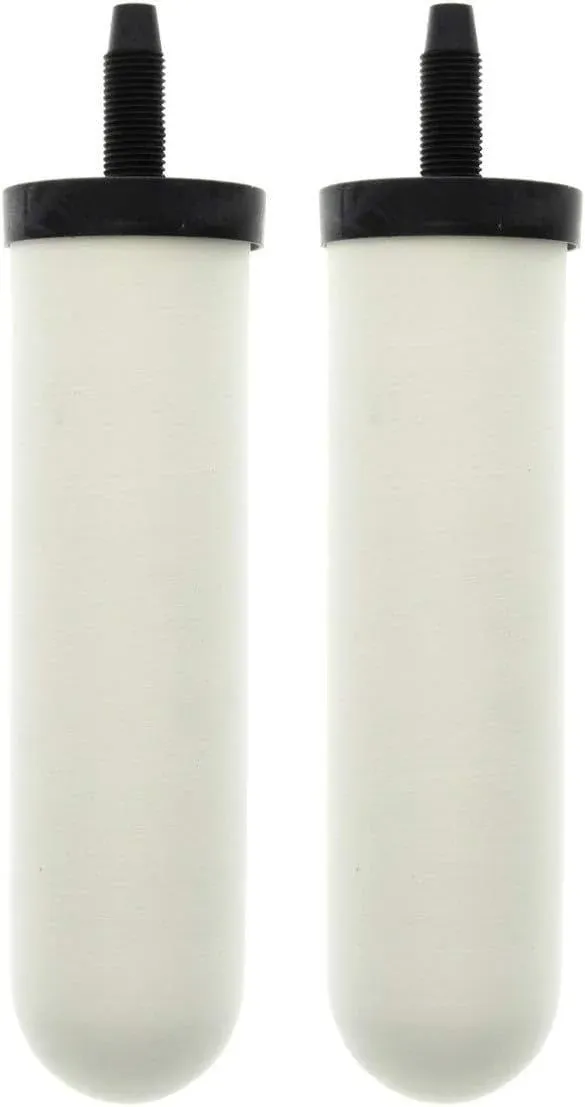
Doulton ATC Super Sterasyl Ceramic Water Filter for Gravity Systems (2-Pack)
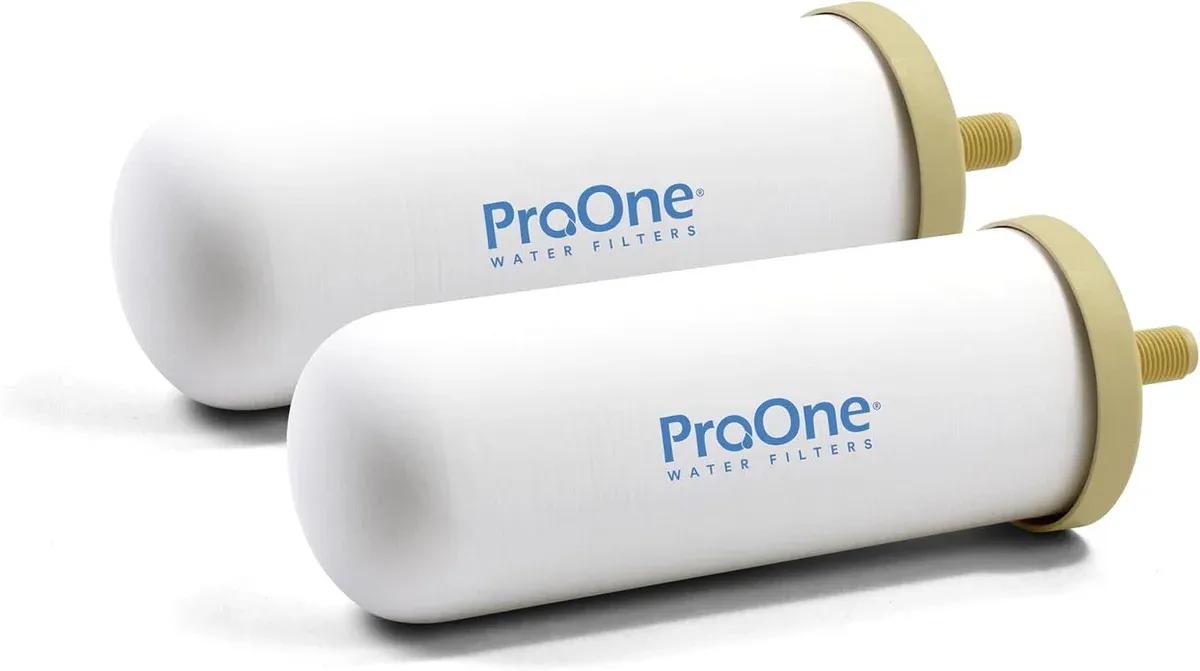
ProOne G-Series 7-Inch Gravity Filter Replacement (2-Pack)
At a Glance
| Feature | Doulton ATC Super Sterasyl Ceramic Water Filter for Gravity Systems (2-Pack) | Editor's Pick ProOne G-Series 7-Inch Gravity Filter Replacement (2-Pack) |
|---|---|---|
| Price | $50–$100 | $100–$250 |
| Filtration | Silver-impregnated ceramic + GAC + heavy metal media | 3-stage G3.0 (ceramic shell + carbon granular + carbon block core) |
| Filter Life | 400 gallons per filter (6 months) | 1,000 gallons per filter |
| Certifications | NSF 42/53/372/401 | IAPMO — NSF 42/53/401/372/P231 |
| Contaminants | Bacteria 99.99%, cysts, chlorine, lead, microplastics, PFAS, pharmaceuticals | 200+ including lead, fluoride, PFAS, microplastics, bacteria, chlorine, pharmaceuticals |
| Dimensions | 7" tall x 2" diameter | 7" tall x 2.75" diameter |
| Check Price | Check Price |
The Doulton Super Sterasyl and ProOne 7-inch G-Series represent two distinct approaches to ceramic gravity filtration. Doulton brings 200 years of UK manufacturing heritage with the broadest NSF certification portfolio. ProOne counters with a more advanced multi-stage architecture, built-in fluoride removal, and 2.5 times the filter life. This comparison breaks down exactly where each filter excels and which trade-offs matter for your specific situation.
Category-by-Category Breakdown
Fluoride Removal
The ProOne 7-inch G-Series removes fluoride as a built-in feature — no add-on filters, no separate cartridges, no additional cost. The fluoride reduction media is integrated into the carbon block core, providing consistent fluoride removal throughout the filter's 1,000-gallon lifespan. For the growing number of households that specifically want to reduce fluoride in their drinking water, this is a significant differentiator that no amount of NSF certification from Doulton can replicate.
The Doulton Super Sterasyl does not remove fluoride at all. Doulton offers a separate "Ultra Fluoride" candle variant, but it cannot be used simultaneously with the Super Sterasyl in the same system — you would need to choose one or the other. This means Doulton owners who want both the Super Sterasyl's NSF 53/401 contaminant coverage and fluoride removal cannot have both from a single filter. ProOne gives you everything in one candle.
To quantify the practical impact: the average US municipal water supply contains 0.7 mg/L of fluoride. Whether you want that reduced is a personal decision, but if you do, the ProOne is one of the very few gravity replacement filters that addresses it without requiring a dedicated fluoride filter mounted below the ceramic candle. This simplifies your system and eliminates one more component that needs tracking, replacing, and budgeting for.
Certifications and Independent Testing
Both filters hold substantial independent certifications, but they come from different certifying bodies and cover different standards. The Doulton Super Sterasyl carries NSF 42 (aesthetic — chlorine, taste, odor), NSF 53 (health — lead, cysts, VOCs), NSF 372 (lead-free compliance), and NSF 401 (emerging contaminants — pharmaceuticals, herbicides). These are certified by NSF International, the most widely recognized independent testing laboratory in the water filtration industry.
The ProOne 7-inch G-Series is certified by IAPMO to NSF 42, 53, 401, 372, and additionally holds Protocol P231 — the microbiological purification standard that verifies bacteria removal at 99.9999%, virus removal at 99.99%, and cyst removal at 99.9%. P231 is the most demanding biological contaminant test available for point-of-use filters, and ProOne is one of the few gravity replacement candles to hold it. While NSF International is the more recognized name, IAPMO is a fully accredited and legitimate certifying body — both are ANSI-accredited, and their testing methodologies follow the same NSF/ANSI standards.
The practical difference: Doulton's certification is broader in terms of chemical and emerging contaminant coverage via NSF 401 (which both hold) and comes from the more widely known certifying body. ProOne adds the P231 biological certification that Doulton lacks. For households concerned primarily about chemical contaminants in treated municipal water, the certifications are roughly equivalent. For households worried about biological contaminants — well water, emergency preparedness, travel — ProOne's P231 is a decisive advantage.
Filter Life and Long-Term Value
The ProOne 7-inch G-Series is rated at 1,000 gallons per filter — 2.5 times the Doulton Super Sterasyl's 400-gallon rating. With a 2-filter system processing 3 gallons per day, the ProOne pair would last approximately 667 days (nearly 22 months) while the Doulton pair lasts about 267 days (9 months). Even accounting for the recommended 6-month replacement cycle on time alone, the ProOne's gallon capacity provides a much larger safety margin within that timeframe.
The cost-per-gallon math is decisive. The ProOne 2-pack costs $146 and delivers 2,000 total gallons — approximately $0.073 per gallon. The Doulton 2-pack costs $84 and delivers 800 total gallons — approximately $0.105 per gallon. Despite the ProOne costing 74% more upfront, it delivers 150% more filtered water, making it cheaper per gallon. Over a year filtering 1,095 gallons, the ProOne costs about $80 in filters while the Doulton costs about $115. The higher upfront cost pays for itself within the first replacement cycle.
There is a caveat: the ProOne G-Series is being discontinued as the company transitions to Culligan MaxClear. Current inventory is available but not being restocked indefinitely. Buyers who plan to use ProOne long-term should consider purchasing 2-3 replacement packs while they remain in stock. The Doulton Super Sterasyl faces no discontinuation and will remain available as a stable, long-term choice.
Filtration Architecture
The Doulton Super Sterasyl uses a 2-inch diameter candle with three layers: a silver-impregnated 0.9-micron ceramic outer shell, a granular activated carbon (GAC) core, and a heavy metal reduction media insert. This is an effective and time-proven design that handles particulate, biological, chemical, and heavy metal contaminants in a compact form factor. The ceramic shell is cleanable — you can scrub it under running water to restore flow rate when sediment accumulates.
The ProOne 7-inch G-Series uses a substantially larger 2.75-inch diameter candle with a more complex three-stage architecture: a 0.5-micron ceramic outer shell (tighter than Doulton's 0.9 micron), a granular carbon layer, and a solid carbon block core. The carbon block is a critical distinction — it provides denser and more uniform chemical adsorption than loose granular carbon, which can develop channeling (water finding paths of least resistance through the media). The larger diameter also means 37.5% more surface area per candle, which contributes to both flow rate and total filtration capacity.
The tighter 0.5-micron ceramic pore structure on the ProOne provides a finer physical barrier than the Doulton's 0.9-micron rating. While both are more than sufficient to block bacteria (typically 0.2-5 microns) and cysts (3-15 microns), the finer pore size gives the ProOne a slight edge against the smallest particulate contaminants. However, tighter pores also mean slightly slower initial flow until the filter breaks in over the first 3-4 fill cycles.
Upfront Cost and Accessibility
The Doulton Super Sterasyl 2-pack costs $84 — exactly $62 less than the ProOne 7-inch G-Series at $146. For households on a tight budget or those trying gravity filtration for the first time, the lower entry cost makes the Doulton more accessible. You get a UK-manufactured ceramic filter with the broadest NSF certification stack in the category for under $100. That is genuine value.
The ProOne's $146 price tag puts it in premium territory for gravity replacement filters. While the cost-per-gallon is actually lower than the Doulton's (as detailed above), the upfront outlay is real. A household replacing filters for the first time — especially one transitioning from Berkey elements that ranged $60-120 per pair — may feel the sticker shock of the ProOne more acutely than the Doulton. The ProOne is the better long-term investment, but the Doulton is the easier short-term purchase.
For budget-conscious buyers who still want certified ceramic filtration, the Doulton's combination of sub-$100 pricing and NSF 42/53/372/401 certification is hard to beat. The ProOne is the better filter by most technical metrics, but not everyone can or should pay 74% more upfront for marginal per-gallon savings that take months to materialize.
Availability and Future-Proofing
The Doulton Super Sterasyl is a stable, long-term product with no announced discontinuation. Doulton has manufactured ceramic filters continuously since 1826, and the Super Sterasyl candle is a core product in their lineup. You can reasonably expect to buy replacement candles for years to come without supply disruption.
The ProOne 7-inch G-Series is being discontinued as ProOne transitions its product line to the Culligan MaxClear brand. As of early 2026, the G-Series remains available on Amazon, but inventory is being depleted without restocking. Once current inventory is gone, buyers will need to transition to the Culligan MaxClear 7-inch — which carries the same $146 price but has a dramatically shorter 50-gallon lifespan per filter. This makes the ProOne G-Series a time-sensitive recommendation: it is the better filter today, but it may not be available in six months.
If long-term supply certainty is important — and for emergency preparedness setups, it absolutely should be — the Doulton is the safer bet. You can build a stockpile plan around a product you know will remain in production. The ProOne requires either buying in bulk now while available or planning a transition to a different filter down the road.
Flow Rate and Daily Throughput
Real-world flow rate is one of the most underappreciated factors in a gravity filter comparison, because it directly determines how much filtered water is available when you need it. The ProOne 7-inch G-Series has a larger surface area due to its 2.75-inch diameter, which generally supports a higher sustained flow rate than the narrower Doulton candle — particularly after the initial break-in period. Users running dual ProOne candles in a standard 2.25-gallon upper chamber typically report faster tank turnaround than equivalent Doulton setups.
That said, the Doulton Super Sterasyl's 0.9-micron pore structure is slightly more open than the ProOne's 0.5-micron shell, which can translate to a marginally faster initial drip rate in the first few uses before any sediment buildup occurs. For households drawing moderate daily volumes — say, one to two full tank cycles — both filters are practically adequate. Where the ProOne's capacity advantage becomes tangible is in high-demand scenarios: larger families, off-grid setups refilling from sediment-heavy sources, or emergency situations where you are filling the tank repeatedly throughout the day.
Who Should Get Which?
Get the Doulton ATC Super Sterasyl Ceramic Water Filter for Gravity Systems (2-Pack) if...
- Budget is your primary constraint — $84 vs $146 upfront
- You want a stable product with no discontinuation risk
- NSF International certification (vs IAPMO) matters to you
- Fluoride removal is not a priority for your household
- You prefer a proven, decades-old UK-manufactured filter design
Get the ProOne G-Series 7-Inch Gravity Filter Replacement (2-Pack) if...
- Fluoride removal is a must-have in your gravity system
- You want the longest lifespan and lowest cost-per-gallon
- Microbiological certification (P231) matters for your water source
- You are willing to stock up now before discontinuation
- You want the most advanced multi-stage ceramic architecture available
Pro Tip: If fluoride removal is your deciding factor, buy the ProOne now while it is still available. The Culligan MaxClear successor offers fluoride removal too, but at 50 gallons per filter versus 1,000 — making ProOne's per-gallon cost for fluoride removal approximately 20 times cheaper. Once ProOne inventory is gone, this specific value proposition disappears from the market entirely.
Breaking Down the Discontinuation Factor
The ProOne discontinuation deserves deeper analysis because it fundamentally changes the buying calculus depending on your time horizon. For a buyer planning one to two replacement cycles (the next 12-24 months), the ProOne G-Series is clearly the better filter — superior technology, better economics, built-in fluoride removal. Buying two or three 2-packs while inventory exists gives you years of supply at the current favorable cost-per-gallon ratio.
For a buyer planning a permanent gravity filtration setup — emergency preparedness, off-grid living, long-term homesteading — the Doulton Super Sterasyl is the more prudent foundation. You cannot build a 10-year filtration plan around a product that is actively leaving the market. The Doulton's 200-year manufacturing continuity and stable product line means replacement candles will be available when you need them, whether that is next year or in 2035.
There is a hybrid approach worth considering: buy one ProOne 2-pack now for immediate use (taking advantage of the superior technology while it lasts) and one Doulton 2-pack as your long-term backup. When the ProOne candles reach end-of-life, transition to Doulton for ongoing replacements. This gives you the best of both worlds — ProOne's advanced filtration now, Doulton's supply stability forever.
Pro Tip: When transitioning from ProOne to a long-term replacement, do not overlook the Doulton Ultracarb as an alternative to the Super Sterasyl. The Ultracarb adds a silver-impregnated carbon core that more closely mirrors ProOne's multi-stage construction — it sits at a slightly higher price point than the Super Sterasyl but bridges the gap between budget certification and advanced contaminant reduction. If you are planning your post-ProOne strategy now, it is worth comparing both Doulton candle variants side by side before committing to a long-term supply.
Frequently Asked Questions
Does the Doulton Super Sterasyl remove fluoride?
Is ProOne being discontinued and should I stock up?
Which filter has a lower cost per gallon?
Can I use ProOne and Doulton candles in the same gravity system?
What does NSF P231 certification mean and why does it matter?
Why is the ProOne 7-inch more expensive than the Doulton if both are ceramic filters?
How do I know when to replace each filter?
Are these filters compatible with Berkey gravity systems?
Our Final Recommendation
On pure filtration merit, the ProOne 7-inch G-Series is the better filter. It offers built-in fluoride removal that the Doulton cannot match, a 1,000-gallon lifespan that delivers lower cost-per-gallon despite the higher sticker price, NSF P231 microbiological certification for verified pathogen protection, and a more advanced carbon block architecture with tighter ceramic pore structure. If you are buying a gravity replacement filter today and want the most capable option available, the ProOne is it.
The Doulton Super Sterasyl is the better long-term choice for buyers who value supply stability, lower upfront cost, and the trust that comes with NSF International certification from a company that has been making ceramic water filters since before the American Civil War. It is a genuinely excellent filter — NSF 42/53/372/401 certification places it among the most thoroughly tested gravity candles on the market. The only thing it cannot do that the ProOne can is remove fluoride.
Our recommendation: if fluoride removal matters to you at all, buy the ProOne now before it disappears. If fluoride is not a concern and you want a stable, long-term ceramic filter with impeccable certification credentials, the Doulton Super Sterasyl will serve you well for years to come.
Track Both Products
We'll email you if either price drops or availability changes.
Only when something changes. Unsubscribe anytime.