Doulton Super Sterasyl vs British Berkefeld BB9-2: Which Ceramic Candle Is Better in 2026?
Quick Verdict: At the same $84 price and from the same UK manufacturer, the Doulton Super Sterasyl ($50–$100) wins on certifications — NSF 42/53/372/401 versus none for the Berkefeld. The British Berkefeld BB9-2 ($50–$100) wins on longevity at 800 gallons per filter versus 400. If you want independently verified filtration performance, choose Doulton. If you want to change filters half as often, choose Berkefeld.
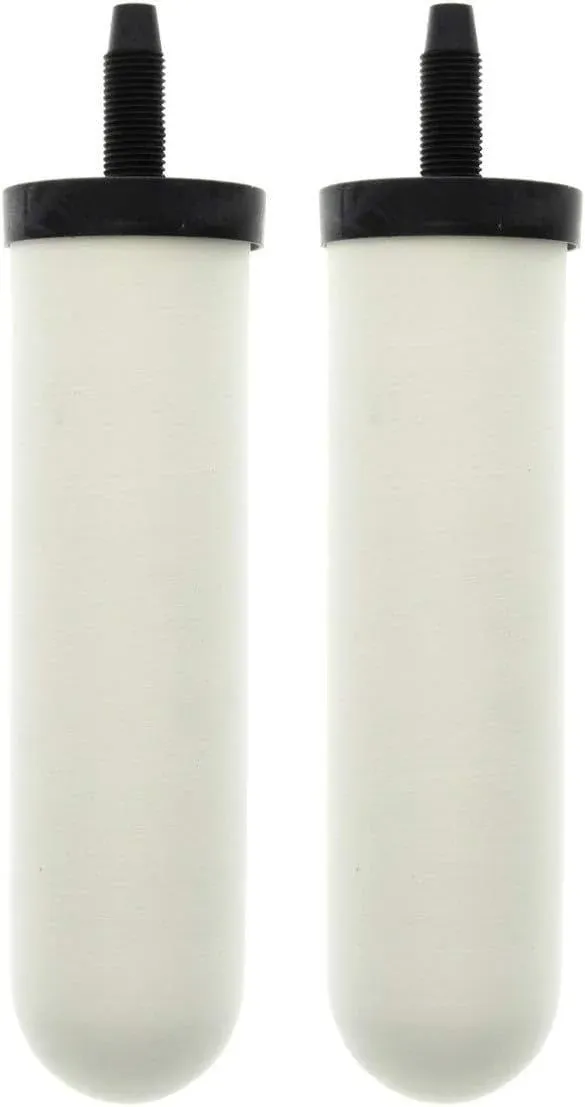
Doulton ATC Super Sterasyl Ceramic Water Filter for Gravity Systems (2-Pack)
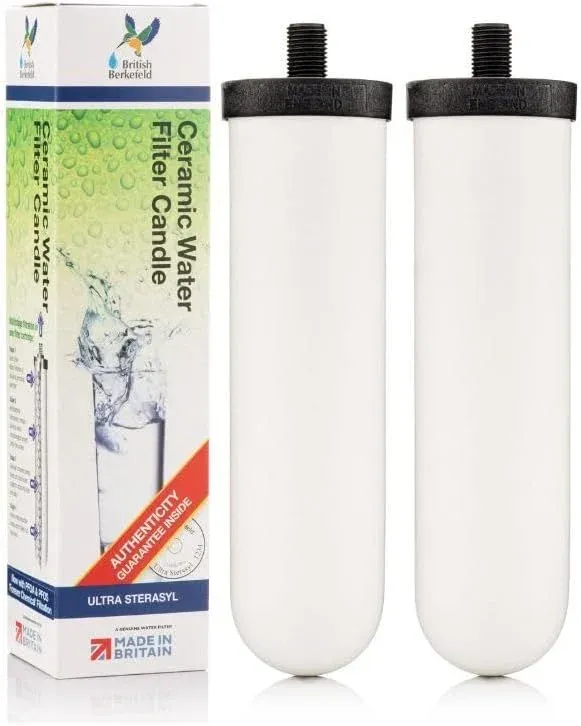
British Berkefeld Doulton Water Filter Candle BB9-2 Compatible (2-Pack)
At a Glance
| Feature | Editor's Pick Doulton ATC Super Sterasyl Ceramic Water Filter for Gravity Systems (2-Pack) | British Berkefeld Doulton Water Filter Candle BB9-2 Compatible (2-Pack) |
|---|---|---|
| Price | $50–$100 | $50–$100 |
| Filtration | Silver-impregnated ceramic + GAC + heavy metal media | Ceramic microfilter + GAC + heavy metal media (Ultra Sterasyl) |
| Filter Life | 400 gallons per filter (6 months) | 800 gallons per filter (6 months) |
| Certifications | NSF 42/53/372/401 | — |
| Contaminants | Bacteria 99.99%, cysts, chlorine, lead, microplastics, PFAS, pharmaceuticals | Bacteria 99.99%, cysts, chlorine, lead, pesticides, pharmaceuticals |
| Pack Size | — | — |
| Check Price | Check Price |
This is a comparison between two ceramic filter candles from the same heritage manufacturer — Doulton — sold under different brand names, at the same price, for the same gravity-fed systems. The differences are subtle but meaningful: one has the certifications, the other has the lifespan. Understanding which trade-off matters more for your household is the key to making the right choice.
Category-by-Category Breakdown
Certifications and Independent Testing
The Doulton Super Sterasyl holds NSF 42, 53, 372, and 401 certifications — the broadest independent testing portfolio of any gravity replacement filter on the market. NSF 42 covers chlorine taste and odor. NSF 53 covers health-related contaminants including lead, cysts, and volatile organic compounds. NSF 372 confirms lead-free compliance of the filter materials themselves. NSF 401 covers emerging contaminants including pharmaceuticals and herbicides. This means every performance claim Doulton makes has been independently verified by a third-party laboratory under controlled conditions.
The British Berkefeld BB9-2 candle carries no listed NSF certifications. Doulton manufactures both products, and the Ultra Sterasyl technology in the Berkefeld candle is derived from the same ceramic platform. But the absence of independent certification means the performance claims rest on manufacturer testing alone. For many gravity filter buyers, especially those who left Berkey specifically because of certification concerns, this distinction is significant. The Doulton Super Sterasyl was tested at both the 400-gallon and 800-gallon marks during NSF evaluation — the filter continued performing at 800 gallons, but Doulton chose the more conservative 400-gallon figure for certification. This conservative approach actually builds confidence in the stated numbers.
Independent certification is not just a badge — it is a fundamentally different standard of proof. NSF testing uses challenge water spiked with known concentrations of contaminants, measures the filter output at multiple points during its rated lifespan, and requires the filter to meet strict reduction thresholds at end-of-life. Without this testing, a manufacturer can claim any removal percentage based on internal lab conditions that may not reflect real-world use. The Doulton has passed this gauntlet. The Berkefeld has not.
Filter Lifespan and Replacement Frequency
The British Berkefeld BB9-2 candle is rated at 800 gallons per filter — exactly double the Doulton Super Sterasyl's 400-gallon rating. For a household filtering 3 gallons per day with a 2-filter system, the Berkefeld pair would last approximately 533 days (nearly 18 months) before replacement, while the Doulton pair would need replacing after about 267 days (roughly 9 months). That is a meaningful difference in both convenience and ongoing cost.
There is an important nuance here: the Doulton's 400-gallon rating is the NSF-certified lifespan — the point at which independent testing confirmed the filter still meets its stated reduction levels. The Berkefeld's 800-gallon rating is manufacturer-stated without independent certification. It is entirely plausible that the Doulton filter continues performing well beyond 400 gallons (Doulton's own testing showed performance at 800 gallons), but the certified conservative figure is what goes on the label. If you are comfortable relying on manufacturer claims, the Berkefeld's 800-gallon rating represents a significant practical advantage. If you want the certainty that comes with independent lab verification, the Doulton's 400-gallon rating is the only number you can fully trust.
For households tracking filter life by time rather than gallons, both manufacturers recommend a 6-month replacement cycle regardless of gallons filtered. This is a safety margin — ceramic candles can harbor bacteria if left in use too long, even if the flow rate remains acceptable. In practice, most gravity filter households replace on a time schedule rather than a gallon count, which narrows the effective difference between these two products.
Cost Per Gallon
Both 2-packs sell for $84, so the upfront cost is identical. The cost-per-gallon difference comes entirely from rated lifespan. At 400 gallons per filter (800 gallons per 2-pack), the Doulton Super Sterasyl costs approximately $0.105 per gallon. At 800 gallons per filter (1,600 gallons per 2-pack), the Berkefeld BB9-2 costs approximately $0.053 per gallon — exactly half. Over a full year of filtering 3 gallons per day (roughly 1,095 gallons), the Doulton would require about 1.4 replacement cycles ($117.60 annual cost), while the Berkefeld would need about 0.68 cycles ($57.12 annually). The Berkefeld saves roughly $60 per year in replacement filter costs.
However, this math assumes you trust and use the 800-gallon rating for the Berkefeld. If you apply a more conservative approach — say, replacing Berkefeld candles at 600 gallons as a safety margin since the rating is not independently certified — the annual savings narrow to around $30. The Doulton's cost premium is essentially the price of independent certification: you are paying more per gallon for the assurance that your filter is performing as claimed at the rated end-of-life point.
Filtration Technology
Both candles use Doulton's 0.9-micron absolute ceramic outer shell — the same base technology that has protected against waterborne pathogens for over two centuries. The ceramic micropore structure physically blocks bacteria (99.99%), cysts, sediment, and particles larger than 0.9 microns. Both candles are impregnated with silver to inhibit bacterial growth on the ceramic surface during storage and between uses.
Inside the ceramic shell, both filters contain granular activated carbon (GAC) for chlorine, taste, and odor reduction, plus a heavy metal reduction media targeting lead and other dissolved metals. The Doulton Super Sterasyl uses what Doulton calls the "ATC" (Activated Carbon + Trace) formulation, while the Berkefeld uses the "Ultra Sterasyl" formulation. Doulton does not publicly detail the precise media differences between these two formulations, but the shared ceramic shell, shared factory, and shared parent company mean the core filtration mechanism is fundamentally the same.
The practical difference in filtration comes down to what has been proven versus what is claimed. The Doulton Super Sterasyl's NSF 53 certification means lead, cyst, and VOC removal has been independently verified. Its NSF 401 certification means pharmaceutical and emerging contaminant removal has been verified. The Berkefeld claims bacteria, cyst, chlorine, lead, pesticide, and pharmaceutical removal — but without independent certification, these are marketing claims supported by manufacturer testing rather than third-party verification. The technology is similar; the burden of proof is not.
Compatibility and Fit
Both candles use the standard 7-inch gravity filter form factor with approximately 2-inch diameter stems. Both fit Berkey systems (Travel, Big, Royal, Imperial, Crown), British Berkefeld systems, Doulton systems, ProOne systems, Alexapure, Purewell, and Phoenix gravity filters. There is no practical compatibility difference between these two products — if one fits your system, the other will too.
The Berkefeld BB9-2 candle is specifically marketed as a direct Berkey BB9-2 replacement, which gives it a slight advantage in discoverability for Berkey owners searching for replacement filters. The Doulton Super Sterasyl is marketed more broadly as a Doulton/gravity system candle. But in terms of physical fit, thread pattern, and gasket seal, the two are interchangeable in any compatible gravity system.
One subtle difference worth noting: the Berkefeld candle ships with no priming required — it works immediately out of the box. The Doulton Super Sterasyl also requires minimal priming but benefits from a brief soak to ensure even flow from the first fill. Neither requires the extensive priming process that some carbon block filters demand, which is a general advantage of ceramic technology.
Brand Reputation and Track Record
Both products come from the Doulton family, which has manufactured ceramic water filters in Staffordshire, England since 1826. Queen Victoria commissioned the first Doulton ceramic filter for the royal household. British Berkefeld is a Doulton sub-brand that has historically supplied ceramic candles to humanitarian and military applications worldwide. The manufacturing heritage is shared and impeccable.
The key difference is in the marketplace: the Doulton Super Sterasyl 2-pack has 85 Amazon reviews with a 4.3-star rating, while the Berkefeld BB9-2 2-pack has only 25 reviews with a 3.9-star rating. The Berkefeld's lower review count reflects a newer ASIN listing rather than an inferior product — the candle technology has been in continuous production for decades, but this particular Amazon listing is recent. Buyers who rely heavily on review volume may find the Doulton's larger review base more reassuring, but neither product has the thousands of reviews that mainstream filters like Waterdrop or Brita accumulate.
Who Should Get Which?
Get the Doulton ATC Super Sterasyl Ceramic Water Filter for Gravity Systems (2-Pack) if...
- Independent NSF certification is non-negotiable for your peace of mind
- You left Berkey specifically because of certification concerns
- You want verified pharmaceutical and emerging contaminant removal (NSF 401)
- You prefer a product with more Amazon reviews and community feedback
- You are on well water or untreated source water and need proven pathogen reduction
Get the British Berkefeld Doulton Water Filter Candle BB9-2 Compatible (2-Pack) if...
- Longer filter lifespan is your top priority — 800 gal vs 400 gal
- You want the lowest replacement cost from a UK-made ceramic candle
- You are comfortable with manufacturer-stated performance without NSF certification
- You already use Berkey and want a familiar BB9-2 form factor drop-in
- Convenience matters — fewer filter changes per year
Pro Tip: If you cannot decide between certification and lifespan, here is a practical approach: start with the Doulton Super Sterasyl to establish a baseline of certified filtration performance in your system. After one full replacement cycle, if you are satisfied with the flow rate and taste, consider switching to the Berkefeld for the cost savings on subsequent replacements. Both use the same mounting system, so swapping is seamless.
The Bigger Picture: Why Both Are Strong Choices
It is easy to get caught up in the differences between these two candles, but the reality is that both are excellent ceramic gravity filter replacements — far superior to the unregulated alternatives flooding the market. Both are manufactured in the UK by a company with genuine expertise in ceramic water filtration. Both use 0.9-micron absolute ceramic with silver impregnation. Both remove bacteria, cysts, chlorine, lead, and a wide range of chemical contaminants. The choice between them is a matter of priorities — verified performance versus extended lifespan — not a question of good versus bad.
For context, many gravity filter owners are replacing Berkey Black elements that lack any NSF certification and have faced growing scrutiny from independent testers and regulatory bodies. Both the Doulton and Berkefeld represent significant upgrades in transparency and manufacturing standards over those elements. If you are switching from Berkey elements to either of these Doulton-manufactured candles, you are making a clear step forward regardless of which one you choose.
The ceramic filtration approach shared by both candles also offers a key advantage over carbon-only alternatives like the Waterdrop BB9-2: a physical pathogen barrier. Carbon filters can adsorb chemicals and improve taste, but they cannot physically block bacteria or cysts the way a 0.9-micron ceramic shell can. If your water source has any risk of biological contamination — well water, rainwater collection, or questionable municipal treatment — ceramic is the technology you want between you and your drinking glass.
Frequently Asked Questions
Are Doulton Super Sterasyl and British Berkefeld made by the same company?
Why does the Berkefeld candle last 800 gallons when the Doulton only lasts 400?
Do either of these filters remove fluoride?
Can I use the Doulton Super Sterasyl in a Berkey system?
What does the red dye test prove, and do these filters pass it?
How often should I scrub or clean these ceramic candles?
Our Final Recommendation
For most gravity filter owners, we recommend the Doulton Super Sterasyl as the default choice. The NSF 42/53/372/401 certification stack is the most comprehensive available in any gravity replacement filter, and the peace of mind that comes with independently verified performance is worth the higher per-gallon cost. When you install a Doulton Super Sterasyl, you know — not hope, not assume, but know — that your water is being filtered to the standards printed on the label.
The British Berkefeld BB9-2 earns a genuine recommendation for cost-conscious households on treated municipal water where the primary goal is taste improvement and general contaminant reduction rather than maximum verified protection. The 800-gallon lifespan cuts your annual replacement costs in half, and the Doulton manufacturing heritage behind the product provides reasonable confidence even without independent certification. Just understand that you are trading verification for value.
If your water source involves any biological risk — private wells, rainwater harvesting, travel, or emergency preparedness — the Doulton Super Sterasyl's certified pathogen reduction performance makes it the only responsible choice between these two. Certification matters most when the stakes are highest.