British Berkefeld 4-Sterasyl vs ProOne 3-Gallon: Which Gravity Filter Wins in 2026?
Quick Verdict: The ProOne 3-Gallon wins on certifications and total value with IAPMO-certified NSF 42/53/401/372 coverage, built-in fluoride removal, and 3,000 gallons of total filter life out of the box. The British Berkefeld 4-Sterasyl wins on heritage, ceramic purity, and the security of a 200-year-old filter brand with no discontinuation risk. Both are excellent Big Berkey alternatives — your choice depends on whether you prioritize certification breadth or brand longevity.
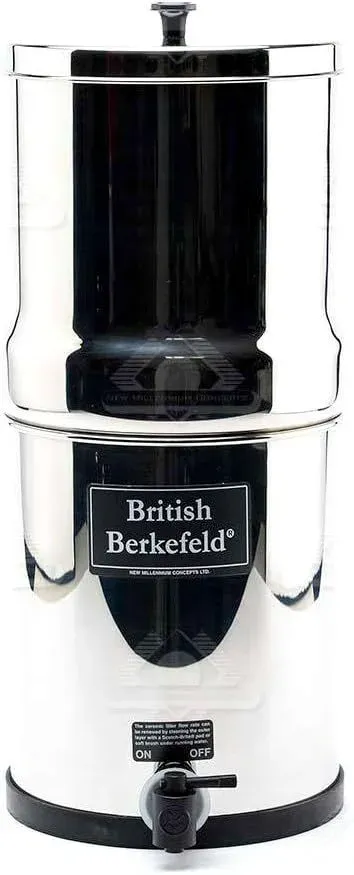
British Berkefeld Gravity Water Filter with 4 Super Sterasyl Ceramic Elements
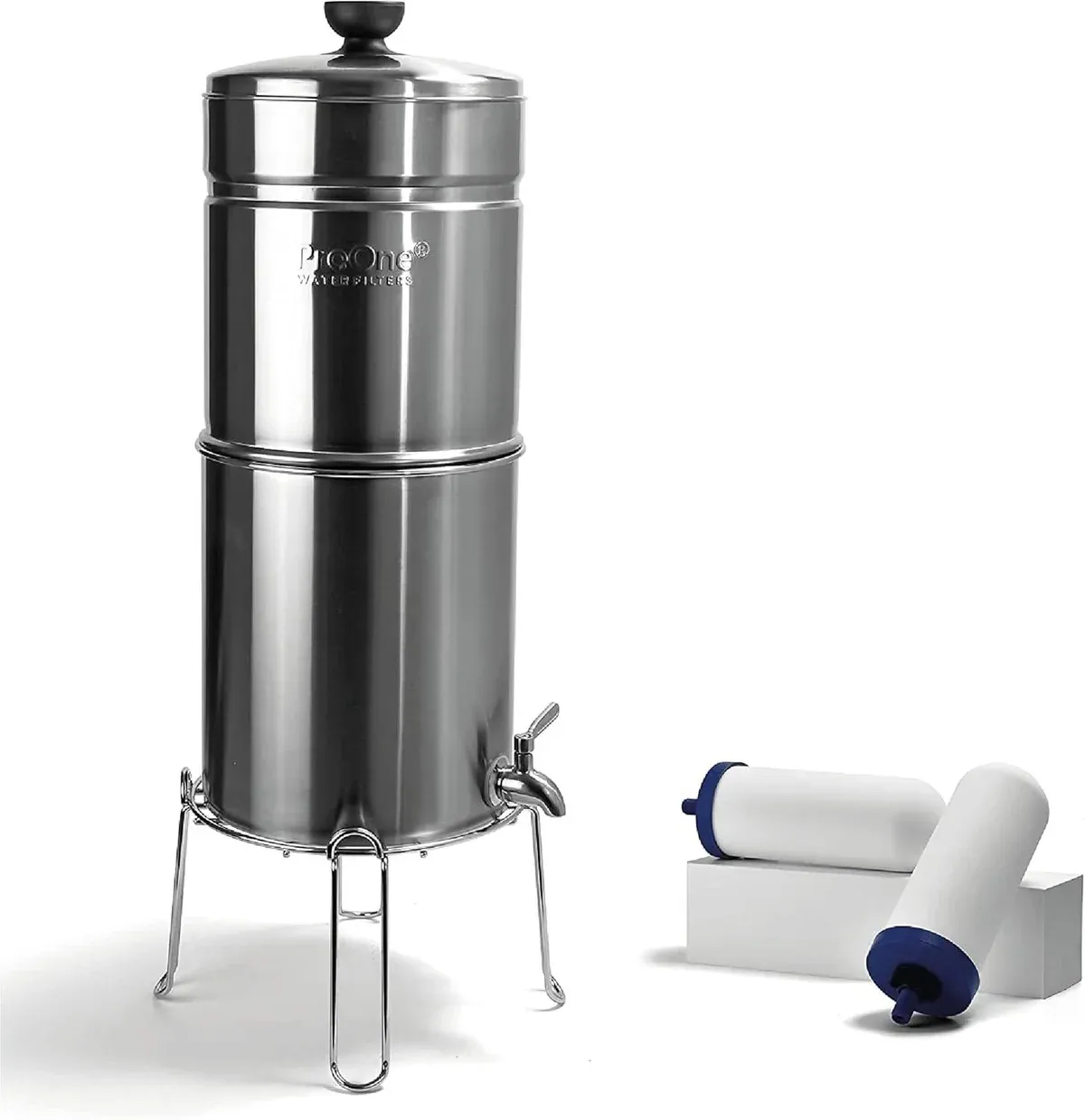
ProOne Gravity Water Filter System 3 Gallon with 3 Filter Elements
At a Glance
| Feature | British Berkefeld Gravity Water Filter with 4 Super Sterasyl Ceramic Elements | Editor's Pick ProOne Gravity Water Filter System 3 Gallon with 3 Filter Elements |
|---|---|---|
| Price | $250–$500 | $250–$500 |
| Filtration | Triple-stage ceramic (0.2 micron shell + GAC + heavy metal media) | 3-stage G3.0 (ceramic shell + carbon granular media + carbon block core) |
| Capacity | ~2.1 gallons | 3 gallons |
| Flow Rate | ~1 GPH (4 filters) | ~0.78 GPH (3 filters) |
| Filter Life | 400 gallons per filter | 1,000 gallons per filter |
| Certifications | NSF/ANSI 401 | IAPMO — NSF 42/53/401/372 |
| Contaminants | Bacteria 99.99%, cysts 99.99%, chlorine 99%, lead, PFAS, microplastics, pesticides | 200+ including lead, fluoride, PFAS, chlorine, microplastics, bacteria, pharmaceuticals |
| Weight | ~9 lbs | ~10 lbs |
| Check Price | Check Price |
The British Berkefeld and ProOne represent two distinct philosophies in gravity water filtration. The Berkefeld carries 200 years of UK ceramic expertise from Doulton — the company that invented modern ceramic water filtration in 1826. The ProOne takes a newer American approach, combining ceramic shells with carbon block cores for hybrid filtration. Both emerged as leading alternatives after the Big Berkey's EPA regulatory troubles, and both deliver genuinely clean drinking water. This comparison breaks down exactly where each system excels and where it falls short.
Category-by-Category Breakdown
Certification & Third-Party Validation
The ProOne holds the broadest certification stack of any gravity filter we have reviewed. Its IAPMO certification covers NSF 42 (taste and odor), NSF 53 (health-effect contaminants including lead, cysts, and VOCs), NSF 401 (emerging contaminants like pharmaceuticals and herbicides), and NSF 372 (lead-free compliance). That is four standards verified by an accredited third-party laboratory — a level of validation that no other gravity system matches.
The British Berkefeld carries NSF/ANSI 401 certification for emerging contaminants, which is a meaningful credential. NSF 401 specifically covers incidental contaminants like prescription drugs, over-the-counter medications, and herbicides that conventional filters may miss. The Berkefeld's certification comes directly from NSF International rather than through IAPMO, and some industry observers consider direct NSF certification to carry marginally more weight. However, both IAPMO and NSF are ANSI-accredited certification bodies, so the practical difference is minimal.
The bottom line is that the ProOne covers more standards, while the Berkefeld covers one standard through the most recognized name in water certification. For buyers who want the broadest documented proof of contaminant removal — especially for lead (NSF 53) and lead-free materials (NSF 372) — the ProOne's four-standard stack is the stronger credential package.
Filtration Technology & Approach
The British Berkefeld uses a triple-stage ceramic approach that has been refined over two centuries. Each Ultra Sterasyl filter starts with a 0.2-micron ceramic shell that physically blocks bacteria, cysts, and sediment. Inside the ceramic shell sits a bed of granular activated carbon for chemical adsorption, followed by a heavy metal reduction media layer. This is pure ceramic-centric filtration — the ceramic does the heavy lifting, and the internal media handles chemical contaminants.
The ProOne G3.0 takes a different architectural approach. It also starts with a ceramic shell, but the internal structure combines granular carbon media with a pressed carbon block core. The carbon block provides significantly more surface area for chemical adsorption than loose granular media alone. ProOne also integrates activated alumina into the carbon core for fluoride adsorption — something the Berkefeld cannot do without a completely separate filter variant.
Both approaches deliver excellent contaminant removal. The Berkefeld's 0.2-micron rating provides documented particle rejection, while the ProOne's ceramic-carbon hybrid covers a broader chemical spectrum including fluoride. For pure mechanical filtration precision, the Berkefeld's documented micron rating gives it an edge in transparency. For chemical breadth and fluoride coverage, the ProOne's hybrid design is more versatile. Neither approach is objectively superior — they represent different engineering philosophies that achieve comparable results through different means.
Flow Rate & Daily Throughput
The British Berkefeld with 4 Ultra Sterasyl filters delivers approximately 1 GPH (gallon per hour). The ProOne 3-Gallon with 3 G3.0 filters produces approximately 0.78 GPH. Neither system is fast by any standard — both require patience and planning to maintain a full supply of filtered water for a household.
In practical daily use, the Berkefeld's flow rate advantage means it can refill its ~2.1-gallon lower chamber in roughly two hours versus nearly four hours for the ProOne to fill its 3-gallon lower chamber. However, the ProOne's larger capacity partially offsets its slower flow — once full, the 3-gallon reservoir holds more water before you need to refill the upper chamber again. For a family of four consuming 1 gallon of filtered water per day for drinking and cooking, both systems require one full cycle daily.
It is worth noting that both flow rates degrade as filters accumulate sediment. The Berkefeld's ceramic shells can be scrubbed with a Scotch-Brite pad to restore flow, which is a faster and simpler maintenance process than the ProOne's cleaning protocol. For users in areas with higher sediment loads — well water, rural sources, or post-storm municipal water — the Berkefeld's easier flow restoration is a practical advantage that compounds over time.
Filter Life & Ongoing Cost
The ProOne G3.0 filters are rated for 1,000 gallons each, and the 3-Gallon system ships with 3 filters — giving you 3,000 gallons of total filter capacity before any replacements are needed. The British Berkefeld Ultra Sterasyl filters are rated for 400 gallons each, and the system ships with 4 filters — giving you 1,600 gallons of total capacity before replacement.
That is a substantial difference in long-term value. At an average household consumption of 1 gallon per day, the ProOne's filters last approximately 8.2 years before all three need replacement, while the Berkefeld's four filters last approximately 4.4 years. The per-gallon cost of filtration with the ProOne is roughly half that of the Berkefeld over the life of the included filters.
The Berkefeld partially compensates with its scrub-cleanable ceramic shells, which can extend practical lifespan beyond the rated 400 gallons in some conditions. Doulton recommends scrubbing the ceramic exterior when flow rate drops noticeably — each scrub removes a thin layer of the ceramic and trapped contaminants, effectively renewing the filter surface. However, even with aggressive maintenance, the rated capacity difference is significant enough that the ProOne delivers better per-gallon economics.
Build Quality & Brand Heritage
The British Berkefeld is manufactured by Doulton, a company founded in 1826 that invented the modern ceramic water filter for Queen Victoria. The Ultra Sterasyl filters are made at Doulton's Staffordshire factory in England — the same facility that has produced ceramic filters for nearly two centuries. This is not a marketing story; it is a manufacturing lineage that predates modern water treatment entirely. The stainless steel housing is polished 304 grade, and the overall construction reflects mature industrial design.
The ProOne system uses the same 304 stainless steel for its housing, and the build quality is solid. The G3.0 filters are manufactured in the United States. ProOne has built a strong reputation in the gravity filter community over the past decade, particularly after the Big Berkey's regulatory issues created a market opening. However, ProOne is currently transitioning its product line to the Culligan MaxClear brand, which introduces uncertainty about long-term parts availability and brand continuity.
For buyers who value manufacturing heritage and the confidence that replacement filters will be available in 10 or 20 years, the Berkefeld's Doulton-backed supply chain is a significant advantage. Doulton has survived two world wars, multiple economic downturns, and two centuries of competition — the filters will be available. ProOne's Culligan transition may ultimately be positive (Culligan is a large, established water treatment company), but the transition itself creates a window of uncertainty that the Berkefeld simply does not have.
Fluoride & Specialty Contaminant Removal
The ProOne G3.0 removes fluoride as part of its standard filtration process — no additional filters, no special configuration, no extra cost. The activated alumina media integrated into the carbon core adsorbs fluoride during normal operation. For the estimated 73% of Americans on fluoridated municipal water who want to reduce their fluoride exposure, this is a genuine convenience advantage.
The British Berkefeld requires a separate Ultra Fluoride filter variant to address fluoride, and critically, you cannot mix Ultra Sterasyl and Ultra Fluoride filters in the same unit. This means choosing between the Ultra Sterasyl's broader contaminant removal and the Ultra Fluoride's fluoride-specific capability — you cannot have both simultaneously. For households that want both general contaminant removal and fluoride reduction from a single gravity system, the ProOne is the only option that delivers both without compromise.
Who Should Get Which?
Get the British Berkefeld Gravity Water Filter with 4 Super Sterasyl Ceramic Elements if...
- You value manufacturing heritage and want filters from a 200-year-old company
- Long-term parts availability is a top priority — Doulton filters will be available for decades
- You prefer pure ceramic filtration technology with a documented 0.2-micron rating
- You want faster flow rate (~1 GPH vs ~0.78 GPH) for daily convenience
- Fluoride removal is not a concern for your water supply
- You want easy maintenance — scrubbing the ceramic shell is simple and effective
- You are uncomfortable with ProOne's transition to the Culligan MaxClear brand
Get the ProOne Gravity Water Filter System 3 Gallon with 3 Filter Elements if...
- You want the broadest certification stack — IAPMO-certified NSF 42/53/401/372
- Built-in fluoride removal matters — no add-on filters or compromises needed
- Long-term filter cost is a priority — 3,000 gallons total capacity vs 1,600
- You need more reservoir capacity — 3 gallons vs approximately 2.1 gallons
- You want ceramic-carbon hybrid filtration for broader chemical coverage
- You are comfortable with the Culligan MaxClear transition and believe it will improve availability
Pro Tip: Both the Berkefeld and ProOne gravity systems benefit enormously from pre-filtering visibly turbid water through a clean cloth or coffee filter before pouring it into the upper chamber. This removes large sediment particles that would otherwise clog the ceramic pores prematurely, extending filter life and maintaining flow rate. This simple step is especially important for the Berkefeld, whose 400-gallon filter rating is more sensitive to sediment loading than the ProOne's 1,000-gallon rating. For well water or any source with visible particulates, pre-filtering can effectively double the time between filter replacements.
How Both Compare to the Big Berkey
Both the British Berkefeld and ProOne emerged as primary alternatives after the Big Berkey's EPA Stop Sale Order in late 2022. The Big Berkey offers superior flow rate (3.5 GPH) and dramatically longer filter life (6,000 gallons per pair), but it carries no NSF or IAPMO certification and faces ongoing regulatory uncertainty regarding its silver-based filtration media classified as a pesticide under FIFRA.
The Berkefeld trades the Big Berkey's speed for ceramic purity and NSF 401 certification from the most recognized name in water testing. The ProOne trades the Big Berkey's flow rate for the broadest certification stack of any gravity system and built-in fluoride removal. Both represent a conscious trade-off: sacrificing throughput speed for certified, independently validated filtration that does not depend on the outcome of an EPA legal proceeding.
For buyers who previously owned a Big Berkey and want a drop-in replacement, the Berkefeld's stainless steel housing has the same 8.5-inch diameter and similar height — it occupies the same counter space. The ProOne's 9-inch diameter and taller profile (22.75 inches plus a 6-inch stand) requires slightly more vertical clearance, which can be a concern under kitchen cabinets. Both accept their respective filters without tools, and both operate on the same gravity-fed principle with no electricity or plumbing required.
Real-World Ownership Considerations
Living with either system daily reveals practical differences that spec sheets do not capture. The British Berkefeld's polished stainless steel shows fingerprints and water spots more readily than the ProOne's brushed (on some models) or polished finish. Both require periodic cleaning of the housing — warm water and mild soap for the exterior, and a vinegar soak for the lower chamber to prevent mineral buildup.
The Berkefeld's four-filter configuration means each individual filter handles a quarter of the total load, which can extend practical per-filter lifespan slightly compared to the ProOne's three-filter arrangement where each filter handles a third of the load. However, this advantage is modest and does not significantly change the overall economics in the ProOne's favor on total capacity.
Both systems have a critical design limitation shared by all stainless steel gravity filters: there is no water level indicator on the lower chamber. Without lifting the upper chamber to peek inside (awkward with a full upper reservoir) or tapping the side to listen for water level, you cannot tell when the lower chamber is approaching capacity. Overfilling results in water backing up into the upper chamber and potentially overflowing. Experienced users develop a refill rhythm based on their household consumption, but new users should monitor closely for the first week to establish that pattern.
Counter space and kitchen aesthetics are also worth factoring into your decision. The Berkefeld's compact footprint and classic polished cylinder profile tends to blend into kitchen décor more discreetly, while the ProOne's taller stance on its included stand makes it more prominent on a countertop. If you plan to store the filter inside a cabinet between uses, verify the assembled height against your available clearance before purchasing either system.
Frequently Asked Questions
What is the main difference between British Berkefeld and ProOne gravity filters?
Which gravity filter has better certifications — Berkefeld or ProOne?
Are British Berkefeld filters compatible with ProOne systems?
Does the ProOne really remove fluoride without add-on filters?
How do replacement filter costs compare between Berkefeld and ProOne?
Is ProOne being discontinued and should I still buy one?
Which system is better for emergency preparedness or off-grid use?
Our Final Recommendation
After comparing both systems across certifications, filtration technology, flow rate, filter life, build quality, and specialty contaminant removal, we believe the right choice depends on what you value most in a gravity filter.
The British Berkefeld 4-Sterasyl is the gravity filter for buyers who want proven ceramic heritage, manufacturing continuity they can count on for decades, and the confidence of NSF-certified filtration from the company that invented modern ceramic water treatment. Its faster flow rate and simpler maintenance protocol make it the more convenient daily-use system. If fluoride removal is not a concern and you want the system most likely to still have replacement filters available in 2046, the Berkefeld is the safer long-term investment.
The ProOne 3-Gallon is the gravity filter for buyers who want the most comprehensive certification package, built-in fluoride removal without compromise, and the lowest long-term cost per gallon. Its 3,000-gallon total filter capacity and broader NSF coverage make it the strongest value proposition on paper. The Culligan MaxClear transition introduces some uncertainty, but the underlying filtration technology and stainless steel housing will continue to function regardless of the brand name on replacement filters.
Both are genuinely excellent gravity filter systems that outperform the Big Berkey on certification credibility. You cannot make a bad choice between these two — only a choice that better fits your specific priorities.
Track Both Products
We'll email you if either price drops or availability changes.
Only when something changes. Unsubscribe anytime.