British Berkefeld W9361139 vs ProOne 3-Gallon: Which Gravity Filter Is Right for You in 2026?
Quick Verdict: The ProOne 3-Gallon is the better value for most households — it holds more water, removes fluoride without add-on filters, carries broader certifications (NSF 42/53/401/372), and costs less per gallon of filtered water over its lifetime. The British Berkefeld W9361139 is the right choice if you prioritize UK ceramic heritage, faster flow rate, and the long-term certainty that Doulton replacement filters will never be discontinued.
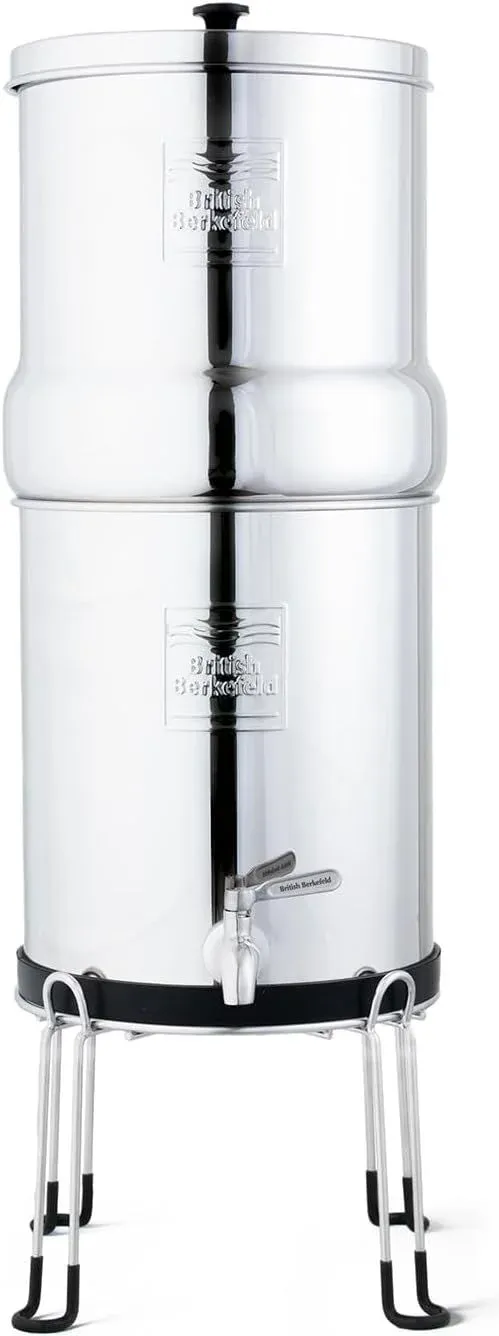
British Berkefeld Doulton W9361139 Gravity Countertop Water Filtration System
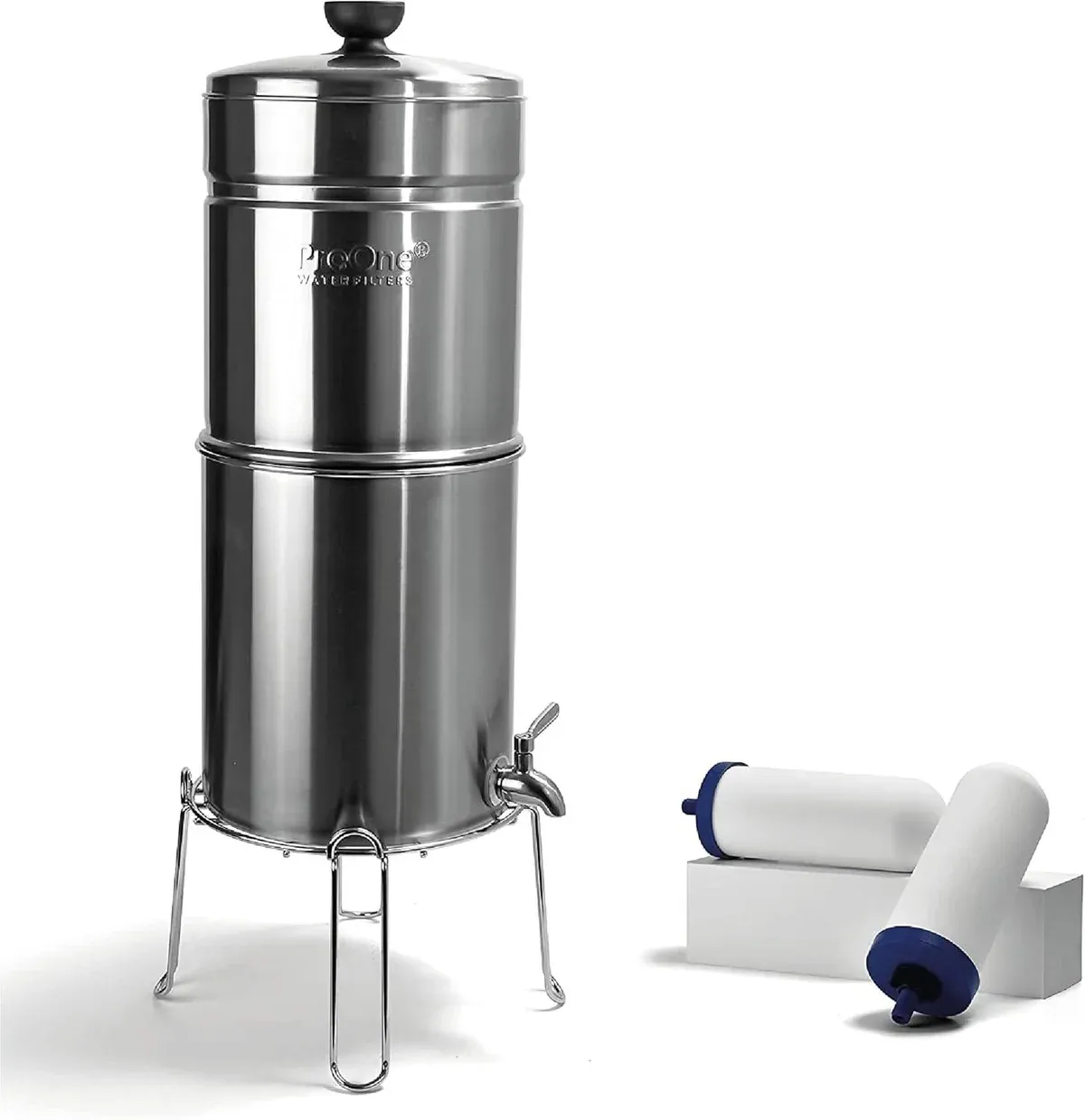
ProOne Gravity Water Filter System 3 Gallon with 3 Filter Elements
At a Glance
| Feature | British Berkefeld Doulton W9361139 Gravity Countertop Water Filtration System | Editor's Pick ProOne Gravity Water Filter System 3 Gallon with 3 Filter Elements |
|---|---|---|
| Price | $250–$500 | $250–$500 |
| Filtration | Triple-stage ceramic (0.2 micron shell + GAC + heavy metal media) | 3-stage G3.0 (ceramic shell + carbon granular media + carbon block core) |
| Capacity | 2.25 gallons | 3 gallons |
| Flow Rate | ~1-2 GPH (4 filters) | ~0.78 GPH (3 filters) |
| Filter Life | 400 gallons per filter | 1,000 gallons per filter |
| Certifications | NSF/ANSI 401 | IAPMO — NSF 42/53/401/372 |
| Contaminants | Bacteria 99.99%, cysts, chlorine, lead, PFAS, microplastics, pharmaceuticals | 200+ including lead, fluoride, PFAS, chlorine, microplastics, bacteria, pharmaceuticals |
| Weight | ~9 lbs | ~10 lbs |
| Check Price | Check Price |
The British Berkefeld W9361139 and ProOne 3-Gallon are two of the most credible gravity filter alternatives on the market since the Big Berkey's EPA regulatory troubles. Both are stainless steel countertop systems that require no electricity or plumbing. But they take notably different approaches to filtration — the Berkefeld relies on 200 years of Doulton ceramic expertise, while the ProOne combines ceramic with carbon block technology for hybrid contaminant removal. This comparison examines every meaningful difference to help you choose the right system for your household.
Category-by-Category Breakdown
Reservoir Capacity & Household Sizing
The ProOne 3-Gallon holds 3 gallons in its lower reservoir — 33% more than the Berkefeld W9361139's 2.25-gallon capacity. For a two-person household, the Berkefeld's capacity is adequate for daily drinking water needs. For families of three or more, or households that use filtered water for cooking, coffee, pet bowls, and plant watering in addition to drinking, the ProOne's extra capacity meaningfully reduces how often you need to initiate a filter cycle.
The capacity difference becomes more significant in emergency scenarios. During a water disruption event where you are filtering stored or collected water, the ProOne's 3-gallon reservoir provides a larger buffer against consumption fluctuations. If you are filtering water for four people during a power outage, the Berkefeld requires more frequent refilling of the upper chamber to keep pace with demand. In a grid-down situation where you are also filtering water for cooking (rice, pasta, reconstituting freeze-dried meals), the extra 0.75 gallons adds up across multiple uses per day.
From a counter space perspective, the ProOne's larger capacity comes with a larger footprint. The ProOne measures 9 inches in diameter versus the Berkefeld's 8.5 inches, and the ProOne stands 22.75 inches tall plus a 6-inch stand — potentially 28.75 inches total. The Berkefeld at 19.25 inches fits under most standard upper kitchen cabinets. If vertical clearance is limited in your kitchen, measure before purchasing the ProOne.
Certification & Independent Testing
The ProOne carries IAPMO certification to four NSF standards: NSF 42 (aesthetic effects including chlorine taste and odor), NSF 53 (health effects including lead, cysts, and VOCs), NSF 401 (emerging contaminants including pharmaceuticals and herbicides), and NSF 372 (lead-free compliance of the system's materials). This is the broadest certification stack of any gravity filter system currently available.
The British Berkefeld W9361139 carries NSF/ANSI 401 certification for emerging contaminants, issued directly by NSF International. NSF 401 covers a specific category of trace-level contaminants — prescription drugs, over-the-counter medications, herbicides like atrazine, and personal care product compounds — that conventional water treatment may not fully remove. This is a meaningful certification, but it covers a narrower scope than the ProOne's four-standard package.
A nuance worth understanding: the Berkefeld's certification is component-level (the filter elements are certified), while the ProOne's IAPMO certification covers the filter elements as tested in their intended system configuration. Both approaches are valid under ANSI accreditation. For practical purposes, the difference that matters most to buyers is breadth — the ProOne's NSF 53 certification specifically validates lead removal performance, which the Berkefeld's NSF 401 alone does not cover. If documented lead removal certification is important to you, the ProOne is the stronger choice.
Flow Rate & Filtration Speed
The British Berkefeld W9361139 with 4 Ultra Sterasyl filters produces approximately 1-2 GPH depending on water temperature and filter condition. The ProOne 3-Gallon with 3 G3.0 filters delivers approximately 0.78 GPH. The Berkefeld is noticeably faster, especially with freshly cleaned or new filters.
In daily use, the speed difference translates to meaningful convenience. If you empty the lower chamber first thing in the morning and refill the upper chamber, the Berkefeld can have 2+ gallons of filtered water ready in under two hours. The ProOne takes closer to four hours to fill its larger 3-gallon lower reservoir. For households that consume most of their filtered water during specific windows — morning coffee and breakfast, evening cooking and drinking — the Berkefeld's faster turnaround means you are less likely to find the lower chamber empty at peak demand times.
Both flow rates degrade over time as the ceramic filter pores accumulate sediment and mineral deposits. The Berkefeld's Ultra Sterasyl ceramic shells are designed for periodic scrubbing with a non-metallic scouring pad, which physically removes the outer layer of trapped contaminants and restores flow rate almost immediately. The ProOne's G3.0 filters can also be surface-cleaned, but the integrated carbon media beneath the ceramic shell means aggressive scrubbing risks damaging the internal filtration layers. Berkefeld's maintenance simplicity contributes to more consistent real-world flow performance over the filter's lifespan.
Fluoride Removal Capability
The ProOne G3.0 filter elements include activated alumina media integrated directly into the carbon block core, providing fluoride adsorption as part of the standard filtration process. No additional filters, no extra cost, no configuration changes — fluoride removal is built into every G3.0 element that ships with the system.
The British Berkefeld W9361139 does not remove fluoride with its standard Ultra Sterasyl filters. To address fluoride, you would need to purchase the separate Ultra Fluoride filter variant. However, Doulton states that you cannot mix Ultra Sterasyl and Ultra Fluoride filters in the same unit — meaning you must choose between the Ultra Sterasyl's broader contaminant removal and the Ultra Fluoride's fluoride-specific capability. This is a significant design limitation for households on fluoridated municipal water that want comprehensive contaminant removal and fluoride reduction from the same system.
Approximately 73% of the US population receives fluoridated water. If you are among them and want fluoride reduction from your gravity filter, the ProOne is the only option that provides it without compromise. The Berkefeld forces an either/or choice that most buyers will find frustrating once they understand the limitation.
Filter Longevity & Replacement Economics
The ProOne G3.0 filters are rated for 1,000 gallons each. With 3 filters included, the total capacity out of the box is 3,000 gallons. The British Berkefeld Ultra Sterasyl filters are rated for 400 gallons each. With 4 filters included, the total capacity is 1,600 gallons. The ProOne delivers nearly double the total filter capacity at a comparable system price.
For a household filtering 1 gallon per day, the ProOne's three filters last approximately 8.2 years before all three need replacing. The Berkefeld's four filters last approximately 4.4 years at the same usage rate. That is a 3.8-year difference in time-to-first-replacement, which translates directly into real cost savings — you defer the expense of replacement filters for nearly four additional years with the ProOne.
The Berkefeld's ceramic scrub-cleaning capability does extend practical life beyond the rated 400 gallons in favorable conditions. Doulton's own guidance suggests that a well-maintained Ultra Sterasyl filter on clean municipal water can last 6-12 months between replacements depending on usage volume. But even with aggressive maintenance, the per-gallon economics favor the ProOne by a meaningful margin. If you are evaluating total cost of ownership over a 10-year horizon, the ProOne is the more economical system despite the two products sitting in a similar mid-range price tier at purchase.
Brand Longevity & Parts Availability
The British Berkefeld is manufactured by Doulton, which has been producing ceramic water filters since 1826 — nearly 200 years of continuous operation. The Ultra Sterasyl filter design has been in production for decades, and Doulton shows no signs of discontinuing the product line. The Staffordshire factory that produces these filters has survived two world wars and multiple economic cycles. When you buy a Berkefeld system, you are buying into a supply chain that has proven its staying power across centuries.
ProOne is currently transitioning its product line to the Culligan MaxClear brand. Culligan is a large, well-established water treatment company with significant manufacturing and distribution resources, so the long-term outlook may actually be positive — more production capacity, wider retail distribution, and the backing of a major corporation. However, the transition itself creates a period of uncertainty. Existing ProOne G3.0 filters are available while supplies last, and the Culligan MaxClear replacement filters are expected to use the same or similar filtration technology. But "expected to" is not the same as "guaranteed to" for a buyer making a 10-year commitment to a filtration platform.
For buyers who value certainty above all else — especially preppers building long-term emergency water infrastructure — the Berkefeld's Doulton heritage provides a level of supply chain confidence that ProOne's brand transition simply cannot match right now. This is not a criticism of ProOne's product quality; it is an observation about timing and uncertainty.
Who Should Get Which?
Get the British Berkefeld Doulton W9361139 Gravity Countertop Water Filtration System if...
- Brand heritage and supply chain certainty are top priorities for you
- You want faster flow rate for quicker daily turnaround (~1-2 GPH vs ~0.78 GPH)
- Fluoride removal is not a concern for your household water supply
- You prefer pure ceramic filtration with easy scrub-clean maintenance
- Kitchen cabinet clearance is limited — the Berkefeld is 9.5 inches shorter
- You are building a prepper water system and want guaranteed long-term filter availability
Get the ProOne Gravity Water Filter System 3 Gallon with 3 Filter Elements if...
- You want the broadest certification package — IAPMO NSF 42/53/401/372
- Built-in fluoride removal is important for your fluoridated water supply
- You need 3 gallons of capacity for a family of 3+ or cooking use
- Long-term filter economics matter — 3,000 gallons vs 1,600 gallons total capacity
- You value ceramic-carbon hybrid technology for broader chemical coverage
- You are comfortable with the Culligan MaxClear transition timeline
Pro Tip: Regardless of which system you choose, always prime new filters according to the manufacturer's instructions before first use. The ProOne G3.0 filters have a documented break-in period where you may notice a slight chemical smell in the first 3-4 filtration cycles — this is normal and dissipates as the carbon media activates. Discard the first 2-3 batches of filtered water to flush any manufacturing residue. The Berkefeld Ultra Sterasyl filters are ready to use immediately without priming, which is a minor convenience advantage during initial setup. Both systems should be cleaned before first use with warm water and mild soap — never use harsh detergents or bleach on the stainless steel housing.
Understanding the W9361139 Listing Difference
Buyers comparing the British Berkefeld W9361139 to the older B002RZRJHI listing may wonder why the W9361139 has a lower rating (3.8 stars vs 4.4 stars) despite being the same physical product. The answer is simple: the W9361139 is a newer Amazon listing with only 60 reviews, compared to 184 reviews on the older listing. A smaller review pool is more sensitive to individual negative reviews — a single one-star review has a much larger impact on the average when there are only 60 data points versus 184.
The product itself — the stainless steel housing, the Ultra Sterasyl filter elements, the capacity, the flow rate, the certifications — is identical between both listings. Doulton uses the W9361139 model number on its current-generation packaging, which is why the newer listing references it. If you are deciding between the Berkefeld and the ProOne, treat both Berkefeld listings as the same product and focus on the 4.4-star rating from the larger review pool as the more statistically representative assessment.
Emergency Preparedness Considerations
Both systems excel as emergency water filtration solutions because they require no electricity, no water pressure, and no plumbing. In a grid-down scenario, either system can filter collected rainwater, stored water, or even carefully sourced surface water through ceramic elements that physically block bacteria (99.99%) and cysts.
The ProOne's larger 3-gallon capacity provides a bigger buffer during emergencies when water access may be intermittent — you can fill the upper chamber when water is available and draw from the lower reservoir throughout the day. The Berkefeld's smaller capacity requires more frequent fill cycles, but its faster flow rate means each cycle completes sooner. For a family of four in an emergency, we would lean toward the ProOne's capacity advantage, but either system is far better than no gravity filtration at all.
For long-term emergency planning (multi-year grid-down scenarios), the Berkefeld's Doulton heritage provides confidence that replacement filters can be sourced even years into the future. ProOne's Culligan transition adds an element of uncertainty to long-term supply chain planning, though Culligan's size and distribution network may ultimately make replacement filters easier to find at retail locations nationwide. Both are solid prepper investments — the choice depends on whether you prioritize immediate capacity or long-term supply certainty.
Frequently Asked Questions
Is the British Berkefeld W9361139 the same as the older B002RZRJHI listing?
Which system holds more water — the Berkefeld W9361139 or ProOne 3-Gallon?
Do both systems require electricity or plumbing connections?
Can I use British Berkefeld filters in a ProOne housing or vice versa?
How often do I need to clean the filters in each system?
What happens if I overfill the upper chamber on either system?
How do these two systems compare to the Alexapure Pro or AquaRain gravity filters?
Our Final Recommendation
After evaluating both systems across capacity, certifications, flow rate, fluoride removal, filter economics, and brand longevity, we believe the ProOne 3-Gallon is the stronger overall package for most households. Its broader certification stack, built-in fluoride removal, larger reservoir, and lower long-term cost per gallon make it the more practical choice for families who want a certified gravity filter that handles the widest range of contaminants out of the box.
The British Berkefeld W9361139 is the right choice for a specific but important buyer profile: those who prioritize manufacturing heritage, long-term parts availability, and the peace of mind that comes from a 200-year-old supply chain. If you are building a water filtration system that you want to rely on for the next 20 years — perhaps in a rural homestead, an off-grid cabin, or a comprehensive prepper setup — the Berkefeld's Doulton heritage provides a level of certainty that no transitioning brand can match.
Both systems are genuinely excellent gravity filters that deliver certified, independently validated water purification without electricity or plumbing. Neither is a wrong choice — they serve different priorities. The ProOne wins on breadth and value. The Berkefeld wins on heritage and certainty. Choose the priority that matters most to your household, and you will be well served by either system for years to come.
It is also worth noting that both systems occupy a similar mid-range price tier, meaning the decision between them does not hinge on budget alone. Buyers at this price point are typically choosing on features and priorities rather than cost constraints — which is precisely why understanding the nuanced differences between these two systems matters so much before committing to a purchase.
Track Both Products
We'll email you if either price drops or availability changes.
Only when something changes. Unsubscribe anytime.