Big Berkey Gravity-Fed Stainless Steel Countertop Water Filter System 2.25 Gallon vs ProOne Gravity Water Filter System 3 Gallon with 3 Filter Elements: Which Is Better in 2026?
Quick Verdict: The ProOne 3-Gallon ($250–$500) is the smarter buy — it costs less, carries IAPMO certification to four NSF standards the Berkey lacks entirely, and includes built-in fluoride removal at no extra cost. But the Big Berkey ($250–$500) delivers 4.5x the flow rate and 6x the filter lifespan, making it the throughput champion for large households and emergency preparedness.
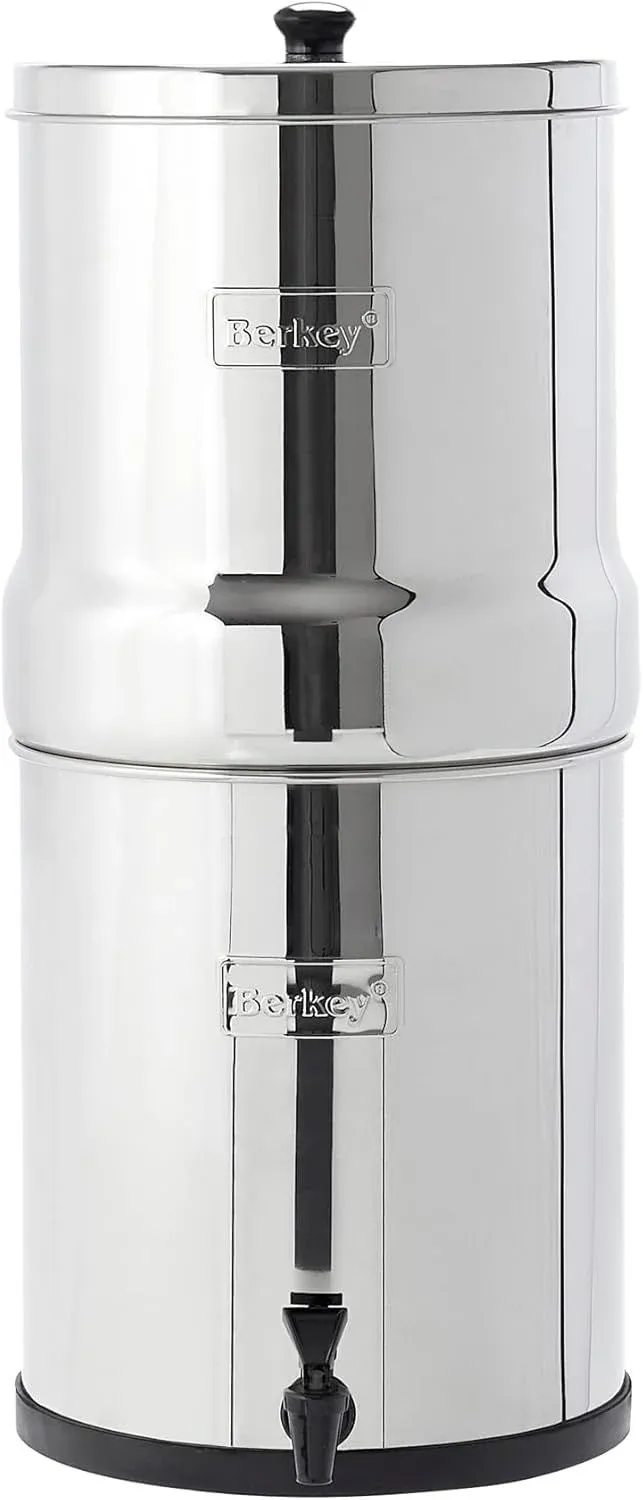
Big Berkey 2.25 Gallon
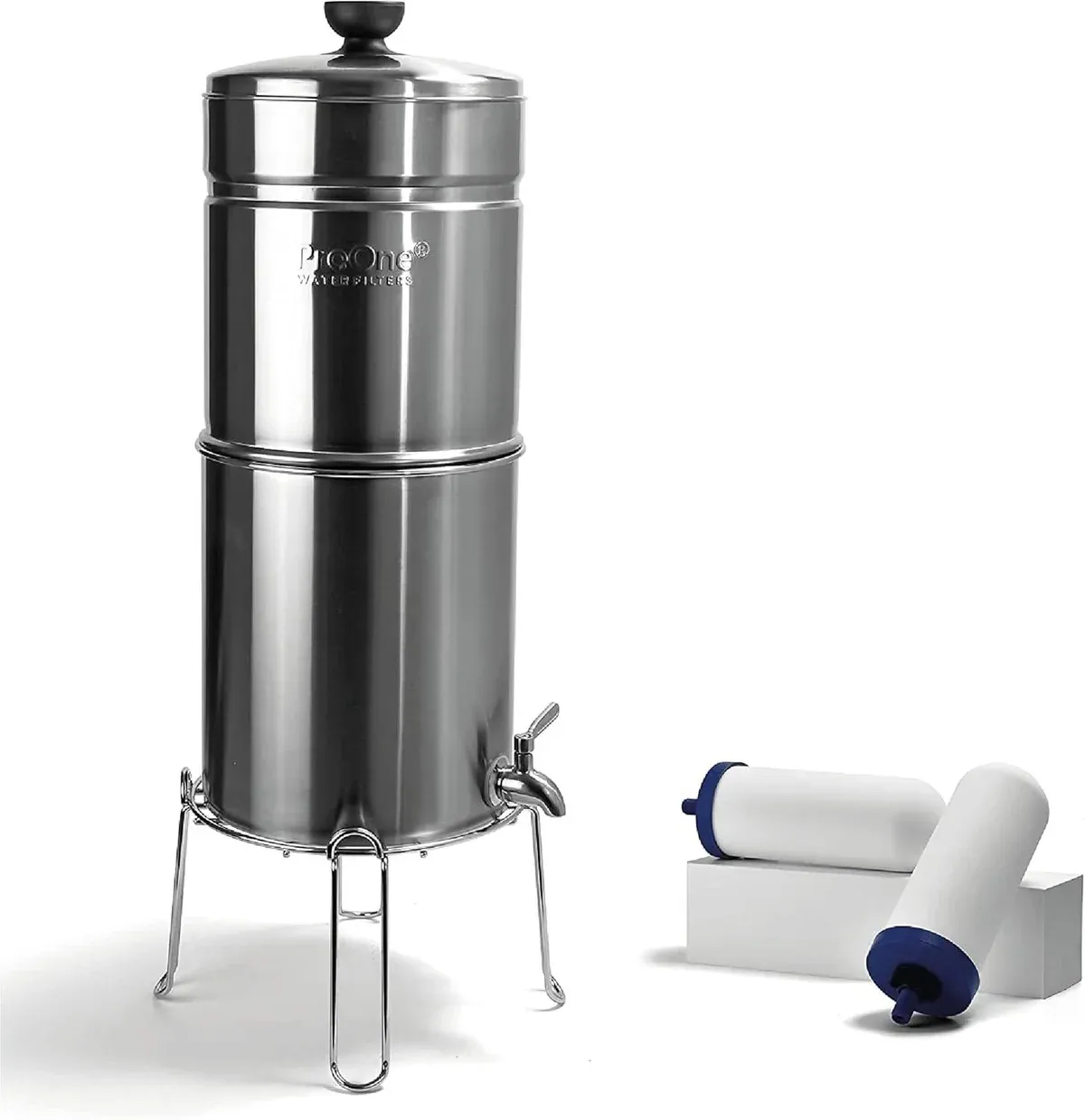
ProOne 3-Gallon (3-Pack)
At a Glance
| Feature | Big Berkey Gravity-Fed Stainless Steel Countertop Water Filter System 2.25 Gallon | Editor's Pick ProOne Gravity Water Filter System 3 Gallon with 3 Filter Elements |
|---|---|---|
| Price Range | $250–$500 | $250–$500 |
| Technology | Proprietary 6-media blend (microfiltration + adsorption + ion exchange) | 3-stage G3.0 (ceramic shell + carbon granular media + carbon block core) |
| Capacity | 2.25 gallons | 3 gallons |
| Flow Rate | 3.5 GPH (2 elements) / 7.0 GPH (4 elements) | ~0.78 GPH (3 filters) |
| Filter Life | 6,000 gallons per pair | 1,000 gallons per filter |
| Certified | — | IAPMO — NSF 42/53/401/372 |
| Weight | 7 lbs (empty) | ~10 lbs |
| Check Price | Check Price |
This is the gravity filter comparison that matters most in 2026: the iconic Big Berkey — the best-selling gravity filter in history — versus the ProOne 3-Gallon, a certified challenger that delivers broader proven contaminant removal at a lower price. One dominates on speed and legacy. The other dominates on verifiable safety claims. Your priorities decide the winner.
We evaluated both systems across six categories that matter most to gravity filter buyers: filtration quality and certification, flow rate, filter lifespan and cost, fluoride removal, build quality, and regulatory standing. Each system wins categories the other cannot — this is not a one-sided comparison.
Category-by-Category Breakdown
Filtration Certification & Verified Performance
The ProOne 3-Gallon carries IAPMO certification to NSF 42 (aesthetic contaminants), NSF 53 (health-effect contaminants including lead, VOCs, and cysts), NSF 401 (emerging contaminants including pharmaceuticals, microplastics, and PFAS), and NSF 372 (lead-free materials). These certifications mean an independent, accredited third-party laboratory has tested the filter elements and verified that they meet specific performance thresholds under controlled conditions. The testing is repeated annually to maintain certification — the results are not a one-time snapshot.
The Big Berkey has no NSF certification of any kind. Berkey has commissioned third-party laboratory testing and publishes results claiming removal of over 200 contaminants, but these tests were performed to demonstrate marketing claims rather than to earn independent certification. The distinction matters: NSF certification requires testing under standardized worst-case conditions (high contaminant concentrations, end-of-filter-life performance, specific flow rates), while voluntary lab testing can be conducted under conditions favorable to the manufacturer. Berkey's filtration may well be excellent, but "probably excellent based on self-reported data" is a different category than "independently verified under controlled conditions." For buyers whose purchasing decisions hinge on documented, repeatable proof of contaminant removal, the ProOne is the only defensible choice.
Flow Rate & Daily Throughput
The Big Berkey's flow rate advantage is not marginal — it is overwhelming. With two standard Black Berkey elements, the system produces approximately 3.5 gallons per hour. With the optional upgrade to four elements, throughput doubles to roughly 7.0 GPH. The ProOne 3-Gallon with its three G3.0 ceramic filter elements delivers approximately 0.78 GPH. That is a 4.5:1 speed ratio with the standard Berkey configuration and a 9:1 ratio with four elements.
In practical terms, the Big Berkey can fill its 2.25-gallon lower chamber from a full upper chamber in approximately 40 minutes. The ProOne 3-Gallon takes roughly 4 hours to process the same volume through its 3-gallon upper chamber. For a household of four drinking the recommended daily water intake plus cooking needs — roughly 3–4 gallons per day — the Big Berkey handles this demand effortlessly with a single fill cycle. The ProOne requires planning: fill in the morning and the water is ready by mid-afternoon, or fill before bed and it is ready by breakfast. Neither approach is wrong, but the Berkey's speed removes the need to think about water availability entirely.
The flow rate gap stems from the fundamental difference in filtration media. Berkey's proprietary carbon compound allows rapid water passage through larger effective channels while relying on adsorption chemistry to capture contaminants. ProOne's ceramic outer shell physically blocks particles at sub-micron pore sizes — a mechanical barrier that inherently restricts flow regardless of filter surface area. You cannot engineer a ceramic filter to match carbon-block throughput without compromising the physical exclusion that makes ceramic valuable in the first place.
Filter Lifespan & Cost Per Gallon
The Big Berkey's Black Elements are rated at 6,000 gallons per pair — the longest lifespan in the gravity filter category by a wide margin. At typical household consumption of 3–4 gallons per day, a single pair of elements lasts approximately 4–5 years before replacement. Replacement cost for a genuine pair of Black Berkey elements runs approximately $120–$140, translating to roughly $0.02 per gallon over the filter's life. Even at the higher end of replacement pricing, the per-gallon cost is among the lowest in any residential filtration category.
The ProOne 3-Gallon ships with three G3.0 7-inch filter elements, each rated at 1,000 gallons — totaling 3,000 gallons before the full set needs replacement. At 3–4 gallons daily consumption, the three-filter set lasts approximately 2–2.5 years. A replacement set of three G3.0 7-inch filters costs approximately $200–$220, yielding a per-gallon cost of roughly $0.07. Over a 5-year period, the Big Berkey requires one filter replacement at roughly $130, while the ProOne requires two full replacement sets at roughly $400–$440 total. The cumulative cost advantage compounds meaningfully over time, particularly for heavy-use households.
One important caveat: the ProOne G3.0 filters are being discontinued as the brand transitions to Culligan MaxClear. The successor MaxClear 7-inch filter carries a dramatically shorter 50-gallon lifespan at a similar price per filter — which would collapse the long-term economics catastrophically if you cannot source G3.0 replacements. Buyers committing to ProOne should factor in the cost and availability of stockpiling G3.0 filters while they remain on the market.
Fluoride Removal
The ProOne G3.0 filter elements include integrated fluoride reduction media as part of the three-stage construction, and fluoride removal is covered under the IAPMO certification to NSF 53. Independent testing has documented reduction rates exceeding 90% through the rated filter life. This is a built-in capability that requires no additional filters, no extra cost, and no separate maintenance schedule.
The Big Berkey does not remove fluoride with its standard Black Elements. Fluoride reduction requires purchasing separate PF-2 fluoride and arsenic reduction filters that attach to the lower stem of each Black Element. A pair of PF-2 filters costs approximately $60–$70 and is rated for 1,000 gallons — dramatically shorter than the Black Elements' 6,000-gallon life. This means PF-2 filters need replacement 6 times during a single Black Element lifespan, adding approximately $360–$420 in cumulative fluoride filter costs over the 6,000-gallon cycle. The PF-2 filters also slow flow rate noticeably and require periodic priming to maintain effectiveness.
For households in fluoridated communities who want to reduce fluoride in their drinking water, the ProOne's integrated approach is materially simpler and cheaper over time. The Big Berkey can achieve fluoride reduction, but at significant additional cost and maintenance complexity that erodes its otherwise strong cost-per-gallon advantage.
Build Quality & Design
Both systems use 304 stainless steel for the upper and lower chambers — the standard food-grade alloy for gravity filter housings. The Big Berkey's polished finish is iconic and well-regarded, with a quality feel that has contributed to its premium brand perception over two decades. The system nests to 13 inches for storage and transport — a practical feature for RV owners, preppers, and anyone who stores the system between camping seasons.
The ProOne 3-Gallon uses the same 304 stainless construction with a similar polished finish, though the larger 3-gallon capacity and three-filter configuration result in a taller profile — approximately 22.75 inches plus the included 6-inch stand, reaching nearly 29 inches total. This height can be a practical concern for kitchens where the system needs to sit under an upper cabinet. The ProOne does not nest as compactly as the Berkey. Both systems maintain an all-stainless water path with no plastic components contacting purified water — a feature that matters to buyers concerned about BPA, phthalates, and microplastic leaching from plastic housings.
The Big Berkey's longer market presence has established a more extensive accessory ecosystem — sight glass spigots, stainless steel stands, and various capacity upper chambers are widely available from both Berkey and third parties. The ProOne accessory market is smaller but growing.
Regulatory Standing & Brand Trust
This category has shifted dramatically since 2022. The Big Berkey operated for years as the unchallenged market leader in gravity filtration — trusted by preppers, off-gridders, and health-conscious households worldwide. The EPA's Stop Sale Order under FIFRA changed that positioning fundamentally. While the order addresses the regulatory classification of silver-containing filters rather than a specific safety finding, it created real practical consequences: Big Berkey systems have been periodically unavailable from authorized retailers, replacement filter sourcing has become less predictable, and the brand's ability to make health-related filtration claims is legally constrained. The company has not yet resolved the regulatory dispute.
ProOne, by contrast, has pursued third-party certification proactively. The IAPMO certification to four NSF standards provides documented, independently verified performance data that the company can legally reference. The transition to Culligan ownership — a company with 90 years of water treatment industry presence and established regulatory compliance infrastructure — further strengthens ProOne's institutional credibility. For buyers who weight regulatory standing and verifiable claims in their purchasing decisions, the ProOne's position is materially stronger than the Big Berkey's in the current landscape.
ProTip — TDS Meters: Purchase a handheld TDS meter ($10–$15 on Amazon) when you set up either system. Test your tap water input and filtered output at installation, then monthly thereafter. A consistent TDS reduction of 50–80% indicates the filter is performing well. Any sudden change in output TDS — especially an increase without a corresponding change in source water — signals the filter media is approaching end of life, often weeks before a noticeable taste change occurs. This simple tool replaces guesswork with data and helps you get every usable gallon from each filter set.
ProTip — Break-In Protocol: Both systems benefit from discarding the first 2–3 full batches of filtered water. The Big Berkey's Black Elements release harmless carbon fines (fine black particles) during initial use that clear after priming. The ProOne G3.0 ceramic filters may produce a slight chemical or earthy taste during the first 3–4 cycles as the carbon media inside the ceramic shell off-gasses manufacturing residues. In both cases, the break-in period is normal, temporary, and resolves fully within the first week of regular use. Do not judge either system's water quality on the first batch.
Who Should Get Which?
Get the Big Berkey 2.25 Gallon if...
- You need high daily throughput for a large household (4+ people)
- Emergency preparedness is a primary use case — speed matters when filtering for multiple people
- You want the lowest long-term cost per gallon at $0.02/gal over filter life
- You plan to nest and transport the system (RV, camping, or seasonal use)
- You are comfortable with Berkey's regulatory situation and can source genuine replacement elements
The Big Berkey remains the performance champion on throughput and filter economy. Its two-decade track record, passionate user community, and portability features make it the go-to for high-volume gravity filtration — provided you accept the EPA uncertainty and verify your replacement filters are genuine.
Check Price on AmazonGet the ProOne 3-Gallon (3-Pack) if...
- Independently verified contaminant removal is non-negotiable for your household
- You want built-in fluoride removal without buying separate add-on filters
- You prefer a system backed by IAPMO certification and clear regulatory standing
- A lower purchase price matters — the ProOne costs $55 less than the Big Berkey
- You are willing to accept slower flow rate (0.78 GPH) and plan fills in advance
The ProOne 3-Gallon is the better choice for buyers who insist on documented proof over brand reputation. Its certification stack is the strongest of any gravity system, and the built-in fluoride removal eliminates the complexity and cost of Berkey's PF-2 add-ons. Stock up on G3.0 replacement filters before the Culligan MaxClear transition completes.
Check Price on AmazonWho Should Skip Both
Gravity filtration is not the right category for every household. If you are on treated municipal water with no specific contaminant concerns beyond chlorine taste, a high-quality countertop pitcher filter or faucet-mount filter delivers adequate improvement at a fraction of the cost and complexity. If you need the highest possible contaminant removal — including dissolved solids, fluoride, PFAS, and nitrates — an under-sink reverse osmosis system outperforms any gravity filter on raw filtration power, though it requires plumbing and a power outlet. Gravity filters occupy a specific niche: households that want strong multi-contaminant reduction without electricity, plumbing, or installation — and within that niche, both the Big Berkey and ProOne 3-Gallon are among the best available options.
Renters who move frequently may also find the countertop footprint of either system impractical compared to a compact pitcher filter like the Clearly Filtered or ZeroWater, both of which offer certified performance in a far more portable form factor. Similarly, households with very high daily water demand — think a large family using filtered water for cooking, coffee, and pets in addition to drinking — may find that even the Big Berkey's 3.5 GPH throughput requires multiple fill cycles per day, at which point a plumbed whole-house or under-sink system becomes the more practical long-term investment.
Frequently Asked Questions
Is the Big Berkey safe to use given the EPA Stop Sale Order?
Does the ProOne 3-Gallon actually remove fluoride without add-on filters?
Why is the Big Berkey so much faster than the ProOne?
Can I use ProOne G3.0 filters in a Big Berkey housing?
Which system is better for emergency preparedness?
What happens to ProOne when the Culligan MaxClear transition completes?
How do I maintain and clean each system to maximize filter life?
Our Final Recommendation
The ProOne 3-Gallon is our recommended gravity filter for most buyers in 2026. Its IAPMO certification to four NSF standards provides the independent verification that the Big Berkey has never obtained, and built-in fluoride removal eliminates the cost and complexity of Berkey's PF-2 add-on system. At $55 less than the Big Berkey, it delivers more verifiable filtration capability per dollar. The regulatory clarity alone — no EPA enforcement actions, no availability disruptions, no counterfeit concerns — makes it the safer recommendation in the current market.
The Big Berkey remains the right choice for a specific buyer: someone who prioritizes throughput above all else, needs to filter large volumes quickly for a family or emergency scenario, and is willing to navigate the regulatory uncertainty to get the fastest flow rate and longest filter life in the category. At 3.5 GPH and 6,000 gallons per filter pair, nothing else in the gravity space matches the Big Berkey's raw performance numbers. If those numbers are what matter most and you can source genuine replacement elements, the Berkey still delivers.
Both systems produce water that is dramatically cleaner than unfiltered tap. The question is not whether either works — both do. The question is whether you prioritize speed and economy (Big Berkey) or certification and built-in fluoride protection (ProOne). For the majority of households, we believe certified performance at a lower price is the stronger value proposition.
Track Both Products
We'll email you if either price drops or availability changes.
Only when something changes. Unsubscribe anytime.