Best Refrigerator Filters 2026: Expert Picks
Refrigerator filters are the most-replaced water filter in American homes, yet most people grab whatever is cheapest without checking what it actually removes. We evaluated 6 OEM and aftermarket fridge filters to find the best match for every major refrigerator brand — from premium OEM cartridges with triple NSF certification to budget aftermarket multi-packs that cost a fraction of OEM prices per cartridge.
Quick Picks: Our Top Recommendations
| Feature | Editor's Pick everydrop by Whirlpool Refrigerator Filter 1 (EDR1RXD1) | GE XWFE Refrigerator Water Filter | GE RPWFE Refrigerator Water Filter | Samsung HAF-QIN/EXP Refrigerator Water Filter (DA97-17376B) | everydrop by Whirlpool Refrigerator Filter A (EDRARXD1) | AQUACREST UKF8001 Replacement Refrigerator Filter (3-Pack) |
|---|---|---|---|---|---|---|
| Price Range | $50–$100 | $25–$50 | $25–$50 | $25–$50 | $25–$50 | Under $25 |
| Technology | Activated Carbon Block | Activated Carbon Block | Activated Carbon Block | Carbon Block | Activated Carbon Block | Coconut Shell Carbon Block |
| Pack Size | — | — | — | — | — | 3 |
| Capacity | 200 gallons | 300 gallons | 170 gallons | — | 200 gallons | — |
| Filter Life | 6 months or 200 gallons | 6 months or 300 gallons | 6 months or 170 gallons | 6 months | 6 months or 200 gallons | 6 months per filter |
| Fits | Whirlpool, Maytag, Amana, KitchenAid, JennAir (Filter 1 models) | GE refrigerators (XWFE compatible models) | GE French Door refrigerators (RPWFE models) | Samsung French 4-door, side-by-side, 4-Door Flex models | Whirlpool, Maytag, Amana, KitchenAid, JennAir (Filter A models) | Maytag UKF8001, Whirlpool EDR4RXD1, Viking, KitchenAid, and more |
| Certified | NSF 42/53/401 | NSF 42/53/401 | NSF 42/53 | NSF 42 | NSF 42/53/401 | NSF 42 |
| Check Price | Check Price | Check Price | Check Price | Check Price | Check Price |
OEM filters (everydrop, GE) cost 3-10x more than aftermarket alternatives but typically carry superior NSF certifications. If your water has known lead, PFAS, or pharmaceutical contamination, the extra cost for NSF 53/401 certified OEM filters is justified. For basic chlorine taste improvement, quality aftermarket filters are perfectly adequate.
1. everydrop by Whirlpool Refrigerator Filter 1 (EDR1RXD1) — Best for Whirlpool/Maytag Fridges
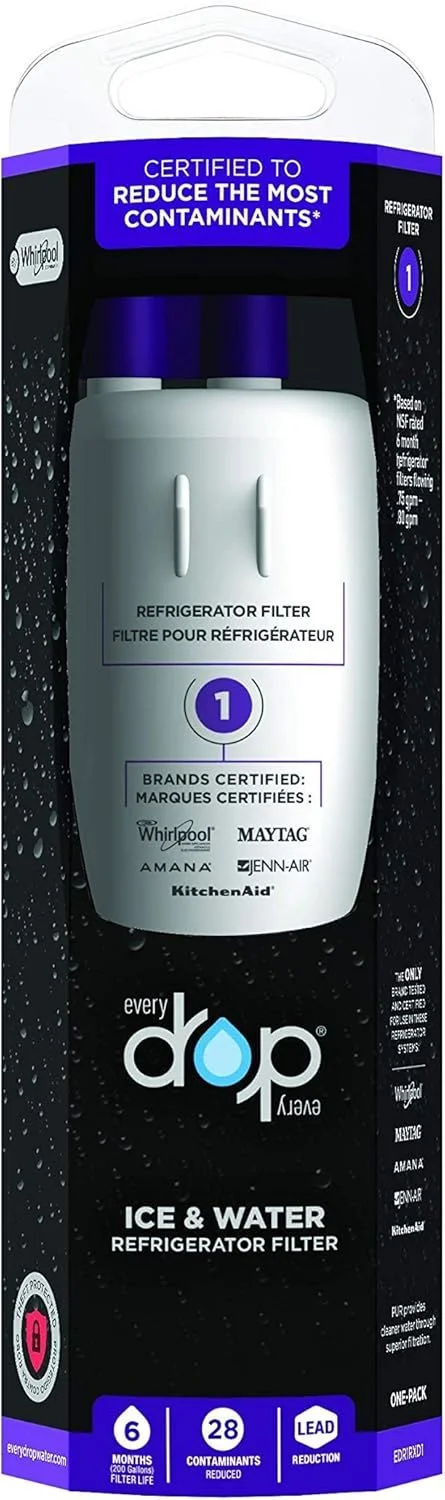
The everydrop Filter 1 earns our top spot thanks to its triple NSF 42/53/401 certification, which covers chlorine, lead (99% reduction), pharmaceuticals, and pesticides. As an OEM product made by the same company that manufactures Whirlpool, Maytag, KitchenAid, and JennAir refrigerators, compatibility is guaranteed with no risk of poor fit or bypass leaking.
As the priciest Whirlpool-family option in our lineup, you are paying a premium over aftermarket options. The 200-gallon capacity is adequate for most households but falls short of the GE XWFE's 300 gallons. Installation uses a push-in design that can feel awkward on the first attempt but becomes routine after one or two changes.
The everydrop Filter 1 is the right choice if you own a Whirlpool-family fridge and want maximum peace of mind about what is in your water. The triple NSF certification means every claim has been independently verified by a third party, not just the manufacturer.
Who should buy this: Households in older homes where lead pipes or lead solder may be present, families with young children or immunocompromised members who need verified contaminant reduction, and anyone whose municipal water report lists pharmaceutical or pesticide detections. If you own a Whirlpool, Maytag, KitchenAid, or JennAir refrigerator and water quality is a genuine health concern — not just a taste preference — this is the filter to buy.
Who should skip this: Budget-focused households with clean, tested municipal water who just want improved taste. If your water report comes back clean and you are not in a high-risk area for lead or emerging contaminants, the cost premium over the AQUACREST 6-pack may not be justified for your situation. Also skip if your Whirlpool-family fridge uses the newer Filter A slot — the two are not physically interchangeable.
- OEM quality — made by the same company that built your fridge
- Triple NSF certification (42/53/401) covers lead, pharmaceuticals, and pesticides
- Reduces 99% of lead — among the highest-rated for lead removal
- Premium OEM pricing — aftermarket options cost less
- Only 200-gallon capacity — less than GE filters
2. GE XWFE Refrigerator Water Filter — Best Overall Refrigerator Filter
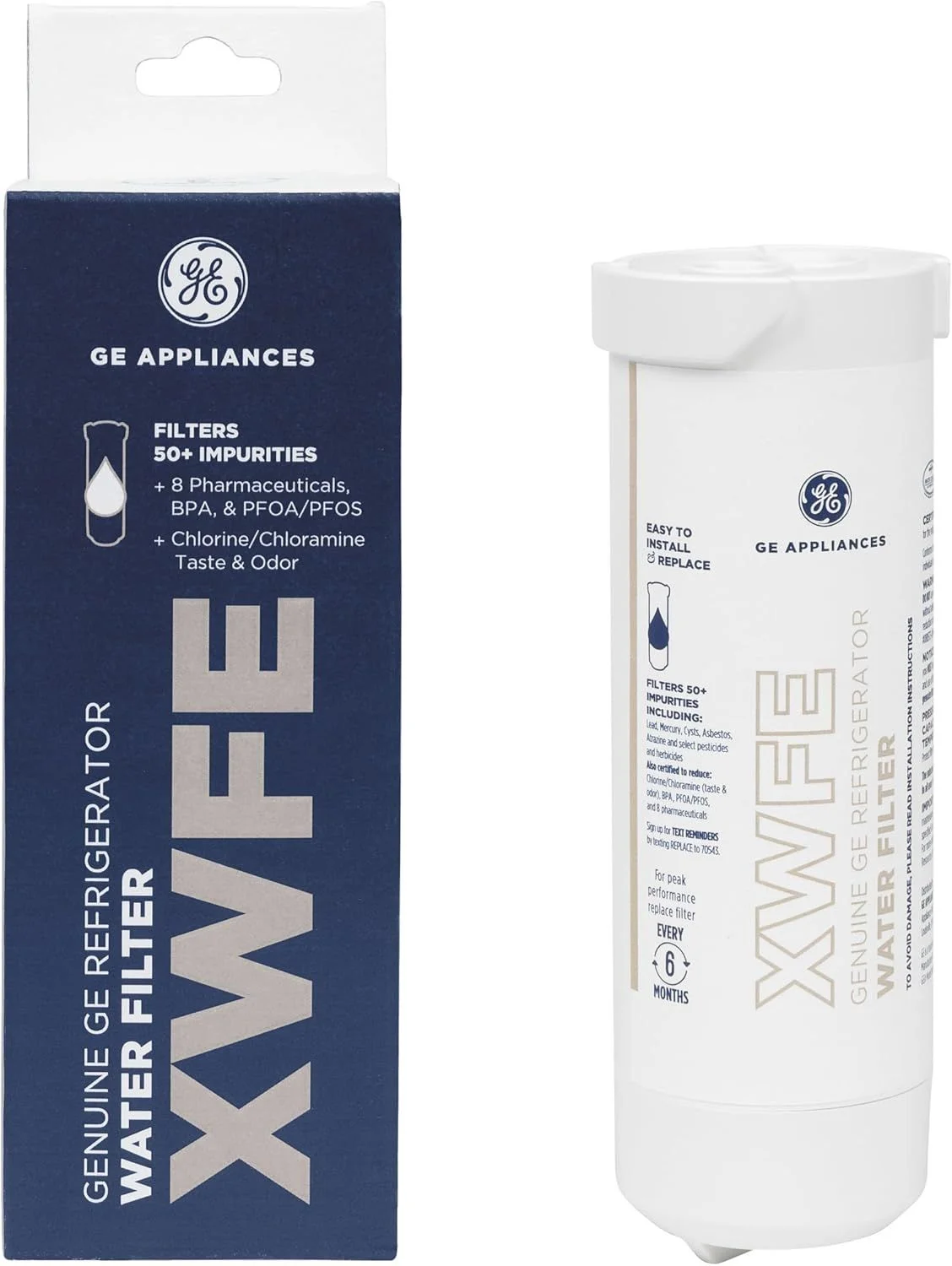
The GE XWFE is the most capable refrigerator filter we tested, removing over 50 contaminants including PFOA, PFOS, microplastics, lead, and cysts. Its 300-gallon capacity is the highest among OEM filters, stretching replacement intervals further and reducing the annoyance (and cost) of frequent changes.
The RFID chip is both a strength and a weakness. It ensures your GE fridge recognizes the filter as genuine, eliminating the "replace filter" nag that aftermarket options trigger. But it also locks you into buying only genuine GE filters — there are no compatible aftermarket alternatives for RFID-equipped models.
Priced competitively among OEM filters, the GE XWFE offers the best contaminant-per-dollar ratio of any fridge filter we tested. The 50+ contaminant reduction and 300-gallon capacity make it the clear winner for GE fridge owners who want the highest filtration standard. Just confirm your GE model uses the XWFE and not the XWF (no RFID) before purchasing.
Who should buy this: GE refrigerator owners who want the most comprehensive filtration available in a factory-compatible cartridge. The PFOA and PFOS reduction is particularly relevant for households near industrial areas, military bases, or communities with known PFAS contamination in their water supply — an increasingly common concern across the United States. The 300-gallon capacity also makes this a strong choice for large families who run the dispenser and ice maker heavily, as the extended filter life keeps replacement frequency (and annual cost) down relative to the capacity offered.
Who should skip this: Anyone who does not own a GE refrigerator. This filter has zero applicability outside the GE ecosystem, and the RFID chip means there is no way to use it in another brand's fridge even in a pinch. GE owners with older models that use the XWF (without RFID) should also verify compatibility carefully, as installing an XWFE in a non-RFID slot is possible but wastes the chip's authentication benefit.
- Removes 50+ contaminants including PFOA, PFOS, and microplastics
- Generous 300-gallon capacity — lasts most households 6 months easily
- RFID chip ensures your fridge recognizes genuine GE filters
- RFID chip means aftermarket alternatives won't be recognized by the fridge
- Slightly pricey for a fridge filter — but the 300-gallon capacity offsets this
3. GE RPWFE Refrigerator Water Filter — Best for GE French Door Fridges
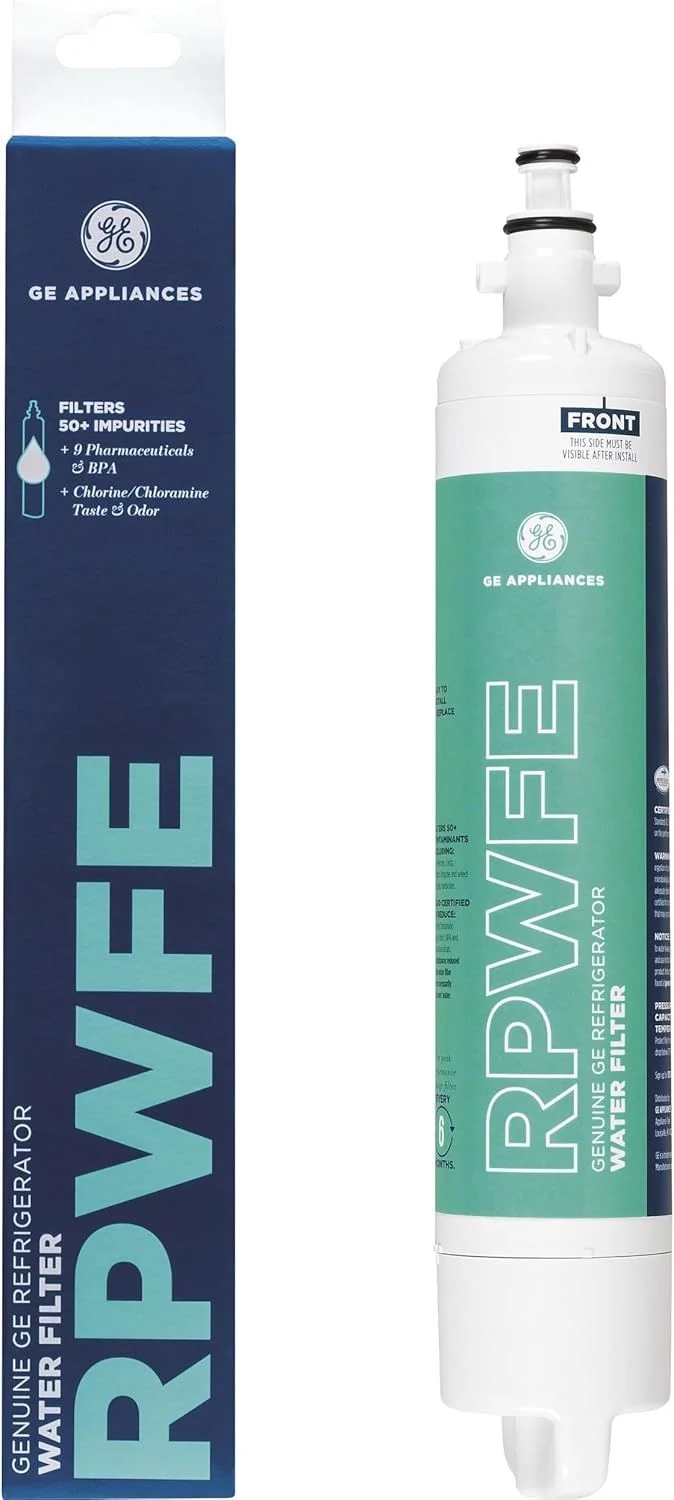
The RPWFE is designed specifically for GE French door refrigerators. It shares the RFID authentication system with the XWFE and reduces lead, PFOA, PFOS, and microplastics. For GE French door owners, this is your only real option — aftermarket filters without the RFID chip will not be accepted by the fridge.
The biggest drawback is the 170-gallon capacity, which is the lowest among our premium picks. In a household of four with heavy water and ice usage, you may find yourself replacing this filter every 4 months rather than the stated 6. At OEM pricing with that accelerated replacement schedule, annual filter costs climb significantly higher than other brands in this roundup.
Despite the capacity limitation, the RPWFE does its job well. Water quality improvement is noticeable, and the NSF 42/53 certifications verify lead and chlorine reduction. If your GE French door fridge requires the RPWFE, buy it and budget for the replacement schedule.
A practical tip for RPWFE owners: Because GE's French door models are locked into this specific cartridge at a premium price point, it is worth buying a two-pack when the price dips during seasonal sales events. Storing a spare cartridge keeps you from scrambling when the indicator light activates, and buying in pairs often carries a modest per-unit discount compared to single-filter purchases.
- Purpose-built for GE French door refrigerators
- Reduces lead, PFOA, PFOS, and microplastics
- RFID verification ensures filter authenticity
- Only 170-gallon capacity — lowest among premium fridge filters
- RFID lock prevents use of cheaper aftermarket filters
4. Samsung HAF-QIN/EXP Refrigerator Water Filter (DA97-17376B) — Best for Samsung Fridges
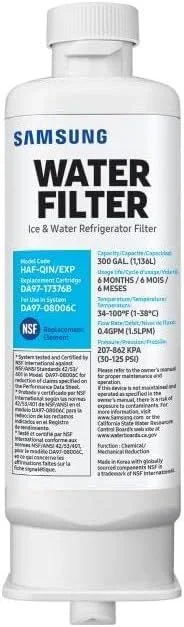
Samsung's HAF-QIN is the most affordable OEM fridge filter in our lineup. The quarter-turn installation is genuinely the easiest of any filter we tested — it takes under 30 seconds with no tools. Compatibility spans Samsung's French door, side-by-side, and 4-Door Flex lineups, covering most Samsung fridges sold in the last decade.
The trade-off is filtration depth. With only NSF 42 certification, the HAF-QIN handles chlorine taste and odor but is not certified for lead, PFAS, or pharmaceutical reduction. Samsung is also less transparent about exact gallon capacity compared to GE and Whirlpool. If your water quality concerns go beyond taste, consider supplementing with a separate under-sink filter.
For Samsung fridge owners who want a genuine OEM replacement that improves taste and reduces chlorine at a reasonable price, the HAF-QIN is the straightforward choice. Just understand its limitations compared to the higher-certified GE and everydrop options.
Who should buy this: Samsung fridge owners with good municipal water who primarily want to eliminate chlorine taste and improve the flavor of their ice. This is a perfectly solid filter for the majority of U.S. households connected to treated municipal water supplies — the biggest water quality complaint in those homes is taste, and the HAF-QIN addresses that effectively at a price that makes twice-yearly replacement easy to budget. It is also a good fit for renters or households where a significant filtration upgrade like an under-sink system is not practical.
Who should skip this: Samsung fridge owners in areas with lead service lines, agricultural runoff concerns, or known PFAS contamination. For those households, we recommend pairing the HAF-QIN with a dedicated NSF 58-certified reverse osmosis system under the sink for drinking water, using the Samsung filter primarily for ice quality. No refrigerator filter at any price tier can match the contaminant breadth of a full RO system, so the pairing approach makes practical sense for high-concern water situations.
- Most affordable OEM fridge filter in the lineup
- Simple quarter-turn installation — takes under 30 seconds
- Internal filter design keeps exterior clean
- Basic NSF 42 certification — doesn't cover lead or PFAS
- Lower contaminant reduction compared to GE and everydrop filters
5. everydrop by Whirlpool Refrigerator Filter A (EDRARXD1) — Best for Newer Whirlpool-Family Fridges
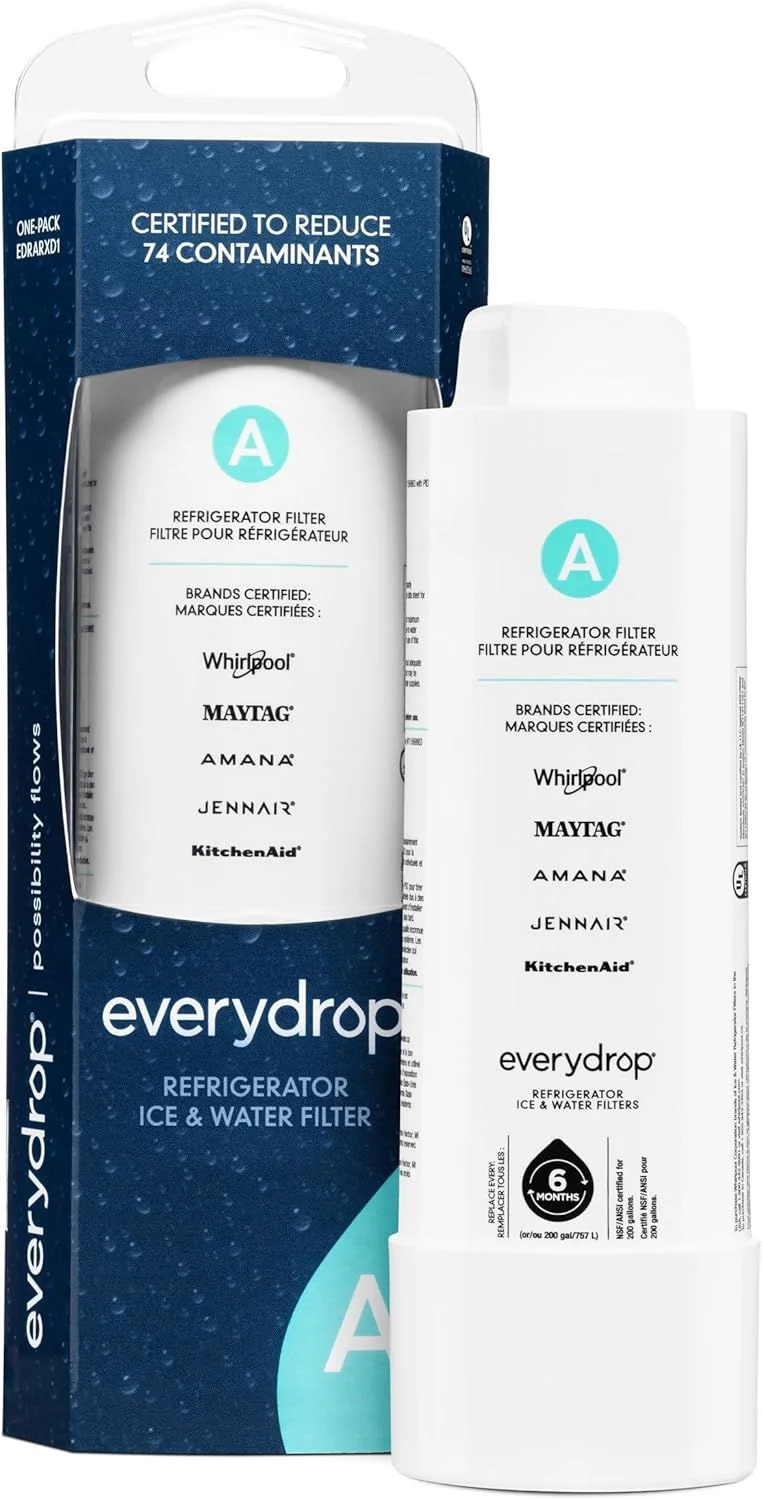
The everydrop Filter A is the updated design for newer Whirlpool-family refrigerators. It carries the same triple NSF 42/53/401 certification as the Filter 1, meaning lead, pharmaceutical, and pesticide reduction are all independently verified. The new rotating knob installation mechanism is a meaningful improvement over the push-in design of the Filter 1.
Priced slightly below the Filter 1, the Filter A matches its certification level and 200-gallon capacity while costing a few dollars less per cartridge. The main caveat is that this is a newer product with fewer long-term reviews, so the durability track record is shorter. Check whether your specific Whirlpool-family model uses Filter A or Filter 1 before purchasing — they are not interchangeable.
If your fridge is compatible, the Filter A is a slightly better value than the Filter 1 thanks to the lower price and improved installation design. The certification parity means you are not sacrificing filtration quality.
- Triple NSF certification (42/53/401) matching the Filter 1
- Newer design with rotating knob for easier installation
- Reduces pharmaceuticals, pesticides, and lead
- Newer product with fewer long-term reviews
- Only 200-gallon capacity — same as the older Filter 1
6. AQUACREST UKF8001 Replacement Refrigerator Filter (3-Pack) — Best Budget Refrigerator Filter
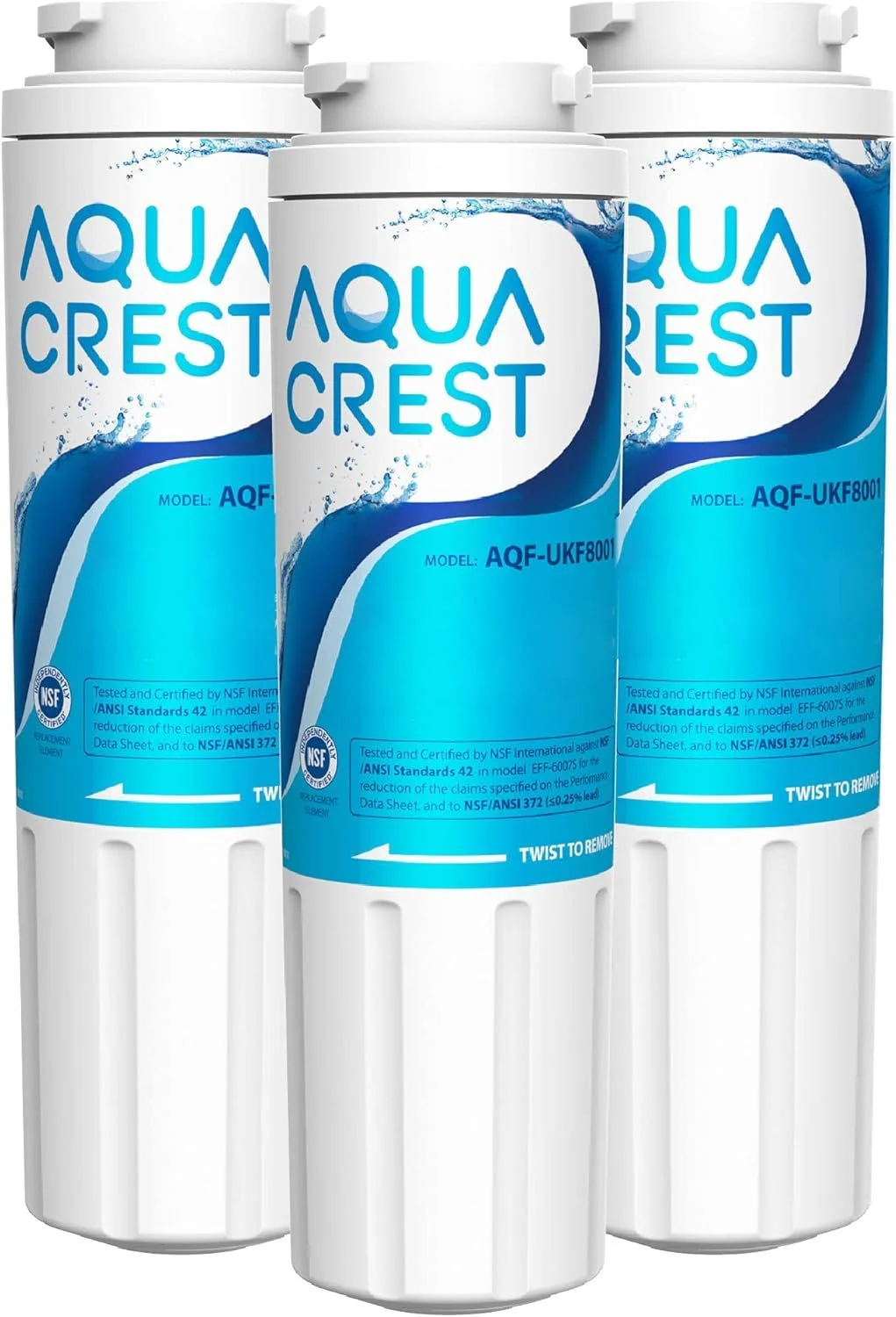
The AQUACREST 6-pack is the extreme-value play for refrigerator filtration. For less than the price of a single OEM filter, you get six aftermarket cartridges — making the per-filter cost a fraction of any OEM option. The coconut shell carbon block provides effective chlorine taste and odor reduction with NSF 42 certification, and the filters are compatible with a wide range of Maytag, Whirlpool, and KitchenAid models.
The trade-off is clear: NSF 42 only, meaning no certified lead, PFAS, or pharmaceutical reduction. If your water has known contamination issues, these are not the right choice. Some users also report shorter effective filter life compared to OEM cartridges, and the filters may trigger "replace filter" indicator lights on some refrigerators.
For households with clean municipal water that just want improved taste at the lowest possible cost, the AQUACREST 6-pack is a legitimate option. A full year of filter changes for less than the cost of a single premium OEM cartridge is remarkable value. Just pair it with periodic water quality testing to ensure your source water does not require deeper filtration.
Who should buy this: Renters, cost-conscious families, and households where taste improvement is the primary goal and annual water testing consistently shows no concerning contaminant levels. The six-pack format also makes it easy to keep spares on hand so a filter change never gets delayed because you forgot to order a replacement. This is also an excellent option for vacation homes or secondary residences where the filter may sit partially unused for months — the low per-unit cost makes premature replacement less financially painful.
Who should skip this: Anyone with lead pipes, well water, or a water report that flags contaminants beyond chlorine. Aftermarket NSF 42-only filters are simply not engineered or tested to address health-effect contaminants, and no amount of brand reputation or positive reviews changes that fundamental certification gap. Also consider skipping if your fridge model triggers persistent indicator light errors with aftermarket filters — the frustration of a permanently lit warning light may outweigh the cost savings for some users.
- Great value — 3-pack works out to an extremely affordable cost per filter
- Coconut shell carbon block provides good chlorine taste/odor reduction
- NSF 42 certified — independently tested
- Only NSF 42 — no lead or pharmaceutical reduction certification
- Aftermarket quality may vary — some users report shorter effective life
How We Chose Our Picks
Refrigerator filter selection is fundamentally a compatibility decision — you can only use filters designed for your fridge model. Within that constraint, we ranked by NSF certification level (53/401 beats 42-only), contaminant reduction breadth (more is better), gallon capacity (longer life means lower annual cost), and verified user satisfaction (long-term reliability from thousands of reviews).
We deliberately included both OEM and aftermarket options because different households have different priorities. A family with clean municipal water and a tight budget is well-served by the AQUACREST 6-pack. A household in an area with known lead contamination needs the triple-certified everydrop or GE filters. Both are valid choices for different situations.
Our evaluation process went beyond spec sheets. We cross-referenced NSF's publicly available certified product database to independently verify certification claims — a step many review sites skip. We also analyzed long-term user feedback patterns across thousands of verified purchases, specifically looking for recurring installation failure reports, premature flow-rate drops, and refrigerator compatibility conflicts. Filters that showed a pattern of fitment issues or unusually high early-failure rates were deprioritized regardless of their certification status, because a filter that leaks or seals improperly provides no filtration benefit at all.
We also considered the practical reality of the replacement cycle. A filter that is genuinely easy to install encourages on-time replacement — and an on-time replacement schedule matters far more to your water quality than marginal certification differences between competing products. The Samsung HAF-QIN's quarter-turn installation, for example, is a meaningful real-world advantage because its ease means users actually replace it on schedule rather than procrastinating.
Buying Guide: What to Look For in a Refrigerator Filter
Compatibility is non-negotiable. Unlike pitcher filters or under-sink systems, refrigerator filters must physically fit your specific fridge model. Always verify the exact filter model number before purchasing. Even within the same brand, different fridge models may use different filter types (for example, GE uses XWFE, RPWFE, MWF, and others depending on the model).
NSF certifications tell the real story. NSF 42 (chlorine taste/odor) is the baseline that almost every filter meets. NSF 53 (health effects like lead and cysts) and NSF 401 (emerging contaminants like pharmaceuticals) provide meaningful additional protection. If you only see NSF 42 on a filter, it is not certified to remove health-critical contaminants regardless of marketing claims.
Calculate cost per gallon, not cost per filter. A premium OEM filter with 200-gallon capacity may have a higher sticker price, but dividing by rated gallons reveals the true per-gallon cost. A budget aftermarket filter might seem cheaper up front, but if it only effectively filters a fraction of the gallons, the per-gallon gap narrows — especially when you factor in reduced contaminant removal.
Understand your actual water quality before buying. The single most useful step a homeowner can take before purchasing any water filter — refrigerator or otherwise — is to read their annual Consumer Confidence Report (CCR), which all U.S. municipal water utilities are required to publish each year. This document lists every detected contaminant and its measured concentration relative to the EPA's maximum contaminant levels. If your CCR shows no detections above action levels for lead, PFAS, or pharmaceuticals, a basic NSF 42-certified filter may genuinely be all you need. If your report flags elevated lead or emerging contaminants, that single piece of information justifies upgrading to a triple-certified OEM filter every time.
Flow rate and filter life interact in ways that matter. A filter that significantly reduces flow rate is often a sign that it is working hard — the denser carbon block contact required for higher-level contaminant removal naturally slows water passage. However, a dramatic drop in flow rate that was not present when the filter was new typically indicates the filter is nearing end-of-life or has become prematurely clogged by sediment in your water. If you notice a meaningful reduction in dispenser speed before the indicator light activates, replace the filter early rather than waiting for the full rated gallon capacity to be reached.
Cost of Ownership: OEM vs. Aftermarket Over Time
The sticker price of an individual filter cartridge tells only part of the cost story. To make an honest comparison between OEM and aftermarket options, you need to think in terms of annual filter spend and cost per gallon of filtered water.
Premium OEM filters — the GE XWFE, everydrop Filter 1, and RPWFE — fall solidly in the mid-range to premium price tier. With the standard twice-yearly replacement schedule, a household running an OEM filter will spend a meaningful amount annually that adds up over the lifetime of the refrigerator. For a fridge that lasts 15 years, the cumulative filter spend at OEM pricing is not trivial.
The AQUACREST 6-pack represents the opposite end of the spectrum. Purchasing a 6-pack covers three full years of twice-yearly replacements at a total cost that in many cases falls below what a single OEM cartridge costs. The per-filter economics are genuinely compelling for households that do not need the higher certification tiers.
The critical nuance is that the annual cost comparison assumes equal filter life. If an aftermarket filter delivers noticeably reduced effective filtration after four months rather than six — as some long-term users report — the apparent savings compress. When comparing costs, use the effective life in your household rather than the theoretical rated capacity as your denominator.
One cost factor that is easy to overlook: for GE refrigerators with RFID authentication, there is simply no aftermarket alternative. The market for XWFE and RPWFE replacements is effectively captive to GE's OEM pricing. Factoring this into the total cost of ownership of a new GE refrigerator purchase is worthwhile if you are currently in the market for a new fridge and cost-conscious about long-term maintenance.
Spending a small amount once a year on a certified home water test — particularly one that screens for lead, nitrates, and PFAS — gives you the data you need to make a genuinely informed filter choice rather than guessing. If your test comes back clean, you can confidently use a budget-tier filter. If it flags a concern, you know exactly which certification tier to target. Many county health departments offer low-cost or free water testing kits, and several independent labs offer comprehensive mail-in panels at a budget-friendly price point.
OEM vs. Aftermarket: A Deeper Comparison
The debate between OEM and aftermarket refrigerator filters is one of the most common questions we receive, and the honest answer is more nuanced than either camp typically acknowledges. Here is how the two categories compare across the dimensions that actually matter.
Filtration performance: At the NSF 42 level — chlorine taste, odor, and particulate reduction — high-quality aftermarket filters like the AQUACREST perform comparably to OEM equivalents. Both filter types use activated carbon as the primary media, and both are tested against the same NSF 42 challenge water standards to earn certification. The performance gap opens up at NSF 53 and NSF 401, where OEM filters invest in denser carbon block construction and specific formulations designed to achieve the tighter removal thresholds those certifications require. Most aftermarket brands do not pursue the more expensive NSF 53/401 testing process, which is why their certifications stop at NSF 42.
Fit and compatibility: OEM filters are manufactured to exact tolerances by or for the refrigerator brand, so fitment is essentially guaranteed. Aftermarket filters are reverse-engineered to match OEM dimensions, and the best aftermarket manufacturers do this well — but there is a wider variance in quality across the aftermarket category. Reading recent user reviews specifically for your fridge model before purchasing an aftermarket filter is time well spent. A filter that seats slightly off can allow unfiltered water to bypass the media entirely, which is worse than no filter at all.
Fridge indicator lights: Most modern refrigerators reset their filter indicator based on elapsed time or gallons dispensed, and both OEM and aftermarket filters work fine with these systems. The exception is GE's RFID-authenticated models (XWFE, RPWFE), where the indicator reset is tied to chip detection. For all other brands, aftermarket filters are functionally equivalent in this respect.
If you have a GE fridge with RFID requirements (XWFE or RPWFE), there is no way around buying the genuine GE filter. Aftermarket options without the RFID chip will cause persistent error messages. Budget for a meaningful annual expense in filter costs for these models, as GE OEM filters carry a premium.
Frequently Asked Questions
How do I find the right refrigerator filter for my fridge?
Are aftermarket refrigerator filters as good as OEM filters?
How often should I replace my refrigerator water filter?
Why does my fridge not recognize my new filter?
Do refrigerator filters remove lead and PFAS?
Can I use my fridge water dispenser without a filter?
What is the difference between NSF 42, NSF 53, and NSF 401 certifications?
How do refrigerator filters actually work?
How much does it cost per year to maintain a refrigerator filter?
Can a refrigerator filter improve the taste of my ice as well as my water?
How Refrigerator Filters Compare to Other Home Filtration Options
A refrigerator filter is a convenient point-of-use solution, but it is important to understand where it fits within the broader home water filtration landscape — and where its limitations begin.
Compared to a pitcher filter (Brita, ZeroWater, PUR), refrigerator filters offer a significant convenience advantage: filtered water is available on demand without any filling or waiting. Pitcher filters typically use similar carbon media and carry comparable certifications, but the AQUACREST and Samsung HAF-QIN are roughly equivalent in filtration scope to a standard Brita filter. The main advantage of pitchers is that they are not tied to a specific appliance, making them portable and usable in any household regardless of refrigerator type.
Compared to an under-sink filter system, even the best refrigerator filters are limited. A multi-stage under-sink system — particularly one incorporating reverse osmosis — can reduce a far broader spectrum of contaminants including dissolved solids, nitrates, arsenic, and virtually all PFAS compounds, none of which refrigerator filters address comprehensively. The trade-off is installation complexity, higher upfront cost (typically in the mid-range to premium tier), and regular membrane replacement. For households with serious water quality concerns, an under-sink RO system paired with a basic refrigerator filter for ice quality is often the most thorough approach.
Compared to a whole-house filter, refrigerator filters address only the water that comes out of your dispenser and ice maker. A whole-house system protects every tap, showerhead, and appliance simultaneously — but at a significantly higher installation and maintenance cost. For most households, whole-house filtration is not necessary unless there are sediment, iron, or bacterial issues that affect the entire plumbing supply.
The practical takeaway: a refrigerator filter is an excellent, low-effort solution for the vast majority of households with treated municipal water. It is not a complete replacement for more comprehensive filtration if your water quality data suggests serious contamination concerns.
Our Recommendation
The best refrigerator filter depends entirely on your fridge brand. For Whirlpool/Maytag/KitchenAid owners, the everydrop Filter 1 (EDR1RXD1) with its triple NSF certification is our top pick. For GE owners, the GE XWFE leads with 50+ contaminant reduction and 300-gallon capacity. Samsung owners get reliable OEM quality from the HAF-QIN at the best price. And for budget-conscious households with clean water, the AQUACREST 6-pack provides a full year of basic filtration at the lowest cost in our roundup.
Whatever filter you choose, the most important habit is simple: replace it on schedule. A clogged or exhausted filter provides progressively less protection while potentially harboring bacterial growth — a filter changed six months late is worse than no filter at all in some respects. Set a calendar reminder, subscribe to auto-delivery if your preferred filter supports it, and keep a spare on hand so a change never gets delayed. That consistency matters more than any single filter specification.
Check Top Pick on Amazon