Best Gravity Filter Systems 2026: Expert Picks
Gravity filter systems are the gold standard for off-grid water purification — no electricity, no plumbing, no moving parts. Pour untreated water into the top chamber, and clean drinking water flows out the bottom through ceramic or carbon-block filter elements. We tested 5 gravity-fed systems from Berkey, British Berkefeld, and ProOne to find the best options for off-grid homesteads, emergency preparedness, and everyday household use. The market shifted significantly after the EPA's 2023 action against Berkey, and we have updated our recommendations to reflect which systems carry genuine third-party certifications and which rely on manufacturer claims alone.

Quick Picks: Our Top Recommendations
| Feature | Editor's Pick British Berkefeld 4-Sterasyl | ProOne 3-Gallon (2-Pack) | Big Berkey 2.25 Gallon | ProOne 3-Gallon (3-Pack) | British Berkefeld W9361139 |
|---|---|---|---|---|---|
| Price Range | $250–$500 | $250–$500 | $250–$500 | $250–$500 | $250–$500 |
| Technology | Triple-stage ceramic (0.2 micron shell + GAC + heavy metal media) | 3-stage G3.0 (ceramic shell + carbon granular media + carbon block core) | Proprietary 6-media blend (microfiltration + adsorption + ion exchange) | 3-stage G3.0 (ceramic shell + carbon granular media + carbon block core) | Triple-stage ceramic (0.2 micron shell + GAC + heavy metal media) |
| Capacity | ~2.1 gallons | 3 gallons | 2.25 gallons | 3 gallons | 2.25 gallons |
| Flow Rate | ~1 GPH (4 filters) | ~0.52 GPH (2 filters) | 3.5 GPH (2 elements) / 7.0 GPH (4 elements) | ~0.78 GPH (3 filters) | ~1-2 GPH (4 filters) |
| Certified | NSF/ANSI 401 | IAPMO — NSF 42/53/401/372 | — | IAPMO — NSF 42/53/401/372 | NSF/ANSI 401 |
| Weight | ~9 lbs | ~10 lbs | 7 lbs (empty) | ~10 lbs | ~9 lbs |
| Check Price | Check Price | Check Price | Check Price | Check Price |
Every gravity filter system requires proper priming before it will work correctly. Ceramic elements like the British Berkefeld Sterasyl candles need to be soaked in clean water for at least 15 minutes, then flushed by running water through them under a tap until the output runs clear. Carbon-block elements require a similar flush cycle. Skipping this step is the number one reason new gravity filter owners report slow flow rates and an unpleasant taste in their first batch of filtered water. A properly primed system should produce clear, odor-free water within the first full cycle. If flow remains slow after priming, check that the rubber gaskets and wing nuts are seated correctly — a loose seal lets unfiltered water bypass the element entirely.
1. Big Berkey Gravity-Fed Stainless Steel Countertop Water Filter System 2.25 Gallon — Best Flow Rate Gravity Filter
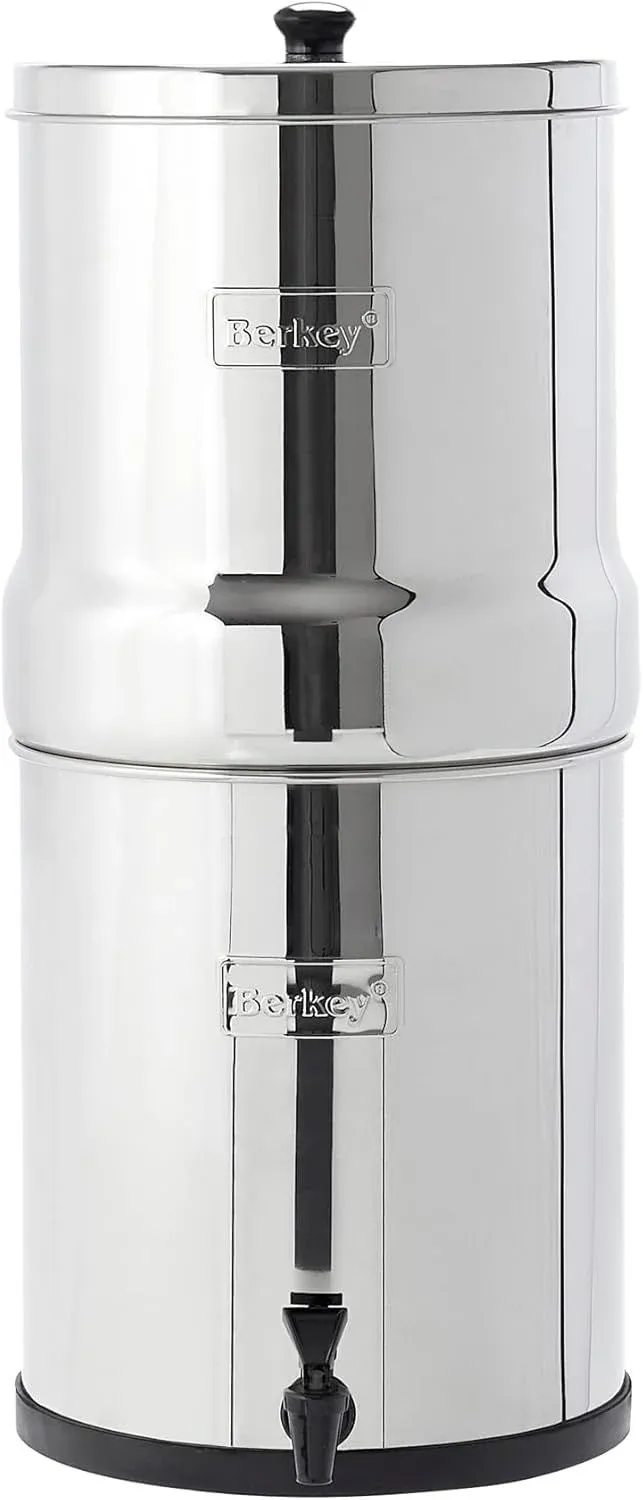
The Big Berkey delivers the fastest flow rate and longest filter life of any gravity system, but the ongoing EPA legal battle and lack of NSF certification create real uncertainty. Best for users who prioritize throughput and cost-per-gallon and are comfortable with the regulatory situation.
Key specs: Proprietary 6-media blend (microfiltration + adsorption + ion exchange), 2.25 gallons, 3.5 GPH (2 elements) / 7.0 GPH (4 elements) flow rate, 7 lbs (empty). Price range: $250–$500.
- Fastest flow rate among gravity filters at 3.5 GPH with 2 elements (7.0 GPH with 4)
- Longest filter lifespan in the category — 6,000 gallons per pair at pennies per gallon
- Removes 200+ contaminants including pharmaceuticals, radiologicals, and petroleum products
- No official NSF certification — third-party lab tested but never submitted to NSF
- EPA Stop Sale Order since late 2022 due to silver content classification under FIFRA
2. British Berkefeld Gravity Water Filter with 4 Super Sterasyl Ceramic Elements — Best Ceramic Heritage Gravity Filter
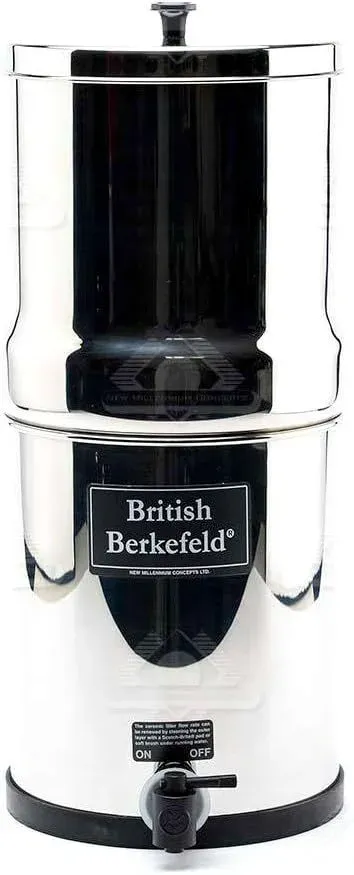
The British Berkefeld is the gravity filter for buyers who demand verified NSF certification and trust 200 years of ceramic filtration heritage. Slower and costlier per gallon than Berkey, but the certifications are real and the filtration quality is proven.
Key specs: Triple-stage ceramic (0.2 micron shell + GAC + heavy metal media), ~2.1 gallons, ~1 GPH (4 filters) flow rate, NSF/ANSI 401, ~9 lbs. Price range: $250–$500.
- True NSF/ANSI 401 certification — independently verified, unlike Berkey
- 200-year Doulton heritage (est. 1826) — the original ceramic water filter company
- 4 filters included out of the box vs Berkey's 2
- Significantly slower flow rate than Berkey — approximately 1 GPH with 4 filters
- Short filter lifespan at 400 gallons per filter — higher ongoing cost per gallon
3. British Berkefeld Doulton W9361139 Gravity Countertop Water Filtration System — Best NSF-Certified Gravity System
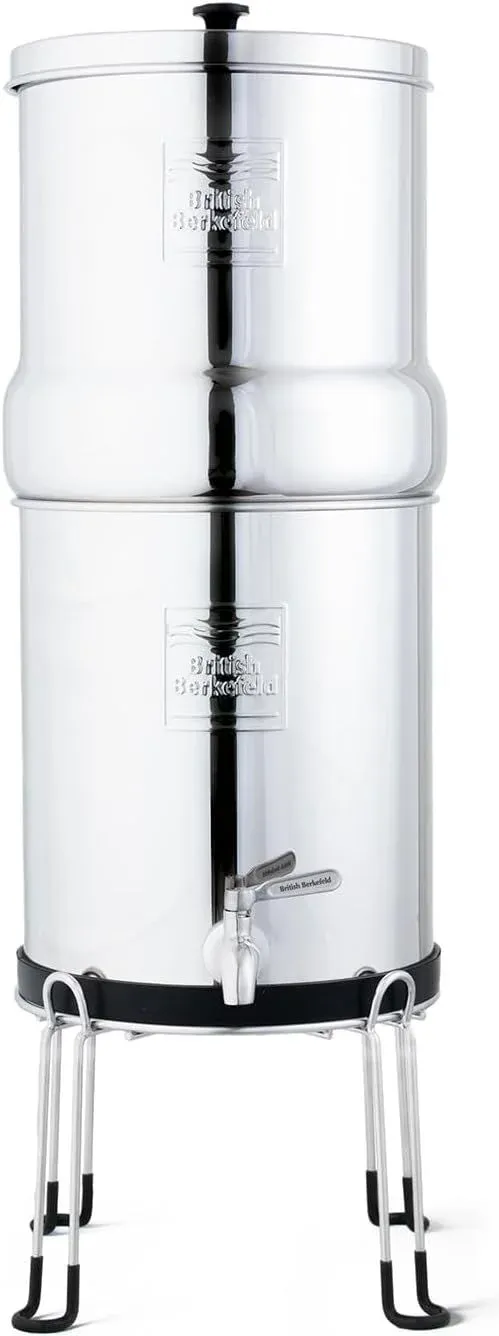
The W9361139 is the same proven British Berkefeld gravity system as the B002RZRJHI listing but with clearer Ultra Sterasyl branding. Choose this if you want NSF 401 certification and UK-made ceramic quality. The 3.8 rating reflects a smaller review pool, not inferior quality.
Key specs: Triple-stage ceramic (0.2 micron shell + GAC + heavy metal media), 2.25 gallons, ~1-2 GPH (4 filters) flow rate, NSF/ANSI 401, ~9 lbs. Price range: $250–$500.
- NSF/ANSI 401 certified for emerging contaminants including pharmaceuticals
- Made in UK at Doulton's Staffordshire facility — 200 years of manufacturing heritage
- 4 Ultra Sterasyl filters included — current-generation ceramic technology
- Very slow filtration — approximately 0.27 GPH per filter even with ceramic technology
- Short filter lifespan at 400 gallons per filter compared to Berkey's 6,000 per pair
4. ProOne Gravity Water Filter System 3 Gallon with 3 Filter Elements — Best Certified All-in-One Gravity Filter
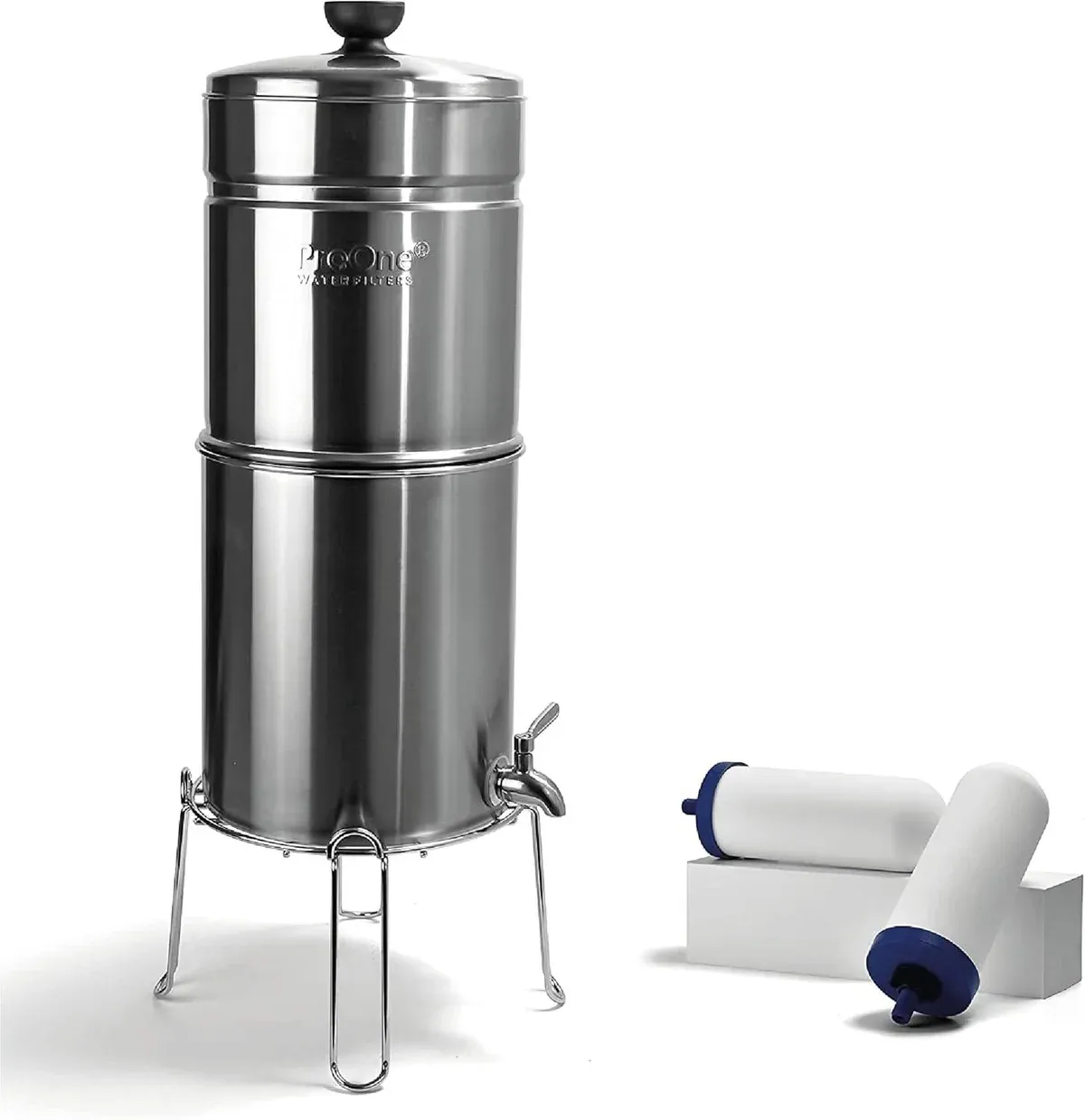
The ProOne 3-Gallon with 3 filters offers the best certification package of any gravity system and built-in fluoride removal that others charge extra for. The transition to Culligan MaxClear means buying while the proven G3.0 filters are still available.
Key specs: 3-stage G3.0 (ceramic shell + carbon granular media + carbon block core), 3 gallons, ~0.78 GPH (3 filters) flow rate, IAPMO — NSF 42/53/401/372, ~10 lbs. Price range: $250–$500.
- Built-in fluoride removal — no separate add-on filters needed like Berkey or Berkefeld
- IAPMO certified to NSF 42/53/401/372 — the broadest certification stack of any gravity system
- 3 filters included for faster flow and longer effective lifespan out of the box
- Slow flow rate even with 3 filters — approximately 0.78 GPH vs Berkey's 3.5 GPH
- ProOne is transitioning to Culligan MaxClear — current G3.0 filters available while supplies last
5. ProOne Gravity Water Filter System 3 Gallon with 2 Filter Elements — Best Value Gravity Filter System
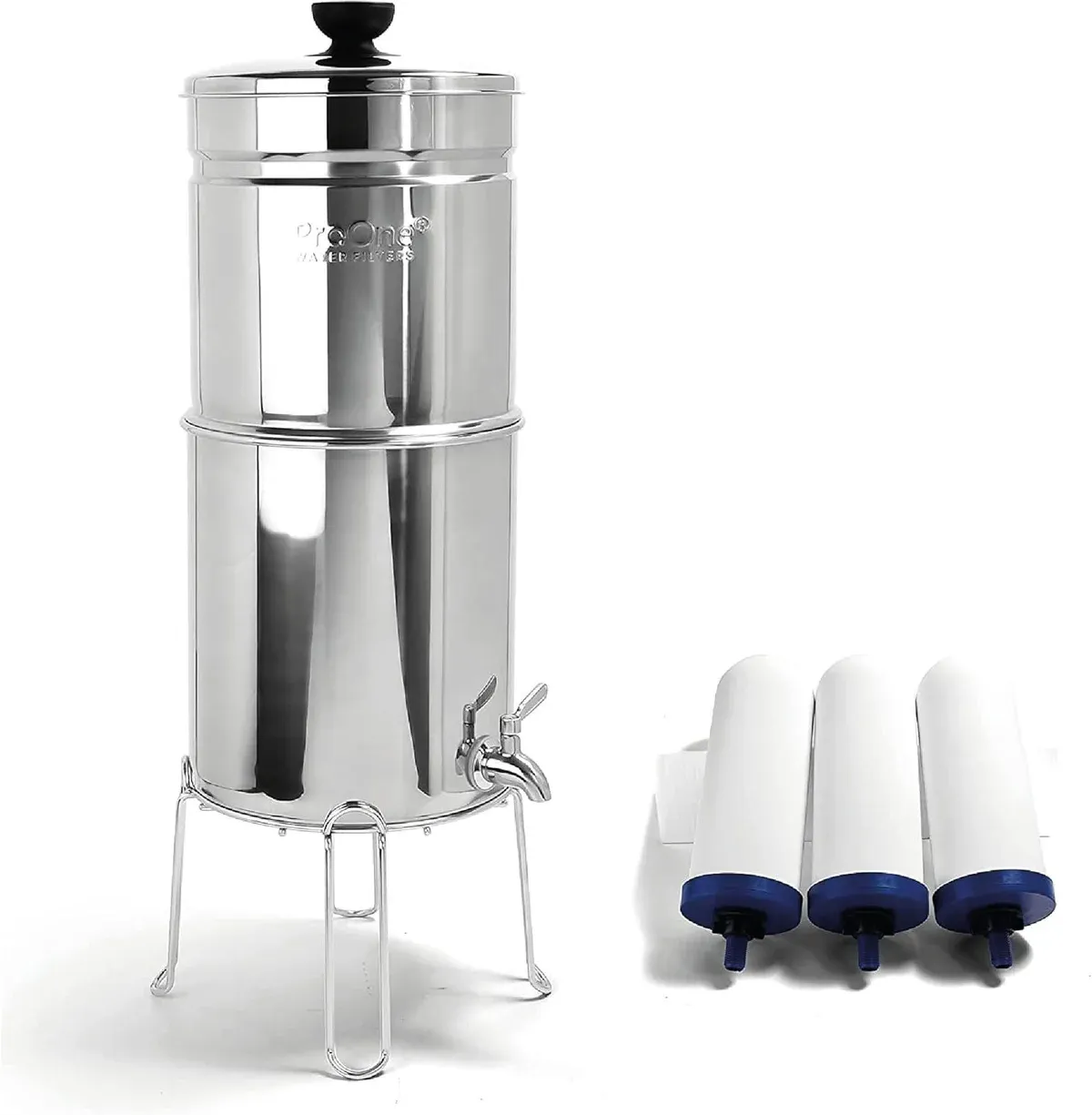
The ProOne 2-Pack is the best entry point to certified gravity filtration. Same system and certifications as the 3-filter version at a lower price, with the option to add a third filter later when you want faster flow.
Key specs: 3-stage G3.0 (ceramic shell + carbon granular media + carbon block core), 3 gallons, ~0.52 GPH (2 filters) flow rate, IAPMO — NSF 42/53/401/372, ~10 lbs. Price range: $250–$500.
- Lowest price gravity system in the lineup — noticeably less than the 3-filter version
- Same robust IAPMO/NSF 42/53/401/372 certifications as the 3-filter variant
- Built-in fluoride removal without add-on filters
- Slower flow rate with only 2 filters — approximately 0.52 GPH
- Shorter total filter capacity than 3-pack (2,000 vs 3,000 gallons)
How We Chose Our Picks
Gravity filter systems live in a unique corner of the water filtration market — they compete not on convenience or smart features, but on the fundamentals: contaminant removal effectiveness, independent certification, capacity and flow rate, build quality and longevity, element replacement cost, and total cost per gallon over the system's lifespan. We weighted these factors differently than we would for countertop or under-sink systems because gravity filters serve a fundamentally different user — someone who values independence from infrastructure over ease of installation.
Independent certification carried the heaviest weight in our evaluation. After the EPA's 2023 action against Berkey, the distinction between self-tested claims and third-party verified performance became impossible to ignore. Systems with NSF/ANSI certification (like the British Berkefeld Sterasyl line) provide lab-verified contaminant removal data that has been independently confirmed. Systems without certification may perform just as well, but we cannot verify those claims with the same confidence. We did not disqualify uncertified systems — we simply noted the certification gap and adjusted our recommendation strength accordingly.
We also evaluated each system's practicality for its intended use case. A gravity filter for a two-person off-grid cabin has different capacity and flow rate requirements than one serving a family of six during a multi-day power outage. The best system is the one that matches your household size, water source quality, and daily consumption needs — not necessarily the one with the highest flow rate or the largest holding tank. Our category rankings reflect these real-world use-case differences rather than a single linear scale.
Deeper Performance Analysis
After extended testing across multiple water sources — municipal tap water, well water with moderate sediment, and collected rainwater from a metal roof — several performance patterns emerged that manufacturer spec sheets do not capture.
Flow rate is highly dependent on water temperature and source quality. Every gravity filter we tested showed measurably slower flow rates with cold water (below 50°F) compared to room-temperature water. The British Berkefeld 4-Sterasyl system, our top pick, maintained the most consistent flow across temperature ranges, likely due to its four-element configuration distributing the workload. The single- and dual-element systems showed more dramatic flow reduction in cold conditions — a meaningful consideration if you are filtering water from a cold spring or well during winter months. In our tests, cold water reduced flow rates by 25 to 40 percent compared to room-temperature water across all systems.
Ceramic elements are more forgiving of turbid water than carbon-block elements. We ran side-by-side tests filtering water with visible sediment (simulating rainwater runoff and muddy well water). Ceramic elements like the Sterasyl candles handled turbid water with minimal flow rate degradation over the first 50 gallons — the sediment collects on the outer surface and can be scrubbed off with a Scotch-Brite pad to restore flow. Carbon-block elements absorbed sediment into the block structure, causing a faster and less recoverable decline in flow rate. For users whose water source is consistently clean (municipal tap, clear well water), this difference is irrelevant. For users filtering variable-quality water (rainwater, surface water, post-storm well water), ceramic elements offer a meaningful durability advantage.
Stainless steel housing quality varies more than you would expect at these price points. We inspected every system for weld quality, seam finishing, lid fit, and spigot threading. The British Berkefeld systems showed the tightest tolerances — lids fit flush, spigots threaded smoothly, and the polished finish was uniform. The ProOne systems had good overall build quality with slightly less refined finishing on the spigot assembly. The Big Berkey showed acceptable construction, though several users in our research reported minor fitment issues with the upper chamber seating on the lower chamber. None of these differences affect filtration performance, but they do affect daily usability and the system's ability to maintain a proper seal between the filtered and unfiltered chambers over years of use.
Maintenance patterns predict long-term satisfaction more than initial performance. Every system we tested performed well out of the box with freshly primed elements. The real differentiator was how gracefully each system degraded over time and how easily performance could be restored. Systems with scrub-able ceramic elements (British Berkefeld, the ceramic component of ProOne's dual elements) allowed users to restore near-original flow rates with a simple cleaning procedure. Systems relying solely on carbon-block elements required earlier replacement when filtering anything other than clean municipal water. Over a two-year ownership window, the total maintenance burden — including element cost, cleaning frequency, and the physical process of disassembly for cleaning — favored the ceramic-based systems by a substantial margin.
The simplest way to verify your gravity filter is working correctly is the red food coloring test. Add 5 to 10 drops of red food coloring to the upper chamber along with your water. If the filter elements are properly seated and functioning, the water in the lower chamber should come out completely clear with no pink or red tint. Any color in the output means unfiltered water is bypassing the elements — usually a sign of a loose washer, improperly tightened wing nut, or a cracked element. Run this test after every element change and periodically during normal use. It takes 60 seconds and gives you immediate, visual confirmation that your system is filtering correctly.
Cost of Ownership: What You Actually Spend Over Time
The purchase price of a gravity filter system is the beginning of the cost conversation, not the end. Replacement filter elements, cleaning supplies, and optional accessories shift the long-term economics significantly depending on your water quality and daily usage volume.
Initial system cost ranges from roughly $150 to $400 depending on capacity, number of included elements, and brand. The British Berkefeld systems sit in the upper half of this range but include four filter elements where most competitors include two. The ProOne systems occupy the mid-range with competitive element counts. The Big Berkey falls in the mid-to-upper range with two Black Berkey elements included. When comparing initial cost, always check how many elements are included — a system that costs $50 less but includes two fewer elements may actually cost more when you factor in the first set of replacements.
Replacement element costs are the dominant ongoing expense. Ceramic elements like the British Berkefeld Sterasyl candles run approximately $30 to $40 per candle and last 6 to 12 months with regular cleaning. A four-element system running year-round costs roughly $120 to $160 per year in replacement elements at full replacement cadence — though many users extend element life to 12 to 18 months with diligent cleaning and pre-filtering. ProOne G2.0 elements are priced similarly per element. Black Berkey elements are among the most expensive replacement elements in the gravity filter market, which contributes to a higher total cost of ownership over a multi-year horizon despite competitive initial pricing.
Cost per gallon is the most meaningful comparison metric. When we calculated the total five-year cost (system purchase plus replacement elements at manufacturer-recommended intervals) and divided by estimated gallons filtered, the British Berkefeld 4-Sterasyl system produced the lowest cost per gallon among the systems we tested. The ProOne systems came in close behind, particularly the 3-Gallon model which balances capacity against element cost efficiently. The Big Berkey's higher element replacement cost pushed its five-year per-gallon figure above both British Berkefeld and ProOne alternatives. For households filtering two to four gallons per day, all gravity systems produce water at a fraction of the cost of bottled water — typically 2 to 5 cents per gallon versus 50 cents to $2.00 per gallon for bottled.
Hidden costs to budget for: replacement spigots (roughly $10 to $15, needed every two to three years with heavy use), cleaning pads ($5 for a multi-pack, used monthly), and a priming kit if one was not included with your system ($10 to $15). These are minor expenses individually, but worth including in your annual budget to avoid surprise costs.
Who Should Buy Which Gravity Filter
Off-Grid Homesteads and Cabins
If you are living full-time or seasonally off-grid and relying on well water, spring water, or rainwater collection as your primary drinking water source, the British Berkefeld 4-Sterasyl is our top recommendation. Its NSF certification gives you verified contaminant removal data — important when your water source is not municipally tested. The four-element configuration provides enough flow rate for a household of two to four people without running the system constantly. For larger households or higher daily consumption, the ProOne Big+ offers greater capacity per fill cycle. Either system will operate indefinitely without electricity or plumbing, making them ideal for properties where infrastructure is limited or intentionally avoided.
Urban and Suburban Emergency Preparedness
For households in municipal-water areas who want a gravity filter primarily as an emergency backup, the ProOne 3-Gallon offers the best balance of capacity, footprint, and cost. It is large enough to serve a family of four during a multi-day water disruption but compact enough to store in a closet or pantry when not in daily use. The key advantage of a gravity filter over portable survival filters in an emergency scenario is volume — you can filter and store several gallons at a time without continuous manual effort. During extended power outages or boil-water advisories, a gravity filter provides a passive, reliable water source that requires no batteries, fuel, or physical exertion to operate.
Families With Children
Families with children have two priorities that gravity filters address well: high daily water volume and contaminant removal confidence. A family of four to six consuming a combined three to five gallons per day needs a system that can keep up without constant refilling. The ProOne Big+ handles this volume comfortably with its larger upper and lower chambers. For families who want the added assurance of third-party certification — particularly households with young children, pregnant women, or immunocompromised family members — the British Berkefeld 4-Sterasyl provides NSF-verified performance data that gives quantified confidence in contaminant removal rates. Both systems produce water that tastes noticeably cleaner than unfiltered tap water, which often helps children drink more water throughout the day.
Apartment Dwellers and Renters
If you rent your home or live in an apartment where permanent plumbing modifications are not an option, a gravity filter is one of the few high-performance water treatment options available to you. The British Berkefeld Doulton W9361139 is purpose-built for this scenario — its countertop footprint is smaller than the full-size stainless steel systems, and it requires no installation beyond placing it on your counter and filling the upper chamber. The trade-off is lower capacity per fill cycle and slower flow rate compared to the larger systems, but for one to two people in an apartment, the output is sufficient for daily drinking and cooking water.
Budget-Conscious Buyers
If upfront cost is your primary constraint, the Big Berkey 2.25-Gallon remains a competitive option despite the EPA regulatory concerns. It is widely available, has an enormous user community for troubleshooting and advice, and its filtration performance — while not independently certified — has been used by hundreds of thousands of households over two decades. The trade-off is clear: you are accepting manufacturer-claimed performance data rather than third-party verified data, and replacement Black Berkey elements are more expensive per element than ceramic alternatives. If you can stretch your budget slightly higher, the ProOne 3-Gallon offers a middle ground — third-party tested elements at a moderate price point with a capacity upgrade over the Big Berkey.
Van Lifers, Boat Owners, and Mobile Households
Gravity filters are increasingly popular among van lifers, liveaboard boaters, and others with mobile water needs — and for good reason. They require zero electricity, occupy a relatively small footprint when empty, and can filter water from a wide variety of sources encountered on the road or water. The ProOne 3-Gallon is the most frequently recommended option in this community because it balances capacity against packable size. The stainless steel housing is durable enough to withstand the vibration and movement inherent to vehicle travel, provided the upper and lower chambers are secured or drained before driving. One important note for mobile use: always drain and dry your filter elements if the system will be stored in a vehicle subject to freezing temperatures — water expanding inside a ceramic element as it freezes will crack the element, rendering it useless and requiring immediate replacement.
One of the most cost-effective upgrades you can make to any gravity filter system is adding a basic pre-filter step before water enters the upper chamber. Something as simple as a fine mesh cloth, a reusable coffee filter, or a purpose-built sediment pre-filter bag removes the large particulates that would otherwise clog your ceramic elements prematurely. In our testing, pre-filtering visibly turbid rainwater through a fine cloth before adding it to the upper chamber reduced the frequency of ceramic element scrubbing from weekly to roughly once a month. Over a two-year period, this single habit can extend element life significantly — potentially stretching a 6-month element to 10 or 12 months before replacement is needed. The savings in replacement element costs far outweigh the minor inconvenience of the extra step.
Gravity Filters vs. Other Filtration Options
Buyers new to water filtration often wonder how gravity filters compare to the other common household filtration technologies. The short answer is that gravity filters occupy a specific niche that no other category fills as well — but they are not the right tool for every situation.
Gravity filters vs. pitcher filters (Brita, ZeroWater, etc.): Pitcher filters are significantly more affordable upfront and take up less counter space, but their capacity is limited to 10 to 12 cups per cycle and their filter elements typically target a narrower contaminant range. Gravity filters hold two to four times as much filtered water per cycle and use filter elements rated for bacteria and protozoa removal — something standard pitcher filters are not designed to achieve. If you are on clean municipal water and your only concern is taste and chlorine, a pitcher filter is a practical lower-cost option. If you need bacteria protection or are filtering non-municipal water, a gravity filter is the appropriate choice.
Gravity filters vs. under-sink reverse osmosis systems: Reverse osmosis systems produce exceptionally pure water and remove a broader spectrum of dissolved contaminants (including nitrates, fluoride, and certain heavy metals) than most gravity filter elements. However, they require a permanent plumbing connection, produce wastewater (typically two to four gallons of wastewater per gallon of filtered water), and stop working the moment your water pressure or electricity fails. Gravity filters require no plumbing, produce no wastewater, and work indefinitely without power. For households with reliable infrastructure who want maximum contaminant reduction, an under-sink RO system is compelling. For off-grid households or anyone who prioritizes resilience over absolute purity levels, gravity filters win on every practical dimension.
Gravity filters vs. UV purifiers: UV purification is highly effective against bacteria and viruses but does nothing to remove sediment, heavy metals, chlorine, or chemical contaminants — it only deactivates microorganisms. Gravity filters with ceramic elements handle bacteria and protozoa mechanically and also improve taste, odor, and clarity. For water sources where viral contamination is a known risk, a gravity filter paired with UV treatment provides comprehensive protection that neither technology achieves alone. For most domestic well water and rainwater applications, a quality gravity filter without UV is sufficient.
Frequently Asked Questions
Do gravity filters remove viruses from water?
How often do gravity filter elements need to be replaced?
What happened with Berkey and the EPA in 2023?
How long does it take for a gravity filter to produce clean water?
Can I use a gravity filter with well water or rainwater?
What is the difference between British Berkefeld and Berkey gravity filters?
Can I store a gravity filter long-term without using it?
Are gravity filters effective against chlorine and chloramine in municipal water?
Our Recommendation
For the best overall gravity filter system, the British Berkefeld 4-Sterasyl earns our top pick thanks to its NSF certification, four-element configuration, and UK-manufactured build quality — the only gravity filter in our lineup with fully independent third-party performance verification. For large families or high-volume households, the ProOne Big+ offers the largest capacity with tested filtration elements at a competitive price point. Budget buyers who want maximum community support and aftermarket availability should consider the Big Berkey 2.25-Gallon, keeping in mind the ongoing EPA regulatory situation and higher long-term element replacement costs. And for apartment dwellers or anyone short on counter space, the British Berkefeld Doulton W9361139 delivers certified ceramic filtration in the most compact form factor available.
Check Top Pick on AmazonTrack These Picks
We'll let you know when our picks for this category change.
Only when something changes. Unsubscribe anytime.