Waterdrop WD-A2 vs Bluevua RO100ROPOT-UV: Which Countertop RO System Is Better in 2026?
Quick Verdict: The Waterdrop WD-A2 ($409) is the better choice if you want a countertop appliance that replaces both your water filter and your hot/cold water dispenser — 6 temperature presets from 59°F to 203°F make it genuinely versatile for coffee, tea, baby formula, and cold drinking water. The Bluevua RO100ROPOT-UV ($317) is the better choice if your priority is certified RO performance and value — its NSF 58 certification specifically verifies reverse osmosis performance, the glass carafe eliminates plastic contact, and it costs $92 less. Both deliver excellent countertop RO with UV sterilization and zero installation.

Waterdrop WD-A2 Countertop Reverse Osmosis System
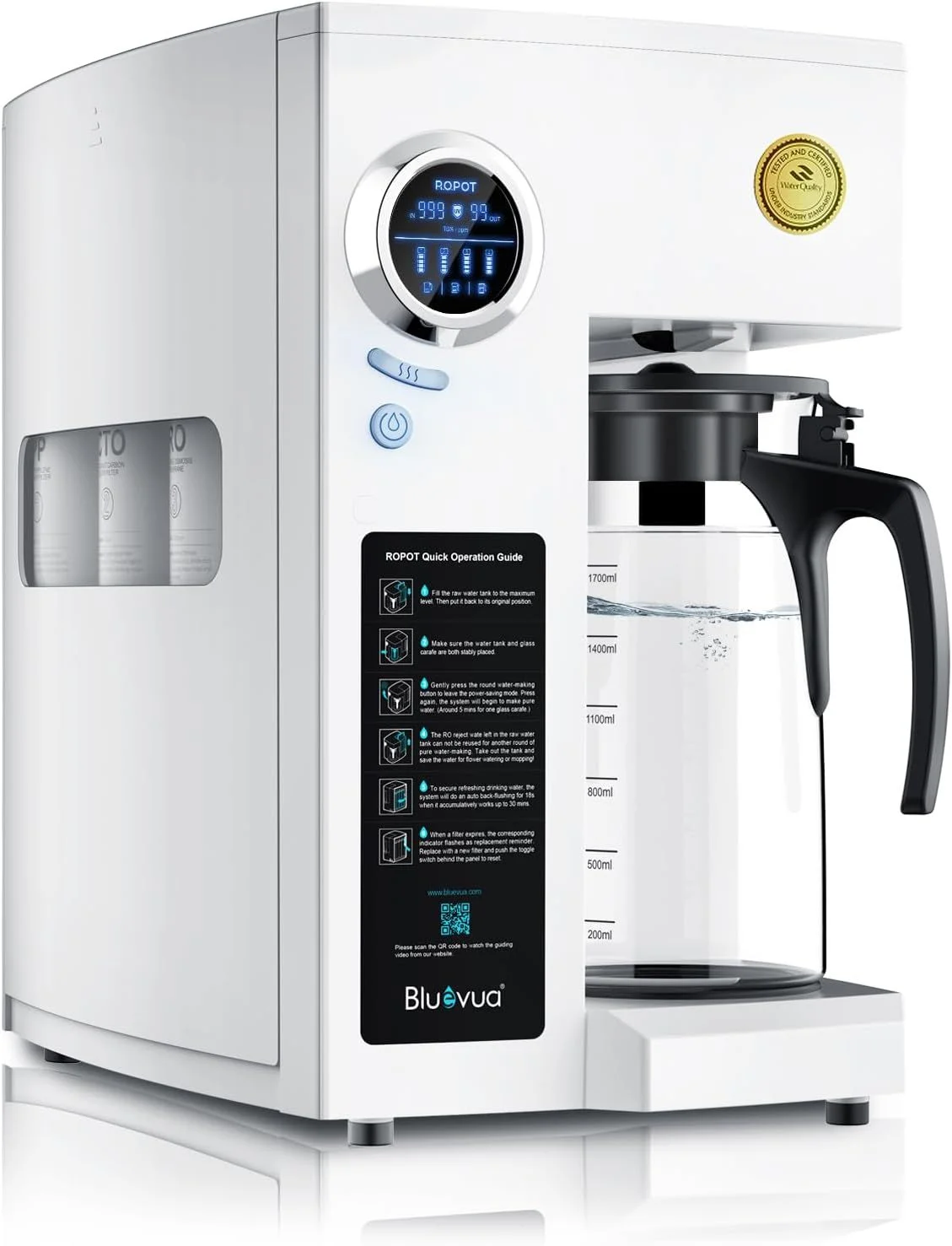
Bluevua RO100ROPOT-UV Countertop Reverse Osmosis System
At a Glance
| Feature | Waterdrop WD-A2 Countertop Reverse Osmosis System | Editor's Pick Bluevua RO100ROPOT-UV Countertop Reverse Osmosis System |
|---|---|---|
| Price | $250–$500 | $250–$500 |
| Filtration | 5-stage RO with UV | Reverse Osmosis + UV + Remineralization |
| Capacity | 159 oz reservoir + 40 oz portable pitcher | 0.75 gallons per cycle |
| Flow Rate / GPD | 100 GPD | ~0.5 GPM |
| Certifications | NSF 372 | NSF/ANSI 58 |
| Contaminants | TDS, PFOA/PFOS, chlorine, fluoride, lead, arsenic, bacteria (UV), viruses | TDS, lead, chlorine, fluoride, bacteria, viruses, heavy metals, PFAS |
| Weight | 22 lbs | 18 lbs |
| Check Price | Check Price |
Countertop reverse osmosis has matured from a niche category into a legitimate alternative to under-sink systems — and the Waterdrop WD-A2 and Bluevua RO100ROPOT-UV represent the two most compelling approaches to no-install RO purification. The WD-A2 reimagines the countertop RO as a multi-function appliance: a water purifier that also dispenses hot and cold water at six temperature presets, essentially combining a water filter, a water cooler, and an instant hot water dispenser into one device. The Bluevua RO100ROPOT-UV takes the purist approach: 6-stage RO with UV sterilization, glass carafe storage to eliminate plastic contact, and NSF 58 certification that specifically verifies the RO membrane's performance. Both require zero plumbing and plug into a standard outlet. The question is whether you are buying a water purifier or a kitchen appliance — because each system excels at one of those roles.
Category-by-Category Breakdown
Temperature Versatility & Dispensing
The Waterdrop WD-A2 is the only countertop RO system that doubles as a hot and cold water dispenser. It offers 6 temperature presets: cold (59°F), room temperature, warm (113°F), hot (149°F), very hot (176°F), and near-boiling (203°F advertised, though reviewers frequently report actual maximums of 165-186°F). The smart touchscreen lets you select temperature and volume, then dispenses filtered water at your chosen setting on demand.
This temperature versatility transforms the WD-A2 from a water filter into a kitchen appliance. Cold filtered water for drinking. Warm water for mixing medications or supplements. Hot water for instant coffee, pour-over, or tea. Near-boiling water for baby formula preparation. In households that currently use a separate electric kettle, a water cooler, or an instant hot water dispenser alongside their water filter, the WD-A2 consolidates multiple devices into one countertop footprint. For a family that goes through multiple cups of coffee and tea daily, the convenience is substantial.
The Bluevua RO100ROPOT-UV has no temperature control — it produces room-temperature filtered water that collects in a glass carafe. If you want hot or cold water, you need separate appliances. This is not a design flaw; it is a different product philosophy. The Bluevua focuses entirely on purification quality and material safety (glass over plastic), while the WD-A2 trades the glass carafe for integrated heating/cooling functionality.
The temperature accuracy caveat is worth repeating: multiple verified purchasers report the WD-A2's hot water maxes out in the 165-186°F range, not the advertised 203°F. For most hot beverage purposes, this is adequate. For applications requiring true near-boiling water (certain teas, sterilization), the WD-A2 may fall short. Manage expectations accordingly.
RO Certification & Filtration Verification
The Bluevua RO100ROPOT-UV carries NSF/ANSI 58 certification — the specific NSF standard designed to evaluate reverse osmosis systems. NSF 58 testing verifies TDS reduction rates, specific contaminant rejection (including lead, arsenic, fluoride, and PFAS), membrane structural integrity under operating pressure, and system efficiency. When a product carries NSF 58, you know that an independent lab has confirmed the RO membrane actually performs reverse osmosis at the claimed efficiency level. This is the most relevant certification for an RO system, and the Bluevua has it.
The Waterdrop WD-A2 carries NSF 372 certification, which verifies that the system's materials are lead-free in construction. This is an important material safety baseline — you want to know that the pipes, fittings, and reservoir inside your water purifier are not leaching lead into the purified water. But NSF 372 does not test the RO membrane's filtration performance. It does not verify TDS reduction, contaminant removal rates, or membrane efficiency. Waterdrop's premium under-sink systems (G3P800, D6) carry NSF 58 — the WD-A2 countertop model does not.
This certification gap is the single most important technical distinction in this comparison. Both systems use RO membranes, both claim to remove TDS and contaminants, and both include UV sterilization. But only the Bluevua's RO performance has been independently verified to the standard designed for RO systems. The WD-A2's RO claims are manufacturer-stated but not NSF 58 certified. For buyers who chose countertop RO specifically because they want the most thorough purification available, the Bluevua's NSF 58 certification provides documented assurance that the Waterdrop does not match.
Water Purity & Glass vs Plastic Storage
The Bluevua RO100ROPOT-UV stores purified water in a glass carafe. The Waterdrop WD-A2 stores purified water in an internal plastic reservoir (159 oz) with an optional 40 oz portable pitcher. This distinction matters more than it might appear on a spec sheet.
Reverse osmosis removes contaminants at the molecular level — including plasticizers, BPA, phthalates, and microplastics. Storing that ultra-purified water in a plastic reservoir creates an ironic recontamination pathway. RO-purified water is a particularly aggressive solvent because it has been stripped of its mineral content — it actively pulls ions from whatever container holds it, including trace amounts of plastic chemicals from the reservoir walls. The Bluevua's glass carafe eliminates this concern entirely. Glass is chemically inert, does not leach chemicals into water regardless of temperature or contact time, and maintains the purity of the RO output from membrane to glass.
The counter-argument is that modern food-grade plastics (BPA-free, FDA-approved) leach contaminants at levels far below regulatory concern. The WD-A2's internal reservoir is designed for water contact and meets food safety standards. For most people, the plastic exposure from the reservoir is negligible compared to the contaminants the RO membrane removes from the source water. But for buyers who specifically chose RO to eliminate plastic-related chemicals from their water, the Bluevua's glass carafe maintains philosophical and practical consistency that the WD-A2's plastic reservoir does not.
Both systems include UV sterilization as part of their filtration pipeline. The WD-A2 uses UV as a post-RO treatment step. The Bluevua also positions UV after the RO membrane. Both claim 99.99% bacteria and virus reduction through UV exposure. The UV implementations are comparable — neither system has a clear advantage in sterilization technology.
Water Efficiency & Waste Ratio
The Waterdrop WD-A2 operates at a 3:1 pure-to-drain ratio — producing 3 gallons of purified water for every 1 gallon of waste water sent down the drain. The Bluevua RO100ROPOT-UV operates at a 2:1 ratio — producing 2 gallons of purified water per 1 gallon of waste. The WD-A2 is 50% more water-efficient, wasting less water per gallon of purified output.
In practical terms: a household consuming 2 gallons of purified water per day produces approximately 0.67 gallons of waste water with the WD-A2 (244 gallons per year) versus 1 gallon of waste with the Bluevua (365 gallons per year). The WD-A2 saves approximately 121 gallons of waste water annually — roughly $0.50-1.50 in water costs depending on local utility rates, but a meaningful consideration for water-conscious households and those in drought-prone regions.
The 3:1 ratio also means the WD-A2's internal reservoir fills faster relative to waste water production, which is a practical convenience when you are waiting for filtered water. Both systems are dramatically more efficient than older-generation countertop and under-sink RO systems, which commonly wasted 3-4 gallons for every gallon purified. The category has improved significantly, and both the WD-A2 and Bluevua represent the current state-of-the-art in countertop RO efficiency.
User Experience & Community Feedback
The Bluevua RO100ROPOT-UV has a 4.4-star rating across 2,800+ reviews on Amazon. The Waterdrop WD-A2 has a 4.3-star rating across 868 reviews. The Bluevua has more than 3x the review volume, providing a more statistically reliable picture of long-term user satisfaction. Both ratings are strong for the countertop RO category, where the complexity of multi-stage filtration systems tends to generate more complaints than simpler products.
Common praise for the Bluevua centers on water taste quality, the glass carafe, ease of initial setup, and the simplicity of operation — fill, wait, pour. Complaints focus on the counter space footprint, slow filtration speed compared to expectations set by under-sink systems, and the cost of proprietary replacement filters.
Common praise for the WD-A2 centers on the hot/cold water dispensing convenience, the smart touchscreen interface, and the novelty of having temperature-selectable filtered water. Complaints focus on the temperature accuracy gap (hot water not reaching advertised 203°F), the manual refilling frequency (the reservoir needs topping off 1-2 times daily for heavy use), and the learning curve of the touchscreen controls.
The review patterns suggest that Bluevua buyers tend to be purity-focused (they specifically wanted RO with glass, and the product delivers). WD-A2 buyers tend to be convenience-focused (they wanted a multi-function appliance, and the hot/cold feature delivers, albeit with temperature caveats). Both user bases are largely satisfied, but dissatisfaction tends to stem from unmet expectations about the specific feature they prioritized.
Price & Value Proposition
The Bluevua RO100ROPOT-UV at $317 is $92 less than the Waterdrop WD-A2 at $409 — a 22% price difference. For $317, the Bluevua delivers: NSF 58-certified RO, 6-stage filtration with UV, glass carafe, 2:1 pure-to-drain, and a 4.4-star rating across 2,800+ reviews. For $409, the WD-A2 delivers: 5-stage RO with UV, hot/cold water dispensing at 6 temperatures, smart touchscreen, 3:1 pure-to-drain, NSF 372, and a 4.3-star rating across 868 reviews.
The $92 premium for the WD-A2 is essentially the price of the hot/cold dispensing system. If you currently spend money on a separate water cooler, electric kettle, or instant hot water dispenser, the WD-A2 may save you the cost of those devices while consolidating counter space. If you only need room-temperature purified water, the Bluevua delivers comparable (arguably superior, with NSF 58) RO performance at a lower price.
Ongoing filter replacement costs are comparable for both systems — both use proprietary multi-stage filter packs that need periodic replacement. The Bluevua's RO membrane is rated for 12 months, with other filters at 6 months. Waterdrop's replacement schedule is similar. Neither system has a significant long-term cost advantage in filter replacements — the upfront price difference is the primary economic differentiator.
For pure RO value — the most certified reverse osmosis performance per dollar — the Bluevua wins. For appliance value — the most functionality per dollar — the WD-A2 wins. These are different definitions of value, and the right one depends on whether you are shopping for a water purifier or a kitchen appliance.
The Filtration Stage Comparison
The Bluevua RO100ROPOT-UV uses a 6-stage filtration pipeline: sediment pre-filter, carbon block pre-filter, RO membrane, carbon post-filter, remineralization stage (adds calcium and magnesium back for better taste), and UV sterilization. The remineralization stage is a meaningful addition — it addresses the common complaint that RO water tastes "flat" or "dead" by restoring beneficial minerals that the membrane strips out. This produces water that tastes more like high-quality spring water than distilled water.
The Waterdrop WD-A2 uses a 5-stage filtration pipeline: sediment pre-filter, carbon block pre-filter, RO membrane, carbon post-filter, and UV sterilization. There is no remineralization stage. The water produced is pure RO output — very clean, but with the mineral-stripped taste profile that some users find unappealing for drinking. For hot beverages (coffee, tea), the absence of minerals may actually be preferable, as minerals can interfere with extraction and affect flavor profiles. For cold drinking water, the Bluevua's remineralization produces a more pleasant drinking experience for most palates.
The additional remineralization stage is one reason the Bluevua is classified as 6-stage versus the WD-A2's 5-stage, but stage count alone is not a quality metric. The WD-A2 compensates with its temperature dispensing system, which adds practical utility that no additional filtration stage provides. The Bluevua's extra stage improves taste. The WD-A2's temperature system improves convenience. Both are genuine value-adds — they just serve different user priorities.
Who Should Get Which?
Get the Waterdrop WD-A2 if...
- You want hot and cold water on demand — 6 temperature presets replace your kettle and water cooler
- You make coffee, tea, or baby formula daily and value instant temperature-selectable water
- Water efficiency matters — 3:1 pure-to-drain wastes 50% less water than the Bluevua
- You prefer a smart touchscreen interface with TDS display and filter life monitoring
- You are consolidating kitchen appliances and want one device that handles filtration + dispensing
- NSF 58 RO certification is not a priority — you trust Waterdrop's brand and product track record
Get the Bluevua RO100ROPOT-UV if...
- NSF 58 RO certification matters — you want independently verified reverse osmosis performance
- Glass storage is important — no plastic contact with your ultra-purified water
- Value is your priority — $317 vs $409 with stronger RO certification
- You want remineralization for better-tasting drinking water (the WD-A2 lacks this stage)
- You do not need hot/cold dispensing — a separate kettle handles your hot water needs
- Community trust matters — 2,800+ reviews at 4.4 stars provides more confidence than 868 reviews
Pro Tip: If you are torn between the WD-A2's temperature versatility and the Bluevua's certification and glass carafe, consider this: a Bluevua RO100ROPOT-UV ($317) plus a quality electric gooseneck kettle ($40-60) gives you NSF 58-certified RO with glass storage AND precise temperature-controlled hot water for less than the WD-A2's $409 price. You lose the integrated convenience and gain a glass carafe, stronger certification, and a separate kettle that likely delivers more accurate temperatures. The WD-A2 wins on counter space consolidation and single-device simplicity. The Bluevua-plus-kettle approach wins on certification, material purity, and total cost.
Countertop RO vs Under-Sink: Is Either Worth It?
Both the WD-A2 and Bluevua exist because a significant number of households cannot or prefer not to install under-sink RO systems. Renters, apartment dwellers, condo owners with plumbing restrictions, and people who simply do not want to modify their kitchen plumbing are the primary audience for countertop RO. For these buyers, the question is not "should I get an under-sink system instead?" — it is "which countertop system best fits my needs?"
However, if you have the option to install under-sink: under-sink RO systems deliver dramatically higher throughput (500-1200 GPD vs the WD-A2's 100 GPD), better water pressure at the dedicated faucet, no manual refilling, no counter space consumption, and generally stronger certifications. The Waterdrop G3P800 at $849 and the iSpring RCC7AK at $199 represent the premium and value ends of the under-sink spectrum. If installation is possible and acceptable, under-sink is objectively the superior RO experience.
Countertop RO makes sense when installation is not an option, when you move frequently (renters), or when you want the portability to take your filtration system with you. Both the WD-A2 and Bluevua are plug-and-play — unbox, fill with water, plug in, start purifying. That zero-installation convenience has real value for the right buyer.
Frequently Asked Questions
Can the Waterdrop WD-A2 really make hot water for coffee and tea?
Does the Bluevua RO100ROPOT-UV glass carafe make a difference?
Which system has better RO certification?
How much counter space does each system require?
Which system wastes less water?
Can either system be used off-grid without electricity?
Our Final Recommendation
For buyers who want a countertop RO system that does more than purify water, the Waterdrop WD-A2 at $409 is a genuinely innovative appliance. The 6-temperature dispensing system replaces your kettle, water cooler, and water filter in a single countertop device. The 3:1 pure-to-drain ratio is the most efficient in the countertop category. The smart touchscreen with TDS display adds a layer of monitoring and control that no other countertop RO offers. If you drink coffee, prepare baby formula, or simply want cold and hot purified water on demand, the WD-A2 delivers a feature set that no competitor matches.
For buyers who prioritize verified purification performance and value, the Bluevua RO100ROPOT-UV at $317 is the stronger choice. Its NSF 58 certification specifically verifies the RO membrane's performance — the standard that matters most for an RO system. The glass carafe eliminates plastic contact with your purified water, maintaining the integrity of the purification all the way to your glass. The 6-stage filtration with remineralization produces better-tasting water than the WD-A2's 5-stage pipeline. And it costs $92 less.
Our recommendation splits on use case. If temperature versatility would genuinely change your daily routine — fewer appliances, faster morning coffee, easier baby formula preparation — the WD-A2's $92 premium is justified by the functionality you gain. If you want the most trustworthy countertop RO purification at the best price, the Bluevua delivers stronger certification, purer storage, and better water taste for less money. Both are excellent systems in a category that is finally delivering on the promise of no-install reverse osmosis.
Track Both Products
We'll email you if either price drops or availability changes.
Only when something changes. Unsubscribe anytime.