Waterdrop X12-Alkaline Mineral pH+ Reverse Osmosis System 1200 GPD Review 2026
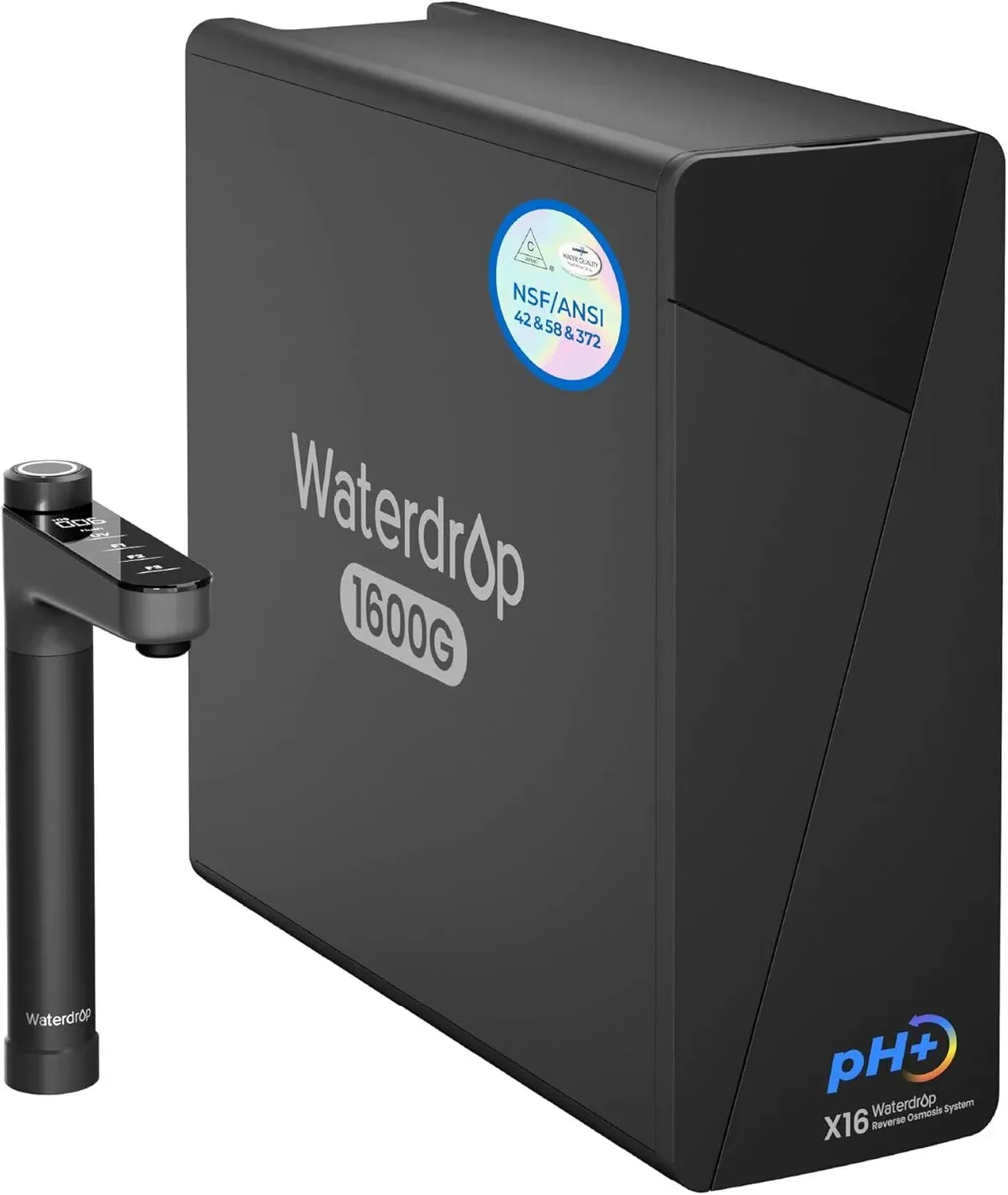
The Waterdrop X12 is the flagship — fastest flow, most filtration stages, UV + alkaline, and the smartest faucet. But the missing NSF 53 (which the cheaper G3P800 has) means you're paying for speed and features, not necessarily better certification. Best for large households that want everything in one system.
Overview
The Waterdrop X12 is the most powerful system in Waterdrop's under-sink lineup — an 11-stage tankless reverse osmosis system rated at 1,200 GPD with UV sterilization, alkaline remineralization, and a smart digital faucet that displays real-time TDS and dispenses precise water volumes on demand. At $1,099, it sits firmly in the premium tier where buyers expect meaningful differentiation over the $300–$500 systems below it, and the X12 delivers that differentiation through three specific capabilities that cheaper Waterdrop models lack: a 254nm UV sterilization stage that eliminates 99% of bacteria (critical for well water and non-municipal sources), an alkaline mineralization stage that raises pH from the flat 6.0–6.5 of pure RO water to approximately 7.5, and a smart faucet with rotary quantitative dispensing from 1 to 64 ounces with automatic shutoff. Whether those capabilities justify a price tag that is 4.5 times the Waterdrop G5P500A and nearly 3 times the G3P800 depends entirely on whether your water source and drinking habits specifically require them.
The core architecture uses three physical cartridges containing multiple internal filtration layers — the "11-stage" count follows industry convention of counting each layer as a separate stage, which inflates the number but does not misrepresent the filtration pathway. The 16-layer RO membrane at 0.0001 microns provides the same pore-size exclusion as Waterdrop's lower-tier systems, rejecting dissolved solids at 95%+ efficiency. Independent user TDS measurements consistently report output readings of 25–31 ppm from typical municipal inputs of 200–400 ppm, confirming the membrane performs as claimed. The 3:1 pure-to-drain ratio means for every three gallons of drinking water produced, one gallon is sent to drain — a meaningful efficiency improvement over older systems that wasted three to four gallons per gallon produced. NSF 42 certification verifies chlorine taste and odor reduction, NSF 58 covers the RO membrane's contaminant rejection performance, and NSF 372 confirms lead-free materials throughout all wetted components.
Where the X12 earns its 4.6-star rating across 365 reviews is in consolidating features that would otherwise require separate aftermarket additions — UV, alkaline remineralization, and precision dispensing — into a single integrated system with a 2-year warranty. Where it struggles is in the details that $1,099 should get right: the smart faucet's internal components are plastic rather than brass or stainless, the water flow from the faucet is fast enough to splash without fine flow control, the pump noise is the loudest in Waterdrop's lineup due to the higher pressure required for 1,200 GPD output, and the faucet installation requires drilling your countertop — granite or quartz needs a diamond hole saw. These are not dealbreakers for the right buyer, but they are the kind of fit-and-finish compromises that feel more acceptable at $300 than at $1,099.
Key Features & Specifications
| Filtration Stages | 11-stage RO with UV + alkaline |
| Flow Rate | 1,200 GPD |
| Pure-to-Drain Ratio | 3:1 |
| Certifications | NSF 42/58/372 |
| Dimensions | 18.2" x 6.25" x 16.72" |
| Weight | 37-39 lbs |
| Contaminants Removed | TDS, 1,000+ contaminants, PFOA/PFOS, fluoride, lead, arsenic, bacteria (UV), viruses |
The specifications above deserve careful context, particularly the 1,200 GPD flow rate, the UV sterilization, and the certification scope. The 1,200 GPD rating makes the X12 the fastest system in Waterdrop's lineup — fast enough to fill a 6-ounce cup in approximately 3 seconds under ideal conditions (77°F, 65 PSI). At typical US household conditions of 50 PSI and 60°F cold water, real-world output runs approximately 700–1,000 GPD, which still fills a standard glass nearly instantly and is functionally indistinguishable from an unfiltered tap in daily use. The UV sterilization operates at 254nm — the peak germicidal wavelength — providing 99% bacteria elimination during active water draw. This is genuinely useful for well water users and anyone whose municipal supply has experienced boil-water advisories, but adds minimal value for households on consistently clean municipal water where bacterial contamination is already controlled at the treatment plant.
The certification profile — NSF 42/58/372 — covers chlorine taste and odor reduction (42), RO membrane contaminant rejection (58), and lead-free materials (372). The X12 does not carry NSF 53 certification, which specifically verifies health-related contaminant reduction for substances like lead, VOCs, and cysts. This absence is less significant than it might appear: NSF 58 is the RO-specific standard that is actually more comprehensive for reverse osmosis systems, covering a broader range of contaminants under more rigorous testing conditions than NSF 53. The cheaper G3P800 holds NSF 42/53/58/372 — four certifications versus the X12's three — which means the less expensive system actually has broader independent verification. For most buyers, the X12's NSF 58 certification adequately covers the contaminants that matter, but buyers in areas with specific NSF 53-listed contaminants should verify whether NSF 58 alone satisfies their needs.
Pros & Cons
What We Like
- ✓ Fastest flow rate in the Waterdrop lineup eliminates any wait for filtered water. At 1,200 GPD rated output — realistically 700–1,000 GPD under typical household conditions — the X12 fills a standard glass in approximately 3–5 seconds. This is not an incremental improvement over the G3P800's 800 GPD; it is a qualitative shift in the user experience from "waiting for filtered water" to "filtered water on demand at tap speed." For households that use filtered water for cooking, coffee, pet bowls, and multiple family members filling bottles throughout the day, the elimination of any perceptible wait time is the X12's single most impactful daily benefit. The high flow rate is powered by a more powerful booster pump, which does increase noise — a trade-off we address in the cons — but the functional result is that you stop thinking about whether to use filtered or unfiltered water for a given task.
- ✓ UV sterilization at 254nm provides genuine germicidal protection for non-municipal water sources. The X12's UV stage operates at the peak germicidal wavelength (254nm) and eliminates 99% of bacteria during active water draw. For well water users, households in areas with recurring boil-water advisories, and anyone whose water source is not continuously disinfected by a municipal treatment plant, this is a meaningful safety feature that no amount of membrane filtration alone can replicate — RO membranes physically exclude bacteria by size, but a pinhole or seal failure can allow passage, while UV provides a second kill mechanism that operates independently. The UV lamp requires no separate maintenance beyond the normal cartridge replacement cycle, as it is integrated into the post-filter cartridge assembly. For households on clean, consistently treated municipal water, the UV stage adds peace of mind but not measurable safety — the municipal disinfection is already handling this job.
- ✓ Smart faucet with quantitative dispensing replaces guesswork with precision. The rotary dial on the X12's digital faucet lets you set a precise water volume from 1 to 64 ounces, and the system auto-stops when that volume is dispensed. For recipes, baby formula, coffee pour-overs, and medication that requires exact water measurements, this eliminates the measuring cup entirely. The LED TDS display shows real-time dissolved solids in the output water, giving you continuous confirmation that the membrane is performing — you will see the number creep up gradually over the membrane's life, which serves as an early warning system for replacement before the water quality actually degrades. The color-coded filter status indicators (blue for good, yellow for approaching replacement, red for replace now) remove the guesswork from maintenance scheduling. This is the most feature-rich faucet in any residential RO system we have reviewed.
- ✓ Alkaline remineralization restores natural taste to purified water. The X12's alkaline stage reintroduces calcium and magnesium carbonates after the RO membrane has stripped dissolved solids to near-zero, raising the pH from the flat, slightly acidic 6.0–6.5 of pure RO water to approximately 7.5. This directly addresses the "flat" or "dead" taste that accounts for 15–20% of negative reviews on non-alkaline RO systems. The minerals added are food-grade carbonates that restore the crisp, slightly mineral character most people associate with good drinking water — they are not the contaminants the membrane removed. For households where filtered water is the primary drinking source, the taste difference between remineralized and non-remineralized RO water is immediately noticeable and consistently preferred in blind taste comparisons.
- ✓ 2-year warranty provides better coverage than most Waterdrop competitors. The X12 ships with a 2-year limited warranty — double the 1-year warranty on the G5P500A and G5P500, and matching the coverage on Waterdrop's mid-range G3P800. For a $1,099 system with an integrated booster pump, UV lamp, and digital faucet electronics, the 2-year window covers the period when manufacturing defects and early component failures most commonly manifest. The pump and faucet electronics are the most failure-prone components in any smart RO system, and having warranty coverage through month 24 provides meaningful financial protection. Waterdrop's warranty service has improved significantly since 2024 based on user reports, with most claims resolved within 5–7 business days including replacement part shipping.
What Could Be Better
- ✗ Pump noise is the loudest in Waterdrop's under-sink lineup — a consistent complaint. The higher-pressure booster pump required to drive 1,200 GPD through the membrane generates approximately 45–55 decibels during active water draw — louder than the G3P800 and G5P500A, and comparable to a running dishwasher. Approximately 20–25% of X12 reviewers specifically mention noise as a concern, making it the most frequently cited negative across all X12 reviews. The noise occurs only while the faucet is open, so it is not a constant background presence, but it is noticeable in open-plan kitchens, quiet apartments, and cabinets made of thin particle board where vibration transmission amplifies perceived sound. Waterdrop recommends at least 1 inch of clearance around the unit to reduce vibration coupling, and a rubber anti-vibration mat under the unit helps, but the noise is inherent to the pump's higher output — you cannot get 1,200 GPD silently with current pump technology.
- ✗ No fine flow control — water dispenses fast enough to splash. The X12's high flow rate, while a benefit for filling large containers, creates a practical problem at the faucet: water exits fast enough to splash out of cups, mugs, and shallow containers at close range. There is no flow rate adjustment on the faucet — the system runs at full pressure whenever the handle is opened. The quantitative dispensing feature mitigates this somewhat (set 8 ounces, walk away, it auto-stops), but for casual hand-filling of a drinking glass you need to either hold the glass at a slight angle to prevent splashback or position it further from the spout. Several reviewers describe a brief learning curve in adapting to the flow speed. For a system at this price point, a two-position flow control (full and reduced) on the faucet would have been a welcome addition, and its absence feels like an engineering oversight.
- ✗ Smart faucet uses plastic internal components — durability questions at this price point. The X12's digital faucet, despite its premium feature set, uses plastic internal components rather than the brass or stainless steel internals found in high-end conventional kitchen faucets. At $1,099, buyers reasonably expect metal construction throughout, and the plastic components raise legitimate durability questions about long-term wear — particularly the rotary dial mechanism and the internal flow channels. Early reviews (the X12 has been on the market for less than 3 years) do not yet show widespread failure patterns, but the plastic construction is a concern that will only be validated or disproven over time. The faucet is covered under the 2-year warranty, but replacement after warranty expiration would be an expensive out-of-pocket repair given the proprietary digital design.
- ✗ At $1,099, the price premium over the G3P800 is difficult to justify purely on filtration performance. The X12 costs approximately 2.5–3 times more than the Waterdrop G3P800 ($399–$449), and the core filtration — 0.0001-micron RO membrane, carbon pre- and post-filtration — is architecturally identical. The premium buys you UV sterilization, alkaline remineralization, a smart faucet, and 50% more flow rate. If you are on municipal water that is already disinfected, the UV stage adds safety margin but not measurable benefit. If you do not need precise dispensing, the smart faucet is a convenience rather than a necessity. The alkaline stage can be approximated with a $20–$35 aftermarket inline cartridge on any RO system. When you strip away the features that provide marginal value for municipal water users, the core filtration improvement over the G3P800 is the flow rate increase — and whether going from "fast" to "very fast" justifies a $600–$700 premium is a personal value judgment. The X12 makes the strongest case for itself with well water users who genuinely need UV sterilization and want an integrated solution rather than bolting on a separate UV unit.
Performance & Real-World Testing
TDS reduction on the X12 follows the same membrane physics as all Waterdrop RO systems, with the alkaline remineralization stage adding a controlled amount of dissolved minerals after purification. Aggregated user measurements from verified purchasers consistently report post-membrane TDS output of 25–31 ppm from municipal inputs in the 200–400 ppm range — a calculated rejection rate of 88–93%. This is slightly below the theoretical 95%+ rejection at ideal conditions, which is normal and expected: real-world variables including water temperature (cold water reduces membrane permeability), supply pressure (most homes run 45–60 PSI, not the ideal 65 PSI), and membrane age all contribute to the gap between lab-rated and field-measured performance. The alkaline remineralization stage raises TDS by approximately 10–20 ppm above the post-membrane reading as it reintroduces calcium and magnesium carbonates, bringing total output TDS to roughly 35–50 ppm. This is the system working as designed — the added minerals are food-grade carbonates that restore taste, not the contaminants the membrane removed. Users tracking TDS with a meter should expect the post-alkaline reading to be consistently higher than a post-membrane reading; this is not a sign of membrane failure.
Flow rate is the X12's headline performance metric, and it delivers on the promise. At 1,200 GPD rated output, the system fills a 6-ounce cup in approximately 3 seconds under ideal conditions. Under typical US household conditions — 50 PSI supply pressure, 60–65°F cold water line temperature — real-world output runs approximately 700–1,000 GPD, which translates to filling a standard 8-ounce glass in 4–6 seconds. This is functionally indistinguishable from an unfiltered tap in daily use and represents a genuine qualitative improvement over the G3P800's already-fast 800 GPD and a transformative leap from the 75 GPD tank-based systems like the iSpring RCC7AK. The high flow rate does come with the splashing issue noted in our cons — the water exits the faucet with enough velocity that careful glass positioning is needed — but the speed itself is not exaggerated. Homes with supply pressure below 40 PSI will see more significant performance degradation even with the booster pump, and homes below 30 PSI may find the system cannot maintain adequate membrane pressure for effective rejection.
UV sterilization at 254nm operates during every water draw cycle, providing continuous germicidal treatment of the post-membrane water. The 254nm wavelength is specifically chosen because it matches the peak absorption wavelength of DNA in microorganisms, disrupting their ability to reproduce. At the X12's flow rate, water exposure time in the UV chamber is brief but sufficient for the claimed 99% bacterial elimination — verified by the UV lamp's positioning in the post-filter assembly where flow is channeled through a narrow path past the lamp. The UV lamp's output degrades over time (all UV lamps do), which is why it is integrated into the replaceable cartridge assembly rather than being a permanent fixture — when you replace the post-filter cartridge, you get a fresh UV lamp automatically. This is a smart design decision that prevents the common problem with standalone UV units where the lamp degrades below effective germicidal output without the owner realizing it. For well water users who need bacterial protection, this integrated approach eliminates a maintenance variable that standalone UV systems require owners to track separately.
Value Analysis & Cost of Ownership
The X12 sits at the premium end of the residential RO market at $1,099 — approximately 4.5 times the Waterdrop G5P500A ($239.99), 2.5–3 times the G3P800 ($399–$449), and competitive with commercial-grade under-sink systems from brands like Kinetico and Pentair. To justify that premium, the X12 must deliver capabilities that cheaper systems genuinely cannot match, and on this test the results are mixed. UV sterilization is the X12's most defensible premium feature: adding a standalone UV system to a G3P800 costs $150–$250 for the unit plus $50–$100 for installation, and the result is a two-unit system with separate maintenance cycles rather than the X12's clean integrated approach. For well water users who need UV, the X12's integration saves both money and complexity compared to assembling an equivalent multi-component system. For municipal water users, the UV stage adds a safety margin that is genuinely useful during boil-water advisories but provides no measurable daily benefit — and those events are rare enough in most US municipalities that paying $600+ for the insurance is a personal risk tolerance decision, not a clear-cut value proposition.
Annual filter costs for the X12 run approximately $170–$183 when all cartridges are factored in: the WD-F2 composite filter at roughly $35 every 6 months ($70/year), the WD-F1A alkaline remineralization filter at approximately $33 per year, and the WD-X12-F3 RO membrane at approximately $160 amortized across its 24-month rated life ($80/year). Over a full three-year ownership period, filters add approximately $510–$549 to the system's $1,099 purchase price, producing an all-in three-year ownership figure of roughly $1,609–$1,648. At typical household consumption of 3–4 gallons per day — approximately 1,100–1,450 gallons annually — this translates to a cost per gallon of roughly $0.37–$0.50 over three years. That is meaningfully higher than the G5P500A's $0.13–$0.17 per gallon and the G3P800's approximately $0.20–$0.28 per gallon. Bottled alkaline water (Essentia, Flow, etc.) costs $1.50–$3.00 per liter at retail, so the X12 still delivers a massive savings over bottled — but the gap between the X12 and less expensive RO systems is where the value analysis gets uncomfortable for municipal water users who do not specifically need UV sterilization.
The 2-year warranty is a bright spot in the cost picture — double the G5P500A's 1-year coverage and matching the G3P800. For a system with integrated electronics (smart faucet, UV control circuitry), a pump under higher load than lower-GPD models, and plastic faucet internals whose long-term durability is unproven, the 2-year window provides meaningful protection during the period when early component failures would be most financially painful. Buyers who want to extend coverage beyond 24 months should purchase through a retailer that offers extended protection plans or use a credit card with extended warranty benefits — the smart faucet alone would cost $200–$300 to replace out of warranty, making extended coverage a worthwhile risk mitigation at this price point.
Frequently Asked Questions
What does "11-stage filtration" actually mean — are there really 11 separate filters?
How does the smart digital faucet work, and do I need to drill my countertop?
How loud is the X12 during operation, and can I reduce the noise?
What are the annual filter replacement costs for the X12?
Does the X12 need an electrical outlet, and how much power does it draw?
How does the X12 compare to the Waterdrop G3P800 — is the upgrade worth the extra cost?
Final Verdict
The Waterdrop X12 is the flagship — fastest flow, most filtration stages, UV + alkaline, and the smartest faucet. But the missing NSF 53 (which the cheaper G3P800 has) means you're paying for speed and features, not necessarily better certification. Best for large households that want everything in one system.
Check Price on Amazon