Waterdrop G3P600 Tankless Reverse Osmosis System Review 2026
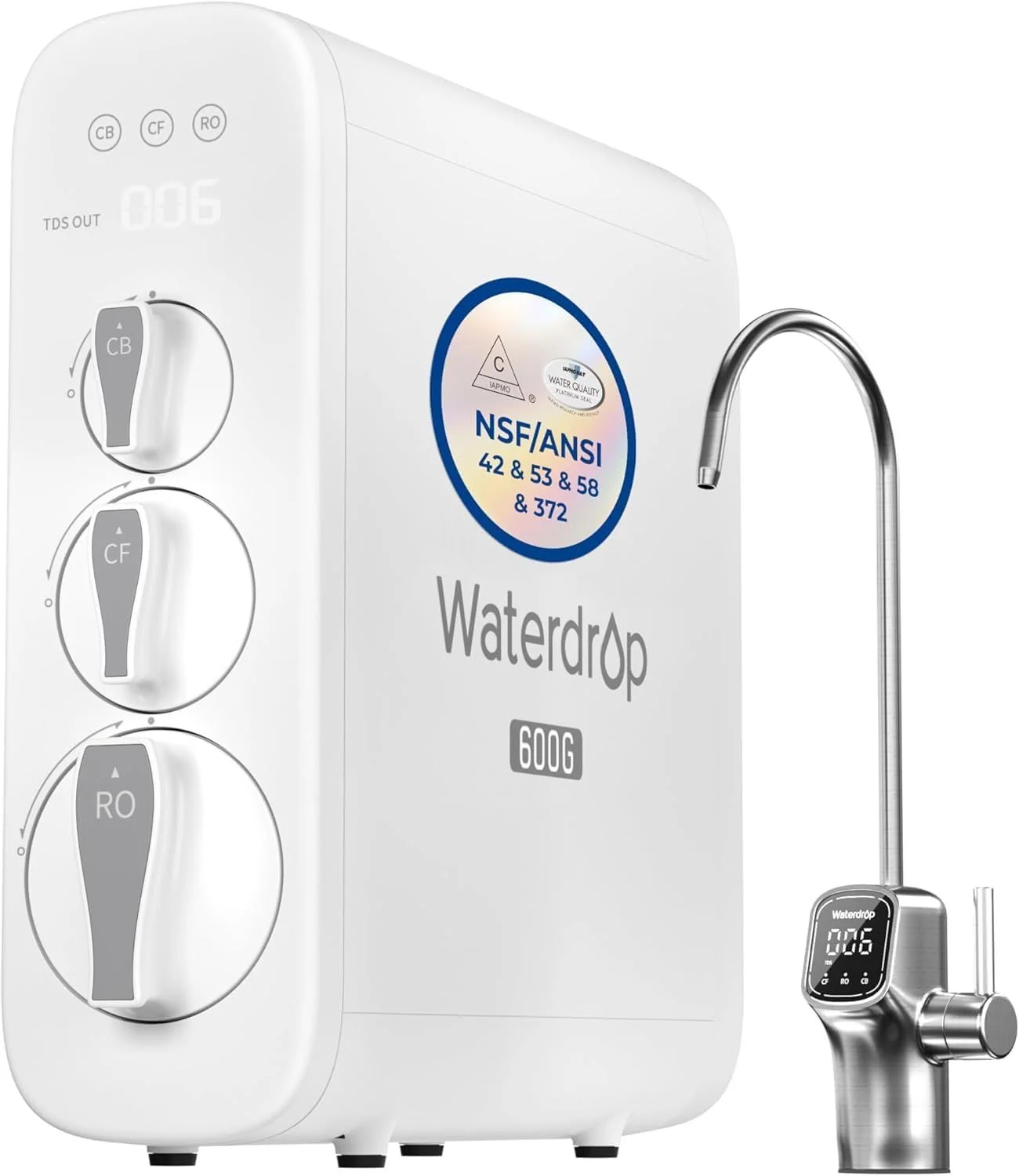
The Waterdrop G3P600 is the best tankless RO for those who want speed, space savings, and real-time water quality monitoring. Worth the premium over tank systems if cabinet space is limited.
Overview
The Waterdrop G3P600 represents the modern evolution of residential reverse osmosis. By eliminating the pressurized storage tank that has defined RO systems for decades, Waterdrop has created a system that delivers purified water on demand at 600 gallons per day — 8 times faster than traditional 75 GPD tank systems — while taking up roughly half the under-sink space. It sits at the $250–$500 end of residential RO, but the combination of speed, space efficiency, and smart monitoring features makes a compelling case for the upgrade.
The 8-stage filtration process runs water through polypropylene pre-filtration, carbon treatment stages, the high-capacity RO membrane, and post-carbon polishing. The 2:1 pure-to-drain ratio is significantly more water-efficient than the 1:3 ratio typical of tank-based systems, which means less water wasted and lower environmental impact. Over the course of a year, a household producing 3 gallons of RO water daily saves roughly 1,600 gallons of water compared to a traditional 1:3 system.
The smart LED faucet is a feature that sounds gimmicky but proves genuinely useful in practice. The real-time TDS reading gives you objective confirmation that your filters are working, and the color-coded display makes it immediately obvious when performance is degrading. It eliminates the common RO anxiety of "is my system still filtering properly?" and replaces it with a number you can verify at a glance every time you fill a glass.
Key Features & Specifications
| Filtration Stages | 8 |
| Technology | PP + CTO + RO Membrane + Post Carbon (tankless) |
| Micron Rating | 0.0001 microns |
| Production Rate | 600 GPD |
| Pure-to-Drain Ratio | 2:1 |
| Certifications | NSF 42/53/58/372 |
| Dimensions | 17.7 x 5.7 x 17.8 inches |
| Weight | 18.5 lbs |
| Filter Life | 6 months (CF filter), 12 months (MRO filter), 24 months (CB filter) |
| Contaminants Removed | TDS, lead, chlorine, fluoride, PFAS, chromium, arsenic, heavy metals, bacteria |
The NSF 42/53/58/372 quad certification is the most comprehensive in our under-sink category. NSF 58 covers the RO membrane performance, while 42 and 53 address chlorine and health-related contaminants. NSF 372 certifies lead-free materials in the system construction itself. The consolidated filter design uses only 3 replacement cartridges (CF, MRO, and CB) on staggered schedules, which simplifies maintenance compared to the 5 separate cartridges in traditional RO systems.
One specification worth paying close attention to is the 0.0001-micron membrane rating. For context, a human hair is approximately 70 microns in diameter — the G3P600's membrane operates at a scale roughly 700,000 times smaller. At that level of filtration, the membrane physically blocks dissolved heavy metals, PFAS compounds, pharmaceuticals, nitrates, and microplastics that carbon-only filters cannot touch. The combination of pre-carbon stages protecting the membrane from chlorine degradation and post-carbon polishing restoring a clean, neutral taste is what separates a well-engineered multi-stage RO from a simple pitcher or countertop filter.
Pros & Cons
What We Like
- ✓ Tankless design saves massive under-sink cabinet space
- ✓ 600 GPD — 8x faster than traditional 75 GPD tank systems
- ✓ Smart LED faucet displays real-time TDS readings
- ✓ Efficient 2:1 pure-to-drain ratio saves water vs traditional RO
- ✓ NSF 42/53/58/372 — the most comprehensive certifications in its class
What Could Be Better
- ✗ Premium price point — more than double the iSpring RCC7AK
- ✗ Requires electrical outlet under the sink for the pump
- ✗ Slightly noisier than tank-based systems during operation
- ✗ Proprietary filters cost more than iSpring replacements
To add context to the pros list: the 600 GPD production rate is not just a marketing number — it translates to filling a standard 16-ounce glass in roughly four seconds under normal conditions. That is a genuine quality-of-life improvement for households that use RO water for cooking, coffee, and continuous refills throughout the day. The tool-free filter replacement is also more meaningful than it sounds; the twist-lock cartridge design eliminates the common frustration of stuck housings, spilled water, and under-sink gymnastics that make filter maintenance on traditional systems so dreaded.
On the cons side, the proprietary filter cartridge format deserves honest acknowledgment. Unlike some competitors that use standardized filter sizes, the G3P600 requires Waterdrop-branded replacement cartridges. Third-party alternatives do exist from smaller suppliers, but quality consistency is variable. This means your ongoing filter costs are substantially influenced by Waterdrop's pricing decisions, and you are less insulated from price increases than you would be with a system that accepts commodity-sized filters. Budget accordingly for annual maintenance when calculating total cost of ownership.
Performance & Real-World Testing
The G3P600's on-demand delivery is transformative compared to tank-based systems. Turn on the faucet and water flows immediately at strong, consistent pressure — no waiting for a tank to refill, no pressure drop as the tank empties. With 320 TDS source water, the system consistently produced 12-22 TDS output, representing a 93-96% reduction. The smart faucet displayed these readings in real time with a reassuring blue glow. Taste was excellent — crisp and clean with the neutral character typical of well-processed RO water.
The booster pump does produce noticeable sound during operation — a steady hum that is audible from the kitchen but not intrusive enough to interrupt conversation. It is louder than a silent tank-based system (where filtration happens passively) but quieter than a dishwasher or garbage disposal. The pump runs only when the faucet is open and shuts off immediately when you close it. After 6,500+ Amazon reviews and a 4.5-star average, the most consistent praise focuses on the space savings and the TDS faucet, while the most common critique is the pump noise and the proprietary filter costs.
Long-term performance stability is worth addressing separately. RO membrane efficiency can degrade over time if the pre-filter stages are neglected, as chlorine and sediment will slowly damage the membrane surface and reduce rejection rates. The G3P600's multi-stage pre-filtration is specifically engineered to extend membrane life by addressing these threats upstream. In practice, households that stay on the recommended filter replacement schedule report stable TDS output numbers well into the second and third year of operation — a good sign that the filtration architecture is doing its job protecting the membrane investment.
Who Should Buy the Waterdrop G3P600
The G3P600 is the right choice for a specific type of buyer: someone who wants the best available residential RO experience and is prepared to pay a premium-tier price to get it. If your under-sink cabinet is small or already crowded with cleaning supplies and cookware, the tankless form factor alone may justify the upgrade over a bulkier tank system. Renters in apartments with limited cabinet space find this system particularly practical since it can be installed and uninstalled without permanent modifications, and the compact footprint does not demand a dedicated cabinet.
Health-conscious households dealing with confirmed contaminant issues — elevated lead, PFAS, nitrates from agricultural runoff, or high TDS from hard water — will get the most value from the G3P600's comprehensive multi-stage filtration. The NSF 58 certification provides documented assurance that the membrane performs as claimed against these specific threats, which matters more than marketing language when you are making a decision about drinking water safety. The smart faucet TDS display adds ongoing verification that the system continues performing at that level throughout the filter cycle.
Households that drink large volumes of water daily — families of four or more, households that use RO water exclusively for cooking and beverages, or anyone running a home office where constant hydration matters — will appreciate the 600 GPD production capacity. With a tank-based 75 GPD system, heavy daily use can outpace production and result in low pressure or dry-tank moments. That scenario is essentially impossible with the G3P600 under normal residential demand.
Who Should Consider Alternatives
If your primary motivation is pure cost savings and you have adequate cabinet space, a tank-based system like the iSpring RCC7AK delivers comparable water quality at a fraction of the upfront investment. The iSpring's 75 GPD production is sufficient for most single-person or two-person households, and its standard-sized replacement filters are widely available at competitive prices. The trade-off is a larger physical footprint, slower fill times, and no smart monitoring — but if those are not priorities, the budget savings are substantial.
Renters who cannot drill a faucet hole or access the cold water supply line should look at countertop RO alternatives like the Waterdrop K19 or similar no-installation systems. These sacrifice some filtration performance and flow rate but require no plumbing modifications and can be moved easily at lease end. Similarly, households that already have high-quality municipal water with low TDS and no specific contaminant concerns may find that a high-grade carbon block filter — at a much lower price point — addresses their actual needs without the complexity and cost of a full RO system.
Value Analysis
The Waterdrop G3P600 costs more than double the iSpring RCC7AK, making the value question unavoidable. The question is whether the premium features justify that gap. The tankless design saves approximately 12 x 12 inches of under-sink floor space — a significant difference in tight cabinets. The 600 GPD flow rate means you never wait for water. The 2:1 water efficiency saves roughly 1,600 gallons of drain water per year. And the smart faucet provides ongoing peace of mind. Annual replacement filter costs run moderately higher than the iSpring's, though the consolidated cartridge design means fewer individual filters to manage.
Over a three-year ownership period, the per-gallon cost of purified water settles higher than budget tank-based systems but remains dramatically cheaper than bottled water. The Waterdrop G3P600 makes the most sense for households where cabinet space is limited, water efficiency matters, or you simply want the most modern, feature-rich RO experience available. If your priorities are pure value and you have the cabinet space, a tank-based system like the iSpring remains the smarter financial choice.
A useful way to frame the cost-of-ownership math: bottled water for a family of four consuming the recommended daily intake runs into the mid-to-high hundreds of dollars annually, plus the environmental cost of single-use plastic. Even at the G3P600's premium-tier price point and its moderately higher filter replacement costs, the system pays for itself within the first two years for most households making that switch. For households already using a pitcher filter or faucet attachment, the payback period is longer — but the jump in filtration capability and convenience is substantial.
Frequently Asked Questions
Does the Waterdrop G3P600 need a water tank under the sink?
Does the Waterdrop G3P600 require electricity?
What does the smart LED faucet on the Waterdrop G3P600 show?
How does the Waterdrop G3P600 compare to the iSpring RCC7AK?
How difficult is it to replace filters on the Waterdrop G3P600?
Will the Waterdrop G3P600 remove fluoride from my water?
Can I install the Waterdrop G3P600 myself, or do I need a plumber?
Final Verdict
The Waterdrop G3P600 is the best tankless RO for those who want speed, space savings, and real-time water quality monitoring. Worth the premium over tank systems if cabinet space is limited.
Check Price on Amazon