VIQUA VH200 Whole-Home Ultraviolet Water System Review 2026
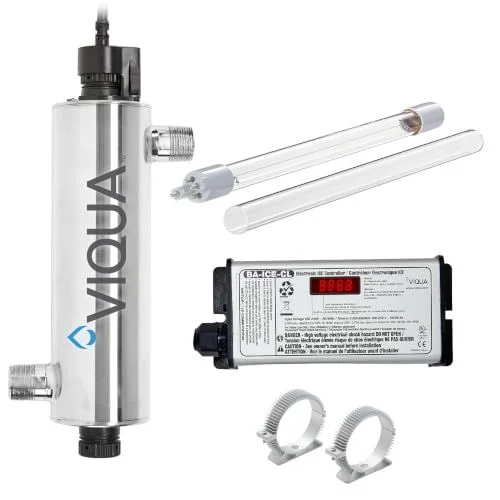
The VIQUA VH200 is the whole-house answer for a well that tests positive for bacteria: UV light at up to 9 gpm, with a lamp alarm. It only disinfects, it needs pre-treated, low-iron water, and this version carries no NSF/ANSI 55 listing.
Overview
The VIQUA VH200 is a whole-house ultraviolet system for homes on a private well. It mounts on the main water line, after the sediment filter, and passes every gallon past a UV lamp inside a 304 stainless steel chamber. VIQUA rates it at 9 gpm at its standard dose, and the Amazon listing describes it as designed for small homes. It sits in the Flagship band among the products on this site.
UV is the chemical-free way to deal with bacteria in well water. VIQUA lists Cryptosporidium, Giardia, E. coli and fecal coliform among the organisms it inactivates, based on its own testing. It adds nothing to the water and changes neither taste nor odor.
Two things to know before buying. First, this plain VH200 is not on NSF's NSF/ANSI 55 listing; VIQUA's VH200-V is (Class B). Second, UV only disinfects. It removes no sediment, iron, lead, nitrates or PFAS, and it needs clear, low-iron water to work.
Key Features & Specifications
| Technology | Ultraviolet disinfection (no filter media) |
| Flow Rate | 9 gpm (30 mJ/cm²); 7 gpm (40 mJ/cm²) |
| Installation | Whole house, point of entry |
| Lamp Life | Lamp: 9,000 hours |
| Certified | Not NSF/ANSI 55 listed (VH200-V is) |
| Connections | 3/4" FNPT or 1" MNPT; 100-240 V |
| Dimensions | 17.75 x 3.5 inches (chamber) |
| What It Treats | Inactivates bacteria and protozoa (E. coli, Giardia, Cryptosporidium); removes nothing |
UV dose is measured in millijoules per square centimeter. VIQUA's spec sheet gives three ratings for the VH200 at 95% UV transmittance: 16 gpm at 16 mJ/cm² (the US Public Health level), 9 gpm at 30 mJ/cm² (VIQUA's standard) and 7 gpm at 40 mJ/cm² (the NSF and EPA level). The slower the water moves, the higher the dose.
The controller shows how much lamp life is left, sounds a reminder when the lamp is due and an alarm if it fails. There is no UV intensity sensor on this model; in VIQUA's HOME range only the VH410M has one. The system draws 35 W and runs on 100-240 V.
Pros & Cons
What We Like
- ✓ Treats the whole house: rated 9 gpm at VIQUA's standard dose and 7 gpm at the 40 mJ/cm² NSF/EPA dose
- ✓ No chemicals and nothing added to the water; VIQUA lists Cryptosporidium, Giardia, E. coli and fecal coliform
- ✓ Controller counts down lamp life and sounds an alarm if the lamp fails
- ✓ 304 stainless chamber and 3/4-inch or 1-inch combo ports
What Could Be Better
- ✗ Not NSF/ANSI 55 certified: NSF lists the VH200-V version (Class B), not this one
- ✗ Needs clean, clear water to work: VIQUA sets limits of 7 grains hardness, 0.3 mg/L iron and 0.1 mg/L tannins
- ✗ Removes nothing: no sediment, metals, nitrates or PFAS, so it sits after a sediment filter
- ✗ Needs constant power, and the lamp is a yearly part (rated 9,000 hours)
Most of the limits in the cons list apply to UV systems generally; the missing NSF/ANSI 55 listing is this unit's own, and the VH200-V carries it. UV is fast and adds nothing to the water, but it works only on clear water, only while it has power, and only on living organisms.
Real-World Performance
VIQUA sets the VH200's water limits at under 7 grains per gallon of hardness, under 0.3 mg/L of iron and under 0.1 mg/L of tannins. Above those, scale and stains build up on the quartz sleeve and block the light, so the dose falls. Hard or iron-rich well water needs a softener or iron filter ahead of it.
Flow matters as much as water quality. At 7 gpm the VH200 delivers the 40 mJ/cm² dose; at 9 gpm, VIQUA's 30 mJ/cm² standard. A household that runs a shower, a washing machine and a kitchen tap at once can exceed those rates, and the water treated during that peak receives a lower dose.
Who Should Buy the VIQUA VH200
Homes on a private well whose lab test shows coliform or E. coli, or wells that are shallow, near livestock or prone to flooding, where bacteria are a recurring risk. With a sediment filter in front of it, the VH200 treats every tap in the house without chemicals.
It suits water that is otherwise in good shape: moderate hardness, low iron and clear. If your test also shows lead, arsenic or nitrates, it is one stage of the answer, with an RO system at the kitchen sink as the other.
Who Should Consider Alternatives
If you want a system certified to NSF/ANSI 55, look for the VH200-V, which NSF lists under Class B, or a Class A system from VIQUA's PRO range for contaminated water. Neither is the product on this page.
If your well tests clean for bacteria, you may not need UV at all: a sediment filter for the house and an iSpring RCC7AK RO system for drinking water cover the common well problems.
Value Analysis
The VH200 is a Flagship-band purchase, and it brings running costs: a lamp each year, a quartz sleeve now and then, and 35 W of power around the clock.
Plan for installation too: it needs a bypass loop, a power outlet near the main line and a sediment filter ahead of it.
Frequently Asked Questions
Is the VIQUA VH200 NSF certified?
What flow rate is the VH200 rated for?
Do I need a filter before a UV system?
How often does the lamp need replacing?
Does UV remove lead, nitrates or PFAS?
Final Verdict
The VIQUA VH200 is the whole-house answer for a well that tests positive for bacteria: UV light at up to 9 gpm, with a lamp alarm. It only disinfects, it needs pre-treated, low-iron water, and this version carries no NSF/ANSI 55 listing.
Check Price on Amazon