Sawyer Micro Squeeze Water Filtration System Review 2026
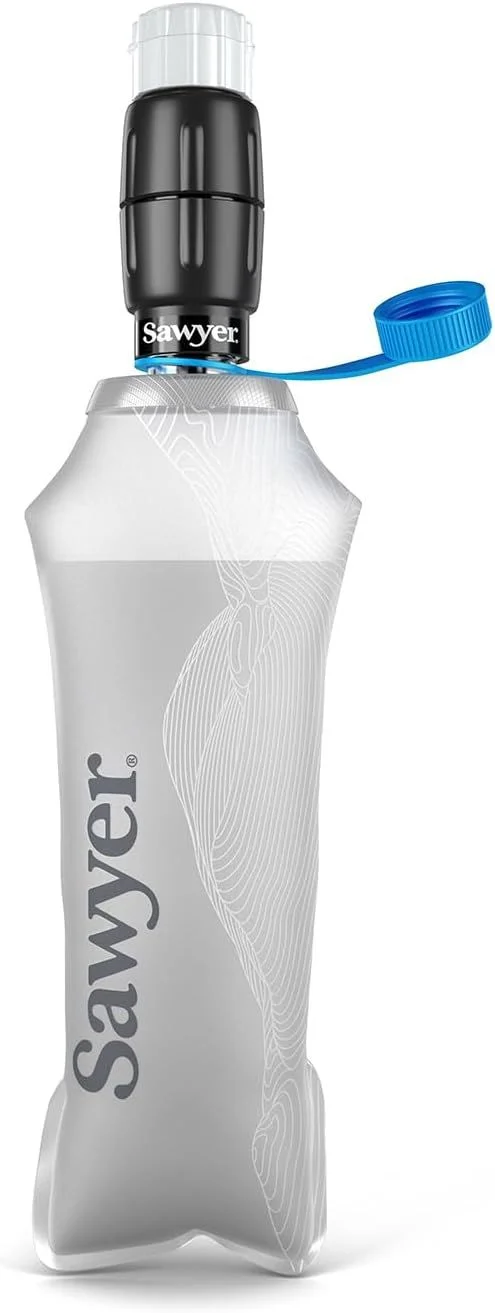
The Sawyer Micro Squeeze is the go-to filter for ultralight backpackers who want Sawyer reliability in the smallest possible package. At 1.65 oz with 100,000-gallon capacity, it is the best weight-to-performance ratio in portable water filtration — paired here with a Cnoc Premium bladder that fixes Sawyer's notorious pouch quality issues.
Overview
The Sawyer Micro Squeeze is the best weight-to-performance ratio in portable backpacking water filtration. At 1.65 oz dry and barely larger than your thumb, this 0.1-micron absolute hollow fiber membrane filter delivers 7-log bacteria removal (99.99999%) and 6-log protozoa removal (99.9999%) with a 100,000-gallon lifetime that will outlast every other piece of gear in your pack. Priced in the $25–$50 range, it hits the value sweet spot between Sawyer's slower Mini and their bulkier full-size Squeeze.
This SP301 bundle pairs the Micro Squeeze filter with a Cnoc Premium 750ml TPU bladder — a meaningful upgrade over the notoriously fragile squeeze pouches Sawyer has included with their filters for years. The Cnoc bladder features a wide-mouth opening for easy filling from shallow streams, reinforced seams rated for thousands of squeeze cycles, and the same 28mm thread connection that fits SmartWater bottles and hydration pack hose adapters. Four use modes — squeeze, inline, straw, and direct bottle-thread — make the Micro Squeeze one of the most versatile filters on the market.
The limitations are straightforward: this is a mechanical filter, not a purifier. The 0.1-micron hollow fiber membrane blocks bacteria, protozoa, and microplastics with absolute certainty, but viruses, chemicals, and dissolved heavy metals pass right through. For North American backcountry use where giardia and cryptosporidium are the primary threats, that is exactly the right level of protection. For international travel or disaster scenarios where viral contamination is a concern, you need a purifier like the Survivor Filter Pro or a chemical treatment backup.
Key Features & Specifications
| Filtration Stages | 1 |
| Technology | 0.1μm Absolute Hollow Fiber Membrane |
| Micron Rating | 0.1 |
| Capacity | 100,000 gallons (378,000 liters) |
| Flow Rate | ~1.4 L/min (squeeze) |
| Dimensions | 1.59 x 1.59 x 4.22 inches (filter) |
| Weight | 1.65 oz dry (47g) / ~4 oz with Cnoc bladder |
| Filter Life | 100,000 gallons |
| Contaminants Removed | Bacteria (99.99999%), protozoa (99.9999%), microplastics (100%) |
The Micro Squeeze uses Sawyer's proven absolute hollow fiber membrane technology — the same 0.1-micron U-shaped fiber bundle found across their entire filter line. "Absolute" means every single pore is at or below the rated size, unlike nominal-rated filters where pore size is an average. Each Micro Squeeze filter is individually tested three times at the factory before shipping, a quality assurance step Sawyer highlights as a differentiator over competitors. The 28mm threaded connection is the industry's most compatible standard — it fits SmartWater bottles (the thru-hiker's favorite), Cnoc bladders, CNOC Vecto 2L bags, and most hydration pack hoses with a simple adapter.
Pros & Cons
What We Like
- ✓ Ultralight at 1.65 oz dry — one of the lightest filters available for backpacking
- ✓ 100,000-gallon filter life is effectively a lifetime purchase
- ✓ Cnoc Premium TPU bladder bundle solves Sawyer's fragile pouch problem
- ✓ Versatile 28mm threading fits SmartWater bottles, Cnoc bladders, and hydration packs
- ✓ Each filter individually tested 3 times at the factory for quality assurance
What Could Be Better
- ✗ Does not remove viruses — only bacteria and protozoa (0.1 micron)
- ✗ Flow rate degrades over time — requires regular backflushing and periodic vinegar soaks
- ✗ Cannot freeze — ice damage silently compromises hollow fibers with no way to verify
- ✗ Not as fast as the full-size Sawyer Squeeze, especially after extended use
The Micro Squeeze's ultralight weight deserves more than a bullet point. At 1.65 oz, it weighs less than a standard granola bar and takes up roughly the same space as a tube of lip balm in your kit. For ultralight backpackers where every gram is a deliberate decision, this is a filter you genuinely forget is in your pack — until you need it. The 100,000-gallon filter life is equally significant: it means you are almost certainly buying this filter once and never replacing the membrane itself, which changes the total cost calculation dramatically compared to filters with short-lived cartridges.
On the cons side, the absence of virus protection is worth understanding in context rather than dismissing. In well-maintained North American wilderness areas, viral waterborne illness from backcountry water sources is extremely rare. However, the risk is not zero — particularly in heavily trafficked areas with poor human waste management, or in regions affected by flooding. Hikers who regularly travel internationally or who want a single all-hazard solution should treat the Micro Squeeze as one layer in a system, pairing it with Aquamira drops or SteriPen UV treatment when viral risk is elevated. The lack of chemical filtration is similarly situational — a concern near agricultural runoff or mine tailings, but irrelevant for the vast majority of alpine and subalpine water sources.
Performance & Real-World Testing
The Micro Squeeze delivers approximately 1.4 L/min in squeeze mode when new — noticeably faster than the Sawyer Mini's 0.5 L/min but slightly behind the full-size Squeeze's 1.7 L/min. In practical terms, filling a 1-liter SmartWater bottle takes about 40-50 seconds of steady squeezing from a Cnoc bladder. That is fast enough to keep a group of two hydrated without feeling like water collection dominates your trail breaks, which is something the Mini cannot claim.
Flow rate is where the Micro Squeeze's long-term story gets more nuanced. Like all hollow fiber filters, the pores gradually clog with sediment, biofilm, and mineral deposits. After filtering 50-100 liters of clear mountain stream water, flow rate drops to roughly 60-70% of new performance. Backflushing with the included syringe restores most of that loss immediately. In silty or tannic water (desert canyon streams, post-rain runoff), flow degradation accelerates significantly — expect to backflush every liter or two. A periodic vinegar soak (8-12 hours in undiluted white vinegar) dissolves mineral buildup that backflushing alone cannot clear.
Compared to the Katadyn BeFree, the Micro Squeeze is slower out of the box but maintains better long-term flow consistency. The BeFree starts fast (2+ L/min) but degrades rapidly in sediment-heavy water with no effective backflush mechanism. Compared to the LifeStraw Peak Series squeeze, the Micro Squeeze offers a significantly longer filter life (100,000 gallons vs 500 gallons) at similar flow rates. The Micro Squeeze's 100,000-gallon capacity means most backpackers will never need to replace the filter itself — it is effectively a lifetime purchase if maintained properly.
In cold-weather testing above treeline, the Micro Squeeze performed reliably down to temperatures just above freezing as long as the filter body itself never froze. Squeeze force required does increase noticeably in cold conditions — the hollow fibers stiffen slightly and water viscosity increases — but filtration remains effective. Wrapping the filter in an insulating sock or carrying it against your torso between water stops addresses this completely. The Cnoc TPU bladder also outperforms Sawyer's stock pouches in cold conditions, remaining pliable and squeeze-friendly at temperatures that would make thinner plastic films brittle and prone to cracking at the seams.
Who Should Buy the Micro Squeeze SP301 — And Who Should Skip It
Buy it if: You are a 3-season backpacker logging serious miles in North American wilderness, a thru-hiker looking for a filter that can go the distance from Mexico to Canada without replacement, or an ultralight-focused hiker where every gram of base weight is a conscious trade-off. The SP301 bundle is specifically the right choice if you have previously experienced Sawyer pouch failures and want the Cnoc bladder's durability from day one. It also makes excellent sense as a primary filter for car campers and overlanders who want something small and reliable stashed in the emergency kit — the 100,000-gallon life means it will be ready years from now without any degradation concerns.
Skip it if: You are filtering water for a group of four or more people, in which case a gravity system like the Platypus GravityWorks or MSR TrailBase will save you significant hand fatigue over a week-long trip. Skip it if you travel internationally to regions with known viral water contamination — the MSR Guardian Purifier or Survivor Filter Pro X are better choices despite their additional weight and cost. Also reconsider if you only hike a few times per year on short day trips; a more affordable entry-level filter like the HydroBlu Versa Flow covers those use cases at a fraction of the investment, and the Micro Squeeze's advanced capabilities will go largely unused.
Consider pairing it with: A 10-tablet strip of Aquamila drops or a small SteriPen Ultralight UV purifier if you want an all-hazards backcountry kit without committing to a dedicated purifier's weight. The Micro Squeeze handles bacteria and protozoa; a secondary chemical or UV treatment addresses viral risk on those rare occasions when the water source is suspect. This layered approach weighs less combined than any single purifier on the market and gives you genuine flexibility across wildly different risk environments.
Value Analysis
At its current price, the Micro Squeeze SP301 bundle is the best value proposition in backpacking water filtration. The filter alone costs noticeably less, which means the Cnoc Premium 750ml bladder adds a fair premium to the package — reasonable market price for the bladder alone, and it eliminates the single biggest reliability complaint about Sawyer filters. Compare this to the full-size Sawyer Squeeze (no premium bladder included, heavier at 3 oz) or the Katadyn BeFree (faster initially but 264-gallon filter life vs 100,000 gallons).
The cost-per-liter math is staggering. At 100,000 gallons (378,000 liters), the Micro Squeeze costs a fraction of a cent per liter filtered — essentially free after the initial purchase. Even factoring in replacement Cnoc bladders every 1-2 years of heavy use, the total 5-year cost of ownership is remarkably low. The Katadyn BeFree, by contrast, requires a new filter cartridge every 264 gallons — a thru-hiker filtering 2 liters per day would burn through the BeFree's capacity in 6 months and spend significantly more per year on replacements.
Where the Micro Squeeze does not make sense: if you need virus removal (look at the Survivor Filter Pro or MSR Guardian instead), if you primarily filter for large groups (the full-size Squeeze or a gravity system like the Platypus GravityWorks will save your hands), or if you only filter water a few times per year on casual day hikes (a budget-priced HydroBlu Versa Flow does the same job at a third of the price). The Micro Squeeze's value is maximized by ultralight backpackers, thru-hikers, and frequent backcountry users who will put serious mileage on the filter over multiple seasons.
It is also worth considering the replacement cost curve over time. With most competing filters in the mid-range price tier, you are budgeting for cartridge or membrane replacements every one to two seasons of active use. With the Micro Squeeze, the filter element itself is almost certainly a one-time purchase. The primary consumable is the squeeze bladder, which can be replaced independently and inexpensively. For hikers who track gear costs carefully over a five-year horizon, this distinction makes the Micro Squeeze's slightly higher upfront cost relative to basic squeeze filters a very straightforward investment to justify.
Frequently Asked Questions
How does the Micro Squeeze compare to the Sawyer Squeeze and Sawyer Mini?
Why does the Cnoc Premium bladder bundle matter?
How do you maintain flow rate on the Micro Squeeze over time?
Can the Micro Squeeze handle freezing temperatures?
Is the Micro Squeeze safe to use as a straw filter directly from a water source?
Can I use the Micro Squeeze as an inline filter with a hydration pack?
Does the Micro Squeeze remove microplastics?
Final Verdict
The Sawyer Micro Squeeze is the go-to filter for ultralight backpackers who want Sawyer reliability in the smallest possible package. At 1.65 oz with 100,000-gallon capacity, it is the best weight-to-performance ratio in portable water filtration — paired here with a Cnoc Premium bladder that fixes Sawyer's notorious pouch quality issues.
Check Price on AmazonSee all Survival & Portable Filters reviews →
Track the Sawyer Micro Squeeze
We check the price daily and monitor availability. You hear from us when something changes.
Only when something changes. Unsubscribe anytime.