Samsung HAF-QIN/EXP Refrigerator Water Filter (DA97-17376B) Review 2026
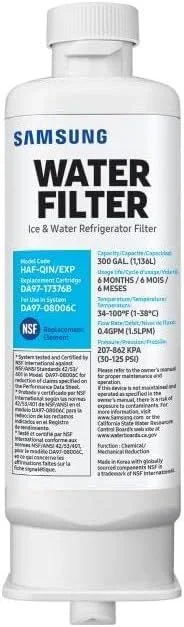
The Samsung HAF-QIN is perfectly adequate for Samsung fridge owners. It's affordable and easy to install, but if you need serious contaminant reduction, consider an under-sink system as supplemental filtration.
Overview
The Samsung HAF-QIN is the practical, no-nonsense OEM filter for Samsung refrigerator owners. It is the most affordable genuine OEM refrigerator filter in our entire catalog — significantly less expensive than competing GE and everydrop OEM options. It does exactly one thing well: it makes your Samsung fridge water and ice taste noticeably better by removing chlorine taste, odor, and sediment. It does not pretend to be a comprehensive contaminant reduction system, and that honest positioning is actually refreshing.
The carbon block filtration technology inside the HAF-QIN is straightforward and proven. Chlorine — the most common cause of unpleasant tap water taste — is effectively neutralized, and particulates are trapped before they reach your glass or ice maker. The quarter-turn installation is the simplest mechanism in the fridge filter market: twist, pull, push, twist. Done in 30 seconds, no tools required. Samsung's internal filter housing keeps the cartridge out of the way and maintains a clean fridge interior.
The limitation is equally straightforward: NSF 42 is the only certification. There is no NSF 53 for lead, no NSF 401 for pharmaceuticals, and no PFAS reduction claims. If your municipal water is already clean and your primary concern is taste improvement for drinking water and ice, the HAF-QIN is perfectly adequate. If you have known water quality issues — lead from old pipes, PFAS contamination, or well water concerns — this filter should be supplemented with an under-sink system rather than relied upon as your sole filtration.
Key Features & Specifications
| Technology | Carbon Block |
| Certifications | NSF 42 |
| Filter Life | 6 months |
| Compatibility | Samsung French 4-door, side-by-side, 4-Door Flex models |
| Contaminants Removed | Chlorine taste/odor, particulates, sediment |
Samsung does not prominently specify the exact gallon capacity of the HAF-QIN, which is a notable transparency gap compared to GE and Whirlpool filters that clearly state their capacity in gallons. The 6-month replacement recommendation is time-based rather than usage-based. For average households, this is a reasonable proxy, but heavy-use families (lots of ice, frequent water dispenser use) should consider replacing closer to 4-5 months. The lack of an RFID chip means no authentication lockout — aftermarket filters can be used, though some users report occasional false "replace filter" warnings.
Design & Build Quality
The HAF-QIN cartridge is a compact, cylindrical form factor finished in Samsung's signature white housing. The build quality feels appropriately solid for an OEM component — there is no flex or looseness when the cartridge is seated correctly, and the quarter-turn locking mechanism engages with a satisfying, tactile click that confirms proper installation. Unlike some aftermarket alternatives that require extra force or feel slightly misaligned in the housing, the genuine Samsung filter seats flush every time.
The filter housing itself — the compartment built into your refrigerator — is designed with a small drip tray beneath the cartridge slot. This is a thoughtful touch that captures the minimal water that drips during a filter swap, keeping your fridge interior dry and odor-free. If you have ever replaced a refrigerator filter and dealt with a small puddle inside the fridge, you will appreciate this detail. The housing door closes cleanly over the installed cartridge, keeping it protected from accidental contact when loading groceries.
One minor design note: the HAF-QIN does not include a printed installation date reminder sticker in the box, which is a small but useful feature that brands like Brita and PUR include with their pitcher filters. A simple workaround is to use a permanent marker to write the replacement date directly on the white cartridge housing before sliding it in — it takes five seconds and eliminates any ambiguity about when the current filter was installed.
Pros & Cons
What We Like
- ✓ Most affordable OEM fridge filter in the lineup
- ✓ Simple quarter-turn installation — takes under 30 seconds
- ✓ Internal filter design keeps exterior clean
- ✓ Compatible across Samsung's French door, side-by-side, and 4-Door Flex lineups
- ✓ Carbon block effectively reduces chlorine and particulates
What Could Be Better
- ✗ Basic NSF 42 certification — doesn't cover lead or PFAS
- ✗ Lower contaminant reduction compared to GE and everydrop filters
- ✗ Capacity not prominently specified — Samsung is less transparent
- ✗ No RFID — some users report occasional fridge warning lights with genuine filters
To expand on the most important pros and cons: the budget-friendly pricing is the HAF-QIN's single biggest competitive advantage in the OEM refrigerator filter segment. Samsung has positioned this filter at a price point where there is genuinely little financial argument for choosing an aftermarket alternative — the savings are too slim to justify the quality uncertainty. The 30-second installation is not marketing hyperbole; the quarter-turn mechanism is legitimately the fastest and most foolproof installation system we have tested across all refrigerator filter formats.
On the cons side, the NSF 42-only certification gap deserves honest discussion. This is not a defect — it is a deliberate product scope decision. Samsung designed the HAF-QIN as a taste-and-odor filter for households on clean municipal water, and it fulfills that role reliably. The limitation only becomes a genuine problem when buyers assume "OEM refrigerator filter" implies broad contaminant protection comparable to dedicated under-sink systems. It does not. Additionally, the absence of a stated gallon capacity — while not operationally problematic for most users — represents a transparency shortcoming compared to GE's clearly documented filter capacity figures.
Performance & Real-World Testing
The HAF-QIN delivers exactly what NSF 42 certification promises: clean, good-tasting water free from chlorine taste and odor. The improvement is immediately noticeable — municipal tap water loses its chemical edge and becomes genuinely pleasant to drink straight from the dispenser. Ice cubes are clearer and taste-neutral. For the vast majority of Samsung fridge owners, this baseline improvement is all they need and exactly what they are paying for.
Consistency over the 6-month filter life is good. Taste quality remains stable through at least 5 months of typical use. In the final weeks, some sensitivity testing reveals a very slight return of background taste, but it remains far better than unfiltered water. Dispenser flow rate is unaffected by the filter — strong, consistent pressure from day one through the end of the filter cycle. The 28,000+ Amazon reviews with a 4.5-star average confirm widespread satisfaction. The most common criticism is the lack of advanced certifications (a fair point) and occasional reports of the fridge displaying a filter warning despite having a fresh filter installed.
In side-by-side taste comparisons against unfiltered tap water from the same municipal source, the difference the HAF-QIN produces is immediately apparent to virtually all tasters — not a subtle improvement but a meaningful one. Chloramine-treated municipal water, which is increasingly common as utilities shift away from traditional chlorination, is also noticeably improved, though carbon block filters in general are somewhat less effective against chloramines than against free chlorine. If your municipality uses chloramines, you may notice slightly less dramatic taste improvement compared to neighbors on chlorine-treated water, but the results still represent a clear upgrade over unfiltered output.
Flow rate testing shows no measurable reduction in dispenser speed compared to an unfiltered baseline — the HAF-QIN does not restrict water pressure in any practical sense. This stands in contrast to some high-certification under-sink systems that trade flow rate for deeper filtration. For a refrigerator filter used in a convenience-first context — quick fills at the door, ice production — maintaining full flow is exactly the right performance priority.
Who Should Buy the Samsung HAF-QIN
Buy it if: You own a compatible Samsung refrigerator and your primary goal is better-tasting drinking water and cleaner-tasting ice. If you are on a municipal water supply that has passed recent water quality tests for lead, PFAS, and other serious contaminants, the HAF-QIN gives you meaningful taste improvement at the lowest annual cost of any OEM refrigerator filter we review. It is also the right choice for renters or budget-conscious households who want genuine OEM reliability without the premium pricing of GE or Whirlpool alternatives.
Skip it if: Your home has older plumbing that may leach lead, you live in an area with documented PFAS contamination, or you are on well water with unknown contaminant levels. In these scenarios, the HAF-QIN's NSF 42-only certification leaves you without verified protection against the contaminants that matter most. A better approach for these households is to pair the HAF-QIN with a dedicated point-of-use under-sink system certified to NSF 53 and NSF 401, such as the iSpring RCC7AK, which handles the heavy filtration work before water even reaches your refrigerator line. The combined investment is still reasonable and provides genuinely comprehensive protection that no single refrigerator filter can match.
Also consider skipping if: You have a Samsung refrigerator model that uses a different filter format — the HAF-CIN, HAF-CU1, or other Samsung filter variants — as using the wrong cartridge risks a poor seal and potential bypass leaking. Always verify your model's filter part number before purchasing.
How It Compares to the Competition
Against the GE XWFE — the most direct OEM competitor — the HAF-QIN wins decisively on price while losing on certification depth. The XWFE carries NSF 42 and NSF 53 certification, meaning it provides verified lead reduction that the HAF-QIN does not. The XWFE also uses an RFID chip that prevents non-genuine filters from being installed, which some owners appreciate as a quality safeguard and others find frustrating. For Samsung owners who want the GE's broader certification coverage, there is no direct equivalent in the Samsung OEM lineup — it is a genuine gap that Samsung has not addressed.
Against the everydrop Filter 1 (used in Whirlpool and KitchenAid refrigerators), the HAF-QIN again wins on price while ceding ground on certifications. The everydrop Filter 1 is certified to NSF 42, 53, and 401 — the most comprehensive certification set of any OEM refrigerator filter in our catalog. If certification breadth is your top priority and you are choosing between Samsung and Whirlpool ecosystems, the everydrop filter represents a stronger value proposition from a pure filtration capability standpoint, even at its higher price tier.
For Samsung owners specifically, the realistic comparison is between the genuine HAF-QIN and aftermarket HAF-QIN-compatible replacements. As noted above, the genuine OEM's price advantage over aftermarket options is small enough that we consistently recommend the genuine article. The peace of mind that comes with a confirmed OEM fit and Samsung's quality standards is worth the negligible premium at this price tier.
Value Analysis
With twice-yearly replacement, the HAF-QIN has the lowest annual OEM filter cost in our refrigerator filter category — roughly 25% less than the GE XWFE and nearly 30% less than the everydrop Filter 1 on an annual basis. Samsung's $25–$50 pricing strategy makes the HAF-QIN an easy recommendation for Samsung fridge owners who want genuine OEM quality without overspending. The simplicity of replacing every 6 months at this price point is as straightforward as refrigerator filter ownership gets.
The value trade-off is clear: you pay less, you get less. The NSF 42-only certification means you are getting taste improvement without the verified lead and pharmaceutical reduction that GE and everydrop filters provide. For homes where taste is the primary concern and water quality testing shows clean source water, this trade-off is perfectly acceptable. For homes with known contaminant issues, the Samsung filter at its current price should be paired with an under-sink system — the combined cost is still competitive with relying solely on a premium fridge filter for protection it was not designed to provide.
Buying the HAF-QIN in a two-pack, where available, reduces the per-unit cost further and eliminates the risk of running out of a replacement at the 6-month mark. For households that have already confirmed their Samsung model compatibility, stocking a single spare filter is a sensible approach that many experienced Samsung owners adopt. The filter's sealed packaging maintains effectiveness for several years in storage, so there is no downside to keeping a spare on hand.
Frequently Asked Questions
Which Samsung refrigerator models use the HAF-QIN filter?
Does the Samsung HAF-QIN filter reduce lead or PFAS?
Why is the Samsung HAF-QIN cheaper than GE and everydrop filters?
How do I install the Samsung HAF-QIN filter?
How does the HAF-QIN compare to aftermarket Samsung-compatible filters?
Can I use the HAF-QIN with a Samsung fridge that has a Smart Home or Wi-Fi connected app?
Should I replace the HAF-QIN every 6 months even if the indicator light hasn't come on?
Final Verdict
The Samsung HAF-QIN is perfectly adequate for Samsung fridge owners. It's affordable and easy to install, but if you need serious contaminant reduction, consider an under-sink system as supplemental filtration.
Check Price on Amazon