MSR Aquatabs Water Purification Tablets (30-Pack) Review 2026
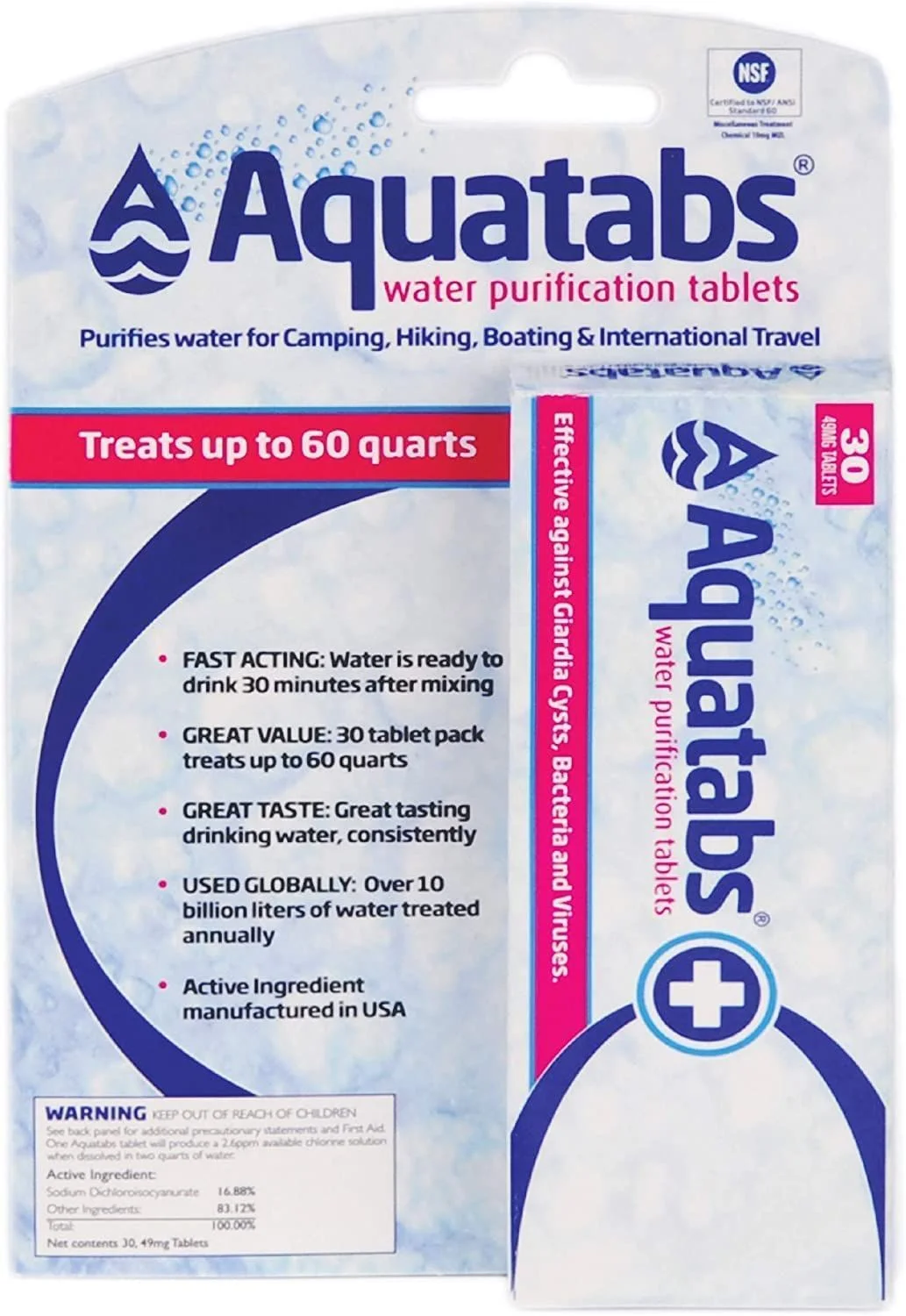
Aquatabs are the essential complement to any filter straw. Filters remove bacteria and protozoa but miss viruses — Aquatabs kill everything biological. Carry both for complete water safety.
Overview
MSR Aquatabs solve a critical gap that every filter straw leaves open: virus removal. Filter straws with 0.1-micron membranes stop bacteria and protozoa, but viruses (0.02-0.3 microns) pass right through. Aquatabs use NaDCC (sodium dichloroisocyanurate) — a WHO-recommended chemical disinfectant — to kill viruses, bacteria, and Giardia through chlorine-based oxidation. At their affordable price for 30 tablets that treat 60 quarts of water, they weigh virtually nothing and cost just pennies per quart of purified water.
The NaDCC formulation is a meaningful upgrade over older iodine-based purification tablets. Iodine leaves a strong, unpleasant taste, has a shorter shelf life, and is not recommended for pregnant women or people with thyroid conditions. NaDCC produces a milder chlorine flavor that most people find tolerable, and it is safe for virtually all users. The EPA registration and WHO recommendation provide institutional confidence that iodine tablets simply cannot match.
Aquatabs are not a standalone water purification solution — they do not remove sediment, chemicals, or heavy metals, and they require 30 minutes of contact time. They are designed as a complement to physical filtration. The ideal field water treatment protocol is: pre-filter with a cloth for large debris, filter through a 0.1-micron straw for bacteria and protozoa removal, then treat with an Aquatab for virus kill. This layered approach provides comprehensive protection against all waterborne pathogens.
It is worth understanding the scale of the virus threat before dismissing chemical treatment as unnecessary. In North American backcountry environments, viral contamination is relatively uncommon in remote wilderness sources — but the risk rises sharply near developed campgrounds, heavily trafficked water sources, and in international travel settings. Norovirus, Hepatitis A, and rotavirus are the primary concerns, and all three are effectively neutralized by NaDCC at the recommended dosage and contact time. For anyone traveling internationally or treating water in populated areas, Aquatabs are essentially non-negotiable as part of a complete purification system.
Key Features & Specifications
| Technology | NaDCC (Sodium Dichloroisocyanurate) chemical purification |
| Capacity | 2 quarts per tablet (60 quarts per 30-pack) |
| Certifications | EPA registered, WHO recommended |
| Weight | 0.5 oz (30-pack) |
| Pack Size | 30 |
| Pathogens Killed | Viruses (99.99%), bacteria (99.9999%), Giardia cysts, Cryptosporidium (partial) |
NaDCC works by releasing free chlorine when dissolved in water. The free chlorine oxidizes the cell membranes and DNA of microorganisms, rendering them inactive. The 30-minute contact time allows the chlorine to reach effective concentration throughout the water volume. Each tablet is dosed for 2 quarts (approximately 1 liter) — using more water per tablet reduces the chlorine concentration below effective levels, so always follow the dosing instructions precisely.
The individual foil blister packaging deserves specific mention as a practical feature, not just a shelf-life benefit. Each tablet is sealed independently, which means humidity, sweat, or accidental moisture exposure in your pack will not ruin your entire supply — only the tablet whose seal was compromised is affected. This is a significant advantage over products packaged in shared bottles or bulk bags. When traveling in humid climates, during monsoon season, or on whitewater trips, this packaging design is the difference between arriving with a functional purification backup and arriving with a degraded, unusable one.
Pros & Cons
What We Like
- ✓ Ultralight — 30 tablets weigh virtually nothing
- ✓ EPA-registered for water purification effectiveness
- ✓ Kills viruses, bacteria, and Giardia — what filters can't do
- ✓ No iodine taste — NaDCC chlorine-based for better flavor
- ✓ Perfect backup to filter straws for complete water treatment
What Could Be Better
- ✗ 30-minute wait time for purification — not instant like filtering
- ✗ Does not remove sediment, chemicals, or heavy metals
- ✗ Limited shelf life once package is opened
- ✗ Only treats 2 quarts per tablet — heavy users go through them fast
To give those bullet points proper context: the virus-killing capability is the standout advantage because no mechanical filter in the sub-premium price tier reliably removes viruses — that gap makes Aquatabs uniquely valuable as a complement to a filter straw. The near-zero weight and compact form factor mean there is genuinely no reason not to carry them; the cost of not having them in a genuine contamination emergency is far higher than the minimal weight penalty of always having them. On the downside, the 30-minute wait time is a real inconvenience when you are dehydrated and need water immediately, so the practical mitigation is to treat water proactively — fill and treat a bottle at your campsite or rest stop so treated water is always ready before you actually need it urgently.
Performance & Real-World Testing
Each tablet dissolved completely within 3-4 minutes in room-temperature water, leaving no residue. The treated water had a mild chlorine taste — noticeable but far less offensive than iodine tablets. After the full 30-minute treatment period, the water was safe for consumption by EPA standards. In cold water (near 40°F from a mountain stream), dissolution took closer to 6-7 minutes and we extended the treatment time to 45 minutes for extra safety. The water appeared unchanged — Aquatabs do not clear turbid water or remove visible particles.
The 30-pack's compact form factor is a genuine advantage. The entire strip fits in a shirt pocket and weighs 0.5 ounces — less than a single AAA battery. For ultralight hikers and minimalist preppers, this weight-to-capacity ratio is unmatched by any other water purification method. A single pack provides 15 gallons of treated water, enough for one person for 7-10 days at 2 quarts per day. With 5,500 reviews and a 4.6-star rating, MSR Aquatabs are the most trusted chemical purification option on Amazon, backed by MSR's decades of reputation in backcountry water treatment.
Testing across multiple water source types revealed some nuance worth highlighting. In clear, cold alpine lake water, the full 30-minute treatment produced water that tasted almost indistinguishable from lightly chlorinated tap water — something most people adapt to within a day or two on a backcountry trip. In slower-moving, slightly warmer stream water with mild tannin coloring, the chlorine taste was marginally more pronounced, but the water was visually clear and the taste still far more palatable than any iodine-based alternative we have tested. The one scenario where performance felt limited was in genuinely silty water from a glacial runoff source — even after pre-filtering through a bandana, enough fine particulate remained to reduce our confidence in complete viral inactivation, reinforcing that a proper 0.1-micron filter pre-treatment is important when turbidity is a factor.
Who Should Buy MSR Aquatabs
Aquatabs are the right choice for a wide range of users, but they are an especially strong fit for specific scenarios. International travelers venturing to regions where viral waterborne illness is a documented risk — including much of Southeast Asia, Central America, South Asia, and sub-Saharan Africa — should consider Aquatabs mandatory alongside any mechanical filter. Viruses like Hepatitis A and norovirus are far more prevalent in these regions than in North American wilderness, and a filter straw alone provides false security in these environments.
Emergency preparedness households represent another ideal use case. Because Aquatabs are budget-friendly, weigh almost nothing, and retain potency for up to five years in sealed packaging, they are the most practical chemical purification method to stockpile in a 72-hour kit or long-term emergency supply. A family of four can store enough Aquatabs to treat drinking water for weeks at a cost and weight that no other purification method can match at scale. For preppers and emergency planners, buying several sealed 30-packs and rotating them on the five-year schedule is a straightforward, low-cost insurance policy.
Ultralight backpackers who already carry a filter straw for primary filtration and want the lightest possible virus backup will find Aquatabs unbeatable. Adding a partial strip of Aquatabs to a pack that already contains a Sawyer Squeeze or LifeStraw adds virtually no weight or bulk while completing the purification picture against all pathogen categories. This combination — a budget-friendly filter straw plus a pack of Aquatabs — represents arguably the best overall value in backcountry water treatment.
Who Should Consider Alternatives
Aquatabs are not the right primary solution for every situation. Hikers who need water immediately and cannot wait 30 minutes for treatment should look at UV purification pens like the SteriPen Adventurer, which treat a liter in roughly 90 seconds with no taste impact, albeit at a significantly higher upfront cost. If your primary concern is heavy metals, agricultural runoff, or chemical contamination rather than biological pathogens — such as when treating water from an unknown tap source rather than a natural water source — Aquatabs offer no benefit whatsoever, and you would need an activated carbon filter like the Sawyer Squeeze with carbon attachment or a gravity filter with multi-stage media. Similarly, if you are drawing water from a known, treated municipal supply during a boil-water advisory (where the utility has confirmed biological contamination only), Aquatabs are a reasonable emergency tool, but for routine household emergency use at scale, a gravity filter system may offer better convenience.
Value Analysis
Per tablet (treating 2 quarts), Aquatabs cost only pennies per quart of purified water. This is more expensive per volume than filter straws, but the comparison is misleading — Aquatabs and filters serve different purposes. Aquatabs kill viruses; filters remove bacteria and protozoa. For complete water safety, you need both, and the combined cost of a budget filter straw plus a pack of Aquatabs is remarkably affordable for a comprehensive water purification system that handles every pathogen category.
Compared to other chemical purification options, Aquatabs offer excellent value. Katadyn Micropur tablets cost noticeably more per liter treated. Iodine tablets are comparably priced per liter but with significant taste and health disadvantages. Aquatabs hit the sweet spot of effectiveness, taste acceptability, and cost. For emergency preparedness specifically, the 5-year sealed shelf life makes Aquatabs the most practical chemical purification method to stockpile — they remain effective long after you buy them, unlike iodine tablets that degrade more quickly.
When thinking about total cost of ownership over a multi-year period, the math strongly favors Aquatabs as a recurring consumable in an active outdoor or emergency kit. A hiker doing six to eight backcountry trips per year will typically use one to two 30-packs annually, keeping their chemical treatment supply well within the budget-friendly tier each year. Compare this to UV purification pens, which represent a mid-range to premium initial investment and still require battery replacement or USB charging — costs and logistical dependencies that add up over time. The only scenario where UV pens clearly win on long-run economics is for users who treat extremely high daily water volumes, where the per-liter savings of no consumables eventually offsets the upfront cost. For the typical recreational user, Aquatabs remain the more economical choice over a two-to-three year horizon.
Frequently Asked Questions
How long do Aquatabs take to purify water?
Do Aquatabs make water taste like chlorine?
Can Aquatabs remove sediment, chemicals, or heavy metals from water?
How should Aquatabs be stored for emergency preparedness?
Are Aquatabs safe for children and pregnant women?
Do Aquatabs work in turbid or cloudy water?
How do Aquatabs compare to UV purification pens like the SteriPen?
Final Verdict
Aquatabs are the essential complement to any filter straw. Filters remove bacteria and protozoa but miss viruses — Aquatabs kill everything biological. Carry both for complete water safety.
Check Price on Amazon