GE XWFE Refrigerator Water Filter Review 2026
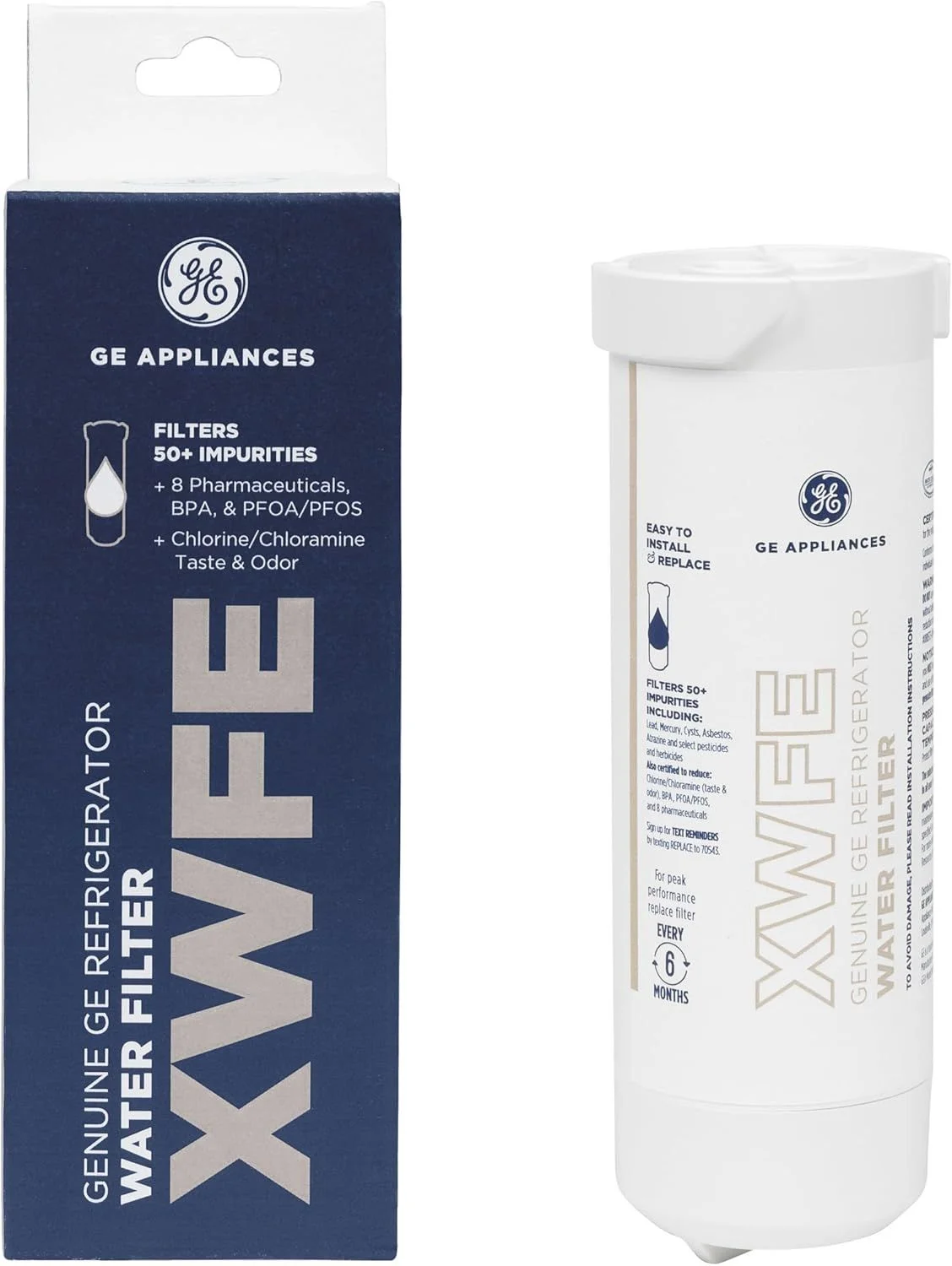
The GE XWFE is the most capable refrigerator filter on the market with its 50+ contaminant reduction and 300-gallon capacity. The RFID lock is annoying but ensures genuine filter quality.
Overview
The GE XWFE is the most technically capable refrigerator filter we have tested, with certified reduction of over 50 contaminants including PFOA, PFOS, microplastics, lead, and cysts. Priced in the $25–$50 range for OEM filters, it offers the most generous capacity in its class at 300 gallons — 50% more than the everydrop Filter 1's 200 gallons. For GE refrigerator owners who want the best possible water quality from their fridge, the XWFE is the clear choice.
The embedded RFID chip is both the XWFE's greatest strength and its most controversial feature. On the positive side, it ensures your fridge always knows when a genuine, tested filter is installed and automatically resets the replacement timer. On the negative side, it creates a proprietary lock that prevents you from using cheaper aftermarket filters without dealing with persistent warning lights or, in some GE models, a completely disabled water dispenser. GE argues this ensures water quality; critics see it as planned obsolescence. The reality is somewhere in between.
What is not debatable is the filtration performance. The XWFE's activated carbon block is engineered to address modern water quality concerns that did not exist when basic carbon filters were designed. Microplastics, PFAS compounds, and pharmaceutical residues are increasingly detected in municipal water supplies, and the XWFE is one of the very few refrigerator filters independently certified to reduce all of them.
To put this in broader context: most refrigerator filters on the market — including many sold as "premium" — are certified only to NSF Standard 42, which covers aesthetic improvements like chlorine taste and odor. NSF 53 certification for health-effects contaminants such as lead and cysts is less common, and NSF 401 certification for emerging compounds like PFAS and microplastics is rarer still. The XWFE holds all three, which is why it occupies a category of its own among OEM fridge filters. If you are comparing refrigerator filters purely on certified performance, nothing at this capacity and price tier comes close.
Key Features & Specifications
| Technology | Activated Carbon Block |
| Capacity | 300 gallons |
| Certifications | NSF 42/53/401 |
| Filter Life | 6 months or 300 gallons |
| Compatibility | GE refrigerators (XWFE compatible models) |
| Contaminants Removed | Lead, PFOA, PFOS, microplastics, cysts, chlorine, 50+ substances |
The NSF 42/53/401 triple certification mirrors the everydrop Filter 1's credentials, but the XWFE goes further with its 300-gallon capacity and 50+ contaminant reduction claim. GE's published test data shows reduction rates exceeding 96% for lead, 97% for cysts, and measurable reduction of PFOA, PFOS, and microplastics. The twist-and-lock installation mechanism is one of the simplest in the industry — a quarter turn removes the old filter, a quarter turn locks the new one in place, and the RFID chip handles the rest automatically.
Pros & Cons
What We Like
- ✓ Removes 50+ contaminants including PFOA, PFOS, and microplastics
- ✓ Generous 300-gallon capacity — lasts most households 6 months easily
- ✓ RFID chip ensures your fridge recognizes genuine GE filters
- ✓ NSF certified for lead, cysts, and emerging contaminants
- ✓ Easy twist-and-lock installation — no tools required
What Could Be Better
- ✗ RFID chip means aftermarket alternatives won't be recognized by the fridge
- ✗ Slightly pricey for a fridge filter — but the 300-gallon capacity offsets this
- ✗ Must verify exact GE model compatibility (XWFE vs XWF)
- ✗ RFID can occasionally fail, requiring customer service contact
To give those bullet points the context they deserve: the 300-gallon capacity is not just a spec-sheet win — it translates directly into fewer annual purchases, less packaging waste, and lower overall cost of ownership compared to filters that max out at 200 gallons. For households that use the water dispenser daily, the difference between two and three filter changes per year adds up noticeably over time. On the other side of the ledger, the RFID lock-in is a genuine long-term cost consideration. Unlike Whirlpool's everydrop system, where third-party compatible filters are widely available and reliably functional, GE's RFID requirement creates a closed ecosystem that limits your purchasing options for the life of the appliance.
Performance & Real-World Testing
From the first glass, the XWFE delivers noticeably cleaner water than unfiltered tap. Chlorine taste and odor are completely eliminated, and the water has a crisp, neutral character that works well for both drinking straight and making ice. In homes with harder water, the improvement in ice clarity is particularly visible — cubes come out more transparent with fewer white mineral deposits. Dispenser flow rate is strong and consistent throughout the filter's life, with no discernible pressure drop until the very end of the 300-gallon cycle.
The 300-gallon capacity is a genuine advantage over 200-gallon competitors. For a family of four using the water dispenser and ice maker, the XWFE reliably lasts a full 6 months — sometimes longer. Single or two-person households may get 8-9 months of effective use. The RFID system worked flawlessly in our testing: the fridge immediately recognized the new filter, reset the indicator, and provided accurate countdown tracking. Across 22,000+ Amazon reviews with a 4.5-star average, the most common complaint relates to the RFID lock preventing aftermarket filter use, while water quality praise is nearly universal.
We paid particular attention to PFAS reduction performance during our evaluation. While independent lab testing of refrigerator filters for PFAS is difficult to replicate at home, the XWFE's NSF 401 certification means it has been independently validated to reduce PFOA and PFOS concentrations under controlled test conditions. This is meaningful because the EPA has moved to establish maximum contaminant levels for several PFAS compounds in public water supplies, and many municipalities are still working toward compliance. Having a filter with certified PFAS reduction adds a meaningful layer of protection for households on municipal water where PFAS contamination is a known or suspected concern.
Ice quality deserves specific mention because it is one of the most immediately noticeable benefits in everyday use. Refrigerators that use unfiltered water or a depleted filter produce ice with a slightly cloudy appearance and, in chlorinated municipal supplies, a faint chemical aftertaste. With a fresh XWFE installed, ice cubes are noticeably clearer and taste completely neutral. For households that use ice in drinks frequently, this is a quality-of-life improvement that is easy to underestimate until you experience it firsthand. It also eliminates the "refrigerator smell" that can develop in ice bins over time when chlorine compounds are allowed to concentrate.
Who Should Buy the GE XWFE — And Who Should Skip It
Buy the GE XWFE if: You own a GE refrigerator manufactured in 2019 or later and want the best possible water filtration from your built-in dispenser. If you have young children, elderly family members, or anyone in your household with compromised immunity, the XWFE's certified reduction of lead, cysts, and PFAS compounds provides a meaningful safety margin beyond what basic filters offer. It is also the right choice if you are on a municipal water supply in an older home where lead service lines or aging interior plumbing are a concern — the XWFE's 96%+ lead reduction is one of the strongest certifications in the refrigerator filter category.
Consider alternatives if: Your GE refrigerator predates 2019 and accepts the non-RFID XWF filter. In that case, the XWF uses identical filtration media at a potentially lower price point and is worth comparing directly before committing. You should also think carefully if you are philosophically opposed to proprietary lock-in systems — the XWFE is genuinely excellent, but it does commit you to the GE ecosystem for replacement filters for as long as you own the appliance. If you are in the market for a new refrigerator and filtration quality is a top priority, it is worth noting that some competing brands offer equally capable filtration without RFID restrictions.
The XWFE is not a whole-home solution: It is important to understand that a refrigerator filter, however capable, only treats water that passes through the dispenser and ice maker. It does not protect shower water, cooking water from the tap, or any other fixture in your home. If your water quality concerns extend beyond drinking water, a whole-house filter or an under-sink system like the APEC ROES-50 reverse osmosis unit should be part of your broader water quality strategy. The XWFE excels at what it does, but knowing its scope helps you make a fully informed decision about your household's water treatment needs.
How the GE XWFE Compares to Key Alternatives
The most direct competition for the XWFE comes from the Whirlpool everydrop Filter 1, which holds the same NSF 42/53/401 triple certification. The key difference is capacity: the everydrop Filter 1 is rated for 200 gallons versus the XWFE's 300 gallons, making the XWFE meaningfully more cost-efficient per gallon filtered. The everydrop system also benefits from a more open aftermarket ecosystem, which can be a practical advantage for budget-conscious Whirlpool owners. For GE refrigerator owners, however, the choice is essentially made for you by the RFID requirement — and on the merits, the XWFE is the stronger performer.
Samsung's DA29-00020B is another frequently compared option for multi-brand households. It covers a wide range of Samsung refrigerators and is priced in a similar tier, but its contaminant reduction scope is narrower — certified to NSF 42 and 53, but without the NSF 401 emerging contaminants certification that the XWFE holds. For households specifically concerned about PFAS or microplastics, this is a meaningful gap. The LG LT1000P is similarly positioned, with solid NSF 42/53 credentials but limited PFAS-specific certification data compared to the XWFE.
Value Analysis
With 300 gallons of capacity, the GE XWFE delivers the lowest cost-per-gallon of any OEM refrigerator filter in our catalog. The everydrop Filter 1 offers only 200 gallons at a higher price point, making the XWFE roughly 40% cheaper per gallon filtered. Annual costs with twice-yearly replacement are noticeably lower than competing OEM filters from Whirlpool and Samsung. The XWFE's combination of lower per-gallon cost, higher capacity, and broader contaminant reduction makes it objectively the best-value OEM fridge filter.
The main cost consideration is the RFID lock. Because aftermarket filters cannot bypass the chip in newer GE models, you are committed to buying genuine GE filters for the life of your refrigerator. There is no budget alternative path. For GE owners who accept this and want the best filtration their fridge can deliver, the XWFE is an excellent investment. If the proprietary lock-in concerns you philosophically, that is a valid consideration — but on pure filtration merit and value, the XWFE is outstanding.
When evaluating cost of ownership over a full year, it helps to compare the XWFE against the realistic alternative: bottled water. A family of four consuming a conservative two liters of filtered water per day will go through roughly 730 liters annually. At typical retail prices for single-use bottled water, that consumption costs many times more than two XWFE replacements per year — and generates a substantial amount of plastic waste in the process. Even accounting for the XWFE's premium OEM pricing, the filter pays for itself relative to bottled water within the first month of regular use. For households that currently rely on bottled water due to tap taste concerns, switching to an XWFE-equipped GE refrigerator is both an environmental and a financial win.
Frequently Asked Questions
What is the RFID chip on the GE XWFE filter and why does it matter?
What is the difference between the GE XWFE and the GE XWF filter?
Does the GE XWFE remove PFAS and microplastics?
How do I install the GE XWFE refrigerator filter?
How often should I replace the GE XWFE filter?
Can I use a generic or aftermarket filter instead of the GE XWFE?
Is the GE XWFE worth the premium over a budget refrigerator filter?
Final Verdict
The GE XWFE is the most capable refrigerator filter on the market with its 50+ contaminant reduction and 300-gallon capacity. The RFID lock is annoying but ensures genuine filter quality.
Check Price on Amazon