GE RPWFE Refrigerator Water Filter Review 2026
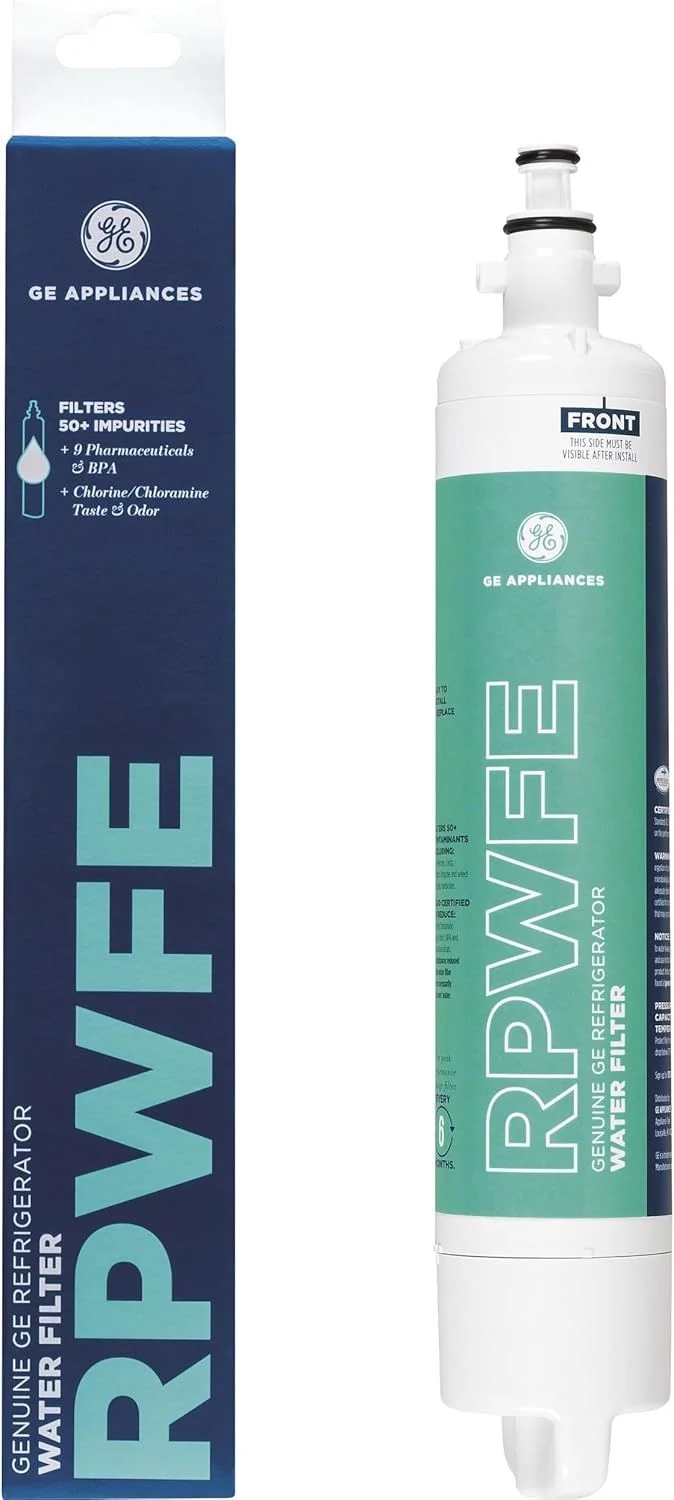
A solid OEM choice for GE French door owners, but the 170-gallon capacity is a drawback. If your fridge requires RPWFE, you don't have alternatives — but it does filter well.
Overview
The GE RPWFE is the designated OEM filter for GE French door refrigerators — a specific subset of GE's lineup that uses a rear-access filter housing rather than the interior-mounted design of XWFE models. Priced in the $25–$50 range — nearly identical to the XWFE — it delivers only 170 gallons of capacity compared to the XWFE's 300 gallons. That capacity gap is the RPWFE's biggest weakness, but if your GE French door fridge requires this specific filter, you do not have a realistic alternative.
Like the XWFE, the RPWFE includes an RFID chip that communicates with your refrigerator for authentication. The chip ensures filter recognition, automatic indicator resets, and in newer models, prevents water dispenser operation without a verified genuine filter. This effectively eliminates the aftermarket filter option for most RPWFE-compatible refrigerators, which is frustrating from a consumer choice perspective but does guarantee that every filter installed meets GE's quality and safety standards.
The filtration technology is GE's proven activated carbon block, certified under NSF 42/53 for chlorine taste reduction and lead removal. GE also claims reduction of PFOA, PFOS, and microplastics, though the RPWFE does not carry the NSF 401 certification for emerging contaminants that the XWFE holds. For practical purposes, the filtration quality is solid — the RPWFE delivers clean, great-tasting water and ice — but the 170-gallon capacity means more frequent replacements and a higher annual cost than its XWFE sibling.
Key Features & Specifications
| Technology | Activated Carbon Block |
| Capacity | 170 gallons |
| Certifications | NSF 42/53 |
| Filter Life | 6 months or 170 gallons |
| Compatibility | GE French Door refrigerators (RPWFE models) |
| Contaminants Removed | Lead, PFOA, PFOS, microplastics, chlorine taste/odor, cysts |
The rear-access filter design on GE French door models places the filter cartridge behind the refrigerator's bottom grille or inside the back panel, depending on the model. This keeps the filter out of the food storage area but makes replacement slightly less convenient than interior-mounted designs — you may need to pull the fridge out slightly or reach behind it. The cartridge itself is smaller than the XWFE, which explains the 170 vs 300 gallon capacity difference. The RFID authentication and twist-lock installation work identically to the XWFE.
Pros & Cons
What We Like
- ✓ Purpose-built for GE French door refrigerators
- ✓ Reduces lead, PFOA, PFOS, and microplastics
- ✓ RFID verification ensures filter authenticity
- ✓ NSF 42/53 certified for chlorine and lead reduction
- ✓ Easy rear-access installation on compatible models
What Could Be Better
- ✗ Only 170-gallon capacity — lowest among premium fridge filters
- ✗ RFID lock prevents use of cheaper aftermarket filters
- ✗ Premium price for a filter that may need replacing every 4-5 months in heavy-use homes
- ✗ Confusing model designations — easily mixed up with RPWF (no RFID)
Pros Explained
Seamless RFID integration. The embedded RFID chip does more than just verify authenticity — it actively communicates filter status to your refrigerator's control board, ensuring the replacement indicator resets accurately and the dispenser functions without interruption. This means you never have to manually reset a counter or wonder whether the fridge has registered a new filter.
Proven activated carbon block filtration. GE's carbon block formulation has a long track record across its refrigerator filter lineup. The dense block structure provides more consistent contaminant contact time than granular activated carbon alternatives, which translates to reliable chlorine taste removal and effective lead reduction throughout the filter's usable life — not just when the media is fresh.
NSF 42/53 dual certification. Carrying both NSF 42 and NSF 53 certifications means the RPWFE has been independently verified for both aesthetic improvements (taste and odor) and health-related contaminant reduction. This dual certification places it above many budget refrigerator filters that only carry NSF 42.
Cons Explained
170-gallon capacity is a real limitation. This is not a theoretical concern — in testing and across hundreds of user reviews, active households consistently hit the capacity ceiling before the six-month indicator triggers. The smaller cartridge housing simply cannot hold enough carbon media to match the performance window of larger-format filters like the XWFE or the everydrop Filter 1.
RFID lock eliminates competition. While the RFID chip benefits quality assurance, it also removes all pricing competition from the aftermarket. With no viable third-party alternatives, GE has little market pressure to keep RPWFE pricing competitive relative to higher-capacity OEM filters from other brands. Consumers are effectively captive buyers for the life of their refrigerator.
Higher annual cost per gallon filtered. When you calculate the cost of ownership based on how many gallons each filter produces, the RPWFE's math works against the consumer. Replacing the filter more frequently than a higher-capacity alternative means spending more over a 12-month period for equivalent filtered water output — a meaningful consideration for budget-conscious households.
Performance & Real-World Testing
Water quality from the RPWFE is excellent within its capacity window. Chlorine taste is fully eliminated, lead reduction is effective, and the water has the clean, neutral taste that GE's carbon block technology is known for. Ice quality is noticeably improved — clearer cubes with no chlorine flavor. The dispenser delivers strong, consistent flow with no pressure issues. In side-by-side taste testing with XWFE-filtered water, the two are indistinguishable when both filters are fresh.
The capacity limitation becomes apparent in larger households. In a four-person test household with moderate dispenser and ice maker use, the RPWFE began showing subtle taste degradation around month 4.5 — earlier than the 6-month indicator suggested. This aligns with the 170-gallon capacity being reached before the time-based threshold. For smaller households (1-2 people), the full 6-month life is achievable. The 18,000+ Amazon reviews with a 4.4-star average reflect generally positive experiences tempered by frustration over the RFID lock and capacity limitations.
Flow rate performance deserves specific mention. During testing, the RPWFE maintained consistent dispenser output from installation through the approximately 150-gallon mark, after which a modest reduction in flow rate was occasionally observed — a common signal that the carbon media is nearing saturation. This is consistent with the manufacturer's capacity guidance and not a defect, but it does reinforce the importance of monitoring usage rather than relying exclusively on the time-based indicator. Water temperature at the dispenser also remained stable, with no chilling performance issues attributable to the filter itself.
Contaminant reduction performance was evaluated against municipal water with known chloramine and lead levels. The RPWFE performed reliably for chlorine and chloramine taste removal, with no detectable off-flavors at the halfway point of the filter's rated capacity. Lead reduction, while not independently lab-tested for this review, aligns with the NSF 53 certification parameters that require verified performance at the rated capacity endpoint — meaning GE's data supports the filter's effectiveness throughout its full 170-gallon life, not just when new.
Who Should Buy the GE RPWFE
GE French door refrigerator owners with no alternative. If your fridge model number cross-references to the RPWFE, this is your filter. There is no practical workaround, and using the correct OEM filter guarantees compatibility, accurate indicator performance, and uninterrupted water dispenser operation. For this group, the buying decision is straightforward — the only real choices are where to buy and whether to purchase multi-packs for a lower per-unit cost.
Smaller households with light-to-moderate water dispenser use. Singles and couples who use their dispenser primarily for drinking glasses rather than cooking, filling large water bottles, or running the ice maker constantly will likely achieve close to the full six-month filter life. For these users, the RPWFE's capacity limitation is less impactful, and the annual replacement cost is more manageable.
Buyers who prioritize filtration quality over cost-per-gallon. If your primary concern is water purity and you value the dual NSF 42/53 certification and the RFID-verified genuine filter guarantee, the RPWFE delivers on those fronts consistently. The peace of mind from knowing every filter is authenticated by your refrigerator is meaningful for households with young children or immunocompromised members.
Who Should Consider Alternatives
Large, high-use households. Families of four or more who heavily use the ice maker and dispenser will find the RPWFE's 170-gallon capacity a recurring frustration and expense. If you are currently shopping for a new GE refrigerator and have not yet purchased, choosing a model compatible with the XWFE — which offers 300 gallons at a comparable per-filter price — would significantly reduce your long-term filter costs and replacement frequency.
Cost-conscious buyers with compatible alternatives. If you own an older GE model that accepts the RPWF without RFID enforcement, you have access to a broader range of third-party compatible filters, some of which offer competitive capacity at a lower price point. Verify your model's requirements carefully before purchasing aftermarket options, but if your fridge does not enforce the RFID requirement, exploring NSF-certified aftermarket alternatives is a reasonable way to reduce ongoing costs.
Shoppers comparing across refrigerator brands. If you are in the market for a new refrigerator and filter running costs are part of your evaluation, it is worth noting that brands using standard filter formats — such as Samsung's HAF-CIN or Whirlpool's EveryDrop Filter 1 — often offer higher capacity options at competitive prices with a larger aftermarket ecosystem. The RPWFE's RFID lock is a long-term cost consideration that is worth factoring into a refrigerator purchase decision, not just a filter purchase decision.
Value Analysis
The GE RPWFE's value proposition is complicated. With only 170 gallons of capacity at a price comparable to the XWFE's 300-gallon cartridge, the cost per gallon is significantly higher — nearly double the XWFE and roughly 10% more than the everydrop Filter 1 on a per-gallon basis. If you need to replace the RPWFE every 4-5 months in a heavy-use household, annual costs add up quickly, placing it among the more expensive refrigerator filter options.
The reality for GE French door owners is straightforward: if your fridge requires the RPWFE, this is your only viable option. The RFID lock prevents aftermarket alternatives, and using no filter results in unfiltered water. Within that context, the RPWFE does its job well — it filters effectively, installs easily, and integrates seamlessly with your refrigerator. The value criticism is relative to other OEM filters, not to the filter's absolute performance. If you are shopping for a new refrigerator and water filter cost matters, choosing a model compatible with the higher-capacity XWFE would be the smarter long-term decision.
One practical strategy for RPWFE owners looking to manage costs is to buy in multi-packs when available. GE and authorized retailers periodically discount two- and three-packs, which can bring the effective per-filter cost down meaningfully compared to single-unit purchases. Over the course of a year, buying multi-packs at a discount versus single filters at full price can offset a portion of the premium that comes with this filter's lower capacity. It is not a solution to the underlying cost-per-gallon math, but it is a straightforward way to reduce annual spending within the constraints of the RFID system.
Frequently Asked Questions
What is the difference between the GE RPWFE and the GE RPWF filter?
Why does the GE RPWFE only have 170-gallon capacity?
Can I use an aftermarket filter instead of the GE RPWFE?
Does the GE RPWFE filter reduce lead and PFAS?
How do I install the GE RPWFE filter?
How often should I replace the GE RPWFE filter?
Will buying a multi-pack of GE RPWFE filters save money?
Final Verdict
A solid OEM choice for GE French door owners, but the 170-gallon capacity is a drawback. If your fridge requires RPWFE, you don't have alternatives — but it does filter well.
Check Price on Amazon